
機率遊戲範例:13 個課堂活動,幫助學生學習真正的數學

Blog 縮略圖

Roll a die, flip a coin, spin a wheel, and something useful happens: an abstract idea like “one in six” turns into something students can see, argue about, and measure. That is why probability is one of the friendliest corners of the math curriculum for hands-on teaching. Students in classes built around active tasks outperform their lecture-only peers, and one analysis of 225 studies found that students in traditional lectures were 1.5 times more likely to fail than those in active-learning classrooms (Freeman et al., 2014).

The games below are the casino-night list rewritten for the classroom. Each one names the probability concept it teaches, a learning objective, a rough grade band, and how to run it in a lesson. Nobody bets money. The payoff is understanding.

The probability concepts these games teach

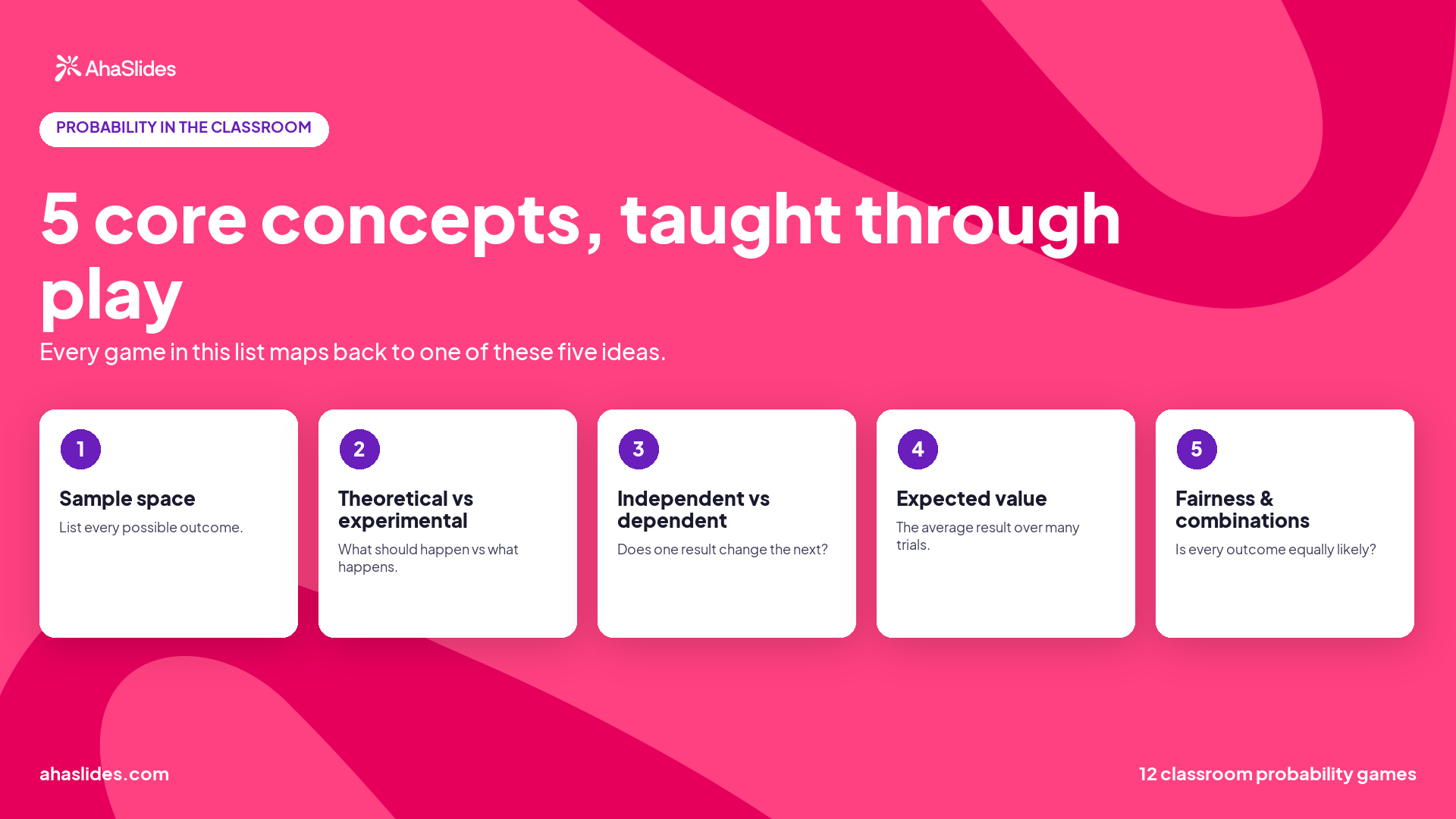
Before the games, here is the map. Most secondary probability standards come down to a handful of big ideas:

  • 樣本空間: listing every possible outcome.
  • Theoretical vs experimental probability: what should happen on paper vs what happens when you try it.
  • Independent vs dependent events: whether one result changes the odds of the next.
  • 預期值: the average result over many trials, and the basis of a smart decision.
  • Fairness, combinations, and permutations: whether every outcome is equally likely, and how to count the ways an event can occur.

Each game is tagged with the idea it targets, so you can drop it into the right lesson.

Infographic showing 5 core probability concepts taught through classroom games

Warm-up experiments: theoretical vs experimental probability

1. Coin-flip pile-up

概念: theoretical vs experimental probability, the law of large numbers. 5-8 年級。 Every student flips a coin 20 times and records the heads. Individually the results are messy: one student gets 13 heads, another gets 7. Then pool the whole class total. As the number of flips climbs into the hundreds, the combined share of heads settles close to 50%. Objective: students see that a small sample can look lopsided while the long-run rate matches the theoretical probability.

2. Two-dice sum showdown

概念: sample space, probability distributions. 6-9 年級。 Ask which sum is most likely when you roll two dice: 2, 7, or 12. Most students guess wrong. Have them roll two dice 30 times, tally the sums, then build a class bar chart. Seven wins because it has six ways to occur (1+6, 2+5, 3+4 and their reverses) out of 36 outcomes, while 2 and 12 have only one each. Objective: connect a listed sample space to a real distribution.

3. Split the points: pink is twice as likely

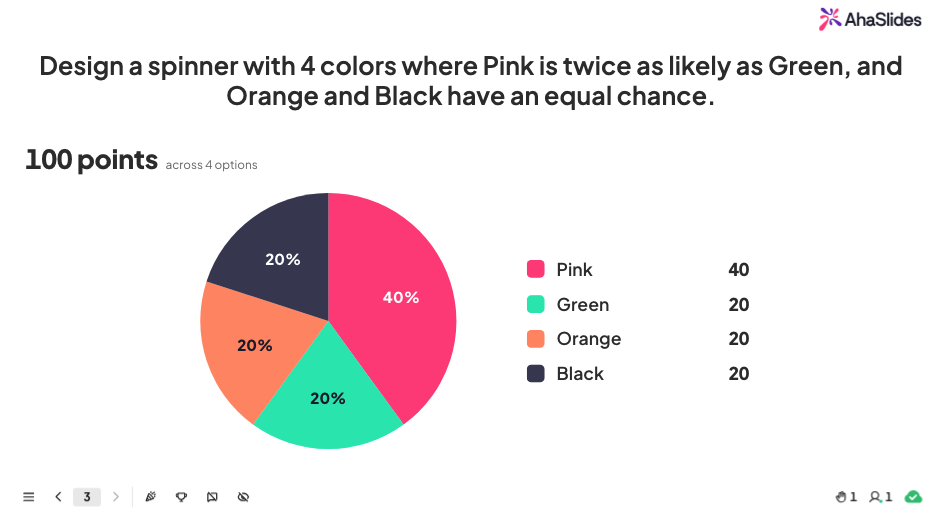
概念: fractions and percentages, parts of a whole. 4-5 年級。 At this age, students are just starting to grasp that 100 represents a whole (100%) and are learning basic fractions, so keep the brief simple and low-stakes. Pose a plain-language rule, such as "Pink should be twice as likely as Green, and Orange and Black should have an equal chance," and have each student split 100 points across the four colors so that their split satisfies it. Nothing is scored and there is no single correct answer, so students can experiment freely instead of freezing up over guessing wrong. Objective: turn an abstract ratio into a concrete percentage of a whole, and check the reasoning by seeing whether each student's split actually adds up to 100 and matches the stated relationship.

AhaSlides Split the Points slide showing 100 points divided across four colors: Pink at 40, and Green, Orange, and Black at 20 each

AhaSlides' Split the Points slide lets the teacher set up the four categories and a 100-point pool; every student submits their own split, and the results build live as a pie chart, so the class can immediately compare splits against the stated rule and talk through who got closest and why.

4. Spin the wheel: fair vs unfair

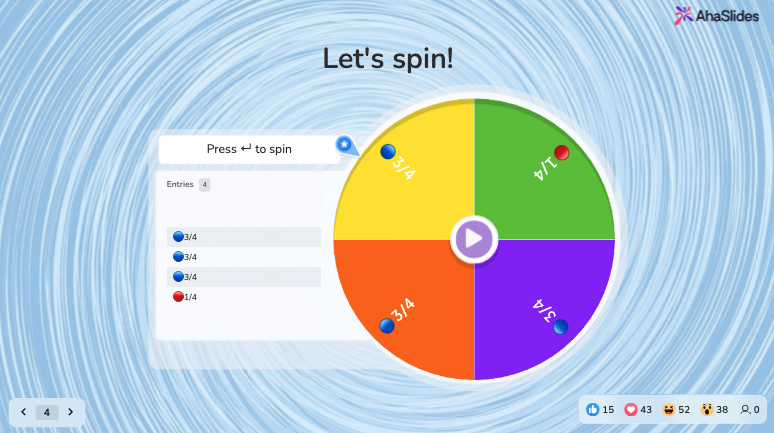
概念: fair vs unfair outcomes, fractions and ratios. 4-7 年級。 Start with a wheel split into equal colored sections, then switch to one where a single color takes up half. Students predict, spin many times, and compare. Objective: express probability as a fraction of the whole and feel the difference between an equal-chance and a weighted spinner.

AhaSlides spinner wheel slide showing a probability game round with unequal odds

Grab the free probability spinner wheel template to run this exact game, teacher vs class, with the odds already built into each round.

5. Card draws: with and without replacement

概念: independent vs dependent events, conditional probability. 8-10 年級。 Draw a card, note it, and ask for the chance of an ace on the next draw. Do it twice: once replacing the card, once keeping it out. With replacement the odds stay 4/52 every time (independent). Without, the deck shrinks and the odds shift (dependent). A quick round of Uno makes the same point: once cards leave the pile, what is left to draw changes. Objective: distinguish independent from dependent events.

Probability puzzles that spark discussion

6. The Monty Hall problem

概念: conditional probability. 9-12 年級。 Three doors, one prize. A student picks a door, you reveal a losing door from the other two, then offer a switch. Should they take it? Switching wins two times out of three, which almost nobody believes until the class simulates it 30 times and counts. Objective: show that new information updates probability, and that intuition can mislead.

7. Greedy Pig

概念: expected value, decision-making under risk. 6-9 年級。 The whole class stands. You roll one die and everyone accumulates the score, but roll a 1 and anyone still standing loses their points for the round. Players sit down when they want to bank what they have. The math: one more roll is worth it until your unbanked score passes about 20, where the expected gain turns negative. Objective: use expected value to guide a real decision.

8. Is this game fair?

概念: fairness, comparing probabilities. 7-10 年級。 Give pairs a rule such as “Player A scores if the two-dice sum is even, Player B if it is odd,” or “A wins on a product over 12.” Students play, suspect an imbalance, then prove it with the sample space. Objective: judge fairness with evidence, not gut feel, then redesign an unfair rule to balance it.

9. The birthday paradox

概念: complementary probability, combinations. 9-12 年級。 Ask how many people you need before two sharing a birthday is more likely than not. The answer, 23, stuns most classes. Then check your own room: with 30 students the chance is about 70%. The trick is counting the ways birthdays can all differ and subtracting from 1. Objective: use complementary counting to reach a surprising result.

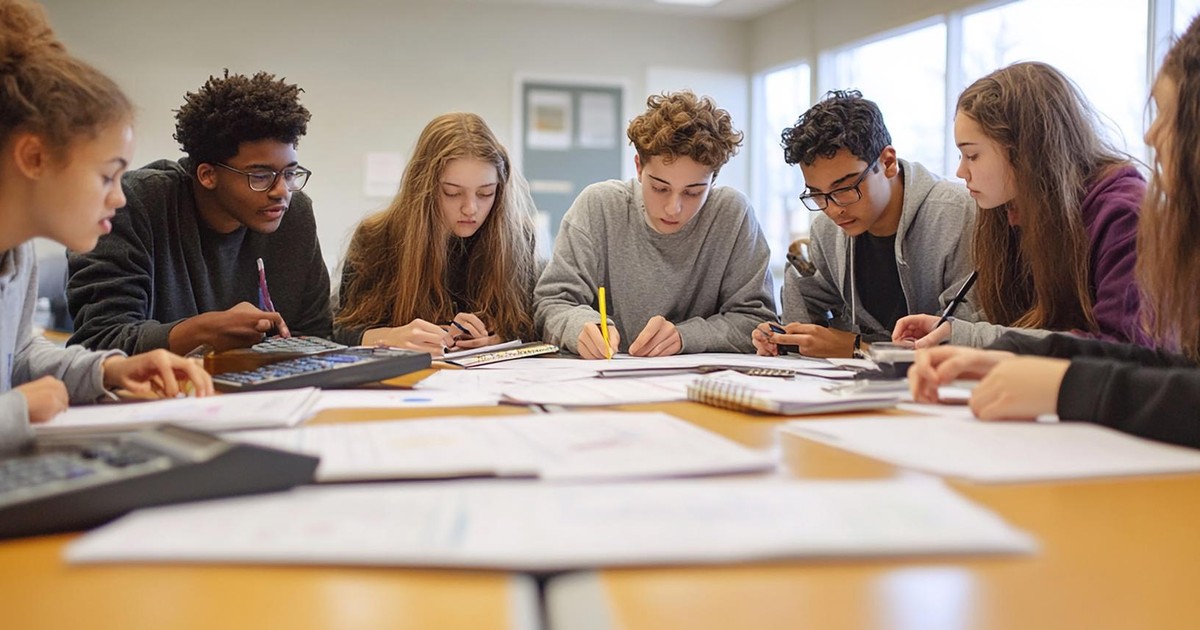
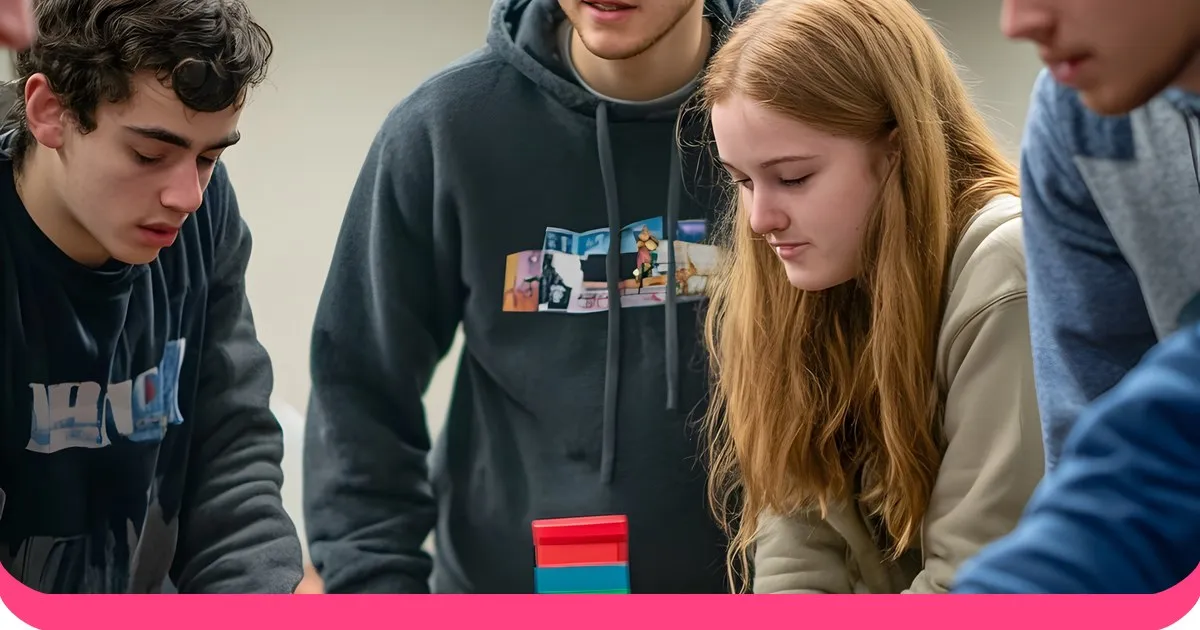
High school students collaborating on math work at a table

Classic games, re-read as probability lessons

10. 快艇

概念: combinations, probability of specific outcomes. 6-9 年級。 Beyond the fun, Yahtzee is a probability engine. What is the chance of rolling three of a kind on the first throw? Should a player keep two pairs or chase a straight? Objective: estimate the odds of target outcomes and use them to make choices.

11. Monopoly, the probability version

概念: applied distributions. 7-10 年級。 Because you move on the sum of two dice, some squares get landed on far more than others, and coming out of jail pulls traffic toward the oranges and reds. Have students predict the hot squares, then tally landings over a game. Objective: apply the two-dice distribution to a familiar board.

12。 賓果

概念: random draws without replacement, ratios. 4-7 年級。 As numbers are drawn and not returned, the chance that the next call helps your card changes every time. Ask students to estimate their odds of a line before and after 10 numbers are out. Objective: reason about a shrinking pool of equally likely draws.

13. Rock-paper-scissors

概念: equally likely outcomes, independent events. 5-8 年級。 With random play each throw has a one-in-three chance, and rounds are independent: yesterday’s win says nothing about today’s. It is also a gentle door into game theory: is there a winning strategy against a truly random opponent? Objective: recognize equally likely, independent outcomes.

Run these live with AhaSlides

Two parts of these activities are fiddly by hand: generating fair randomness, and pooling everyone’s results fast enough to discuss them. AhaSlides handles both from the front of the room.

  1. 轉輪 does the random draws, picking a student, a number, or a color, so a spin is visible to the whole class and provably unrigged.
  2. 現場投票 collect experiment data in seconds. Every student submits a heads count or a dice sum, the bar chart builds live, and the class compares the experimental result against the theoretical prediction on the spot.
  3. 測驗投影片 turn the concepts into a scored round, such as “What is the probability of rolling a 7?”, with a leaderboard that keeps a fairness or expected-value debate lively.

Because responses are captured and charted automatically, you spend the lesson on the reasoning rather than on tallying, and the pooled class data is exactly what makes the law of large numbers land.

將其整合在一起

Probability is easiest to teach when students can watch it happen. Pick two or three of these games for a unit: one warm-up experiment, one puzzle that breaks intuition, and one familiar game re-read through the math. Name the concept every time, collect real data, and let the gap between theory and experiment do the teaching.

參考

Freeman, S., Eddy, S. L., McDonough, M., Smith, M. K., Okoroafor, N., Jordt, H., & Wenderoth, M. P. (2014). Active learning increases student performance in science, engineering, and mathematics. Proceedings of the National Academy of Sciences, 111(23), 8410-8415. https://www.pnas.org/doi/10.1073/pnas.1319030111

未找到任何項目。
訂閱即可獲得提升觀眾參與度的技巧、見解和策略。
謝謝! 您的提交已收到!
糟糕! 提交表格時出了點問題。

查看其他帖子

AhaSlides 已被福布斯美國 500 大企業所採用。立即體驗互動的力量。

開始免費試用
© 2026 AhaSlides 私人有限公司