
Serious workplace injuries cost US employers more than $58 billion a year in direct costs, which is over $1 billion every week (Liberty Mutual Workplace Safety Index). That figure leaves out indirect costs such as lost productivity, investigation time and replacing staff. The US Bureau of Labor Statistics counted 2.5 million nonfatal injuries and illnesses in private industry in 2024 (BLS), and 5,070 workers died from work-related injuries that year (BLS).
Most of those incidents trace back to predictable, trainable hazards. The question for HR and L&D teams is not whether to cover workplace safety, but which topics to prioritise and how to make training stick.
This guide walks through 21 workplace safety topics for any serious training programme, grounded in OSHA enforcement data and BLS injury statistics.
The 21 workplace safety topics at a glance
Φυσικοί κίνδυνοιθέματα 7
- Ετοιμότητα και αντίδραση έκτακτης ανάγκης
- Επικοινωνία κινδύνου
- Εξοπλισμός ατομικής προστασίας (PPE)
- Machine safety and lockout/tagout
- Προστασία από πτώση
- Εργονομία χώρου εργασίας
- Ηλεκτρική ασφάλεια
Environment and exposureθέματα 7
- Ασφάλεια φωτιάς
- Χειρισμός επικίνδυνων υλικών
- Περιορισμένη είσοδος χώρου
- Αναπνευστική προστασία
- Έκθεση θορύβου
- Driving and vehicle safety
- Heat illness prevention
People and wellbeingθέματα 7
- Workplace violence prevention
- Ψυχική υγεία και διαχείριση άγχους
- Smartphone and distraction management
- Substance use and fitness for duty
- Active threat and workplace security
- Suicide prevention and mental health crisis response
- Cardiac emergency response
Why OSHA's most-cited violations matter for your training plan
Each year OSHA publishes the ten standards it cites most often. Fall protection has topped the list for 15 consecutive fiscal years. These were the top five in fiscal year 2025, with the final violation counts (Safety+Health):
OSHA top five, fiscal year 2025Πρότυπα 5
- 1. Fall protection, general requirements: 6,992
- 2. Hazard communication: 3,010
- 3. Ladders: 2,842
- 4. Lockout/tagout: 2,562
- 5. Respiratory protection: 2,294
The same gaps keep appearing. Building your training calendar around what OSHA actually cites means you target the risks organisations consistently fail to manage. The current list is on the Ιστότοπος OSHA.
The 21 topics
1. Emergency preparedness and response
Workers need to know what to do before an emergency happens. Evacuation routes, assembly points, emergency contacts and the roles of designated responders should be covered at onboarding and rehearsed at least once a year through drills.
Include both building-wide emergencies, such as fire or a chemical spill, and role-specific scenarios. A warehouse worker's emergency procedures differ from a lab technician's.
2. Hazard communication
Hazard communication (HazCom) was the second most-cited OSHA standard in fiscal year 2025, with 3,010 violations (Safety+Health). It covers chemical labelling, Safety Data Sheets (SDS) and training on the hazards of the chemicals people work with.
The practical gap is rarely knowing that SDS exist. It is reading one quickly under pressure and understanding what the GHS pictograms mean, so build that into training rather than assuming people will work it out.
3. Personal protective equipment (PPE)
PPE is the last line of defence, after the hazard has been removed or controlled, but it still has to be right for the job. Training should cover which PPE each task needs, how to inspect it before use, how to fit it and what to do when it is damaged.
OSHA expects employers to assess the workplace for hazards before choosing PPE, so the assessment is a good first exercise for a team to run together.
4. Machine safety and lockout/tagout
Lockout/tagout (LOTO) controls hazardous energy while equipment is serviced or maintained. It was the fourth most-cited standard in fiscal year 2025, with 2,562 violations (Safety+Health).
Training should cover the full sequence: prepare, shut down, isolate, lock out and tag out, release stored energy and verify. People should practise it on the equipment they actually use, not just watch a generic video.
5. Fall protection
Fall protection (general requirements, construction) has been the most-cited OSHA standard for 15 consecutive fiscal years, with 6,992 violations in fiscal year 2025 (Safety+Health). Ladders (2,842) and scaffolding (2,286) are also in the top six.
Height thresholds, anchor points, harness inspection and rescue procedures all need hands-on practice. Guardrails, safety nets and personal fall arrest systems each have their own installation and inspection rules, which a classroom session alone does not cover.
6. Workplace ergonomics
Ergonomics is more than an adjustable chair. Training covers lifting technique, workstation layout, task rotation and the early warning signs of strain, such as persistent soreness or tingling.
Ergonomic injuries build up gradually and often go unreported until they are serious. Regular check-ins and workstation assessments catch problems before they become lost-time incidents.
7. Ηλεκτρική ασφάλεια
Training should cover arc flash awareness, lockout procedures for electrical equipment, grounding requirements and how to spot damaged cords and outlets.
For people who are not electricians, the most useful lesson is knowing when to stop work and call someone qualified rather than assuming a task is safe.
8. Πυρασφάλεια
Beyond where the extinguishers are and the pull, aim, squeeze, sweep technique, fire safety training should cover prevention: keeping ignition sources away from flammable materials, keeping exit routes clear and knowing which extinguisher suits which class of fire. The wrong type can make things worse.
Drills, exit signage and tested alarms are the infrastructure. Training is what makes people act usefully rather than freeze.
9. Hazardous materials handling
People who handle hazardous chemicals, biological agents or flammable materials need training on storage compatibility, spill containment, disposal and emergency response. This goes beyond HazCom awareness into the physical handling of their specific materials.
Labelling errors, incompatible storage and missing secondary containment are the common failure points, and procedure-based training prevents all of them.
10. Confined space entry
Confined spaces such as tanks, silos, manholes and ductwork have restricted entry and limited ventilation, and they are not designed for continuous occupancy.
OSHA's permit-required confined space standard calls for atmospheric testing, ventilation, attendants and written entry permits, and requires a rescue plan before anyone goes in. Training must be specific to the spaces your workers actually enter.
11. Αναπνευστική προστασία
Respiratory protection was the fifth most-cited standard in fiscal year 2025, with 2,294 violations (Safety+Health). Requirements include a written programme, medical evaluation, fit testing and training on each respirator's limits.
A common gap is voluntary use: workers who wear respirators without the medical and fit-testing steps. Even voluntary use has OSHA requirements that many organisations overlook.
12. Έκθεση στο θόρυβο
Occupational hearing loss is permanent and preventable. OSHA requires a hearing conservation programme when workers are exposed to an average of 85 decibels or more over an eight-hour shift. It includes noise monitoring, hearing tests, hearing protection and training.
Hearing damage often goes unnoticed until it is significant, so the case for prevention is harder to make in training, and more important.
13. Driving and vehicle safety
Transportation incidents were the leading cause of fatal work injuries in the United States in 2024, with 1,937 deaths, or 38.2% of the total (BLS). Whether someone is a fleet driver or occasionally uses a company vehicle, training should cover defensive driving, distracted driving policy, pre-trip inspections and fatigue.
Where forklifts and other powered industrial trucks are used, OSHA's standard (2,150 violations in fiscal year 2025) requires operator training specific to the equipment and workplace.
14. Workplace violence prevention
Violent acts killed 733 US workers in 2024, about 14% of all fatal work injuries (BLS). OSHA defines workplace violence as any act or threat of physical violence, harassment, intimidation or other threatening behaviour at the work site (OSHA).
Training should cover how to recognise escalating behaviour, de-escalation, reporting routes and when to involve security or the police. Healthcare, retail and social services need scenarios from their own sector, not generic modules.
15. Mental health and stress management
High stress and burnout make people less attentive and more likely to take shortcuts. Training on how to reach the Employee Assistance Programme (EAP), spot burnout in yourself and colleagues and ask for adjustments reduces both the human and the operational cost.
NIOSH's Total Worker Health approach treats protecting workers from hazards and supporting their wellbeing as one job rather than two.
16. Smartphone and distraction management
Distracted walking leads to trips, falls and failures to notice moving vehicles. In manufacturing, construction, warehouses and anywhere with moving equipment, a clear policy on device use in hazardous areas matters.
Training should explain why the policy exists, not only what it says, and name the areas where phone use is not allowed.
17. Substance use and fitness for duty
Unintentional overdoses from drugs or alcohol killed 410 US workers on the job in 2024 (BLS), and impairment of any kind is a safety risk around machinery and vehicles.
Training should cover your substance use policy, how to recognise and report impairment in a colleague, and how to reach EAP support without fear of discipline. Apply post-incident testing policies consistently and explain them at onboarding.
18. Active threat and workplace security
Active threat training, typically built around run, hide, fight, is now standard in many organisations. It should also cover reporting suspicious behaviour before an incident, access control and how to communicate with emergency services during a crisis.
Annual refreshers keep the procedures current and help people keep the decision-making patterns they would need under stress.
19. Suicide prevention and mental health crisis response
Violent acts at work include suicides: 35.9% of the 733 violent-act deaths in 2024 (BLS), roughly 260 people. Training managers and supervisors to recognise signs of crisis, respond without stigma and connect people with help is both a safety duty and a retention issue.
In the United States, the 988 Suicide and Crisis Lifeline offers free, confidential support by call or text, and every training session on this topic should show people how to reach it.
20. Cardiac emergency response
OSHA estimates that about 10,000 of the 220,000 sudden cardiac arrests in the United States each year happen at work, and that waiting for emergency services alone means only 5 to 7% survival, against up to 60% one year after an arrest when defibrillation is immediate (OSHA, a 2003 publication).
OSHA encourages employers to consider on-site AEDs and trained responders, placed so that help reaches a collapsed colleague within three to five minutes. Training should include hands-on CPR and AED practice, not only a slide of the steps.
21. Heat illness prevention
Heat stroke and heat exhaustion are preventable. Good practice covers acclimatising new workers, water, rest breaks, shade and recognising the early signs before heat exhaustion becomes heat stroke.
OSHA proposed a federal heat rule in August 2024, but the latest sources we checked show it is still not final. Until it is, heat hazards can be cited under the General Duty Clause, and several states, including California, Oregon and Washington, have their own rules. For outdoor and high-temperature work, refresh training before the hot season rather than covering it once at onboarding.
How to run more effective safety training
A 2006 meta-analysis by Burke and colleagues in the American Journal of Public Health of worker safety and health training methods found that the more engaging the method, the greater the knowledge gained and the fewer the negative outcomes. Discussions, scenario practice and live demonstrations beat handouts and videos on their own.
- Shorter, topic-specific sessions work better than one all-day annual safety day.
- Scenario questions and knowledge checks during training improve retention.
- Live refreshers after incidents or near-misses reinforce the right behaviour when people are most receptive.
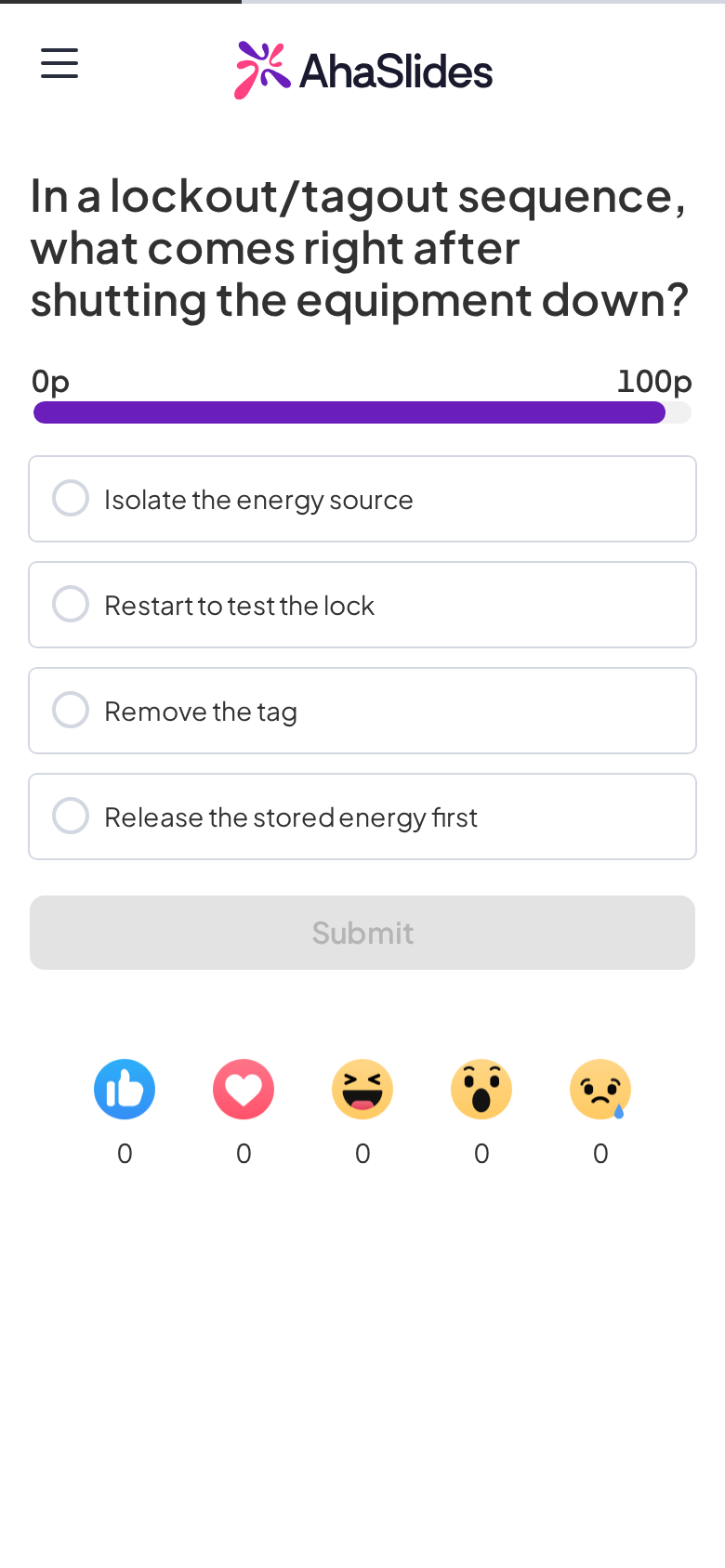
On AhaSlides you can run a κουίζ, έναν ψηφοφορία και ανώνυμα Q&A in the same session. A quiz question on the lockout/tagout sequence shows at once which steps people are unsure about. For more ideas, see our guides to θέματα εκπαίδευσης εργαζομένων και Gamification.
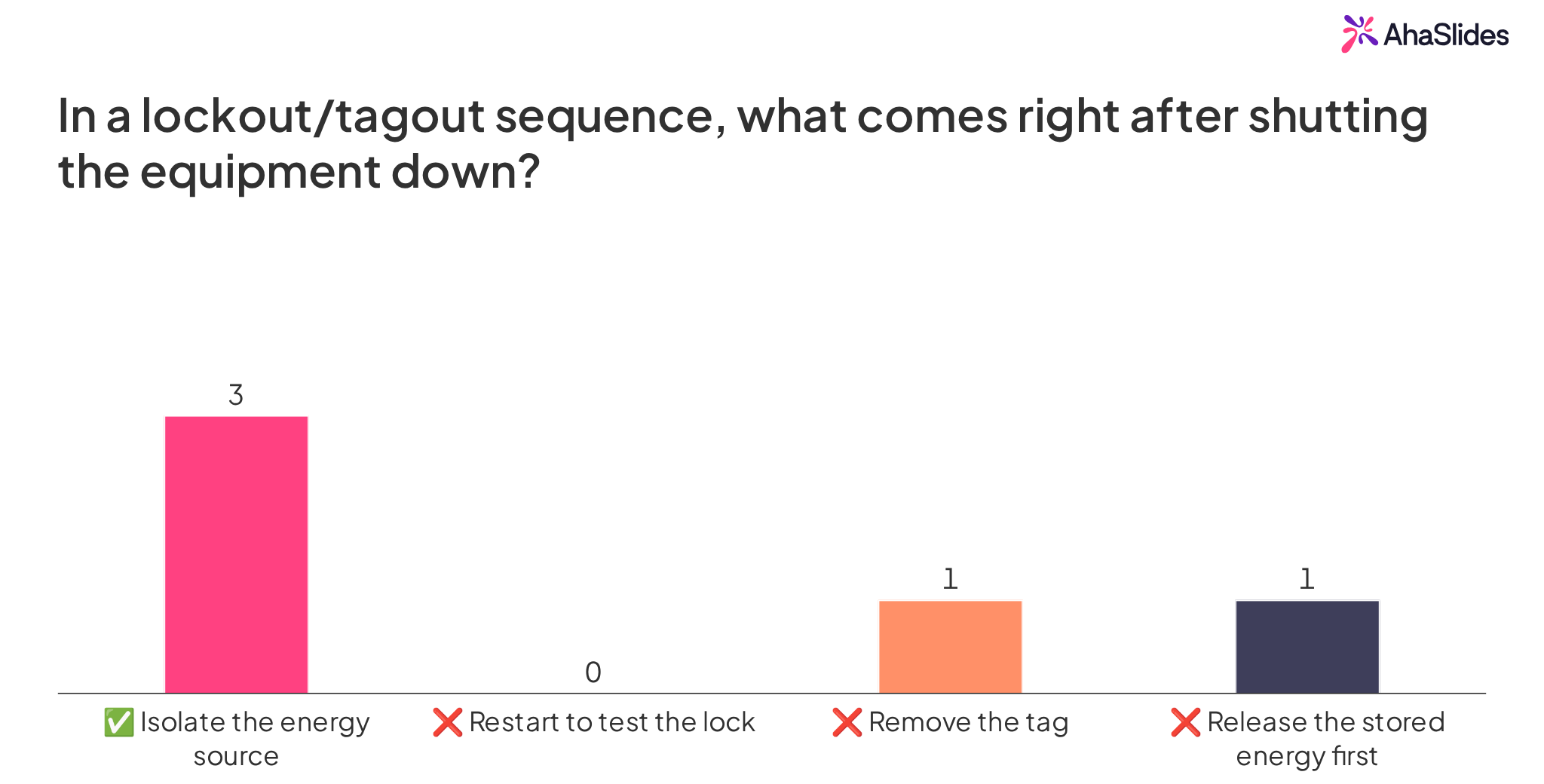
When the timer ends, the slide reveals the correct step and how the room voted, so the trainer can address the wrong answers while people are still paying attention.
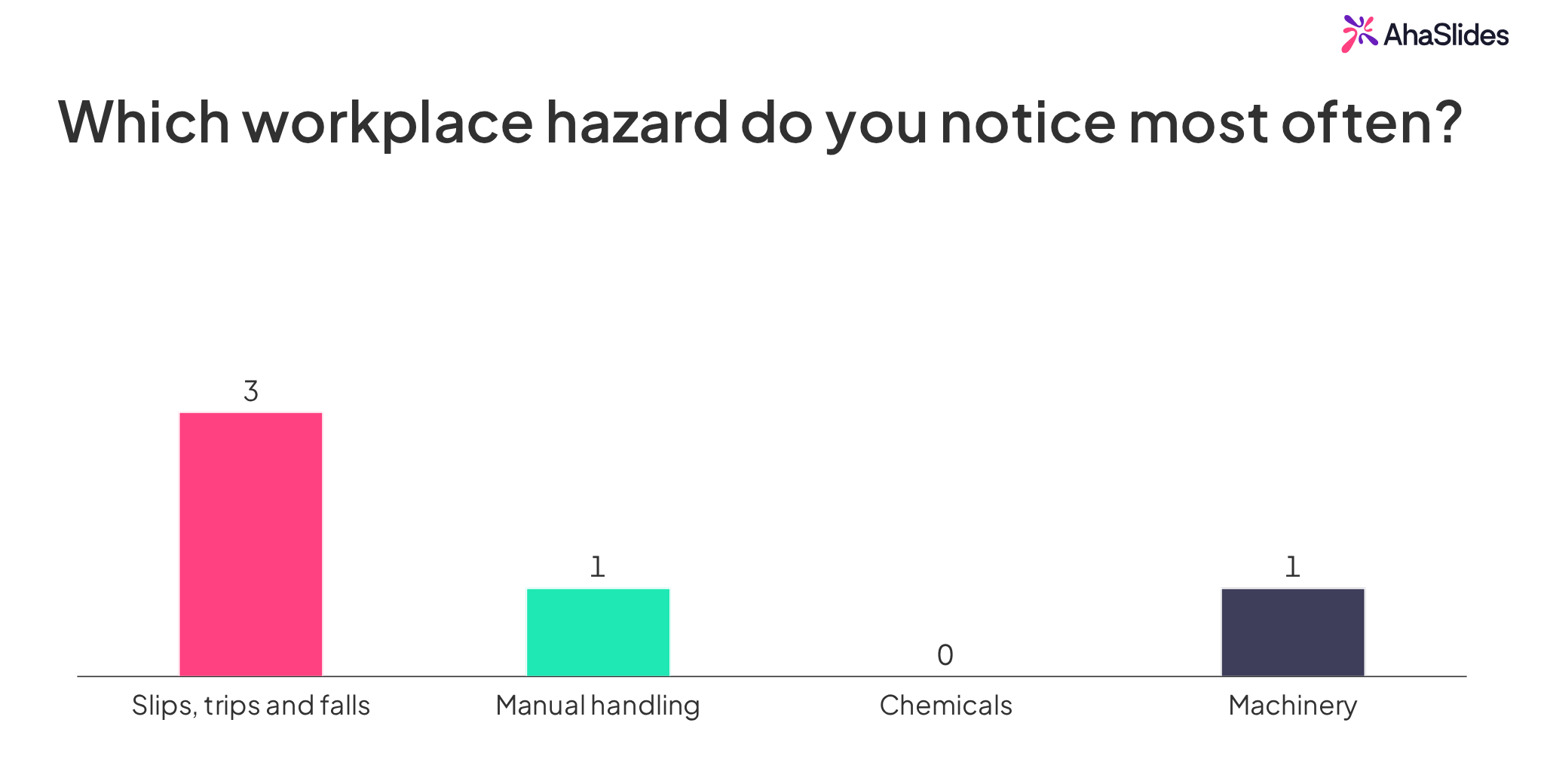
A poll works for the topics where there is no single right answer, such as which hazard people see most often, and the results show where to focus the next session.
Πηγές
[1] Liberty Mutual Insurance. Δείκτης ασφάλειας στο χώρο εργασίας. The most disabling workplace injuries cost US employers about $58 billion a year in direct costs. https://business.libertymutual.com/insights/workplace-safety-index/
[2] US Bureau of Labor Statistics. Employer-Reported Workplace Injuries and Illnesses, 2024. 2.5 million nonfatal cases in private industry. https://www.bls.gov/news.release/osh.nr0.htm
[3] US Bureau of Labor Statistics. National Census of Fatal Occupational Injuries in 2024. 5,070 fatal work injuries; 1,937 transportation incidents; 733 violent acts. https://www.bls.gov/news.release/cfoi.nr0.htm
[4] OSHA. Top 10 Most Frequently Cited Standards. https://www.osha.gov/top10citedstandards
[5] Safety+Health. OSHA reveals final Top 10 data for FY 2025. Final violation counts for each standard. https://www.safetyandhealthmagazine.com/?p=52496
[6] OSHA. Βία στο χώρο εργασίας. https://www.osha.gov/workplace-violence
[7] OSHA. Saving Sudden Cardiac Arrest Victims in the Workplace (OSHA 3185-09N, 2003). https://www.osha.gov/Publications/osha3185.pdf
[8] Burke, M.J., et al. (2006). "Relative Effectiveness of Worker Safety and Health Training Methods." American Journal of Public Health, 96 (2), 315-324. https://pmc.ncbi.nlm.nih.gov/articles/PMC1470479/