
Need fresh, interesting topics for discussion, whether for work, class or a casual get-together? Below are 70 discussion questions, grouped by theme: hypothetical situations, technology, the environment, ESL learning, gender, high school life and diversity. Each one is open-ended, so it starts a conversation rather than a one-word answer.
Every question sits on its own numbered card. Read them out, print the page, or load them into a live session so everyone, quiet voices included, can answer from their phone.
Discussion questions about hypothetical situations
Open with these when the room needs to warm up. Nobody can be wrong about something that has not happened.
Hüpoteetilised olukorrad10 küsimused
1What would you do if you could go back in time and stop one mistake from happening?
2Imagine a world without electricity. How would it change communication and relationships?
3Mis juhtuks, kui kõigi unistused saaksid avalikuks?
4What if social status were determined by kindness rather than money or power?
5What would happen if gravity switched off for an hour?
6If you woke up as the CEO of a global company tomorrow, which company would you want it to be?
7If you could invent one superpower, what would it be?
8Free ice cream for life or free coffee for life. Which do you choose, and why?
9Imagine education was entirely self-directed. How would that change learning?
10If you could change one aspect of human nature, what would you alter?
Short on time? Pick one question from each section, put them to a vote, and discuss whichever wins.
Discussion questions about technology
Good for mixed groups, because everyone has an opinion on the devices they use every day.
Tehnoloogia10 küsimused
11How has technology changed the entertainment industry, from music to gaming?
12What might automation and AI mean for the job market over the next decade?
13Should deepfake technology be banned or tightly regulated?
14How has technology changed the way we access and trust news?
15Are there ethical concerns around autonomous weapons systems?
16How has technology reshaped sport and athletic performance?
17Has constant connectivity affected our attention spans?
18What are virtual and augmented reality good for, beyond gaming?
19Should facial recognition be used in public spaces?
20What are the advantages and drawbacks of online learning versus a physical classroom?
Discussion questions about the environment
These suit classrooms and sustainability workshops, and they reward people who have read around the topic.
Keskkond10 küsimused
21Kuidas saame lahendada veepuuduse ja tagada kõigile juurdepääs puhtale veele?
22What does overfishing mean for marine ecosystems and food security?
23What are the consequences of unchecked urban sprawl?
24How does public activism change environmental policy?
25What is ocean acidification doing to marine life and coral reefs?
26How can the fashion and textile industry become more sustainable?
27How can tourism minimise its impact on the places it visits?
28What would get more businesses to adopt environmentally friendly practices?
29How does sustainable urban planning contribute to greener cities?
30What are the trade-offs between renewable energy and fossil fuels?
Discussion questions for ESL learners
For English as a Second Language classes and conversation clubs. Each pairs an everyday topic with an open follow-up.
ESL learners10 küsimused
31What is the most challenging thing about learning English for you, and how do you work on it?
32Kirjeldage oma riigi traditsioonilist rooga. Mis on peamised koostisosad?
33Kas teile meeldib teiste kultuuride tundmaõppimine? Miks või miks mitte?
34Describe a time you had to solve a problem. How did you approach it?
35Do you prefer the countryside or the coast? Why?
36What are your goals for improving your English?
37Share a quote or saying that inspires you, and explain why.
38What are some important values in your culture?
39What is your opinion of social media, and how often do you use it?
40Mis on teie lemmikaastaaeg ja miks?
Discussion questions about gender
Set ground rules first: listen without interrupting, and speak from your own experience.
SUGU10 küsimused
41How do people understand the relationship between gender identity and biological sex?
42What stereotypes are commonly attached to different genders, and where do they come from?
43How has gender inequality shown up in your life or the lives of people you know?
44How does gender shape the way people communicate at work?
45How does media coverage influence perceptions of gender roles?
46How have traditional gender roles shifted in the last generation?
47What would help boys and men feel able to express a fuller range of emotion?
48What is the effect of gender expectations on mental health and wellbeing?
49Kuidas mõjutab sugu karjäärivalikuid ja -võimalusi?
50Why does gender diversity in leadership matter for decision-making?
Discussion questions for high school students
Pitched at ages 14 to 18. Each takes a clear position that a student can argue for or against.
Keskkooli õpilased10 küsimused
51Should personal finance be a required part of the school curriculum?
52Does social media use among teenagers affect the stigma around mental health?
53Should schools provide free menstrual products?
54What is the role of physical education in a healthy lifestyle?
55Should schools have stricter anti-cyberbullying policies?
56How can schools teach media literacy so students can judge influencer advice critically?
57Should schools teach mindfulness and stress management?
58What role should students have in school decision-making?
59Should schools use restorative justice instead of traditional discipline?
60What ethical questions come with influencer sponsorships and product endorsements?
Thought-provoking diversity questions, by age group
Ten questions sorted by age, so you can match the language and the stakes to the group.
Elementary school (ages 5 to 10)3 küsimused
61What makes your family special? What traditions do you celebrate?
62If you had a superpower to make the world kinder, what would it be?
63We all have different names, skin colours and hair. What makes that special?
Middle school (ages 11 to 13)3 küsimused
64What does diversity mean to you, and how can your class be more inclusive?
65Do the books, films or shows you love represent people from different backgrounds?
66Why are stereotypes harmful, and how can we challenge them?
High school (ages 14 to 18)4 küsimused
67How do race, gender and religion shape people's experiences of the world?
68Research a diversity-related current event. Why does it matter to you?
69How can privilege be used to create a more equitable world?
70What would make your school feel more welcoming to someone who is new to it?
How to write a discussion question that works
. Cornell Center for Teaching Innovation sets out what makes a question effective: it is meaningful and understandable to the group, and it challenges people without being too difficult. It also names two kinds to avoid, questions that are too vague (people are unsure what is being asked) and questions that are too loaded (people guess what you want to hear rather than say what they think). In practice:
- Start from the objective. Decide what people should think about, analyse or explore, then write the question to match.
- Keep it open. Open-ended questions draw out expanded thinking, while a yes or no question only checks a fact.
- Väldi suunavat keelt. A question that hints at the right answer turns a discussion into a quiz.
- Tee see selgeks. If someone has to ask what you mean, rewrite it.
- Match the audience. Pitch it at what the group already knows and cares about.
Run the discussion live, and let quieter voices in
Raising a hand favours the people who are already confident. Running the same questions on a live slide gives everyone a turn at once. Here is a short flow that works with any question from the lists above.
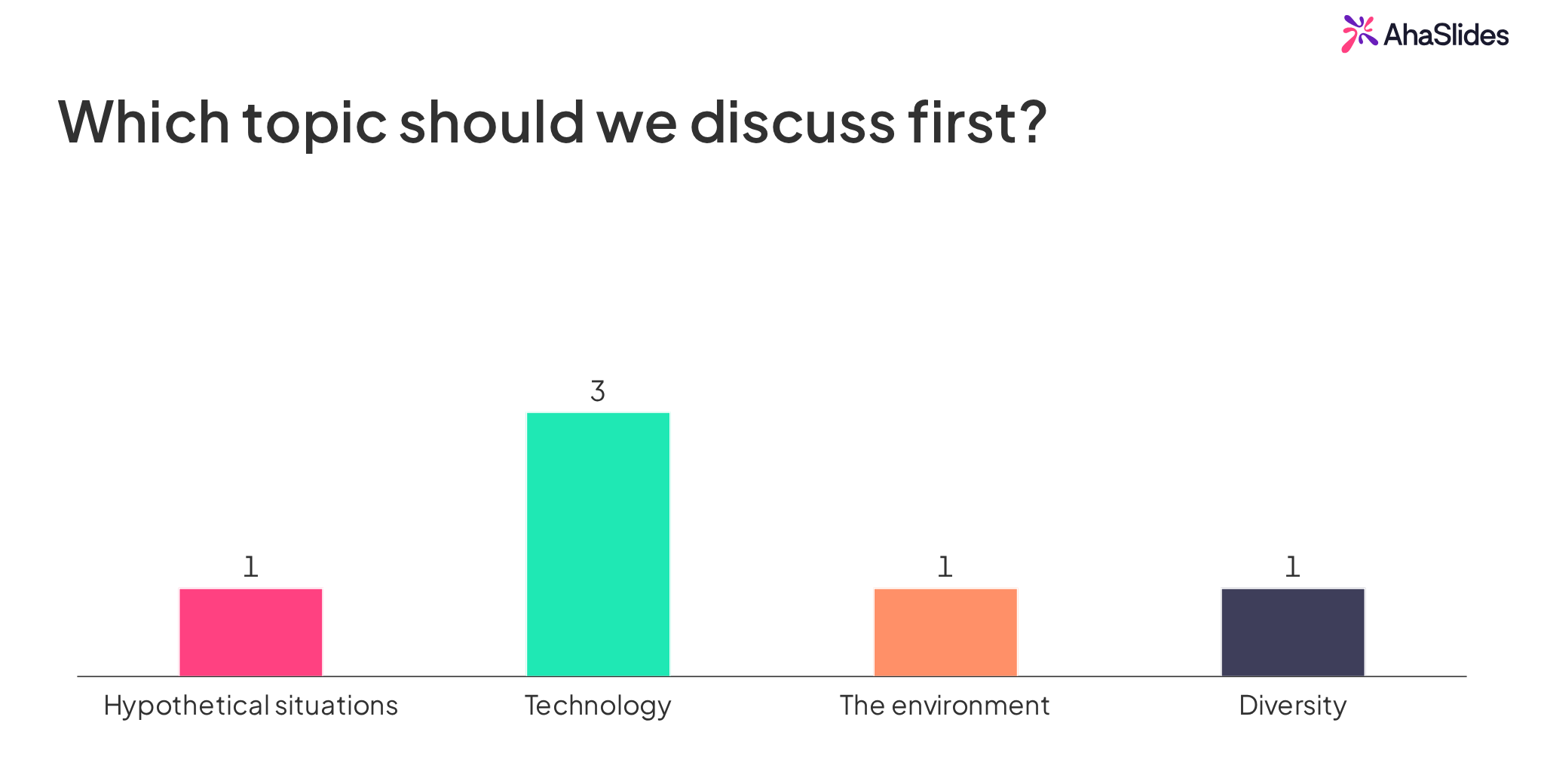
1. Let the room choose the topic
Put four of the themes on a poll and let people vote. The winner becomes the first discussion, and the result shows you what the group cares about before you say a word.
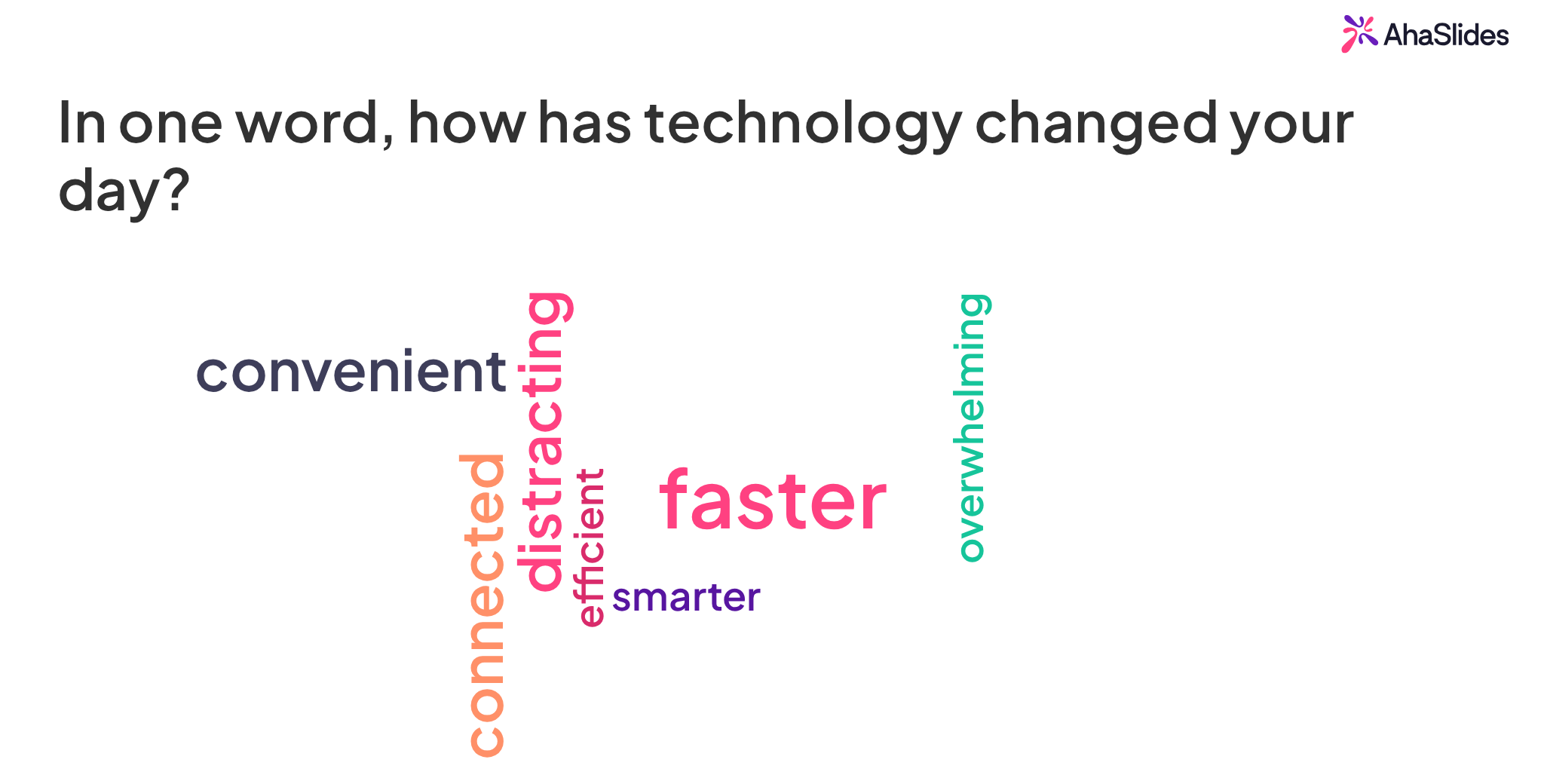
2. Warm up with a word cloud
Ask for one word in response to the question, such as how technology has changed daily life. A word cloud takes seconds to answer and gives the loudest and quietest people the same space on screen.
3. Collect questions anonymously
Open a Q&A slide and let people type their own follow-up questions on their phones. The name field is optional, so they can ask without putting their name to it, and the questions are sorted into Top, New and Answered tabs for the host to work through.

Peamised kaasavõtmised
Seventy questions cover the common ground, but the best discussions come from adapting a question to the room. Keep it open, keep it neutral, and give everyone, including the quietest person in it, a real way to answer.
Korduma kippuvad küsimused
What makes a good discussion question?
An open, non-leading question that invites a perspective rather than a recalled fact. "How has gender inequality shown up for people you know?" works better than "Is there gender inequality?" because it asks for a viewpoint, not a yes or no.
What is a leading question, and why avoid it?
A leading question steers people toward a specific answer, which narrows the range of views a discussion surfaces. Cornell's teaching centre calls this being too loaded: people guess what you want them to say rather than tell you what they think.
How do I write a discussion question from scratch?
Define the objective, pick a topic relevant to the group, keep the question open-ended, avoid leading language, and match it to what the audience already knows.
How many discussion questions do I need for one session?
Three to five usually fill an hour. Pick the questions that suit the group and leave the rest for another session.