
We are surrounded by claims, headlines and confident opinions. Critical thinking is the skill that helps you decide which ones to believe and what to do about them. This guide explains what critical thinking is, why it matters, the skills it involves and a step-by-step way to apply it, with a worked example.
מהי חשיבה ביקורתית?
The most widely cited definition comes from Michael Scriven and Richard Paul, presented to the 1987 International Conference on Critical Thinking and Education Reform. They describe it as ‘the intellectually disciplined process of actively and skillfully conceptualizing, applying, analyzing, synthesizing, and/or evaluating information gathered from, or generated by, observation, experience, reflection, reasoning, or communication, as a guide to belief and action’ (יסודות לחשיבה ביקורתית).
In plain terms, critical thinking means questioning information, weighing the evidence and reasoning to a conclusion you can explain, rather than accepting or rejecting something because of how it feels.
A panel of 46 experts convened by the American Philosophical Association reached a similar view in the Delphi Report, directed by Peter Facione. It calls critical thinking ‘purposeful, self-regulatory judgment’ and names six core skills (Facione, ERIC):
| מְיוּמָנוּת | מה זה אומר בפועל |
|---|---|
| פרשנות | Understanding what information, data or a situation means |
| אָנָלִיזָה | Breaking an argument into its claims and reasons |
| הערכה | Judging how credible a source is and how strong an argument is |
| הסקה | Drawing reasonable conclusions and considering alternatives |
| הסבר | Stating your result and justifying your reasoning |
| ויסות עצמי | Monitoring and correcting your own thinking |
Critical thinking is a skill built through practice, not a fixed trait. Curiosity helps, but the habits can be learned at any age.
Why is critical thinking important?
- בעבודה: it supports better decisions, clearer problem solving and stronger recommendations. It also pairs closely with יכולות אנליטיות.
- בחינוך: it moves students from memorising facts to testing and applying them.
- בחיי היום יום: it helps you judge news sources, read the small print and handle big personal choices without being rushed.
How to apply critical thinking: 8 steps
- הגדירו את השאלה. State exactly what you are trying to decide or understand.
- Gather relevant information. Use trustworthy sources and look for more than one.
- Question assumptions. Ask what you are taking for granted and what you would need to see to change your mind.
- Analyse the information. Split it into parts and look for patterns, links and gaps.
- Consider other perspectives. Ask how someone who disagrees would see it.
- Evaluate the evidence. Check who produced it, how recent it is and whether it supports the claim.
- Reach and explain a conclusion. Choose a position and be able to say why.
- לְשַׁקֵף. Afterwards, review what worked and what you would do differently.
Practise spotting assumptions
Separating facts from assumptions is the step people skip most. A fact can be checked; an assumption is something taken for granted. A quick quiz makes a good warm-up for a class or team: show four statements and ask which one is an assumption.
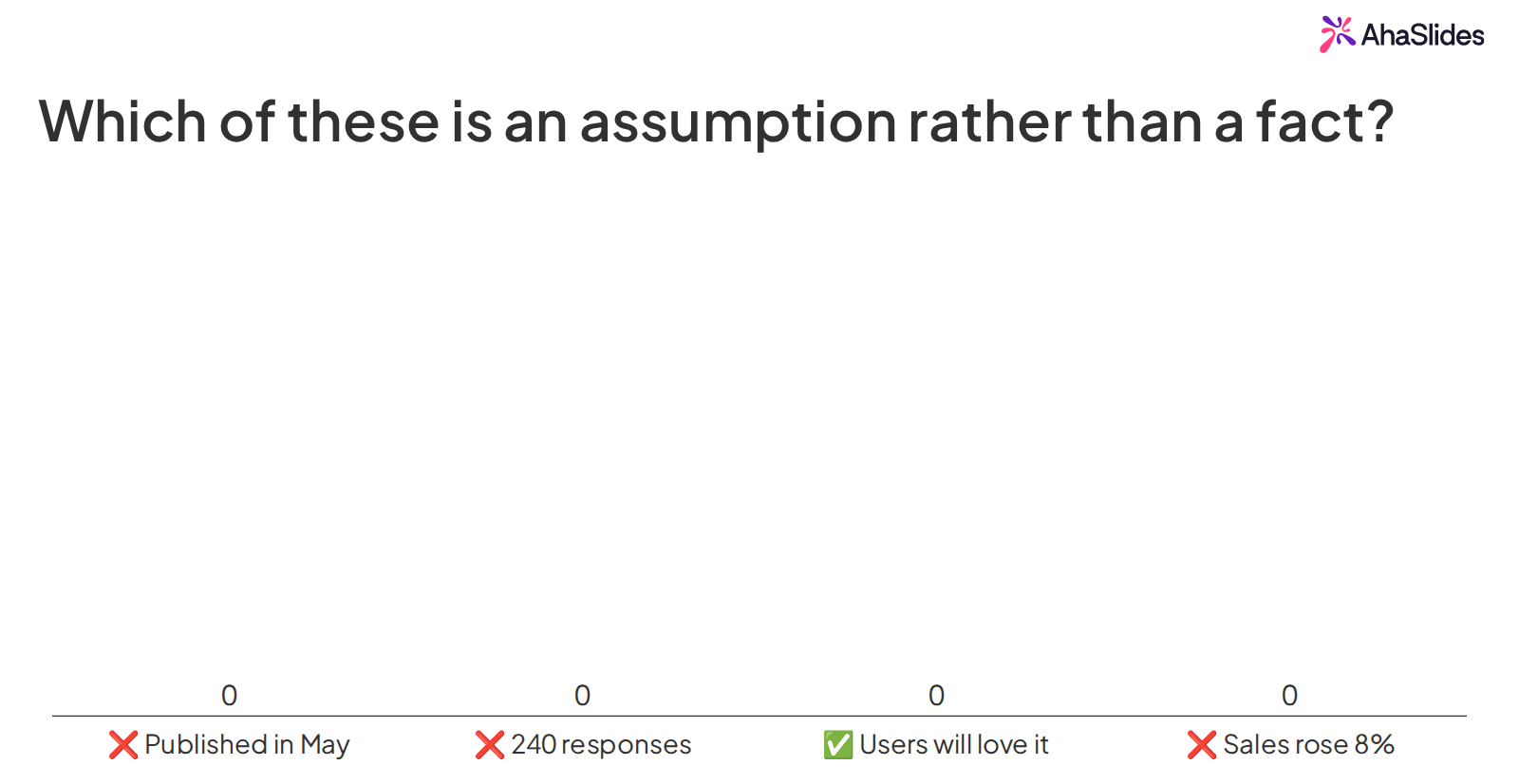
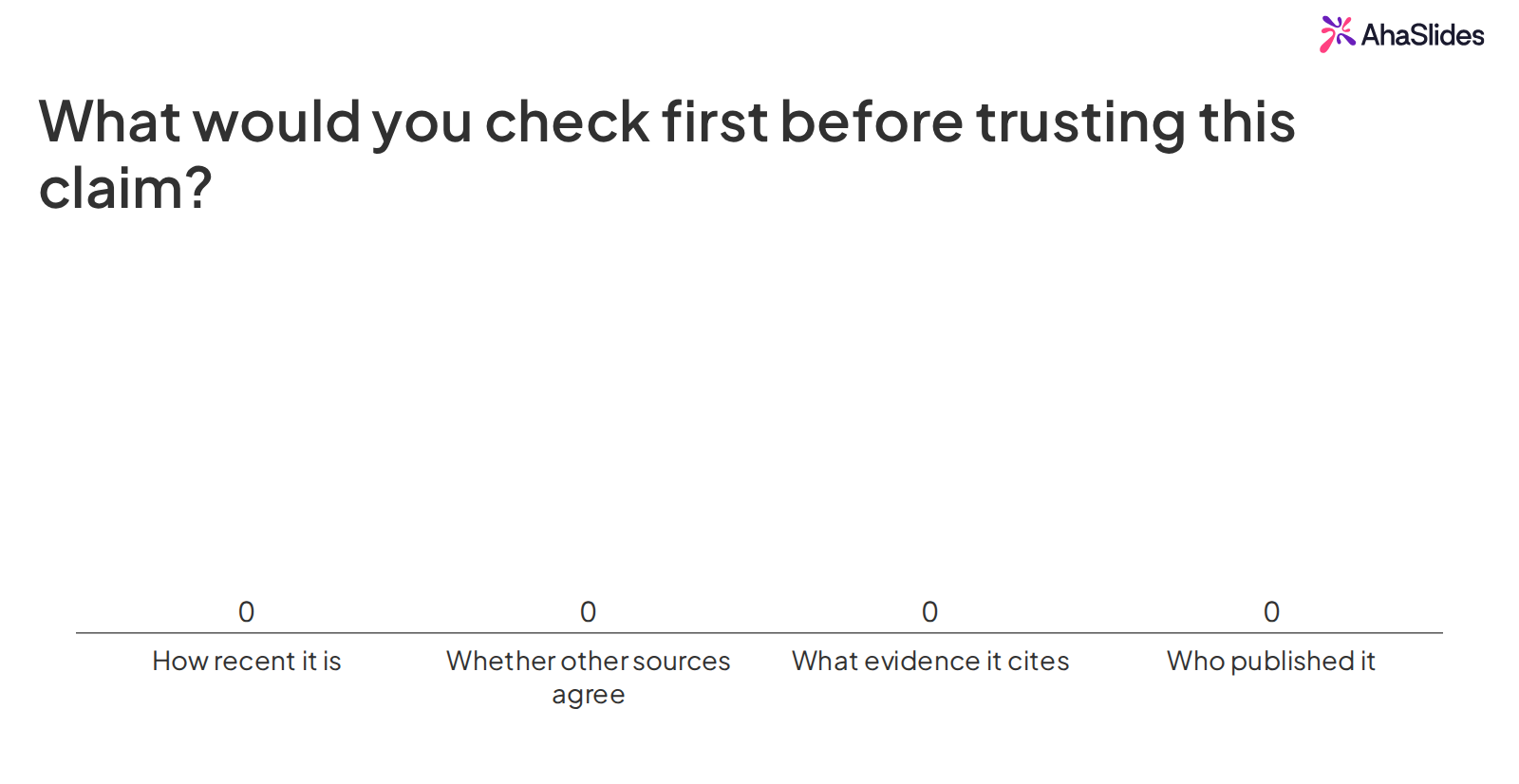
A follow-up poll asks the group what they would check first before trusting a claim. The split in answers (the source, the evidence, other sources, the date) is a ready-made discussion about how people evaluate information.
Critical thinking example: choosing a college major
Imagine a high school student deciding on a major.
- הגדירו את השאלה: which major fits my interests, skills and career goals?
- לאסוף מידע: course requirements, graduate outcomes and the job market for each option.
- Question assumptions: ‘I must pick whatever pays most’ and ‘I should study what my parents did’ are both assumptions worth testing.
- אָנָלִיזָה: compare the curriculum, outlook and typical salaries side by side.
- Consider other perspectives: talk to advisers, lecturers, working professionals and students on different courses.
- Evaluate the evidence: check the date and source of every statistic and forecast.
- מסכם: narrow the list to a few majors that match both interests and goals.
- משקף: stay open to switching as you learn more.
The outcome is not a guaranteed right answer, but a decision you can explain and revisit.
Ways to build the habit
- Ask ‘How do we know that?’ of any claim, including your own.
- Read one source that disagrees with you each week.
- Explain your reasoning aloud or in writing; gaps show up fast.
- Use group activities such as מפגשי סיעור מוחות to practise weighing ideas, not just collecting them.
טעימות מפתח
- Critical thinking is disciplined, evidence-based reasoning that guides what you believe and do.
- It combines interpretation, analysis, evaluation, inference, explanation and self-regulation.
- Start by separating facts from assumptions, then test your sources.
- It can be taught and improved with regular practice.
שאלות נפוצות
למה אנחנו צריכים חשיבה ביקורתית בחיים?
It helps you solve problems, make decisions, spot weak arguments and avoid being misled, at work, in study and in everyday choices.
האם ניתן ללמוד ולשפר חשיבה ביקורתית?
Yes. Practices such as analysing arguments, checking sources, seeking out other viewpoints and reflecting on your own reasoning all build the skill over time.
כיצד אוכל לעודד חשיבה ביקורתית אצל ילדים ותלמידים?
Encourage questions, ask for reasons (‘Why do you think that?’), compare different sources and use discussion, debate and problem-solving activities. Interactive polls and quizzes give every student a voice, not only those who speak up first.