

プレゼンテーションの書き方:例文付き完全ガイド

Blog サムネイル画像

Most people write their presentation the same way they'd write a report. They open a document, list what they want to cover, add some structure around it, and call it a script. Then they stand up to deliver it and something feels off. The sentences are too long. The transitions don't land. The whole thing sounds like it's being read, because it was written to be read.

Presentation writing is a different craft. Your audience hears your words once, in real time, with no ability to pause or reread. If a sentence doesn't land on first pass, it's gone. That changes everything about how you should write.

This guide covers how to do it well: how to structure a presentation script, how to write for the ear rather than the eye, and how to build in the moments that make delivery feel natural rather than performed.

The challenge most presenters don't see coming

The instinct when writing a presentation is to be thorough. To include everything that might matter. To make sure nothing gets left out.

That instinct produces bad presentations.

Your audience can't absorb complexity the way a reader can. They can't slow down, reread, or sit with a difficult idea until it makes sense. They're moving at your pace whether they're ready or not. The job of a presentation script isn't to contain all your thinking. It's to guide your audience through a carefully chosen selection of it, in an order that makes sense, at a speed they can follow.

Write less than you think you need. Structure it more carefully than you think you should. That's the starting point.

How to write a presentation script

Start with an outline. Every time, without exception. The outline is where you make the structural decisions: what your core message is, what your three to five main points are, what evidence supports each one, and how you get from one to the next. The script is just the outline with words around it. If you skip the outline and go straight to writing, you'll discover your structure somewhere around slide ten, when it's too late to fix it without starting over.

始まり

Your audience decides in the first thirty seconds whether they're paying attention. Open with something that earns that attention: a question, a surprising observation, a short story, or a specific scenario they'll recognize. Then signal your direction clearly. "Today we're covering three ways to reduce project timelines" tells your audience what to expect and gives them a frame to hang everything else on. Don't make them wait to find out what the presentation is about.

Each main point gets its own section. Within each section, the pattern is the same: state the point clearly, support it with evidence, explain why it matters to your audience, then transition to the next point. The transition is the part most people write last and should write first. "Now that we've covered why this matters, let's look at how to implement it" tells your audience they're moving to a new idea and why that move makes sense. Without it, sections feel like they're just stacked on top of each other rather than building toward something.

Evidence looks different for different audiences. Technical audiences want data. Emotional audiences want stories. Most audiences want both: a number that makes the scale of something clear, and a story that makes it feel real.

結論

Restate your core message. Remind your audience what you've covered and why it matters. Then close with a specific call to action: what do you want them to do with this information? Adopt a policy, try a technique, schedule a meeting, think differently about a problem. Vague endings produce vague outcomes. The clearer you are about what you want to happen next, the more likely it is to happen.

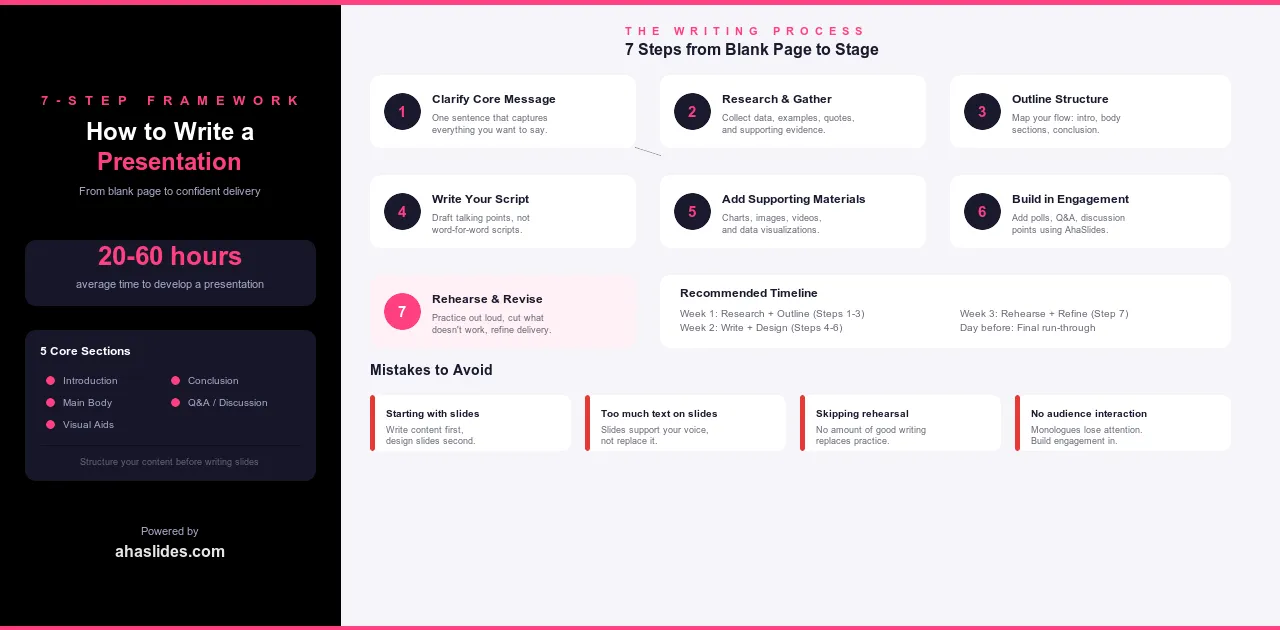
Infographic showing the seven-step framework for writing a presentation from clarifying your core message through research outlining scripting design engagement and rehearsal

プレゼンテーション作成の5つの原則

Write for the ear, not the eye

Read your script aloud before you finalize it. Sentences that look fine on the page often sound wrong when spoken. "Considering the aforementioned implications" is readable. It's also unlistenable. "This changes how we approach the problem" says the same thing in a way that actually lands when heard. Your script should sound like you talking to someone, not like a document being performed.

Repeat the things that matter

In written prose, repetition is a style failure. In presentations, it's technique. Your audience hears your words once. If something is important, say it more than once. Introduce the idea, develop it with examples, then recap it. The pattern feels redundant when you're writing it. It feels clear when your audience is listening.

Handle numbers carefully

Your audience can't pause to process "we increased efficiency by 27.3%." By the time they've absorbed the number, you've moved on. Translate statistics into something the ear can hold: "we cut the time required by more than a quarter" or "what used to take ten days now takes two." Concrete comparisons land. Abstract percentages don't.

Signal your structure explicitly

Audiences need signposts. "We'll cover three areas today" tells them what to expect. "First, second, third" tells them where they are. "That covers the problems. Now let's look at solutions" tells them you're shifting. These lines feel obvious when you write them. They're essential when your audience is listening, because unlike a reader, they can't look back at the heading to reorient themselves.

Build delivery into the script

A script that's just words is half a script. Mark where you pause. Note where you look up from your notes and make eye contact. Indicate where you slow down for emphasis. If you're using interactive tools like polls or Q&A, write them in as deliberate moments rather than interruptions: "let me pause here and get your input on something" is a line, not an afterthought. The difference between a script that's been written and one that's been prepared for 配達 shows up the moment you open your mouth.

Professional smiling while working on a presentation at a laptop in a modern office

脚本から納品まで

Writing the script is not the last step. It's the second to last.

Once you have a draft, read it aloud from start to finish. Not in your head. Out loud, at the pace you'd actually deliver it. Notice where you rush, where you stumble, where a sentence takes too long to get to its point. Those are the places to edit. If you can't get through a sentence without losing your breath, it's too long. If you find yourself rereading a line to make sure you understand it, your audience won't understand it either.

If you marked your script for delivery as you wrote it, this is where those marks start earning their place.

Most people practice by reading their script silently a few times and assuming that counts. It doesn't. The only practice that prepares you for speaking out loud is speaking out loud. Do it enough times that the structure feels familiar, but not so many times that it starts to feel memorized. You want to know where you're going, not recite how you get there.

AhaSlidesでさらに進化

One thing a script can't fully prepare you for is the gap between what you planned to say and what your audience actually needs to hear. You can write the clearest, best-structured presentation in the world and still misjudge where your audience is, what they already know, or what they're most confused about.

Interactive tools close that gap in real time. A poll before your main section tells you what your audience already believes before you try to change their minds. A word cloud mid-presentation surfaces what's resonating and what isn't. A Q&A at a natural transition point catches confusion before it compounds.

Write these moments into your script the same way you'd write any other section. "At this point I'll run a quick poll" is a scripted moment, not an interruption. AhaSlides makes it straightforward to build these interactions directly into your presentation flow, so the shift from content to participation feels deliberate rather than bolted on.

The best presentation scripts don't just plan what you'll say. They plan how your audience will respond. Interactive elements are how you make that happen.

包み込む

The gap between a presentation that informs and one that actually lands comes down to how it was written. Not how confidently it was delivered, not how good the slides looked, but whether the words were written for an audience that hears them once, in real time, with no ability to go back.

Write for the ear. Structure for clarity. Build in the moments where your audience participates rather than just listens.

Do those three things and the delivery takes care of most of itself.

視聴者のエンゲージメントを高めるためのヒント、洞察、戦略を購読してください。
ありがとうございました! あなたの提出物は受領されました!
おっと! フォームの送信中に問題が発生しました。

他の投稿をチェックする

AhaSlidesは、Forbes誌のアメリカ版トップ500企業に採用されています。エンゲージメントの力を今すぐ体験してください。

今すぐ探索する
© 2026 AhaSlides Pte Ltd