
You prepared solid material. You practiced your delivery. But halfway through the session, half the room is glazing over and the other half is sneaking looks at their phones.
Sound familiar? You're not alone. Gallup's latest workplace report found that U.S. employee engagement has fallen to its lowest level in a decade, with only 31% of employees engaged at work. Disengagement shows up in the training room just as often as it does on the job, and passive, lecture-style delivery is a big part of why. When people sit still for an hour absorbing information, their brains simply check out.
The fix isn't a complete training overhaul. It's a shift in approach: interactive training. And the research backs it up with hard numbers.
In this guide, I'll walk you through what interactive training actually is, why it works (with real data), the methods that get results, and how to start using it in your next session.
What is interactive training?

Interactive training is any learning experience where participants actively engage with the content instead of passively receiving it. Rather than listening to a 60-minute lecture, learners answer questions, contribute ideas, solve problems, and get real-time feedback throughout the session.
This can take many forms depending on your training context: live polls during a presentation, competitive quizzes that test knowledge on the spot, word clouds that visualize group thinking, anonymous Q&A sessions, scenario-based exercises, role-play activities, or gamified learning modules.
The common thread? Learners do something with the information rather than just hear it. And that distinction matters more than most trainers realize.
Why interactive training works: what the research says
The case for interactive training isn't based on hunches. It's grounded in cognitive science and backed by large-scale studies.
Higher test scores: A landmark 2014 meta-analysis by Freeman et al., published in the Proceedings of the National Academy of Sciences, analyzed 225 studies comparing aktīva mācīšanās with traditional lecturing in STEM courses. Average exam scores rose by about 6% under active learning, and students in traditional lecture courses were 1.5 times more likely to fail than those in active learning sections.
Labāka noturība: Cognitive psychologists Roediger and Karpicke's influential 2006 research on the "testing effect" found that actively retrieving information, by answering a question or taking a quiz, builds far stronger long-term retention than simply re-reading or re-hearing the same material. Every quiz or knowledge check you add to a training session is a small dose of that same izguves prakse.
Stronger engagement: In TalentLMS's Gamification at Work survey, 89% of employees said they'd be more productive if their work (including training) felt more like a game, and 88% said gamified elements made them happier while learning. When people are engaged enough to talk, compete, and respond, they process the material instead of just hearing it.
Ietekme uz biznesu: LinkedIn Learning's workplace research consistently finds that 94% of employees would stay at a company longer if it invested in their career development and training. Interactive, well-run sessions are a visible signal of that investment, not just a nice-to-have.
The bottom line: interactive training isn't just more engaging. It produces measurably better learning outcomes and real business results.
Interactive training methods that get results
Not every interactive method fits every training scenario. Here are the approaches that consistently deliver, organized by what they're best at.
Tiešraides aptaujas un aptaujas
Polls are the simplest way to shift a session from one-way to two-way. Drop a quick poll every 10-15 minutes to check understanding, gather opinions, or simply re-engage attention. They work especially well for compliance training, onboarding sessions, and large-group workshops where not everyone feels comfortable speaking up. When participants see their responses appear in real time, it creates a sense of collective participation that lectures can never match.
Viktorīnas un zināšanu pārbaudes
Competitive quizzes with leaderboards tap into something powerful: people's natural drive to perform. Use them to reinforce key concepts during training, assess knowledge gaps in real time, or as energizers between dense content sections. TalentLMS's survey found 89% of employees feel more productive when work is gamified, which is exactly what a well-timed quiz does to a training session. For corporate trainers running sales enablement or product knowledge sessions, quizzes are especially effective because they create immediate, measurable feedback loops. If you want a deeper look at formats, see our guide to 9 best types of quizzes to use.
Word clouds and brainstorming
Word clouds let you capture group thinking instantly. Ask a question, let everyone submit their responses, and watch a visual map of ideas emerge. This is particularly valuable for needs assessments at the start of a training program, gauging prior knowledge before diving into new content, or running inclusive brainstorming sessions where the loudest voice doesn't dominate. Every participant gets equal input.
Anonīmi jautājumi un atbildes
Most people in a training room have questions. Very few will raise their hands. Anonymous Q&A removes that barrier entirely. It's especially critical in sensitive training topics like HR policy updates, compliance sessions, or organizational change management. When anonymity is available, participation typically spikes because learners aren't worried about asking a "dumb" question in front of their peers or managers. See 9 tips to make your Q&A session a success for ways to keep the questions coming.
Scenario-based and role-play exercises
For skills that require judgment and decision-making, nothing beats putting learners in realistic situations. Customer service teams can practice handling difficult interactions. Sales teams can rehearse objection handling. Safety teams can work through emergency response protocols. The key is creating scenarios specific to your industry and making them interactive rather than theoretical.
Newer interactive formats worth trying
Beyond the staples above, AhaSlides ships 30+ interactive slide types and adds new ones roughly every month. The formats that suit training span standard types — Pick Answer (multiple-choice quiz), Categorise, Match Pairs, Correct Order, Type Answer, Word Cloud, Open Ended, Q&A, Rating Scale, Spinner Wheel, Brainstorm and Idea Board — alongside newer ones like True or False, This or That, Fill in the Blanks, Draw Answer, 2x2 Matrix, Split the Points, Duck Race and a YouTube-to-quiz tool. A few of the newer ones fit training especially well:
- Uzzīmēt atbildi has learners sketch a response on their phones that shows live on the main screen. Use it as a quick check by asking people to diagram a process; more creatively, ask an onboarding group to draw the customer journey from memory and compare versions.
- 2x2 matrica plots responses on two axes as a quadrant grid. Use it to sort ideas by effort versus impact in a planning session; more creatively, have a team place current initiatives on an urgent-versus-important grid to prompt debate.
- Sadaliet punktus gives each learner a pool of points to spread across options, revealing priorities instead of a flat vote. Use it to weight which topics need the most session time; more creatively, have groups allocate a limited budget across competing proposals to surface trade-offs.
- Ideju padome gathers free-text ideas into columns the room can vote on. Use it for an organised brainstorm at the start of a program; more creatively, run a keep/stop/start retrospective and vote the top actions to the top.
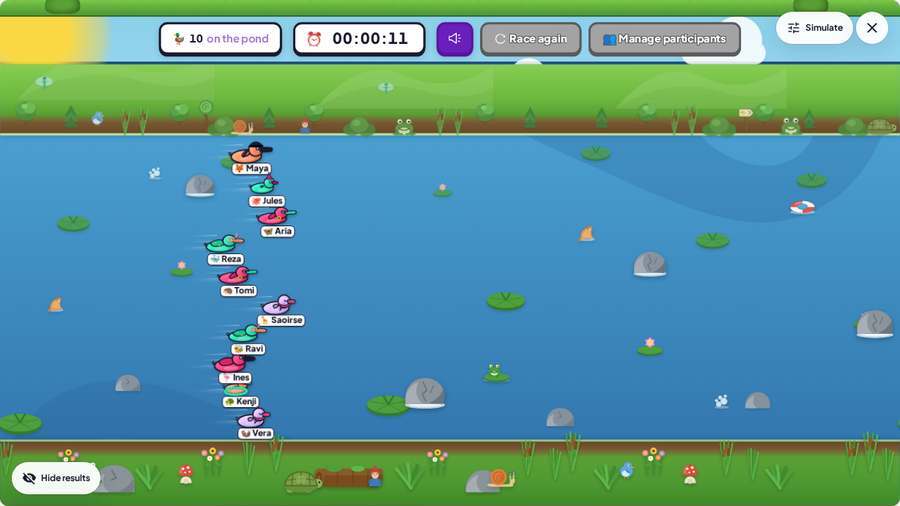
- Pīļu sacīkstes ir rotaļīgs nejaušības principa spēlētājs: ekrānā sacenšas multfilmu pīļu rinda, un viena no tām nejauši uzvar. Tas ir jautrs un nelielo likmju veids, kā salauzt ledu, piešķirt uzdevumu, piešķirt atlīdzību vai vienkārši izvēlēties uzvarētāju, un tas notiek tiešraidē. AhaSlides now. Use it to pick who answers next or which group presents first, keeping participation light and fair; more creatively, run it as a mid-session energiser or to give away a small reward, resetting attention without breaking the flow.
How interactive training compares to traditional methods
The differences between interactive and traditional training go beyond engagement levels. Here's how they stack up across the factors that matter most to L&D professionals:
| Faktors | Tradicionālā apmācība | Interaktīva apmācība |
|---|---|---|
| saderināšanās | Attention drops after 10-15 minutes; relies on presenter charisma | Sustained participation through activities every 10-15 min |
| Saglabāšana | Single exposure to material; no built-in recall practice | Retrieval practice (quizzes, Q&A) strengthens long-term recall; active learning lifts exam performance ~6% on average |
| Līdzdalība | Typically limited to confident, vocal individuals | Everyone contributes (especially with anonymous tools) |
| Atsauksmes | End-of-course evaluations; delayed insights | Real-time data on comprehension and engagement |
| Mērogojamība | Limited by room size and facilitator capacity | Works for 10 or 10,000 with digital tools |
| Novērtējums | Post-training tests; no visibility into learning process | Continuous knowledge checks throughout the session |
| Tālvadības/hibrīda | Difficult to maintain engagement virtually | Designed for digital; works across in-person and remote |
How to make your training interactive (without starting from scratch)

You don't need to rebuild your entire training program. Most trainers see immediate results by layering interactive elements into their existing content. Here's a practical approach:
Sāc ar to, kas tev ir. Take your current slides or training materials and identify the natural pause points. Every 10-15 minutes, there's an opportunity to insert an interactive moment: a quick poll, a knowledge check question, or a brainstorming prompt.
Pick one tool and learn it well. Interactive presentation platforms like AhaSlides let you add polls, quizzes, word clouds, and Q&A sessions directly into your slides. If you already use PowerPoint, you can import your deck as editable slides and layer interactive elements between your existing content. AhaSlides integrējas arī ar Microsoft Teams and Zoom, so remote and hybrid sessions get the same interactive experience. See our Tālummaiņas prezentācijas padomi if you're running training over video call. If you also need to turn a session into a self-paced module learners can revisit later, AhaSlides' tiešsaistes kursu veidotājs extends the same interactivity beyond the live room.
Use the 10-minute rule. Research on attention spans supports breaking content into 10-15 minute chunks separated by interaction. This isn't about dumbing things down. It's about giving your learners' brains a chance to process and apply what they've heard before moving on.
Make participation easy. The best interactive tools work on any device with no app download required. Share a QR code or link, and participants join from their phones. The lower the barrier to entry, the higher your participation rates.
Sekojiet līdzi tam, kas darbojas. One of the biggest advantages of interactive training is the data it generates. Tools like AhaSlides automatically track participation rates, quiz scores, and response patterns, giving you concrete evidence of what's landing and what needs reworking. This is invaluable for proving training ROI to stakeholders.
Interactive training in action: real-world examples
Wondering how this plays out in practice? Here are two examples from organizations that made the switch.
Deloitte Leadership Academy: When Deloitte added gamification, including badges, leaderboards, and weekly-reset competition, to its online leadership training platform, weekly return visits rose by 47% and course completion times dropped by 50%. The approach worked well enough that Deloitte carried the same principles into its in-person programs at Deloitte University.
Gamification, more broadly: TalentLMS's Gamification at Work survey backs this up at scale: 89% of employees said gamified elements would make them more productive, and 78% said gamification in a hiring or training process makes a company more appealing to work for. The pattern holds whether it's one leadership platform or an entire workforce.
How to measure if your interactive training is working
Good interactive training generates its own evidence. Here are the five metrics worth tracking:
Participation rate: What percentage of your audience actively engages with polls, quizzes, and activities? Aim for 80% or higher. If you're below that, the barrier to participation may be too high or the activities aren't relevant enough.
Zināšanu saglabāšana: Run brief assessments before and after training. The gap between pre- and post-scores tells you exactly how much learning happened. Interactive tools make this easy with built-in quizzes.
Completion rates: Strong interactive training programs see 85%+ completion. If people are dropping off, look at where in the session they leave. That's your signal to add more interaction at that point.
Learner satisfaction: A quick post-session survey (aim for 8+ out of 10) tells you whether the format resonated. Happy learners are also more likely to apply what they learned back on the job.
Biznesa rezultāti: Ultimately, training should move a business metric. Whether that's reduced onboarding time, higher compliance completion, better customer satisfaction scores, or improved sales performance, connect your training data to the outcomes that matter to your organization.
Sāciet ar vienu izmaiņu
Interactive training works because it aligns with how our brains actually learn: through doing, not just hearing. The research is clear, and organizations that have made the switch are seeing measurable improvements in engagement, retention, and business results.
You don't need to overhaul everything at once. Add one interactive element to your next session. A single poll, a quick quiz, or an anonymous Q&A. See what happens when your learners become participants instead of spectators.
That one small change might be the biggest upgrade your training program has ever had.
Looking for more formats to pull from? Our roundup of 15 interaktīvas prezentācijas idejas covers plenty that translate directly to a training session.
Avoti
Gallup (2025). U.S. Employee Engagement Sinks to 10-Year Low. gallup.com
Freeman, S., et al. (2014). "Active learning increases student performance in science, engineering, and mathematics." Procesu Nacionālās Zinātņu akadēmijas, 111 (23), 8410-8415. pnas.org
Roediger, H. L., & Karpicke, J. D. (2006). "The power of testing memory: Basic research and implications for educational practice." Psiholoģijas zinātnes perspektīvas, 1 (3), 181-210. psychnet.wustl.edu
LinkedIn Learning. 94% of employees would stay at a company longer if it invested in their career development, as reported by CNBC
Talantu pārvaldības sistēma (2019). Gamification at Work: The 2019 Survey Results. talentlms.com
Deloitte Leadership Academy gamification case study, as documented by Engagify