
Comprendre les styles de leadership n'est pas qu'un simple exercice théorique. C'est le fondement d'un leadership plus efficace, de la construction d'équipes plus performantes et de la création d'environnements propices à l'épanouissement professionnel. Que vous soyez un nouveau manager en phase d'apprentissage ou un cadre expérimenté souhaitant perfectionner son approche, la connaissance des différents styles de leadership et de leur pertinence peut transformer votre efficacité.
Ce guide complet vous permettra d'explorer 12 styles de leadership distincts, d'examiner leurs forces et leurs faiblesses, et de découvrir les approches les plus adaptées à votre personnalité, à votre équipe et à votre organisation. Plus important encore, vous apprendrez que les leaders les plus performants ne s'appuient pas sur un seul style, mais savent s'adapter avec souplesse à chaque situation.
Quels sont les styles de leadership ?
Les styles de leadership désignent les méthodes et comportements caractéristiques utilisés par les leaders pour diriger, motiver, gérer et inspirer leurs équipes. On peut les considérer comme la boîte à outils dans laquelle les leaders puisent pour influencer la performance de leur équipe, façonner la culture organisationnelle et atteindre les objectifs stratégiques.
Votre style de leadership influence tous les aspects de la communication, de la prise de décision à la délégation des tâches et à la résolution des conflits. Il a un impact significatif sur le moral des équipes, la productivité, l'innovation et la fidélisation. Selon une étude Gallup, les managers sont responsables d'au moins 70 % de la variation des scores d'engagement des employés, principalement en raison de leur approche du leadership.

L'évolution de la théorie du leadership
Notre compréhension des styles de leadership a considérablement évolué au cours du siècle dernier. En 1939, le psychologue Kurt Lewin a mené des recherches pionnières qui ont permis d'identifier trois styles de leadership fondamentaux : autocratique, démocratique et laissez-faire. Ce cadre conceptuel a jeté les bases de plusieurs décennies de recherches ultérieures.
En 1978, James Mac Gregor Burns Il a introduit le concept de leadership transformationnel dans son ouvrage fondateur sur le leadership politique, concept ensuite étendu par Bernard Bass en 1985 au contexte organisationnel. Leurs recherches ont démontré que les leaders qui inspirent et transforment leurs collaborateurs obtiennent des résultats supérieurs à ceux qui se contentent de gérer par le biais de transactions et de récompenses.
L'article de Daniel Goleman paru en 2000 dans la Harvard Business Review, intitulé « Leadership That Gets Results », a permis d'affiner notre compréhension en identifiant six styles de leadership basés sur l'intelligence émotionnelle et en démontrant comment les leaders efficaces passent de l'un à l'autre en fonction des circonstances.
Les spécialistes actuels du leadership reconnaissent qu'un leadership efficace ne consiste pas à trouver un style parfait, mais à développer la conscience et la capacité de s'adapter avec authenticité à de multiples approches. Cette flexibilité situationnelle, fondée sur la connaissance de soi, représente le summum de la maturité en matière de leadership.
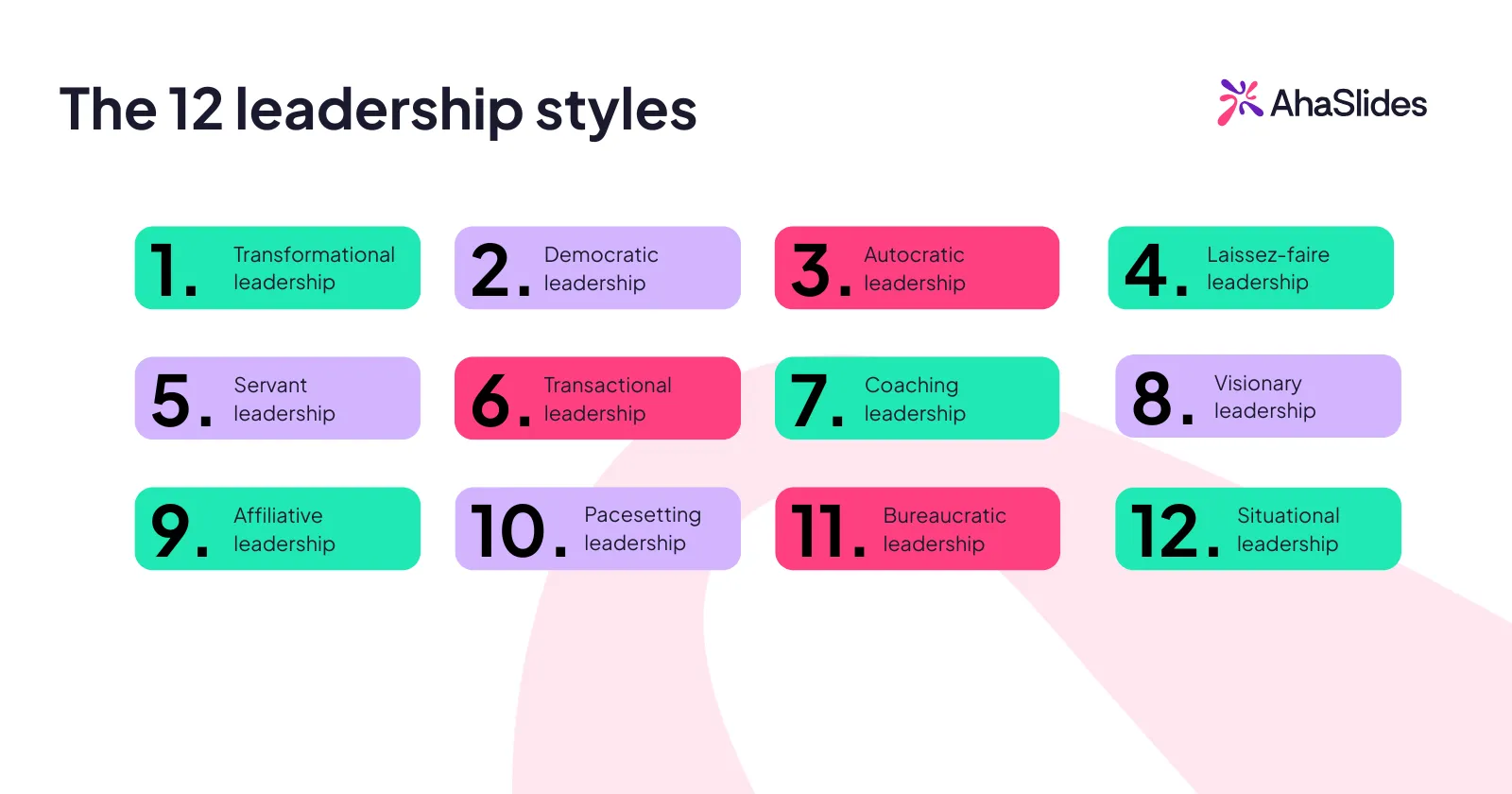
Les 12 styles de leadership fondamentaux expliqués
Explorons en détail les 12 styles de leadership les plus reconnus, en examinant dans quelles situations chacun fonctionne le mieux et les pièges potentiels à éviter.
1. Leadership transformationnel
Le leadership transformationnel inspire et motive ses collaborateurs à atteindre des résultats exceptionnels tout en développant leurs propres compétences de leadership. Ces leaders ne se contentent pas de diriger ; ils transforment leurs organisations et les personnes qui y travaillent grâce à leur vision, leur inspiration et leur attention personnalisée.
Principales caractéristiques:
- Une approche de la communication extrêmement inspirante et visionnaire
- Forte orientation vers le changement organisationnel et l'innovation
- Engagement profond envers la croissance personnelle et le développement des membres de l'équipe
- Présence de leadership charismatique et émotionnellement intelligente
- Encourage la créativité, la remise en question des hypothèses et la recherche de meilleures solutions.
- Il montre l'exemple, en démontrant les valeurs et les comportements attendus.
Points forts :
Les leaders transformationnels inspirent à leurs équipes une motivation et un engagement exceptionnels. Lorsque les collaborateurs adhèrent à une vision inspirante et se sentent valorisés par leur leader, ils sont prêts à se surpasser.
Ce style de leadership favorise l'innovation et la résolution créative de problèmes, car les membres de l'équipe se sentent habilités à remettre en question l'ordre établi et à proposer de nouvelles idées. Le lien émotionnel que tissent les leaders transformationnels renforce la résilience lors des périodes difficiles.
Surtout, cette approche forme les leaders de demain. En investissant dans le développement des membres de leur équipe et en leur offrant des opportunités de piloter des initiatives, les leaders transformationnels créent un vivier de leaders compétents au sein de toute l'organisation.
Points faibles :
La pression constante pour la transformation et la performance peut mener à l'épuisement professionnel. Tout le monde ne s'épanouit pas dans un environnement de changement permanent et d'attentes élevées.
Les leaders transformationnels peuvent négliger les détails opérationnels quotidiens au profit d'une vision globale. Cela peut engendrer des lacunes dans la mise en œuvre, les idées inspirantes ne se traduisant pas toujours en résultats concrets.
Ce style de leadership exige un niveau d'énergie élevé et constant de la part du leader, ce qui peut s'avérer épuisant sur le long terme. Il existe également un risque de dépendance excessive à l'égard de la vision du leader, les membres de l'équipe peinant alors à travailler de manière autonome.
Dans un environnement stable et routinier, le leadership transformationnel peut paraître une perturbation inutile. Parfois, une gestion stable et cohérente est précisément ce dont on a besoin.
Quand utiliser le leadership transformationnel :
Lors d'initiatives majeures de changement organisationnel, de fusions, de réorientations ou de transformations culturelles, le leadership transformationnel apporte l'inspiration et la direction nécessaires pour naviguer en période d'incertitude.
Lors de la création d'une nouvelle équipe ou d'un nouveau département, cette approche instaure d'emblée une culture forte et un engagement optimal. Dans les secteurs créatifs ou pour les postes axés sur l'innovation, elle libère le potentiel créatif des membres de l'équipe.
Pour les initiatives stratégiques à long terme nécessitant un engagement et une adaptation soutenus, le leadership transformationnel maintient la motivation sur de longues périodes.
Exemples célèbres:
Nelson Mandela a incarné le leadership transformationnel dans son travail pour mettre fin à l'apartheid et construire une nouvelle société sud-africaine, inspirant des millions de personnes par sa vision et son autorité morale.
Steve Jobs a transformé de nombreux secteurs grâce à son leadership visionnaire chez Apple, même si son approche a également révélé certaines tendances autocratiques que nous explorerons plus tard.
2. Leadership transactionnel
Le leadership transactionnel s'appuie sur des structures claires de récompenses et de conséquences, établissant des attentes explicites et offrant des incitations pour les atteindre. Ce style privilégie l'efficacité opérationnelle, les procédures standardisées et la réalisation d'objectifs convenus grâce à un système d'échanges entre le leader et son équipe.
Principales caractéristiques:
- Établit des attentes et des normes de performance claires
- Il offre des récompenses pour l'atteinte des objectifs et des conséquences en cas d'échec.
- L'objectif est de maintenir efficacement les systèmes et processus existants.
- Surveille de près les performances par rapport aux indicateurs établis.
- Utilise des récompenses conditionnelles pour motiver les comportements souhaités.
- Met l'accent sur le respect des règles et des procédures opérationnelles standard
Points forts :
Le leadership transactionnel définit des attentes claires et une responsabilité partagée, éliminant toute ambiguïté quant à ce à quoi ressemble le succès et ce qui se passe si les normes ne sont pas respectées.
Cette approche s'avère très efficace pour les tâches routinières et mesurables où la constance et l'efficacité sont primordiales. La production, les objectifs de vente et l'excellence opérationnelle bénéficient de structures transactionnelles.
Les systèmes de récompense peuvent motiver les performances à court terme, notamment chez les personnes qui réagissent bien aux incitations externes et aux indicateurs clairs.
Pour les nouveaux employés qui font leurs premiers pas dans le métier, le leadership transactionnel offre une structure et un retour d'information clair sur leur capacité à répondre aux attentes tout en développant leurs compétences.
Ce style excelle dans le maintien de la stabilité et de l'efficacité opérationnelle des systèmes établis, ce qui le rend précieux pour préserver ce qui fonctionne déjà bien.
Points faibles :
Le leadership transactionnel étouffe la créativité et l'innovation car les individus se concentrent uniquement sur l'atteinte d'objectifs définis plutôt que de remettre en question les hypothèses ou d'améliorer les processus.
L'approche fondée sur la motivation extrinsèque peut, à terme, nuire à la motivation intrinsèque. Des études montrent qu'une attention excessive portée aux récompenses externes peut réduire l'intérêt réel des individus pour leur travail.
Ce style de management ne développe pas les compétences supérieures des employés et ne les prépare pas à des rôles de leadership. Il forme des exécutants compétents, mais pas des penseurs stratégiques ni des leaders.
Les membres de l'équipe peuvent se concentrer sur la « réussite à l'examen » en manipulant les indicateurs plutôt que d'améliorer véritablement la qualité ou les résultats pour le client.
Dans des environnements en évolution rapide qui exigent une adaptation constante, l'accent mis par le leadership transactionnel sur les procédures établies devient un handicap plutôt qu'un atout.
Quand utiliser le leadership transactionnel :
Pour les tâches opérationnelles courantes dotées de procédures claires et de résultats mesurables, le leadership transactionnel garantit la cohérence et l'efficacité.
Dans les environnements de vente avec des objectifs chiffrés et des structures de commissionnement, les éléments transactionnels alignent les incitations individuelles sur les objectifs organisationnels.
Durant les périodes stables axées sur l'excellence opérationnelle plutôt que sur la transformation, la gestion transactionnelle maintient et optimise les systèmes existants.
Pour les travailleurs temporaires ou saisonniers qui ont besoin d'une orientation claire sans avoir à investir beaucoup dans leurs relations, les approches transactionnelles offrent la structure nécessaire de manière efficace.
Exemples célèbres de leadership transactionnel :
McDonald's : La chaîne de restauration rapide McDonald's est souvent citée en exemple de leadership transactionnel en entreprise. L'entreprise utilise un système très structuré de récompenses et de sanctions pour motiver ses employés à atteindre des objectifs précis, tels que l'augmentation des ventes et la réduction du gaspillage.
Durant les années de croissance de Microsoft, Bill Gates a combiné des éléments visionnaires avec un leadership transactionnel fort, établissant des attentes de performance claires et des structures d'incitation impitoyablement compétitives.
Vince Lombardi, entraîneur de football légendaire, a utilisé efficacement le leadership transactionnel grâce à une discipline rigoureuse, des attentes claires et un temps de jeu basé sur la performance.
3. Leadership autocratique
Le leadership autocratique, parfois appelé leadership autoritaire, concentre le pouvoir de décision entre les mains du leader, qui n'a qu'une influence minimale sur les membres de l'équipe. Le leader donne des directives claires, exige l'obéissance et exerce un contrôle strict sur les processus de travail.
Principales caractéristiques:
- Autorité décisionnelle centralisée avec délégation limitée
- Établit une chaîne de commandement et des structures de reporting claires.
- Assure la supervision directe et le suivi étroit du travail
- Exige l'obéissance et le respect des décisions et des directives.
- Approche axée sur les règles, avec des procédures et des protocoles établis
- Autonomie limitée de l'équipe ou prise de décision discrétionnaire
Points forts :
Le leadership autocratique permet une prise de décision rapide dans les situations critiques où les retards pourraient avoir de graves conséquences. Quand chaque seconde compte, le débat est inutile.
Ce style de communication définit clairement les directives et les attentes, éliminant toute ambiguïté quant aux tâches à accomplir et aux responsabilités de chacun. Pour certains membres de l'équipe, notamment les nouveaux venus, cette clarté réduit le stress et la confusion.
Lors de crises réelles exigeant une action immédiate, un leadership autocratique permet de dissiper l'incertitude et d'apporter aux équipes les décisions nécessaires. Une hiérarchie clairement définie réduit les risques de confusion quant aux responsables.
Les équipes inexpérimentées ayant besoin de structure et d'un encadrement précis, un leadership autocratique leur fournit le cadre nécessaire à un apprentissage efficace. L'autonomie n'est pas donnée à tous immédiatement.
Points faibles :
Le leadership autocratique étouffe la créativité et l'innovation car les membres de l'équipe comprennent que leurs idées ne sont pas valorisées. Avec le temps, ils cessent de faire des suggestions ou de signaler les problèmes, attendant plutôt que la direction les remarque et prenne des décisions.
Cette approche engendre souvent une baisse du moral des équipes et de la satisfaction au travail. Les adultes aspirent généralement à une certaine autonomie et à pouvoir s'exprimer dans leur travail ; le sentiment d'être contrôlés et ignorés nuit à leur engagement.
Les organisations dirigées de manière autocratique connaissent souvent un taux de roulement du personnel plus élevé, car les personnes talentueuses recherchent des environnements où elles ont plus d'influence et de respect.
Le leadership autocratique crée une dépendance envers le leader pour toutes les décisions, empêchant ainsi les membres de l'équipe de développer leur propre jugement et leurs capacités de résolution de problèmes.
Cette approche passe également à côté d'apports précieux de la part des membres de l'équipe, qui possèdent souvent des connaissances et des informations dont les dirigeants sont privés de par leur position.
Quand recourir au leadership autocratique :
Les situations de crise exigeant des décisions immédiates, sans possibilité de consultation, justifient les approches autocratiques. Les interventions d'urgence, les incidents de sécurité et les problèmes urgents relèvent de cette catégorie.
Pour les équipes véritablement inexpérimentées qui n'ont pas les connaissances nécessaires pour contribuer de manière significative aux décisions, un leadership autocratique fournit la structure nécessaire pendant qu'elles développent leurs compétences.
Dans les secteurs hautement réglementés comme les opérations militaires, les environnements de fabrication avec des protocoles de sécurité stricts ou les contextes où la conformité est primordiale, des éléments autocratiques garantissent le respect des procédures critiques.
Pour les tâches routinières et bien définies où l'efficacité prime sur la créativité, une direction autocratique peut rationaliser l'exécution.
Quand éviter le leadership autocratique :
Dans le travail créatif, le travail intellectuel et les situations exigeant de l'innovation, le leadership autocratique compromet précisément ce dont vous avez besoin : les meilleures idées et réflexions des individus.
Exemples célèbres:
Martha Stewart a bâti son empire de marques grâce à un contrôle méticuleux de chaque détail, démontrant à la fois l'efficacité et les limites des approches autocratiques.
Au début d'Apple, Steve Jobs incarnait un leadership autocratique, caractérisé par un perfectionnisme exigeant et un contrôle absolu des décisions relatives aux produits, même s'il a évolué par la suite vers des approches plus équilibrées.
Note importante : Utilisez le leadership autocratique avec parcimonie et privilégiez le développement des relations pour éviter le ressentiment. Même dans les situations exigeant un leadership directif, traiter les gens avec respect et expliquer vos raisons favorise des relations plus durables.
4. Leadership du laissez-faire
Le leadership de type « laissez-faire » privilégie une approche non interventionniste, accordant aux membres de l'équipe une grande autonomie pour prendre des décisions et gérer leur travail avec un minimum de supervision ou d'ingérence. Le leader fournit les ressources et le soutien nécessaires, mais fait confiance à l'équipe pour déterminer comment atteindre les objectifs.
Principales caractéristiques:
- Intervention ou direction minimale dans le travail quotidien
- Forte confiance dans les capacités et le jugement des membres de l'équipe
- Délègue à la fois l'autorité et la responsabilité de manière générale
- Fournit les ressources nécessaires, mais un accompagnement continu limité.
- Permet et encourage l'autogestion et la prise de décision indépendante.
- N'intervient que sur demande expresse ou en cas de problèmes graves.
Points forts :
Le leadership de type laissez-faire encourage l'indépendance et l'innovation en donnant aux individus la liberté d'expérimenter, de prendre des risques et de trouver des solutions créatives sans surveillance constante.
Cette approche permet aux professionnels hautement qualifiés de travailler de la manière qu'ils jugent la plus efficace, dans le respect de leur expertise et de leur jugement professionnel.
La flexibilité et l'autonomie peuvent accroître la satisfaction au travail des personnes qui valorisent l'indépendance. De nombreux travailleurs du savoir préfèrent une supervision minimale lorsqu'ils ont les compétences nécessaires pour travailler de manière autonome.
Ce style de management réduit le stress et l'inefficacité liés à la microgestion, tant pour les dirigeants que pour les équipes, permettant ainsi aux dirigeants de se concentrer sur la stratégie tandis que les équipes exécutent de manière autonome.
Pour les équipes distantes et distribuées, le leadership de type laissez-faire reconnaît le fait qu'une supervision étroite n'est ni pratique ni souhaitable, et privilégie plutôt la mise en place d'une confiance nécessaire.
Points faibles :
Sans attentes claires et sans structure, les équipes peuvent être confrontées à une confusion quant aux rôles, aux priorités et aux normes, ce qui entraîne une qualité de travail inégale.
Les approches de type laissez-faire peuvent entraîner une mauvaise coordination entre les membres de l'équipe si personne ne facilite l'alignement et la collaboration.
Les délais et les normes de qualité risquent d'être dépassés en l'absence de mécanismes de contrôle et de responsabilisation suffisants.
Cette approche est totalement inefficace pour les équipes inexpérimentées qui ont besoin d'encadrement, de structure et de développement de compétences. Jeter des novices dans le grand bain sans soutien est néfaste, et non constructif.
En l'absence de structures de responsabilisation, la productivité peut diminuer car certains membres de l'équipe se laissent aller à la dérive, sans direction ni motivation.
Certains membres de l'équipe peuvent percevoir un leadership de type laissez-faire comme un désengagement ou un abandon plutôt que comme une marque de confiance, ce qui nuit au moral et aux relations.
Quand utiliser un leadership de type laissez-faire :
Avec des équipes d'experts chevronnés, autonomes et hautement qualifiés, le leadership de type laissez-faire respecte leurs compétences tout en leur donnant la liberté d'exceller.
Dans un travail créatif et axé sur l'innovation, nécessitant expérimentation et approches novatrices, un excès de structure et de contrôle peut étouffer la créativité même dont vous avez besoin.
Pour les équipes de recherche et développement travaillant sur des problèmes complexes sans solutions claires, l'autonomie pour explorer différentes approches est essentielle.
Lorsqu'il s'agit de gérer d'autres dirigeants ou des professionnels expérimentés qui attendent légitimement l'autonomie nécessaire pour diriger leurs propres domaines, un leadership de type laissez-faire témoigne d'une confiance appropriée.
Exemples célèbres:
Warren Buffett est connu pour son approche de laissez-faire envers les dirigeants des filiales de Berkshire Hathaway, leur accordant une autonomie quasi totale pour gérer leurs entreprises comme bon leur semble.
La reine Elizabeth II a pratiqué un leadership de type laissez-faire en tant que monarque constitutionnelle, assurant stabilité et continuité tout en laissant aux élus l'autonomie nécessaire pour gouverner.
5. Leadership serviteur
Le leadership serviteur bouleverse les hiérarchies traditionnelles en privilégiant les besoins, le développement et le bien-être des membres de l'équipe par rapport aux intérêts du leader. Ces leaders considèrent que leur rôle principal est de servir leurs équipes, d'éliminer les obstacles et de permettre à chacun d'atteindre son plein potentiel.
Principales caractéristiques:
- Accorde une réelle priorité aux besoins et au développement des membres de l'équipe.
- Elle privilégie l'autonomisation des autres plutôt que l'exercice du pouvoir sur eux.
- Fait preuve d'humilité et d'engagement au service des autres
- Établit des relations solides fondées sur la confiance et le respect mutuel.
- Écoute activement pour comprendre les points de vue et les préoccupations des membres de l'équipe
- S'efforce d'éliminer les obstacles et de fournir aux équipes les ressources nécessaires à leur réussite
Points forts :
Le leadership serviteur engendre une confiance et une loyauté exceptionnelles. Lorsque les individus sentent sincèrement que leur leader se soucie de leur réussite et de leur bien-être, ils le lui rendent par leur engagement et leurs efforts.
Cette approche crée une culture de travail positive, caractérisée par la collaboration, le soutien mutuel et la sécurité psychologique. Les équipes dirigées par des leaders serviteurs font souvent preuve d'une cohésion remarquable.
La satisfaction et l'engagement des employés s'améliorent généralement de manière significative car les gens se sentent valorisés en tant qu'êtres humains, et non pas seulement en tant que ressources productives.
Les leaders serviteurs développent intentionnellement les compétences et les capacités des membres de leur équipe, créant ainsi de solides viviers de talents et une équipe organisationnelle performante.
La santé et la pérennité organisationnelles à long terme ont tendance à être plus fortes car les dirigeants serviteurs développent des systèmes et des compétences plutôt que de créer une dépendance envers eux-mêmes.
Points faibles :
Le leadership serviteur exige un investissement important en temps dans l'établissement de relations, le coaching et le soutien, ce qui peut ralentir l'exécution dans des environnements dynamiques.
Ce style peut être perçu comme une faiblesse ou un manque d'autorité s'il n'est pas contrebalancé par une fermeté appropriée. Certaines situations exigent une action directe, et non une consultation.
Il existe un risque d'être exploité par des membres de l'équipe qui interprètent le leadership serviteur comme de la permissivité ou un manque de normes.
Dans des environnements hautement concurrentiels ou lors de restructurations nécessaires, l'orientation bienveillante du leadership serviteur peut rendre les décisions difficiles émotionnellement plus difficiles à mettre en œuvre.
Les leaders serviteurs peuvent négliger leur propre développement et leur bien-être au service des autres, ce qui peut mener à l'épuisement professionnel à terme.
Quand utiliser le leadership serviteur :
Dans les organisations et associations à but non lucratif axées sur le service, où l'alignement sur la mission et l'engagement de l'équipe sont essentiels, le leadership serviteur est en phase avec les valeurs et renforce la culture.
Pour le développement à long terme des équipes et la construction de capacités organisationnelles durables, le leadership serviteur crée les conditions permettant aux individus de s'épanouir et d'exceller.
Dans les environnements d'équipes collaboratives où les relations et la confiance sont les moteurs de la performance, le leadership serviteur renforce le tissu social qui permet la collaboration.
Face aux défis liés à la fidélisation des talents, le leadership serviteur répond aux besoins humains fondamentaux de respect, de développement et de travail valorisant qui déterminent les décisions des individus de rester ou de partir.
Exemples célèbres:
Herb Kelleher, cofondateur de Southwest Airlines, a incarné le leadership au service des autres par son souci sincère du bien-être de ses employés, déclarant notamment : « Vos employés passent avant tout. Et si vous les traitez bien, devinez quoi ? Vos clients viennent ensuite. »
Mère Teresa a fait preuve d'un leadership au service des autres à l'échelle mondiale, consacrant sa vie au service des plus vulnérables tout en inspirant des millions de personnes à se joindre à sa mission.
6. Leadership démocratique
Le leadership démocratique, également appelé leadership participatif, implique les membres de l'équipe dans les processus décisionnels, tandis que le leader conserve l'autorité finale et la responsabilité. Cette approche collaborative valorise la diversité des points de vue et fonde ses décisions sur la consultation et la recherche de consensus.
Principales caractéristiques:
- Encourage activement la participation et la contribution de l'équipe aux décisions
- Valorise la diversité des points de vue et crée un espace pour toutes les voix.
- Maintient une communication transparente sur les décisions et leur raisonnement.
- Facilite la résolution collaborative de problèmes et le brainstorming
- S'efforce de dégager un consensus lorsque cela est possible avant de prendre les décisions finales.
- Valorise les membres de l'équipe en démontrant que leurs opinions comptent. Donne du pouvoir aux membres de l'équipe en leur montrant que leurs opinions sont importantes. Permet à chacun de s'exprimer en toute conscience. Donne de l'importance à l'opinion des membres de l'équipe. Renforce l'autonomie des membres de l'équipe en leur montrant que leurs opinions sont prises en compte. Donne du pouvoir aux membres de l'équipe en leur montrant que leurs opinions comptent. Apporte son soutien aux membres de l'équipe. Fait en sorte
Points forts :
Le leadership démocrate s'accroît considérablement l'engagement de l'équipe et la satisfaction au travail. Lorsque les employés se sentent écoutés et impliqués dans les décisions qui affectent leur travail, ils développent un plus fort sentiment d'appartenance et un engagement accru envers les résultats.
Cette approche favorise la créativité grâce à l'intelligence collective issue de perspectives diverses. Les problèmes complexes tirent profit de points de vue multiples, et les processus démocratiques font émerger des solutions auxquelles aucun individu n'aurait pu penser.
Elle instaure la confiance et le respect au sein des équipes, car chacun se sent valorisé pour son expertise et ses idées. Ce climat de sécurité psychologique encourage les individus à exprimer leurs problèmes, à partager leurs idées et à collaborer plus efficacement.
La qualité des décisions s'améliore souvent car on s'appuie sur des connaissances et une expérience plus larges. Les membres de l'équipe les plus proches du terrain apportent fréquemment des perspectives que les dirigeants, de par leur position, n'ont pas.
Points faibles :
Les processus démocratiques prennent plus de temps que les décisions unilatérales. Lorsque la rapidité est essentielle, des consultations approfondies peuvent engendrer des retards dangereux.
Il existe un risque de décisions « prises par un comité », où la recherche du consensus aboutit à des compromis médiocres qui ne satisfont pleinement personne. Toutes les décisions ne tirent pas profit d'une large consultation.
Si l'avis de l'équipe est fréquemment ignoré, le leadership démocratique devient purement symbolique et nuit davantage à la confiance que les approches autocratiques. Les équipes se rendent vite compte que leur participation n'est que symbolique.
Ce style de communication exige une animation compétente pour gérer les conflits de manière constructive et maintenir les discussions ciblées. Sans ces compétences, les processus démocratiques peuvent dégénérer en disputes stériles.
Quand recourir au leadership démocratique :
Pour résoudre des problèmes complexes exigeant des expertises variées, le leadership démocratique tire parti de l'intelligence collective de l'équipe. Lorsque l'expertise de différents domaines fonctionnels est nécessaire, la collaboration devient essentielle.
Lorsque l'adhésion de l'équipe est essentielle à la réussite d'une mise en œuvre, impliquer les personnes dans la décision renforce leur engagement à bien l'exécuter. Les séances de planification stratégique bénéficient grandement des approches démocratiques.
Dans les environnements créatifs et les projets axés sur l'innovation, le leadership démocratique libère la créativité collaborative nécessaire aux idées novatrices.
Ce style de leadership est optimal lorsque les membres de l'équipe possèdent l'expérience et les connaissances nécessaires pour apporter une contribution significative. Un leadership démocratique avec des équipes inexpérimentées peut engendrer de la confusion.
Exemples célèbres:
Indra Nooyi, ancienne PDG de PepsiCo, était réputée pour son approche de leadership inclusive, sollicitant régulièrement l'avis des membres de l'équipe à tous les niveaux et intégrant véritablement leurs points de vue.
Tout au long de sa présidence, Barack Obama a fait preuve d'une approche consultative en matière de prise de décision, en réunissant notamment des conseillers aux profils variés et en s'efforçant véritablement de confronter les points de vue divergents avant de prendre des décisions.
7. Direction des entraîneurs
Le leadership par le coaching vise à développer le potentiel à long terme des membres de l'équipe plutôt que de simplement diriger leur travail actuel. Ces leaders agissent comme des mentors et des formateurs, investissant du temps pour comprendre les forces et les axes d'amélioration de chacun, puis créant des opportunités pour développer leurs compétences.
Principales caractéristiques:
- Elle se concentre principalement sur le développement et la croissance individuels.
- Fournit régulièrement des commentaires et des conseils constructifs
- Il pose des questions pertinentes plutôt que de donner toutes les réponses.
- Crée des opportunités d'apprentissage et des défis de développement
- Fait preuve de patience face aux erreurs, qu'elle considère comme des expériences d'apprentissage.
- Maintient une perspective à long terme sur le renforcement des capacités
Points forts :
Le coaching en leadership développe systématiquement les compétences et les capacités des employés, créant ainsi des équipes plus fortes et des organisations plus performantes au fil du temps.
Cette approche améliore les performances à long terme car les individus développent des compétences qui vont au-delà de leurs fonctions actuelles, les préparant ainsi à assumer des responsabilités accrues.
L'engagement des employés et leur satisfaction au travail s'améliorent généralement car les individus se sentent impliqués et soutenus dans leur développement professionnel.
Les coachs qui accompagnent les dirigeants mettent en place des filières de succession solides en développant intentionnellement les futurs leaders capables d'assumer de plus grandes responsabilités.
L'attention personnalisée aide les membres de l'équipe à découvrir et à exploiter leurs forces uniques tout en répondant à leurs besoins de développement de manière constructive.
Points faibles :
Le coaching des dirigeants exige un investissement en temps considérable, susceptible d'entrer en conflit avec des impératifs opérationnels urgents. On ne peut pas coacher efficacement dans la précipitation.
Ce style de coaching est inefficace lorsque les membres de l'équipe ne sont pas réceptifs aux commentaires ou ne s'investissent pas dans leur propre développement. Le coaching requiert la participation active des membres.
Dans les situations à forte pression exigeant des résultats immédiats, l'approche développementale du coaching peut ralentir l'exécution alors qu'une action rapide est nécessaire.
Tous les dirigeants ne possèdent pas les compétences de coaching, la patience et l'intelligence émotionnelle que cette approche exige. Un coaching efficace est véritablement difficile.
Ce style de management risque de frustrer les collaborateurs les plus performants qui ont besoin de moins d'encadrement et qui souhaitent simplement disposer des ressources et de l'autonomie nécessaires pour exécuter leurs tâches.
Quand utiliser le leadership de coaching :
Pour développer les employés à haut potentiel que vous préparez à des rôles de leadership, l'investissement dans le coaching rapporte d'énormes bénéfices en termes de préparation et de capacité.
Lorsque les membres d'une équipe occupent de nouvelles fonctions ou font face à des lacunes en matière de compétences, le coaching les aide à développer leurs compétences plus efficacement que les approches du type « débrouillez-vous ou nagez ».
Dans les environnements de travail intellectuel où l'apprentissage continu est essentiel pour rester à jour, le leadership par le coaching intègre le développement dans le travail régulier.
Pour améliorer des problèmes de performance spécifiques, le coaching s'attaque aux causes profondes et développe des compétences durables plutôt que de simplement exiger de meilleurs résultats.
Exemples célèbres:
John Wooden, entraîneur légendaire de l'équipe de basketball de l'UCLA, a incarné le leadership en matière d'entraînement en développant le caractère et les compétences de vie de ses joueurs parallèlement à leurs aptitudes athlétiques, créant ainsi une excellence durable.
Satya Nadella a transformé la culture de Microsoft en appliquant les principes du coaching en matière de leadership, en privilégiant un état d'esprit de croissance et le développement des employés plutôt qu'une concurrence féroce.
8. Leadership visionnaire
Le leadership visionnaire, également appelé leadership autoritaire, offre une orientation forte grâce à une vision claire et inspirante de l'avenir, tout en laissant aux membres de l'équipe l'autonomie nécessaire pour déterminer comment y parvenir. Ces leaders définissent la direction que prend l'organisation, mais donnent aux collaborateurs les moyens de tracer leur propre chemin vers cet objectif.
Principales caractéristiques:
- Elle articule une vision claire et convaincante de l'avenir
- Fournit une orientation stratégique tout en laissant une autonomie tactique
- Inspire l'engagement grâce à un objectif significatif
- Maintient des convictions fermes quant à la destination
- Souple quant aux méthodes et aux chemins pour y parvenir
- Communique avec force le « pourquoi » pour créer du sens
Points forts :
Un leadership visionnaire fournit une orientation stratégique claire qui aligne les efforts de l'équipe sur des objectifs communs tout en évitant la microgestion de l'exécution.
Cette approche inspire l'engagement et la motivation en reliant le travail à des résultats significatifs et à des objectifs stimulants qui vont au-delà du simple fait de percevoir un salaire.
L'alliance d'une orientation claire et d'une autonomie de mise en œuvre permet d'équilibrer structure et flexibilité, évitant ainsi à la fois le chaos et la rigidité.
Le leadership visionnaire est particulièrement efficace en période de changement, lorsque les gens ont besoin de comprendre où ils vont et pourquoi c'est important, même si les détails restent flous.
Ce style développe la pensée stratégique des membres de l'équipe en les impliquant dans la définition des moyens d'atteindre la vision plutôt que de simplement suivre des instructions.
Points faibles :
Un leadership visionnaire exige des compétences exceptionnelles en communication pour exprimer et inspirer autour de sa vision. Tous les leaders ne possèdent pas naturellement cette capacité.
L'accent mis sur la vision à long terme peut parfois négliger les réalités opérationnelles à court terme ou les défis actuels qui nécessitent une attention immédiate.
Si la vision s'avère irréaliste ou en décalage avec la réalité, un leadership visionnaire peut égarer l'organisation plutôt que de la mener vers le succès.
Ce style de management repose en grande partie sur le jugement stratégique du dirigeant. Si ce jugement est erroné, les conséquences peuvent être importantes.
Certains membres de l'équipe préfèrent des directives plus concrètes et peuvent trouver la vision globale du leadership visionnaire trop abstraite sans orientation tactique.
Quand recourir au leadership visionnaire :
Lors de changements stratégiques majeurs ou de transformations organisationnelles, un leadership visionnaire fournit la direction convaincante dont les individus ont besoin pour naviguer dans l'incertitude.
Lors du lancement de nouvelles initiatives ou de l'entrée sur de nouveaux marchés, une vision claire de la destination aide les équipes à tracer leur chemin dans l'incertitude.
En période de crise ou de défi majeur, un leadership visionnaire rappelle aux gens pourquoi ils se battent et pourquoi c'est important.
Dans le cadre d'un travail axé sur l'innovation, un leadership visionnaire fixe l'objectif tout en laissant aux équipes créatives la liberté de déterminer la meilleure voie à suivre.
Exemples célèbres:
Martin Luther King Jr. a incarné un leadership visionnaire à travers son discours « J'ai un rêve » et son travail pour les droits civiques, offrant une vision convaincante tout en donnant aux nombreux leaders les moyens de faire progresser la cause.
Elon Musk fait preuve d'un leadership visionnaire dans toutes ses entreprises, en formulant des visions audacieuses pour les véhicules électriques, l'exploration spatiale et l'énergie durable, tout en accordant aux équipes une autonomie considérable pour innover.
9. Leadership affilié
Le leadership participatif privilégie les personnes, les émotions et l'harmonie, en bâtissant des relations solides et une cohésion d'équipe grâce à l'empathie, au soutien émotionnel et à la résolution des conflits. Ces leaders créent des environnements émotionnellement positifs où chacun se sent connecté, valorisé et soutenu.
Principales caractéristiques:
- Priorise le bien-être émotionnel et les relations positives
- Fait preuve d'empathie et d'une véritable attention envers les membres de l'équipe
- Elle vise à instaurer l'harmonie et à résoudre les conflits.
- Offre généreusement des éloges et des commentaires positifs
- Crée des environnements d'équipe inclusifs et solidaires
- Privilégie les personnes aux processus ou aux résultats à court terme.
Points forts :
Le leadership affilié renforce les liens émotionnels et la cohésion d'équipe, créant ainsi des équipes résilientes qui se soutiennent mutuellement face aux difficultés.
Cette approche apaise les divisions et réduit les conflits en privilégiant les points communs et la compréhension mutuelle plutôt que la confrontation.
Lors de périodes stressantes ou suite à un traumatisme organisationnel, le leadership affiliatif apporte la stabilité émotionnelle et le soutien dont les équipes ont besoin pour se rétablir.
Le moral des employés et leur satisfaction au travail s'améliorent généralement de manière significative dans les environnements où règne un esprit d'appartenance et où les gens se sentent véritablement pris en charge.
Ce style de travail renforce la sécurité psychologique, incitant les membres de l'équipe à prendre davantage de risques, à admettre leurs erreurs et à demander de l'aide en cas de besoin.
Points faibles :
Mettre l'accent sur l'harmonie permet d'éviter les conflits nécessaires ou les conversations difficiles qui doivent avoir lieu pour l'efficacité de l'équipe.
Le leadership affiliatif peut négliger les problèmes de performance au profit du maintien de relations positives, laissant ainsi les mauvaises performances se perpétuer sans contrôle.
Sans équilibre, ce style peut créer des environnements où la responsabilité fait défaut et où la gentillesse prime sur les résultats.
Dans certaines cultures organisationnelles qui privilégient l'exécution des tâches aux aspects relationnels, le fait de se concentrer sur les émotions et les relations peut être perçu comme un manque de professionnalisme.
Les dirigeants qui privilégient les relations d'affiliation peuvent avoir du mal à gérer les restructurations nécessaires, les licenciements ou les décisions difficiles qui nuisent aux relations, même lorsque cela est nécessaire pour l'organisation.
Quand utiliser le leadership affiliatif :
Lors de conflits au sein d'une équipe ou lorsque les relations sont tendues, un leadership affiliatif peut réparer les divisions et rétablir une collaboration productive.
Suite à des traumatismes organisationnels tels que des licenciements, des fusions ou des scandales, les individus ont besoin de soutien émotionnel et de réassurance, qualités que les leaders fédérateurs apportent efficacement.
Lors de la constitution de nouvelles équipes, les approches affiliées permettent d'établir rapidement la confiance et les liens, jetant ainsi les bases de performances futures.
Dans les environnements à haut risque de stress, le leadership affiliatif apporte un soutien émotionnel qui prévient l'épuisement professionnel et préserve le bien-être de l'équipe.
Exemples célèbres:
Le leadership de Joe Torre à la tête des Yankees de New York a démontré des principes d'affiliation, établissant des relations solides avec les joueurs tout en gérant les egos et les conflits dans un environnement à haute pression.
Le leadership de Jacinda Ardern en tant que Première ministre néo-zélandaise a illustré des approches affiliatives, notamment lors des crises où son empathie et son intelligence émotionnelle ont permis de bâtir la confiance et l'unité.
10. Leadership d'avant-garde
Le leadership exemplaire consiste pour le leader à définir des normes de performance élevées et à les incarner personnellement, attendant des membres de son équipe qu'ils suivent son exemple et atteignent les mêmes niveaux d'excellence. Ces leaders montrent l'exemple, démontrant concrètement ce que signifie l'excellence par leur propre travail.
Principales caractéristiques:
- Établit des normes de performance exceptionnellement élevées
- Il montre l'exemple, incarnant l'excellence.
- S'attend à ce que les membres de l'équipe suivent le rythme et la qualité du leader
- Faible tolérance pour les performances médiocres ou le non-respect des normes
- Met l'accent sur la rapidité et l'excellence dans l'exécution.
- Intervient rapidement lorsque les normes ne sont pas respectées.
Points forts :
Un leadership exemplaire peut générer des performances élevées au sein d'équipes compétentes qui s'élèvent pour atteindre les normes et suivre l'exemple du leader.
Ce style de leadership démontre sa crédibilité par l'action. Les dirigeants qui incarnent les normes qu'ils prônent gagnent le respect et la légitimité.
Pour les équipes ambitieuses et autonomes, un leadership exemplaire crée des environnements stimulants où les éléments les plus performants s'épanouissent et se motivent mutuellement.
Dans des environnements concurrentiels et dynamiques, donner le ton peut mobiliser les équipes pour une exécution rapide et des résultats de haute qualité.
L'engagement et l'éthique de travail visibles du leader peuvent inspirer les autres à améliorer leurs propres performances et leur dévouement.
Points faibles :
Un leadership axé sur l'excellence conduit fréquemment à l'épuisement professionnel des équipes, car le rythme effréné et les attentes élevées deviennent insoutenables à la longue.
Ce style peut démoraliser les membres de l'équipe qui ne peuvent pas suivre le rythme ou les exigences du leader, en particulier si ce dernier possède des talents naturels exceptionnels.
La course aux performances individuelles nuit souvent à la collaboration car les individus se concentrent uniquement sur leurs performances individuelles au lieu de s'entraider ou de coordonner leurs efforts.
Cette approche offre peu d'encadrement ou de développement. Les responsables s'attendent simplement à ce que les employés se débrouillent pour atteindre les objectifs sans orientation ni soutien.
L'innovation et la créativité déclinent car les gens se concentrent sur le respect des normes plutôt que de remettre en question les hypothèses ou d'explorer de nouvelles approches.
Quand utiliser un leadership exemplaire :
Pour les projets urgents à court terme nécessitant une exécution rapide par des équipes compétentes, donner le rythme permet de mobiliser efficacement des efforts intenses.
Avec des équipes compétentes et motivées qui réagissent positivement aux défis, l'exemplarité peut permettre d'atteindre des performances exceptionnelles sans conséquences négatives.
Dans les environnements concurrentiels où la rapidité est essentielle et où vous disposez d'équipes performantes, donner le rythme vous aide à surpasser vos concurrents.
Pour les livrables critiques assortis de délais serrés, la définition d'un rythme soutenu concentre toute l'énergie sur l'exécution.
Quand éviter de donner l'exemple :
Pour la plupart des tâches routinières ou des initiatives à long terme, le maintien d'un rythme soutenu ne peut se faire sans conséquences importantes sur le bien-être et le moral.
Exemples célèbres:
Le leadership de Michael Jordan avec les Chicago Bulls était un exemple de leadership exemplaire : il exigeait l’excellence de ses coéquipiers tout en la démontrant lui-même, même si cette approche créait parfois des frictions.
Jeff Bezos a bâti Amazon grâce à un leadership novateur, en établissant des normes implacables en matière de rapidité et de service à la clientèle, tout en donnant lui-même l'exemple d'une intensité de travail extrême, ce qui a entraîné des résultats positifs et des critiques importantes.
11. Leadership bureaucratique
La direction bureaucratique applique rigoureusement les règles, les procédures et les hiérarchies, en insistant sur le respect des systèmes et protocoles établis. Ces dirigeants veillent à ce que le travail suive les voies hiérarchiques appropriées, que la documentation soit tenue à jour et que toutes les exigences réglementaires et procédurales soient respectées.
Principales caractéristiques:
- Respect strict des règles, procédures et politiques
- L'accent est mis sur une documentation appropriée et des processus formels.
- Des structures hiérarchiques et des chaînes de commandement claires
- Valeurs : stabilité, prévisibilité et aversion au risque
- Garantit la conformité réglementaire et les procédures opérationnelles standard
- Approche méthodique et systématique du travail
Points forts :
Un leadership bureaucratique garantit la conformité dans les secteurs hautement réglementés où le respect des procédures n'est pas une option, mais une obligation légale et éthique.
Ce style de management réduit les risques et les erreurs grâce à des processus et des contrôles systématiques, évitant ainsi des erreurs coûteuses dans les environnements sensibles.
Les procédures claires garantissent la cohérence et la prévisibilité, assurant ainsi que le travail soit effectué de la même manière, quel que soit l'employé.
Les approches bureaucratiques protègent les organisations grâce à une documentation appropriée et à des pistes d'audit, essentielles à la responsabilisation et à la protection juridique.
Pour les tâches routinières et répétitives où la constance prime sur l'innovation, le leadership bureaucratique garantit une exécution fiable.
Points faibles :
Le leadership bureaucratique étouffe l'innovation et la créativité en privilégiant le respect des règles plutôt que la résolution de problèmes ou l'amélioration.
Ce style peut se révéler lent et rigide, peinant à s'adapter aux circonstances changeantes ou aux situations uniques qui requièrent du jugement plutôt que des procédures.
La bureaucratie excessive frustre les employés talentueux qui se sentent bridés par des formalités administratives inutiles plutôt que d'être habilités à faire preuve de discernement.
Le fait de privilégier le processus plutôt que les résultats peut créer des situations où les gens suivent parfaitement les procédures sans pour autant en saisir l'essentiel ou sans parvenir à obtenir les résultats escomptés.
Les environnements bureaucratiques ont souvent du mal à susciter l'engagement des employés, car ces derniers se sentent comme des rouages d'une machine plutôt que comme des contributeurs valorisés.
Quand recourir au leadership bureaucratique :
Dans les secteurs hautement réglementés comme la santé, la finance ou l'administration publique, où la conformité n'est pas facultative mais légalement obligatoire, les éléments bureaucratiques garantissent le respect des obligations.
Pour les opérations critiques en matière de sécurité où tout écart par rapport aux procédures pourrait entraîner des blessures ou des décès, le respect bureaucratique des protocoles protège les personnes.
Dans la gestion des processus nécessitant des pistes d'audit et une documentation à des fins légales ou réglementaires, la direction bureaucratique veille à ce que les enregistrements appropriés existent.
Dans les environnements à fort taux de rotation du personnel où la constance est importante, les procédures bureaucratiques garantissent la bonne continuité du travail, quel que soit l'employé qui l'effectue.
Exemples célèbres:
Harold Geneen a transformé ITT en un conglomérat grâce à un leadership bureaucratique axé sur des contrôles financiers rigoureux, une documentation exhaustive et des processus de gestion systématiques.
Les dirigeants de la fonction publique illustrent souvent le leadership bureaucratique en veillant à ce que les agences respectent les procédures appropriées et rendent des comptes aux citoyens et aux élus.
12. Leadership situationnel
Le leadership situationnel reconnaît qu'aucun style de leadership n'est universel et adapte son approche en fonction des compétences et de l'engagement des membres de l'équipe pour chaque tâche. Ce modèle flexible module son comportement, passant d'un style directif à un style de soutien, selon les besoins de chacun.
Principales caractéristiques:
- Adapte son style avec souplesse en fonction de la situation et des besoins individuels
- Évalue les compétences et l'engagement des membres de l'équipe pour des tâches spécifiques
- Cela varie entre des comportements de leadership directifs et de soutien.
- Reconnaît qu'une même personne a besoin d'approches différentes pour des tâches différentes
- L'objectif est de développer l'autonomie des individus au fil du temps.
- Équilibre entre l'obtention de résultats et le développement des compétences
Points forts :
Le leadership situationnel maximise l'efficacité en adaptant l'approche aux besoins réels plutôt qu'en appliquant un leadership standardisé.
Ce style de management permet de développer les membres de l'équipe de manière systématique en leur apportant un soutien et des défis adaptés à chaque étape de leur parcours de croissance.
Cette flexibilité permet d'éviter à la fois de sur-superviser les personnes compétentes et de sous-soutenir celles qui ont besoin d'être guidées, optimisant ainsi votre énergie de leadership.
Le leadership situationnel témoigne du respect envers les individus en reconnaissant leurs capacités différentes et en s'adaptant en conséquence plutôt que de traiter tout le monde de la même manière.
Cette approche instaure la confiance car les personnes reçoivent le soutien dont elles ont réellement besoin plutôt que celui qui arrange le dirigeant.
Points faibles :
Le leadership situationnel exige un jugement sophistiqué pour évaluer avec précision les niveaux de compétence et d'engagement, ce que de nombreux dirigeants ont du mal à faire de manière constante.
Cette adaptation constante peut être épuisante pour les dirigeants et peut paraître incohérente aux membres de l'équipe si elle n'est pas clairement expliquée.
Ce style exige des relations solides et une communication efficace afin que les membres de l'équipe comprennent les raisons des différentes approches plutôt que de percevoir du favoritisme.
Les dirigeants moins expérimentés peuvent avoir du mal à gérer la complexité de l'adaptation continue plutôt que de s'installer dans des habitudes confortables.
Ce modèle nécessite du temps pour évaluer correctement les situations, ce qui peut faire défaut dans des environnements évoluant rapidement.
Quand utiliser le leadership situationnel :
Le leadership situationnel est largement applicable dans la plupart des contextes car il s'agit fondamentalement d'adapter son approche aux besoins réels plutôt que de suivre des formules rigides.
Ce style excelle particulièrement dans la gestion d'équipes diversifiées aux niveaux d'expérience variés, où différentes personnes ont besoin d'approches différentes simultanément.
Pour accompagner le développement des membres d'une équipe au fil du temps, le leadership situationnel offre une feuille de route pour passer d'une supervision étroite à une plus grande autonomie à mesure que les compétences se développent.
Exemples célèbres:
Paul Hersey et Ken Blanchard ont développé le modèle de leadership situationnel dans les années 1960 en se basant sur leur observation selon laquelle les leaders efficaces s'adaptent constamment plutôt que de maintenir des styles fixes.
Les dirigeants modernes comme Mary Barra chez General Motors font preuve de leadership situationnel en adaptant leur approche selon qu'ils s'adressent à des ingénieurs expérimentés, à de nouvelles recrues ou à des membres du conseil d'administration.
Comparaison des styles de leadership : trouver le style qui vous convient le mieux
Comprendre les styles de leadership individuels est précieux, mais les comparer et les relier entre eux offre une perspective encore plus approfondie. Examinons ces styles selon plusieurs dimensions clés afin de vous aider à identifier les approches les plus adaptées à différents contextes.
Le spectre de l'autorité
Les styles de leadership s'inscrivent dans un continuum allant d'un leadership très directif à un leadership très autonome. À une extrémité, le leadership autocratique et bureaucratique maintient un contrôle strict et une prise de décision centralisée. Au centre, les styles démocratique et de coaching équilibrent structure et participation. À l'autre extrémité, le leadership de type laissez-faire accorde une liberté maximale aux équipes.
Aucun des deux extrêmes de ce spectre n'est intrinsèquement supérieur. Le niveau d'autorité approprié dépend des compétences de votre équipe, de l'urgence de la situation et de la nature de la tâche. Les nouvelles équipes ont souvent besoin de plus d'encadrement ; les équipes expérimentées en requièrent moins. Les situations de crise justifient une approche directive ; les périodes de stabilité favorisent la participation.
Les leaders les plus efficaces adaptent leur leadership au contexte plutôt que de rester figés dans une position unique. Le leadership situationnel formalise cette adaptabilité, mais tous les styles de leadership peuvent être appliqués avec un degré de contrôle plus ou moins important.
L'accent mis sur la relation
Une autre dimension cruciale réside dans l'importance accordée par chaque style aux relations par rapport aux tâches. Le leadership affiliatif et le leadership serviteur privilégient les liens émotionnels et le bien-être de l'équipe. Le leadership transformationnel et le leadership de coaching équilibrent les aspects relationnels et opérationnels. Le leadership autocratique, transactionnel et de pilotage se concentre principalement sur l'atteinte des objectifs.
Là encore, le contexte détermine les besoins. Lors de crises organisationnelles ou de périodes de stress intense, privilégier les relations permet aux individus de rester engagés et résilients. Face à des menaces existentielles ou à des échéances critiques, se concentrer sur la tâche devient essentiel à la survie.
Le danger réside dans un déséquilibre tel qu'on se concentre exclusivement sur une seule dimension. Les dirigeants qui négligent les relations créent des environnements toxiques, caractérisés par un fort taux de roulement. Ceux qui ignorent les résultats font échouer leur organisation et, finalement, leurs équipes, lorsque l'organisation rencontre des difficultés.
Orientation vers le changement ou la stabilité
Certains styles de leadership excellent dans la conduite du changement, tandis que d'autres privilégient la stabilité. Le leadership transformationnel et visionnaire crée et gère efficacement le changement. Le leadership transactionnel et bureaucratique préserve les acquis et garantit une mise en œuvre cohérente.
Les organisations ont besoin de ces deux orientations à différents moments et dans différents domaines. Votre équipe d'innovation peut avoir besoin d'un leadership transformationnel, tandis que votre équipe opérationnelle tirera profit d'approches transactionnelles. En période de croissance, privilégiez les styles axés sur le changement. Lors d'une intégration ou d'une consolidation, les approches axées sur la stabilité contribuent à consolider les acquis.
Développement versus performance
Le coaching et le leadership serviteur investissent massivement dans le développement des compétences à long terme, parfois au détriment des résultats à court terme. Le leadership axé sur la performance et le leadership autocratique exigent des résultats immédiats, potentiellement au détriment du développement.
La tension entre développement et performance est bien réelle, mais pas insurmontable. Les meilleurs dirigeants savent que le développement des talents est la clé d'une performance durable, et non une alternative à celle-ci. Se concentrer sur la performance à court terme peut s'avérer nécessaire en période de crise, mais des périodes prolongées sans développement engendrent des problèmes de performance à long terme.
Exigences en matière d'intelligence émotionnelle
Les styles de leadership varient considérablement selon leurs exigences en matière d'intelligence émotionnelle. Le leadership serviteur, le leadership participatif et le leadership de coaching requièrent des compétences émotionnelles très développées. Le leadership bureaucratique et autocratique peut fonctionner avec une intelligence émotionnelle moindre, même s'il en bénéficie indéniablement.
Cette réalité a des implications sur le développement du leadership. Si votre intelligence émotionnelle naturelle est limitée, il vous sera plus difficile d'adopter un style de leadership authentique reposant fortement sur l'empathie et les compétences relationnelles. Cependant, l'intelligence émotionnelle peut se développer par une pratique délibérée, enrichissant ainsi votre palette de compétences au fil du temps.
Considérations culturelles
Les styles de leadership ne sont pas isolés culturellement. Certaines cultures valorisent l'autorité hiérarchique et attendent un leadership directif. D'autres privilégient la participation démocratique et perçoivent les approches autocratiques comme offensantes. Dans un contexte interculturel, comprendre ces préférences permet d'éviter les malentendus et d'accroître l'efficacité.
Les recherches de Geert Hofstede ont mis en évidence des dimensions culturelles clés influençant l'efficacité du leadership, notamment la distance hiérarchique (l'acceptation de l'autorité hiérarchique), l'individualisme versus le collectivisme et l'aversion à l'incertitude. Le leadership démocratique trouve un écho favorable dans les cultures à faible distance hiérarchique, comme en Scandinavie, mais peut paraître inefficace dans les contextes à forte distance hiérarchique. Les approches autocratiques qui fonctionnent dans les contextes hiérarchiques asiatiques peuvent se révéler contre-productives au sein d'équipes américaines ou australiennes.
La solution ne réside pas dans l'abandon de son style, mais dans le développement d'une sensibilité culturelle et une adaptation appropriée, tout en préservant son authenticité. Un leader démocratique peut adapter son approche dans des cultures plus hiérarchisées sans pour autant devenir autocratique, par exemple en affirmant clairement son autorité avant de solliciter la participation.
Comment trouver son style de leadership
Découvrir son style de leadership ne consiste pas à passer un test et à se voir étiqueté à jamais. C'est un processus continu de découverte de soi, d'expérimentation et de perfectionnement qui évolue tout au long de votre carrière. Voici un cadre pour développer une conscience authentique de votre approche du leadership.
Cadre d'autoréflexion
Commencez par un examen honnête de vos tendances et préférences naturelles. Posez-vous les questions suivantes :
Face à des décisions importantes, avez-vous tendance à solliciter instinctivement l'avis d'autrui ou préférez-vous analyser la situation et décider de manière indépendante ? Votre réponse révélera si vous avez une approche démocratique ou autocratique.
Lorsque les membres de votre équipe rencontrent des difficultés, leur apportez-vous immédiatement des solutions ou leur posez-vous des questions pour les aider à trouver leurs propres réponses ? Cela révèle si le coaching est une approche naturelle pour vous ou si vous privilégiez une approche directive.
Votre motivation provient-elle de l'inspiration que vous apportez aux autres en les guidant vers de grandes visions, ou de la garantie d'une excellente exécution des processus établis ? Cela permet de déterminer si un leadership transformationnel ou transactionnel correspond à vos points forts.
Comment réagissez-vous lorsque des membres de votre équipe font des erreurs ? Si votre premier réflexe est la frustration face au non-respect des normes, vous pourriez être enclin à donner l’exemple. Si, au contraire, vous pensez immédiatement aux opportunités d’apprentissage, le coaching pourrait être votre style naturel.
Qu'est-ce qui vous épuise en tant que leader ? Établir des relations ? Prendre des décisions rapides sans consultation ? Donner une direction constante ? Vos schémas énergétiques révèlent vos points forts naturels et les domaines dans lesquels vous devrez travailler davantage.
Recueillir des commentaires à 360 degrés
Votre perception de votre style de leadership peut différer considérablement de celle des autres. Recueillir des retours structurés auprès de votre responsable, de vos collègues et des membres de votre équipe vous permettra de confronter votre approche de leadership à la réalité.
Instaurez un climat de confiance propice aux retours sincères en expliquant que votre objectif est de comprendre et de vous améliorer, et non de recevoir des compliments. Les sondages anonymes suscitent souvent des réponses plus franches que les entretiens en face à face.
Posez des questions précises sur les comportements observables plutôt que des évaluations de satisfaction générales. « À quelle fréquence est-ce que je sollicite des avis avant de prendre des décisions ? » fournit des informations plus utiles que « Aimez-vous mon style de leadership ? » Demandez des exemples de situations où votre leadership a été particulièrement utile ou non.
Portez une attention particulière aux écarts entre votre style de leadership souhaité et la façon dont il est perçu. Vous vous considérez peut-être comme un leader démocratique, mais votre équipe vous perçoit comme autocratique car vous ignorez fréquemment leurs suggestions. Cet écart représente votre plus importante opportunité de développement.
Évaluez votre contexte
Votre style de leadership doit être adapté non seulement à votre personnalité, mais aussi à votre contexte. Les mêmes approches qui fonctionnent à merveille dans un environnement peuvent se révéler catastrophiques dans un autre.
Tenez compte de votre secteur d'activité et de votre culture organisationnelle. Les agences de création privilégient les styles démocratiques et transformationnels. Les organisations militaires ont besoin d'éléments plus autocratiques. Les environnements de production tirent profit d'approches transactionnelles et bureaucratiques pour garantir la sécurité et la qualité. Les startups technologiques ont besoin d'une vision à la fois visionnaire et flexible pour favoriser l'innovation.
Évaluez les caractéristiques de votre équipe. Les professionnels expérimentés s'épanouissent dans un style de leadership souple ou démocratique. Les nouveaux membres ont besoin d'accompagnement et parfois d'une direction plus autoritaire. Les équipes hétérogènes requièrent une capacité d'adaptation du leadership.
Analysez les défis organisationnels actuels. Les initiatives de transformation exigent un leadership transformationnel ou visionnaire. Les efforts visant l'excellence opérationnelle tirent profit d'approches transactionnelles. Les problèmes culturels nécessitent un leadership participatif ou de service.
Identifiez vos objectifs de développement
En vous appuyant sur vos réflexions, les retours d'information et l'analyse du contexte, identifiez un ou deux styles de leadership que vous souhaitez développer. N'essayez pas de tout maîtriser simultanément. Le développement durable s'acquiert par une pratique ciblée dans des domaines spécifiques.
Si vous avez un style directif naturel mais que l'on vous reproche de ne pas suffisamment impliquer votre équipe, le leadership démocratique devient votre objectif de développement. Si vous excellez dans la vision mais que vous avez des difficultés à créer des liens émotionnels, développer vos compétences relationnelles renforcera votre impact.
Commencez par vous entraîner dans des situations à faible enjeu. Si vous souhaitez développer vos compétences en coaching, débutez par des projets moins critiques où les erreurs n'entraîneront pas de conséquences graves. Si vous expérimentez des approches démocratiques, commencez par solliciter des avis sur des décisions d'importance moyenne pour lesquelles vous avez le temps de participer.
Développez votre style de signature
Plutôt que de tenter de maîtriser les douze styles de leadership de manière égale, développez votre propre approche, qui allie avec authenticité vos forces, vos valeurs et votre contexte. Les leaders les plus efficaces s'appuient principalement sur deux à quatre styles complémentaires et en accord avec leur personnalité.
Vous pourriez allier vision transformationnelle et participation démocratique, créant ainsi une orientation inspirante tout en intégrant véritablement les contributions de l'équipe. Ou encore, combiner leadership de service et coaching pour une approche de développement puissante. Une structure transactionnelle pourrait constituer votre base, enrichie par la construction de relations d'affiliation.
Votre style personnel doit paraître authentique, non forcé. Si l'approche émotionnelle et relationnelle vous épuise, elle ne devrait probablement pas être au cœur de votre démarche, quels que soient ses avantages théoriques. Si vous êtes naturellement visionnaire, misez sur cette force tout en développant des styles complémentaires pour combler vos angles morts.
L'objectif n'est pas de devenir quelqu'un d'autre, mais de devenir la version la plus efficace de ce que vous êtes déjà, en développant des compétences ciblées dans les domaines où vous êtes naturellement plus faible.
Mise en pratique des styles de leadership
Comprendre les styles de leadership intellectuellement est une chose. Les appliquer efficacement dans la réalité complexe du monde organisationnel en est une autre. Voici comment transformer les connaissances théoriques en une excellence pratique en matière de leadership.
Savoir reconnaître quand s'adapter
Un leadership efficace exige une analyse précise des situations et une adaptation de son approche en conséquence. Développez votre capacité à reconnaître les signes indiquant que votre style actuel est inefficace.
Lorsque l'engagement de l'équipe chute brutalement ou que les conflits s'intensifient, votre style de leadership est peut-être inadapté aux besoins du moment. Vous privilégiez peut-être une collaboration démocratique alors que votre équipe a besoin d'une orientation claire en période de crise. Ou bien, vous adoptez une approche trop directive alors que vos collaborateurs ont acquis une expertise et aspirent à davantage d'autonomie.
Si une même approche donne systématiquement des résultats différents selon les personnes, il est nécessaire de faire preuve de flexibilité. Le coaching qui favorise le développement d'un membre de l'équipe peut en frustrer un autre qui souhaite des directives claires. L'autonomie qui valorise un professionnel expérimenté peut s'avérer trop lourde pour un débutant.
Face à un changement radical du contexte organisationnel, il est essentiel de réévaluer votre style de leadership. Fusions, restructurations, bouleversements du marché ou changements de direction modifient les attentes à votre égard. Votre style, autrefois efficace, pourrait ne plus être adapté.
Développer votre capacité d'adaptation
La flexibilité en matière de leadership ne signifie pas renoncer à son authenticité ni semer la confusion par un comportement erratique. Il s'agit d'enrichir ses compétences tout en préservant la cohérence de ses valeurs et de son caractère.
Commencez par expliquer clairement pourquoi votre approche change selon les situations. Lorsque vous passez d'une approche démocratique à une approche autocratique en période de crise, reconnaissez explicitement ce changement : « Normalement, je souhaiterais en discuter ensemble, mais nous devons agir immédiatement, c'est pourquoi je prends la décision maintenant. »
Élaborez des plans d'action pour les scénarios courants. Définissez à l'avance les styles de leadership à adopter pour les situations récurrentes. L'intégration des nouveaux membres de l'équipe comprend systématiquement du coaching. Les séances de planification stratégique favorisent toujours la participation démocratique. Les interventions d'urgence impliquent systématiquement une prise de décision autoritaire.
Entraînez-vous délibérément à adopter des styles de leadership inhabituels dans un environnement sécurisant. Si le leadership participatif vous semble difficile à mettre en œuvre, commencez par développer ces compétences en privilégiant des entretiens individuels réguliers axés sur le bien-être, plutôt que sur les conflits majeurs. Si les approches démocratiques vous mettent mal à l'aise, commencez par solliciter des avis sur les décisions mineures.
Concilier cohérence et flexibilité
Le paradoxe du leadership adaptatif réside dans la nécessité de concilier constance et flexibilité. Une constance excessive engendre la rigidité et limite l'efficacité. À l'inverse, une flexibilité excessive paraît incohérente et nuit à la confiance.
Maintenez la cohérence de vos valeurs fondamentales, de votre éthique et de votre engagement envers votre équipe. Ces piliers restent immuables, quelles que soient les circonstances. Vos exigences en matière de respect, d'intégrité et d'effort doivent demeurer constantes.
Adaptez vos méthodes, pas vos principes. Votre façon de prendre des décisions, de communiquer vos directives ou de donner du feedback peut évoluer, tandis que votre engagement fondamental envers l'équité et l'excellence demeure inchangé.
Faites preuve de constance dans votre flexibilité. Si vous pratiquez le leadership situationnel, adaptez-vous systématiquement en fonction de la disponibilité des membres de l'équipe plutôt que de votre humeur ou de votre convenance. Des principes d'adaptation prévisibles assurent la stabilité malgré les variations de comportements.
Créer des boucles de rétroaction
Mettez en place des mécanismes de rétroaction systématiques pour savoir si votre style de leadership est efficace. Sans rétroaction, vous naviguez à vue et êtes incapable de vous adapter correctement.
Interrogez régulièrement et directement les membres de votre équipe sur ce qui fonctionne et ce qui doit être ajusté dans votre façon de les manager. « De quoi avez-vous besoin de plus ou de moins de ma part en ce moment ? » est une question très pertinente.
Surveillez les indicateurs clés de la santé de votre équipe : niveau d’engagement, fréquence des conflits, propositions innovantes, implication volontaire et fidélisation. Une baisse de ces indicateurs suggère que votre style de leadership doit être ajusté.
Sollicitez l'avis de vos pairs ou mentors de confiance, capables de vous apporter un regard extérieur sur votre efficacité en matière de leadership. Ils repèrent souvent des tendances qui vous échappent.
Créez des canaux de communication sécurisés pour que les membres de l'équipe puissent faire part de leurs préoccupations sans crainte de représailles. Des sondages anonymes, des réunions régulières avec la hiérarchie ou une politique de porte ouverte claire permettent de déceler les problèmes rapidement.
Tirer parti de la technologie pour un meilleur leadership
Les outils modernes peuvent renforcer votre efficacité en matière de leadership, quel que soit votre style. Les plateformes de présentation interactives comme AhaSlides favorisent un leadership démocratique grâce aux sondages en direct pendant les réunions, un leadership transformationnel grâce à des présentations de vision engageantes et un accompagnement du leadership par l'évaluation des compétences.
Pour une gouvernance démocratique efficace, utilisez des sondages en temps réel afin de recueillir l'avis de l'équipe sur les décisions, des nuages de mots pour des séances de brainstorming collaboratives et des modules de questions-réponses pour exprimer anonymement les préoccupations ou poser des questions si nécessaire. Cette technologie facilite et enrichit la participation par rapport aux discussions traditionnelles.
Pour un leadership transformationnel, créez des présentations percutantes qui communiquent votre vision grâce à des éléments multimédias, des composantes interactives qui renforcent l'engagement et des séances de définition d'objectifs collaboratives où chacun contribue à définir les objectifs.
Les responsables du coaching peuvent utiliser des questionnaires pour évaluer les compétences, des enquêtes anonymes pour recueillir des commentaires sur l'efficacité du coaching et des présentations de suivi des progrès qui mettent en valeur la croissance au fil du temps.
Même les approches autocratiques bénéficient d'une technologie qui communique clairement les décisions et permet d'évaluer la compréhension grâce à des contrôles rapides.
Erreurs courantes à éviter
Comprendre ce qu'il ne faut pas faire est aussi important que de savoir ce qu'il faut faire. Ces erreurs courantes nuisent à l'efficacité du leadership, quel que soit votre style de leadership.
La rigidité stylistique arrive en tête. Refuser d'adapter son approche lorsque les situations exigent clairement de la flexibilité témoigne d'un manque de maturité en matière de leadership. Le leader qui insiste sur la participation démocratique lors de véritables urgences ou qui maintient un contrôle autocratique lorsqu'il dirige des experts de haut niveau fait défaut à son équipe.
L'incohérence sans explication sème la confusion et perturbe les équipes. Si votre approche change de façon imprévisible en fonction de votre humeur plutôt que de la situation, vos collaborateurs ne pourront ni vous faire confiance ni prévoir comment travailler efficacement avec vous.
Un style de management inadapté au contexte engendre des frictions et de mauvais résultats. Adopter un style de management laxiste avec des équipes inexpérimentées ou des approches autocratiques dans des environnements créatifs est contre-productif.
Ignorer les retours sur votre impact en tant que leader révèle soit un manque de confiance en vous, soit de l'arrogance. Si plusieurs personnes vous font régulièrement remarquer que votre style de leadership ne fonctionne pas, il serait imprudent de rejeter leurs observations.
Copier le style de leadership d'autrui sans l'adapter véritablement engendre un leadership factice. On peut s'inspirer des approches des autres, mais il faut les transposer à travers sa propre personnalité et ses valeurs, et non les imiter superficiellement.
Traiter tout le monde de la même manière, sans tenir compte des besoins individuels, gaspille le potentiel du leadership situationnel et frustre les membres de l'équipe qui ont besoin d'approches différentes.
Le fait de trop s'appuyer sur son style naturel sans développer sa flexibilité limite son efficacité et crée des angles morts qui l'empêchent de bien diriger.
Questions fréquemment posées sur les styles de leadership
Quel est le meilleur style de leadership ?
Il n'existe pas de style de leadership « idéal » car l'efficacité dépend entièrement du contexte, de la composition de l'équipe, du secteur d'activité et des situations spécifiques. Les recherches montrent que les styles démocratique et transformationnel produisent souvent des résultats positifs dans les environnements de travail intellectuel, en corrélation avec un engagement, une innovation et une satisfaction au travail accrus. Cependant, un leadership autocratique peut s'avérer essentiel lors de crises réelles exigeant des décisions immédiates. Les approches de type « laissez-faire » fonctionnent parfaitement avec des équipes d'experts, mais échouent lamentablement avec des équipes inexpérimentées. Les meilleurs leaders développent la flexibilité nécessaire pour adapter leur approche aux besoins réels plutôt que de suivre rigidement un seul style quelles que soient les circonstances.
Peut-on avoir plusieurs styles de leadership ?
Absolument, et vous devriez. Les leaders les plus efficaces combinent plusieurs styles ou s'adaptent à la situation, une pratique formalisée sous le nom de leadership situationnel. Vous pourriez privilégier des approches démocratiques pour les séances de planification stratégique où la diversité des points de vue enrichit les décisions, un leadership autocratique pour les situations d'urgence exigeant une action immédiate et le coaching pour les entretiens de développement individuel. L'essentiel est une adaptation authentique et intentionnelle, fondée sur les besoins réels de la situation, plutôt que des changements erratiques dictés par l'humeur ou la facilité. Votre combinaison de styles devient votre signature de leadership, reflétant vos forces, vos valeurs et le contexte, tout en conservant une flexibilité suffisante pour répondre aux exigences variées.
Comment puis-je changer mon style de leadership ?
Modifier son style de leadership exige une bonne connaissance de soi, une pratique délibérée et de la patience. Commencez par analyser votre style actuel grâce à une introspection honnête et à des retours à 360° de vos supérieurs, collègues et collaborateurs. Identifiez un ou deux styles spécifiques que vous souhaitez développer plutôt que de tenter de tout changer simultanément. Entraînez-vous à ces nouvelles approches dans des situations sans enjeu majeur, où les erreurs n'auront pas de conséquences graves. Sollicitez régulièrement des retours sur la façon dont votre leadership est perçu, et pas seulement sur la façon dont vous l'envisagez. Envisagez de faire appel à un coach en leadership qui pourra vous apporter un accompagnement expert et un suivi rigoureux. N'oubliez pas qu'un véritable changement nécessite des mois, voire des années, de pratique régulière, et non des semaines. Soyez patient avec vous-même tout en restant engagé dans votre progression.
Quel style de leadership est le plus efficace pour les équipes travaillant à distance ?
Les styles démocratique, transformationnel et laissez-faire fonctionnent souvent particulièrement bien pour les équipes distantes, même si le succès repose en fin de compte sur une adaptabilité situationnelle basée sur la maturité de l'équipe et les besoins du projet. Le travail à distance limite naturellement les possibilités de supervision directive, rendant les approches fondées sur la confiance plus pertinentes. Le leadership démocratique favorise l'engagement par la participation lorsque la présence physique est impossible. Le leadership transformationnel crée un alignement grâce à une vision partagée plutôt qu'à la proximité physique. Les approches laissez-faire reconnaissent qu'une supervision étroite n'est ni possible ni souhaitable au sein d'équipes distribuées. Cependant, la réussite du leadership à distance dépend davantage d'une communication claire, de pratiques d'engagement ciblées, d'attentes explicites et de relations interpersonnelles solides que d'un style en particulier. Les approches autocratiques sont plus difficiles à mettre en œuvre sans présence physique, mais peuvent néanmoins s'avérer nécessaires dans certaines situations.
Comment les différences culturelles influencent-elles les styles de leadership ?
Le contexte culturel influence profondément les styles de leadership attendus, acceptés et efficaces. Les recherches de Geert Hofstede et d'autres chercheurs démontrent que les cultures varient selon des dimensions telles que la distance hiérarchique (l'aisance face à l'autorité hiérarchique), l'individualisme versus le collectivisme et l'aversion à l'incertitude, autant de facteurs qui façonnent les attentes en matière de leadership. Les cultures à forte distance hiérarchique, comme celles de nombreux pays asiatiques, apprécient un leadership plus autocratique et hiérarchique, tandis que les cultures à faible distance hiérarchique, comme celles de Scandinavie, valorisent les approches démocratiques et participatives. Les cultures occidentales individualistes sont sensibles au leadership transformationnel qui célèbre la réussite individuelle, tandis que les cultures collectivistes valorisent les approches qui mettent l'accent sur l'harmonie du groupe et la réussite partagée. Lorsque l'on dirige à l'échelle mondiale ou dans un contexte interculturel, il est essentiel de se renseigner sur les normes culturelles, de solliciter l'avis de personnes issues de ces cultures et d'adapter son approche en conséquence, tout en restant fidèle à ses valeurs fondamentales.
Quelle est la différence entre un leadership autocratique et un leadership autoritaire ?
Bien que ces termes se ressemblent, ils décrivent des approches très différentes. Le leadership autocratique (ou autoritaire) prend des décisions unilatéralement, sans consultation de l'équipe, et exige obéissance et conformité. Le leader autocratique déclare : « Faites-le parce que je l'ai dit », et contrôle à la fois la vision et les méthodes d'exécution. Le leadership démocratique (ou visionnaire) fournit une orientation claire et une vision inspirante, tout en laissant une grande autonomie quant à la manière de la concrétiser. Le leader démocratique explique : « Voici où nous allons et pourquoi c'est important ; je vous fais confiance pour déterminer comment y parvenir. » Le leadership démocratique inspire l'engagement grâce à un objectif porteur de sens, tandis que le leadership autocratique impose l'obéissance par l'autorité hiérarchique. La plupart des employés réagissent bien plus positivement aux approches démocratiques qu'aux approches autocratiques, même si les deux ont leur utilité dans certains contextes.
Le style de leadership peut-il avoir une incidence sur le roulement du personnel ?
Oui, de façon significative. Les recherches démontrent systématiquement une forte corrélation entre le style de leadership et la fidélisation. Le leadership autocratique est souvent associé à un taux de roulement plus élevé car il engendre un faible moral, limite les opportunités de développement et infantilise les adultes. Les employés quittent les managers qui ne valorisent pas leurs idées ou ne font pas confiance à leur jugement. À l'inverse, les styles de leadership démocratique, transformationnel, de service et de coaching améliorent généralement la fidélisation grâce à un engagement accru, des investissements dans le développement et un traitement respectueux. Les employés restent fidèles aux leaders qui les font progresser, valorisent leurs contributions et créent un environnement de travail positif. Cependant, le contexte est primordial. Dans certains secteurs ou pour certains postes à fort taux de roulement, des éléments autocratiques peuvent s'avérer nécessaires pour assurer la stabilité, malgré les difficultés de fidélisation. L'essentiel est d'adapter son approche aux besoins réels de la situation tout en minimisant le roulement inutile grâce à un leadership respectueux et axé sur le développement, lorsque cela est possible.
Comment savoir si mon style de leadership fonctionne ?
Évaluez l'efficacité de votre leadership à l'aide de sources de données multiples plutôt que de vous fier uniquement à votre instinct. Suivez les indicateurs de performance de l'équipe, notamment la productivité, la qualité, l'innovation et l'atteinte des objectifs. Une baisse de performance indique que votre approche n'est pas propice au succès. Observez les indicateurs d'engagement de l'équipe, tels que la participation aux réunions, les efforts volontaires au-delà des exigences minimales, les suggestions innovantes et la résolution collaborative de problèmes. Le désengagement des équipes révèle des problèmes de leadership. Suivez les taux de rotation du personnel, en particulier les départs volontaires des collaborateurs les plus performants. La perte de bons éléments indique de sérieux problèmes de leadership. Sollicitez un feedback systématique à 360 degrés auprès de votre responsable, de vos pairs et des membres de votre équipe concernant votre impact en tant que leader. Leurs perceptions sont plus importantes que vos intentions. Surveillez la dynamique d'équipe, notamment la fréquence des conflits, les niveaux de confiance et la sécurité psychologique. Dans une équipe saine, on se sent en sécurité pour s'exprimer, exprimer des désaccords de manière constructive et prendre des risques mesurés. Si les membres de l'équipe sont engagés, performants, développent de nouvelles compétences et restent fidèles à l'entreprise, votre style de leadership est probablement efficace dans votre contexte.
Soutenez votre style de leadership avec AhaSlides
Un leadership efficace ne se résume pas aux principes que vous défendez, mais aussi aux outils pratiques que vous utilisez pour les mettre en œuvre. Les plateformes de présentation et d'engagement interactives comme AhaSlides peuvent considérablement améliorer votre efficacité de leadership, quel que soit votre style de leadership, en permettant une participation en temps réel, en recueillant des retours constructifs et en favorisant des interactions d'équipe plus stimulantes.
Leadership démocratique renforcé
Le leadership démocratique repose sur la collecte d'avis authentiques des membres de l'équipe, mais les formats de discussion traditionnels peuvent être dominés par des personnes très extraverties, tandis que les membres plus discrets restent silencieux. Les fonctionnalités interactives d'AhaSlides favorisent une participation plus inclusive.
Utilisez les sondages en direct lors des réunions de décision pour recueillir anonymement l'avis de tous, et pas seulement de ceux qui se sentent à l'aise pour s'exprimer. Lorsque vous devez choisir entre différentes options stratégiques, organisez un vote où chacun peut voter, afin que chaque voix compte de manière égale, indépendamment de l'ancienneté ou de la personnalité.
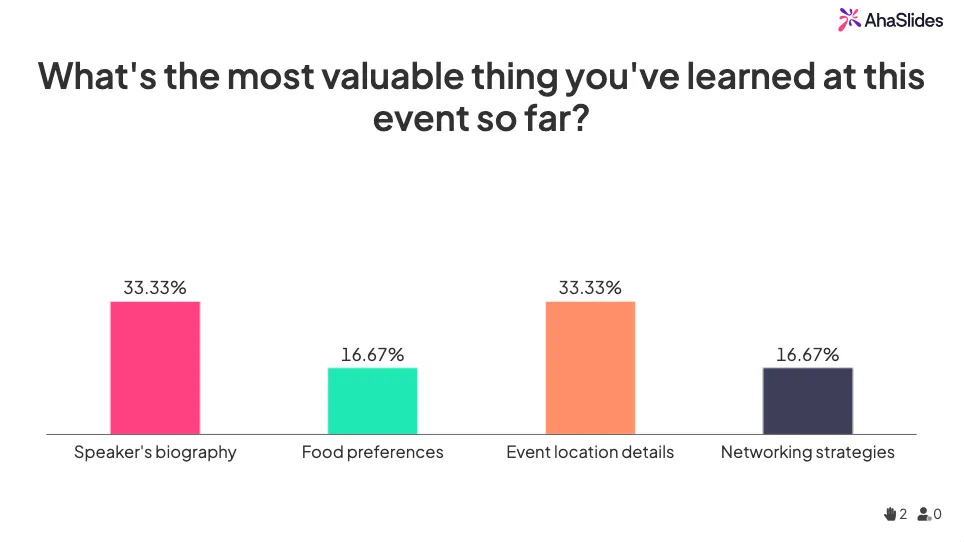
La fonctionnalité de nuage de mots facilite le brainstorming collaboratif : chaque contribution apparaît à l’écran, permettant ainsi de visualiser les idées des uns et des autres et de créer une véritable intelligence collective. Les membres de l’équipe peuvent soumettre des idées anonymement s’ils préfèrent ne pas les partager publiquement.
La fonction de questions-réponses permet de soumettre anonymement des questions ou des préoccupations, faisant ainsi émerger des problèmes qui ne seraient jamais abordés lors de discussions traditionnelles où l'on craint d'être jugé ou de subir des représailles. Cela crée le climat de confiance indispensable à une véritable participation démocratique.
Les sondages de classement permettent de prioriser les options lorsqu'il y en a plusieurs et que l'avis de l'équipe est nécessaire pour déterminer les plus importantes. Chacun classe ses préférences et le système agrège les résultats, alliant ainsi participation démocratique et prise de décision efficace.
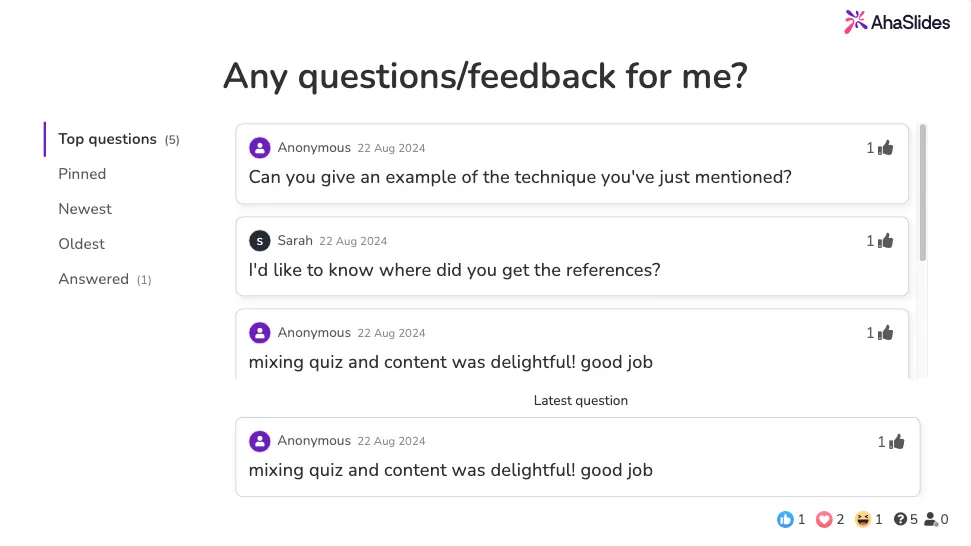
Leadership transformationnel amplifié
Le leadership transformationnel s'appuie sur une communication inspirante et la création d'un engagement émotionnel envers une vision partagée. AhaSlides vous aide à créer des présentations qui touchent les cœurs et les esprits, et pas seulement à transmettre des informations.
Les modèles de présentation de vision vous permettent de communiquer votre orientation stratégique grâce à des visuels percutants, des éléments narratifs et des composantes interactives qui favorisent l'engagement plutôt qu'une écoute passive. Intégrez des sondages pour interroger les membres de l'équipe sur ce qui les enthousiasme le plus dans cette vision ou sur les points qu'ils souhaitent aborder.
Les ateliers de définition d'objectifs deviennent des expériences collaboratives où chacun contribue à définir les objectifs et les indicateurs de réussite grâce à des activités interactives. Utilisez des échelles pour mesurer le niveau de confiance, des nuages de mots pour exprimer ce que signifie la réussite et des sondages pour parvenir à un consensus sur les priorités.
Les séances d'alignement d'équipe bénéficient de prises de pouls régulières utilisant de simples réactions emoji ou des échelles d'évaluation pour mesurer le degré d'alignement des participants avec la direction stratégique et identifier les points nécessitant des clarifications.
Créez du contenu inspirant qui non seulement informe, mais implique aussi, en utilisant des quiz interactifs pour renforcer les messages clés ou des défis pour aider les gens à appliquer votre vision à leurs rôles spécifiques.
Outils de coaching en leadership
Le coaching nécessite un retour d'information régulier, des échanges francs sur le développement et un suivi des progrès au fil du temps. Les outils interactifs rendent ces échanges plus productifs et moins intimidants.
Les modèles de rétroaction individuelle offrent des cadres structurés pour les discussions de développement, utilisant des échelles d'évaluation pour évaluer les compétences ensemble, des questions ouvertes pour explorer les opportunités de croissance et des outils interactifs de définition d'objectifs pour définir des plans de développement en collaboration.
Les séances de planification du développement deviennent plus stimulantes lorsqu'on utilise des outils visuels pour représenter les compétences actuelles, les compétences souhaitées et le chemin à parcourir. Les activités interactives aident les coachs à développer leurs propres idées plutôt que de se voir imposer un développement.
Les enquêtes d'évaluation des compétences permettent d'établir un état des lieux des capacités actuelles et peuvent être répétées au fil du temps pour mesurer les progrès. Constater des progrès concrets confirme la valeur des efforts de développement.
Les présentations de suivi des progrès mettent en valeur la croissance, en montrant comment les compétences ou les performances se sont améliorées au fil des semaines ou des mois. Cette progression visuelle renforce la motivation et démontre que votre investissement en coaching porte ses fruits.
Soutien au leadership situationnel
Le leadership situationnel exige d'évaluer la préparation des membres de l'équipe à des tâches spécifiques et d'adapter son approche en conséquence. Les outils interactifs permettent de recueillir efficacement les informations nécessaires à ces évaluations.
Les évaluations de la préparation des équipes utilisent des sondages rapides pour évaluer les niveaux de compétence et d'engagement avant d'attribuer des tâches ou de déterminer le niveau de supervision nécessaire. Cela permet de passer d'une évaluation basée sur des suppositions à une évaluation basée sur des données.
Les évaluations par matrice de compétences créent des cartes visuelles de qui peut faire quoi et à quel niveau de maîtrise, vous aidant ainsi à faire correspondre les tâches aux capacités et à identifier clairement les besoins de développement.
Des points de contrôle d'adaptabilité tout au long des projets utilisent de simples sondages rapides pour évaluer si votre approche de leadership actuelle fonctionne ou si elle nécessite des ajustements en fonction de la façon dont les membres de l'équipe la perçoivent.
Applications générales en matière de leadership
Quel que soit votre style de leadership principal, certaines fonctionnalités d'AhaSlides prennent en charge les activités fondamentales de leadership.
Les questionnaires d'auto-évaluation du style de leadership vous aident, vous et les membres de votre équipe, à réfléchir à vos tendances naturelles et à vos approches préférées, créant ainsi un langage commun pour discuter du leadership.
La collecte de commentaires à 360 degrés devient moins menaçante lorsqu'elle est effectuée au moyen de sondages numériques anonymes que les gens remplissent honnêtement sans crainte de représailles.
Les enquêtes sur la culture d'équipe évaluent régulièrement l'engagement, la sécurité psychologique, la clarté et d'autres indicateurs culturels, permettant ainsi de détecter rapidement lorsque votre style de leadership ne favorise pas la santé de l'équipe.
Les sondages d'efficacité des réunions à la fin des réunions d'équipe permettent de recueillir rapidement des commentaires sur la valeur de vos réunions, vous aidant ainsi à améliorer continuellement l'animation.
Démarrer
Explorez la bibliothèque de modèles d'AhaSlides pour trouver des formats prédéfinis pour bon nombre de ces activités de leadership, personnalisez-les en fonction de votre contexte spécifique et des besoins de votre équipe, et commencez à expérimenter des approches interactives lors de vos activités de leadership régulières.
L'avantage des outils interactifs est qu'ils permettent de développer un leadership fondé sur des données probantes plutôt que sur la seule intuition. Vous collecterez des données sur ce qui fonctionne, ce qui ne fonctionne pas et comment adapter votre approche, ce qui vous permettra d'être plus efficace quel que soit votre style de leadership.
Conclusion : Votre parcours de leadership se poursuit
Les styles de leadership ne sont pas des tests de personnalité qui vous enferment dans des catégories rigides, mais des cadres de compréhension des diverses approches pour diriger, motiver et développer des équipes. Les douze styles principaux que nous avons explorés présentent chacun des atouts distincts, des limites spécifiques et conviennent à des contextes particuliers. Il n'existe pas de style « idéal » universel, car l'efficacité du leadership dépend entièrement de l'adéquation de votre approche aux besoins de votre équipe, au contexte organisationnel et aux défis spécifiques auxquels vous êtes confrontés.
Les leaders les plus performants ne s'appuient pas sur un style unique, mais développent une grande flexibilité pour s'adapter aux situations tout en restant fidèles à leurs valeurs et à leur personnalité. Que vous soyez naturellement porté vers l'inspiration transformatrice, la collaboration démocratique, le soutien bienveillant ou une autre approche, l'essentiel est un leadership intentionnel et conscient de soi, qui serve véritablement votre équipe et votre organisation, et non votre ego.
Comprendre les styles de leadership n'est que le point de départ de votre développement. Le véritable art du leadership réside dans une connaissance approfondie de soi, la compréhension de chaque membre de son équipe, une analyse précise des situations et la capacité d'adapter son approche aux besoins réels plutôt qu'à l'habitude ou au confort. Cela exige du temps, une pratique délibérée, des retours constructifs et un engagement sincère envers l'apprentissage continu.
Prenez le temps de réfléchir honnêtement à vos tendances naturelles en matière de leadership en utilisant le cadre d'introspection que nous avons exploré. Recueillez des retours à 360 degrés auprès des personnes que vous encadrez, de vos pairs et de votre supérieur hiérarchique afin de comprendre comment votre leadership est réellement perçu, et pas seulement tel que vous le souhaitez. Engagez-vous à développer un ou deux styles spécifiques qui renforceront votre efficacité globale en matière de leadership et mettez-les en pratique de manière délibérée dans des situations à enjeux croissants.
Les leaders les plus efficaces n'ont de cesse d'apprendre, de progresser et de perfectionner leur approche. Ils restent attentifs à leur impact, humbles face à leurs limites et déterminés à mieux servir leurs équipes et leurs organisations. Votre parcours de leadership est un processus continu ; il ne s'agit pas d'une destination à atteindre, mais d'un chemin à parcourir avec intention, conscience et dévouement envers ceux que vous avez le privilège de diriger.
Vos prochaines étapes
Commencez par évaluer honnêtement votre style de leadership actuel à l'aide des cadres et des questions de réflexion proposés dans ce guide. Ne vous fiez pas uniquement à votre propre perception ; sollicitez activement l'avis de personnes qui subissent directement votre style de leadership.
Identifiez un ou deux styles de leadership que vous souhaitez développer davantage, en fonction des écarts entre votre approche actuelle et les exigences de votre contexte. Concentrez vos efforts de développement plutôt que d'essayer de tout maîtriser simultanément.
Recueillez régulièrement les commentaires de votre équipe sur leur perception de votre leadership et sur ce dont ils ont besoin, en plus ou en moins. Créez des espaces de dialogue sécurisés pour un échange franc et ouvert, sans crainte de représailles ni de réactions défensives.
Explorez des outils pratiques comme AhaSlides qui peuvent soutenir votre approche de leadership préférée grâce à un engagement interactif, un retour d'information en temps réel et une participation inclusive, quel que soit le style que vous développez.
Envisagez d'investir dans un développement formel du leadership par le biais de cours, de coaching ou de programmes structurés qui offrent un encadrement d'experts et un suivi de votre parcours de croissance.
Avant tout, faites preuve d'authenticité, de flexibilité et d'un engagement sincère au service des personnes et des objectifs qui vous ont été confiés. Votre style de leadership unique, fruit d'une réflexion approfondie et d'une application adaptée, aura l'impact positif que votre équipe et votre organisation méritent.