


Teamwork matters because the people closest to the work see problems first, and a team only fixes them when everyone feels safe to say so. When Google studied 180 of its own teams (115 engineering project teams and 65 sales pods), the first of the five dynamics that set effective teams apart was psychological safety: the shared belief that the team is safe for interpersonal risk taking.
This guide covers 5 benefits of teamwork, 6 examples of bad teamwork to spot early, 8 teamwork skills with examples, and 5 ways to build them.
5 benefits of teamwork at work
Why is teamwork important in the workplace? Good teamwork helps both the people on the team and the organisation around them, which is why companies invest in teamwork skills at every level.
1. Less workplace conflict
Conflict grows in a workplace where people get unequal treatment or chase competing interests. Teams meet task conflict (different views on what to do), relationship conflict (friction between people) and value conflict (different beliefs). When people have clear roles and trust each other, a disagreement over approach stays a disagreement over approach.
Gallup's study of nearly 7,500 full-time employees found that people who strongly agree they are often treated unfairly at work are 2.3 times more likely to experience a high level of burnout. Fair treatment is a teamwork habit as much as a policy.
2. More innovation and creativity
When teammates listen and build on each other's thoughts, people dare to share the half-formed idea. One person offers it, a colleague adds an honest challenge, and together they make it work. That needs speaking up to feel safe, which is why Google's research puts psychological safety first.
3. A more positive workplace
Good teamwork keeps free riders, misunderstandings and needless arguments down. Even after a hard disagreement, teammates tend to understand each other better, because they have a shared goal to return to.
A good team member also offers help, such as covering a task during a colleague's personal emergency.
4. Personal and organisational growth
In a high-performing team you learn from experts and experienced seniors. If a colleague is self-disciplined, manages time well and pays attention to detail, you can pick those habits up. That builds your knowledge, your decisions and your case for promotion.
A company with many strong teams builds a better reputation and attracts more talent.
5. Less anxiety and burnout
Teams that work well tend to meet deadlines, catch errors and share the load, so no one person absorbs every spike in demand. Gallup's burnout research points the same way: employees who feel strongly supported by their manager are about 70% less likely to experience burnout on a regular basis, and so are employees who often or always have enough time for their work (Gallup, 2018).
Teamwork in the workplace: good examples
Four examples to look for on your own team.
- A clean handover. The outgoing owner writes a short note and the incoming owner asks questions before day one. Nobody repeats work.
- A disagreement that ends in a decision. Someone summarises both approaches, the group picks one, and everyone supports it afterwards.
- A busy week shared out. When a launch spikes one person's workload, colleagues take tasks off their plate unasked.
- A mistake raised early. A junior team member flags an error on day one instead of day ten, because the team fixes mistakes without punishing them.

6 examples of bad teamwork to avoid
Strong individuals can still be slow to collaborate. These six patterns help you check your own team.
1. Focusing on results only
Many leaders keep their eyes on results and ignore how the team produces them. Letting workload fall unfairly on whoever says yes, and leaving team rules unclear, are the reasons teams split.
2. Lipsa de încredere
A team without trust performs collaboration instead of doing it. People hedge, protect their work from scrutiny and try to do everything alone, which leads to burnout and, over time, to people leaving.
3. Lipsa de responsabilitate
Free riding happens in many teams. When one or two people under-deliver and face no consequences, motivated colleagues see equal rewards for unequal effort and lose the drive to improve. Dependability is second on Google's list of dynamics: "When my teammates say they'll do something, they follow through with it."
4. Negative competition
Competition can sharpen performance. It goes too far when people withhold information or undermine each other's work, and collective output drops.
5. Egos
When people put their egos first, they resist advice, blame others for failures and push others to follow them. That slows every decision.
6. Comunicare slabă
Poor communication is common, especially in virtual teams. It shows up as forgotten tasks, duplicated work, errors, wrong assumptions and missed deadlines. It also shows up as weak team coordination: two people finish the same task while a third is never asked. Gallup found that only 60% of workers strongly agree that they know what is expected of them at work, so clear expectations are a good place to start.
8 teamwork skills to master
These skills can be seen, practised and improved. Each one comes with an example.
1. Comunicare
Effective communication helps everyone work from the same information, in person, in meeting tools or by email. It covers verbal clarity and tone, and non-verbal signals such as body language, attention and eye contact.
Exemplu: after a planning call, send three lines: what was decided, who owns each action, and the date. Nobody has to guess.
2. Colaborare
Collaboration is the ability to work with others towards a common goal. It means active listening, taking responsibility and acknowledging your colleagues' goals, challenges and differences.
Exemplu: if a colleague is talked over in a meeting, bring the discussion back to them and ask them to finish their point. If you do not understand something, ask for clarification and summarise it back before you move on.
3. Ascultarea activă
A skilled listener pays attention to what is said out loud and to the unsaid message, and listens without judging.
Exemplu: most of the team agrees on a set of project milestones, and a few dissenting voices have valid concerns. As team leader, or as a supportive colleague, bring the conversation back so their views are heard and discussed with an open mind.
4. Conștiința de sine
Self-awareness in a team means knowing your own habits and your teammates' personalities, which builds over time. Once you know who is who, it is easier to decide when to speak and how to help others speak.
Exemplu: a team member is shy and has had ideas turned down before. Invite them to send ideas to you privately, and promise a response without judgement. A live Q&A that allows anonymous questions does the same job for a whole team.
5. Managementul conflictelor
Conflict in a team is common, and what happens next can make or break the team. A leader's job is to negotiate, give constructive feedback and build consensus so the decision sticks after the meeting ends.
Exemplu: two designers disagree on a layout. Ask each to state what the other's option does well, then agree on the test that will decide between them.
6. Responsabilitate
Whether you lead or follow, be accountable for your actions and decisions, so colleagues trust you with personal and sensitive company information alike. When a roadblock threatens a deadline, find the source and act on it.
Exemplu: when you are going to miss a date, tell the team the day you know, not the day it is due.
7. Conviction
Not every day is a good day. There are setbacks, rejections, delays and personal losses, and in those moments the team needs a growth mindset and the belief that "we can do this".
Exemplu: if a new website does not get the response you hoped for, analyse what went wrong, learn from it and build a better version. If a hiring strategy is not working, set it aside and build another from scratch.
8. Compasiune
Compassion is one step beyond empathy. You feel what a colleague feels and take a step to ease it. You listen, put yourself in their shoes and respond in a way that fits the situation, in team sessions, one-to-ones, virtual calls or email.
Exemplu: a usually reliable colleague misses two deadlines. Ask what is going on before you assume a motivation problem.
These skills work in the classroom, in group brainstorms and even in the theatre. The key is to keep practising.
5 ways to build teamwork on your team
The five C's of teamwork, often listed as communication, camaraderie, commitment, confidence and coachability, are a handy checklist when you plan a teamwork strategy. Use them with the ways below.
1. Clarify team rules and personal duties
Set clear team rules before people start working together. An introductory meeting helps new teams and newcomers align with team goals. Cover how decisions are made, how disagreements get raised, and what good communication looks like.
2. Run team-building activities with a purpose
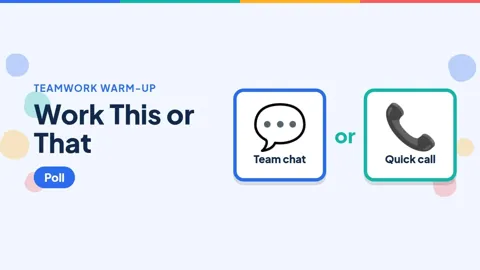
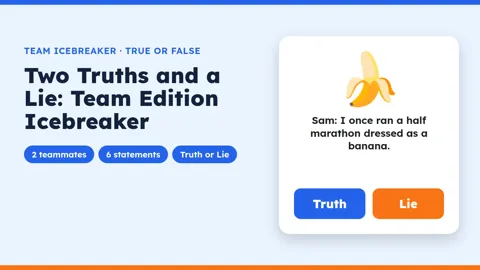
One common list names five types of team-building activity: meeting kick-offs, communication, problem-solving, brainstorming and employee bonding. Pick the one that matches your goal: an icebreaker poll opens a meeting, and a trivia quiz shows how well teammates know each other. Our guides to the types of team building și jocuri online de team building have ideas for each type.
Open a meeting with a this or that round on the Sondaj slide:
Or see how well teammates know each other with two truths and a lie on the True or False slide:
3. Make feedback a routine
Teams that give feedback only in annual reviews lose the benefit of timely correction. Short, regular check-ins, such as a 10-minute retrospective at the end of a sprint, make honest communication a habit and make any single conversation lighter.
4. Debrief after every project
Teams learn most just after a project ends, which is when the debrief gets dropped. A 30-minute retrospective on what worked, what did not and what to change turns experience into lessons.
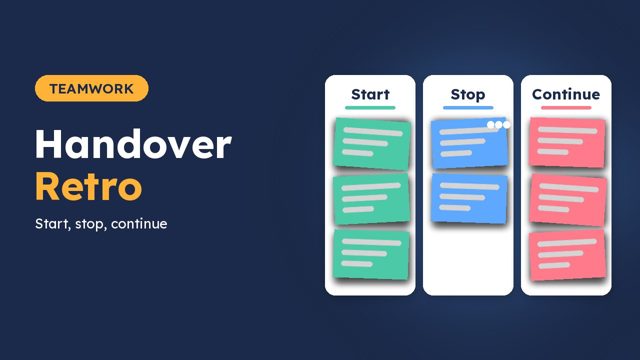
Run the debrief on one slide with a Start, Stop, Continue retro:
5. Use tools that bring everyone in
Hybrid and remote teams face higher coordination costs than teams in one office. Pick tools that let every person take part, as the next section shows.
Linia de jos
Teams that do well share a few habits: people feel safe to raise problems, do what they say they will, and know what is expected of them. Pick one skill and one activity from this guide and try them at your next meeting.
Cum să îl găzduiești pe AhaSlides
Don't confuse who speaks most with what the team thinks. People who say the least often have the opinions you most need to hear, so give everyone a way to contribute that does not depend on being the first to talk. AhaSlides is an all-in-one engagement platform for teams and classrooms: participants join from their phones, and the free plan engages up to 50 participants live. Here are five ways to use it in a teamwork session on the skills above.
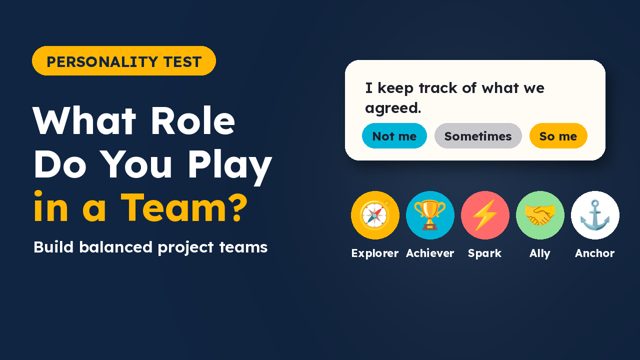
- Test de personalitate for balanced teams. A fun what-type-are-you icebreaker: each person gets one of five fixed types (The Explorer, The Achiever, The Spark, The Ally or The Anchor) with a shareable result card, and the screen shows the team's mix. It is not an MBTI test, but it starts a useful talk about self-awareness and how a new project team is balanced. For a deeper guide, read our test de personalitate pentru construirea unei echipe post.
- Echipa Retro for the debrief. Run a whole retrospective on one slide: ideas go into columns such as Start, Stop and Continue, the team groups and votes on them, and each action can be given an owner. This covers ways 3 and 4 above in one 30-minute session.
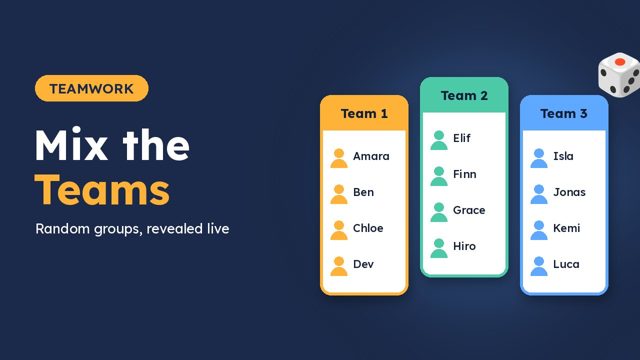
- Creator de grup aleatoriu for mixed teams. Split everyone into random groups and reveal them on the screen, so people work with colleagues they do not usually sit near. For a quick pair-up, use Random Pair Generator, and for calling a name at random, the Spinner Wheel still does the job.
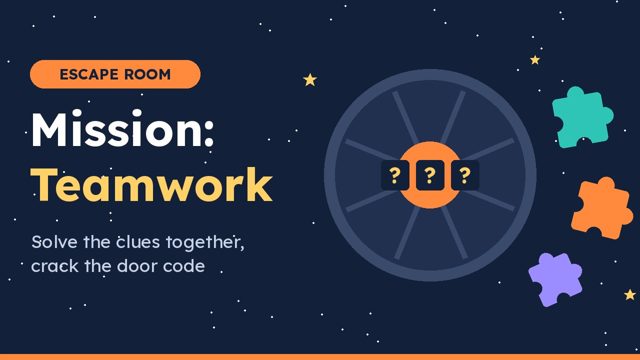
- Cameră de evadare. Each player moves from room to room on their own phone, solving clue questions on the way to the Final Door, and the fastest escape wins. It needs a little set-up. Afterwards, ask how people cracked the hardest clue, which opens a talk about sharing what you know.
- Harta mintii pentru planificare. Start with one central idea, and everyone adds branches from their phones. It works for brainstorming and for breaking a project into parts that people then own.
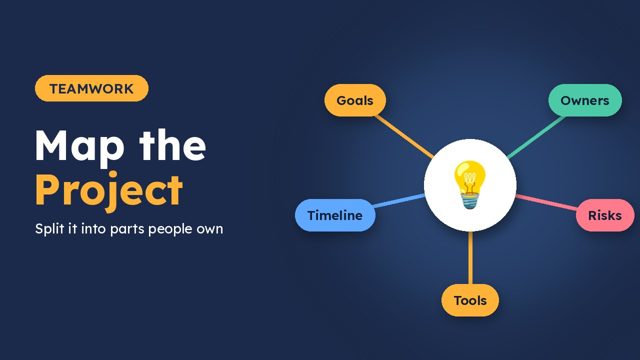
Începe de la Stronger together teamwork huddle template și schimbați propriile întrebări.
Tips for running team sessions
- Ține-l scurt. Ten minutes of activity beats an hour of slides, and people join in when it is quick.
- Let people answer on their phones. Quieter team members then contribute as easily as the loudest voice.
- Act on the results. Pick one action from the session and review it at the next one, or people stop taking part.
Întrebări frecvente
Care este cel mai important lucru despre munca în echipă?
Communication. It lets team members update each other, plan together and avoid misunderstandings. Google's research adds that psychological safety, the belief that you can speak up without penalty, sits first among the five dynamics of effective teams.
De ce este valoroasă munca în echipă?
Strong teamwork lets people share ideas with confidence, collaborate and build positive relationships, so the team reaches shared goals faster.
Care sunt beneficiile muncii în echipă?
There are 5 main benefits: less workplace conflict, more innovation and creativity, a more positive workplace, personal and organisational growth, and less anxiety and burnout.
What is the difference between teamwork and collaboration?
Teamwork is a group working towards a shared goal. Collaboration is how team members work together on the task: sharing ideas, listening and building on one another's thinking.
What does "teamwork makes the dream work" mean?
It is a popular saying that a big goal is reached sooner when people work together than when one person tries it alone. It is a popular saying, not a research finding.
Why is team building important?
Team building gives people practice at the skills above, such as listening, trust and conflict management, in a low-stakes setting before they need them on real work.
Postări asemănatoare
- To match an activity to your goal, read our guide to the tipuri de team building.
- For a remote or hybrid team, try these jocuri online de team building.
- Want to go deeper on types and roles? See our test de personalitate pentru construirea unei echipe.
- In a classroom or training room, these strategii de învățare colaborativă build the same skills.
Host your teamwork session on AhaSlides gratuit
Sign up, add your own activities and share the access code. Everyone joins on their phones, with no app to download.