You meet ten new people in a workshop, and twenty minutes later you cannot recall a single name. That is normal, and a good game fixes it faster than good intentions. This guide gives you six name games for classes, teams and new groups, plus a short explanation of why names are so easy to lose and how to make them stick.
Snabb fakta
| Fråga | Svar |
|---|---|
| Hur många personer? | 6 to 12 works best; split larger groups into circles |
| Var kan du spela? | Indoors, in a circle or online |
| Hur lång tid tar det? | 5 to 10 minutes per game |
| Vad behöver du? | A soft ball, name cards or a slide with a spinner wheel |
Why names are hard to remember
Names are harder to retrieve than common words. Cohen and Burke's review of memory for proper names (1993) found that proper names are more prone to being forgotten than other kinds of information, both when you learn new ones and when you try to bring familiar ones to mind. A name usually carries no meaning you can attach to a face, so it has little to hold on to.
What helps is being asked for the name again. In a classic study of name learning, Landauer and Bjork (1978) found that quizzing people on a name at gradually longer intervals gave almost twice as many correct recalls at the end as a single presentation. You can read the originalpapper from UCLA's Bjork lab. Each game below builds in the same habit: say a name, then be asked for it again a little later.
1. Ball-toss name game
The simplest and most reliable of the six.
- Stand or sit in a circle and choose a starter.
- The starter says their own name, then tosses a soft ball to someone else while saying that person's name: "This is for Sarah."
- The catcher says thanks, states their own name, and tosses to a new person using that person's name.
- Keep going until everyone has caught the ball at least twice, and speed up as confidence grows.
Gör det svårare: add a fact when you introduce yourself, such as a favourite food or a hobby, and ask the thrower to repeat it.
2. Action syllables
Good for a new class or team that needs to loosen up.
- Stand in a circle.
- Each person says their name and makes one gesture per syllable. Garvin has two syllables, so he might touch his ear and tap his shoulder.
- The group repeats the name and the gesture back.
- The person then calls someone else by name, and that person repeats the routine.
- Play until someone forgets a name or a gesture.
Movement gives the name a second memory cue, which helps people who do not retain words well by hearing alone.
3. In three words
Each person introduces themselves with their name plus three words about a prompt, then the group takes turns recalling the names and words.
Prompts that work:
- Vad har du för hobbies?
- Which skill would you most like to learn?
- Vad gör dig unik?
- Which emoji do you use most?
- Which book do you like most?
Because each person has a memorable hook, names attach to something. In a round afterwards, ask "who said popcorn, cycling and chess?" and let the room name the person.
4. Name bingo
Also called "find someone who" bingo. It suits larger groups because everyone moves around and speaks to many people.
- Before the session, collect one fun fact from each person.
- Build a bingo card of those facts, one per square, with a name-free description such as "has visited five countries".
- Players circulate to find who matches each fact, and write the person's name in the square.
- The first player to complete a row, column or diagonal shouts "bingo", then everyone checks the names aloud.
Writing a name down and connecting it to a fact gives you two chances to remember it.
5. Name card memory
This adapts the classic pairs game to names.
- Make two cards per person: one with their name and one with their fun fact, or a photo if your group has consented.
- Shuffle them face down in a grid.
- On your turn, flip two cards. If the name matches the fact, you keep the pair and go again. If not, turn them back over.
- The player with the most pairs wins.
You have to hold both the name and the fact in mind, which is exactly what you need at the coffee break.
6. Spin to recall (online or in the room)
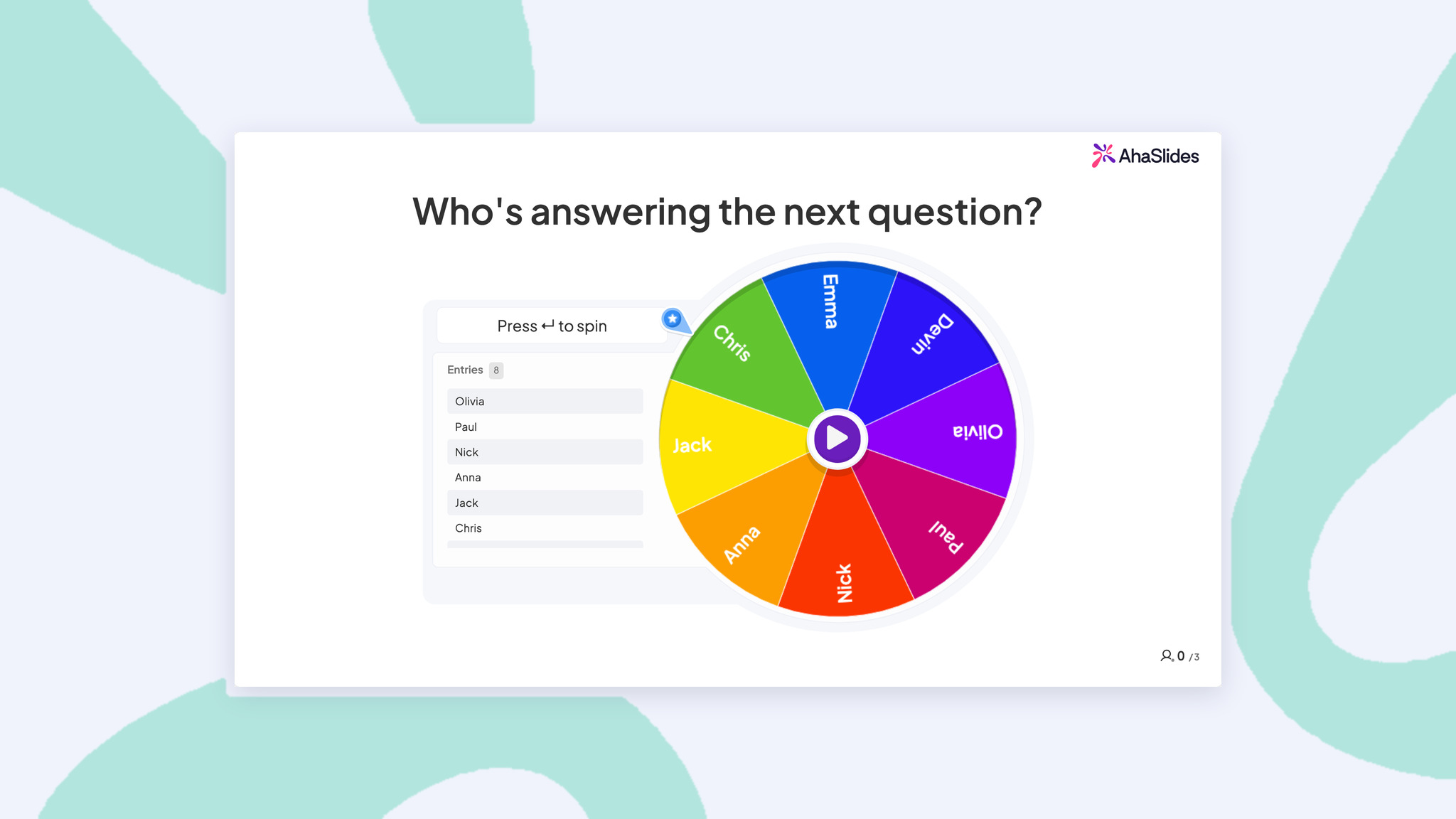
Use a spinner wheel to make the recall spaced and random. Put every attendee's name on the wheel, spin, and ask the group "who is this, and what did they tell us earlier?" Coming back to a name after several minutes is the spaced retrieval the Landauer and Bjork study describes.
Lägg till ordmoln as a warm-up: ask everyone to type one word that describes themselves, then have the group match words to people.
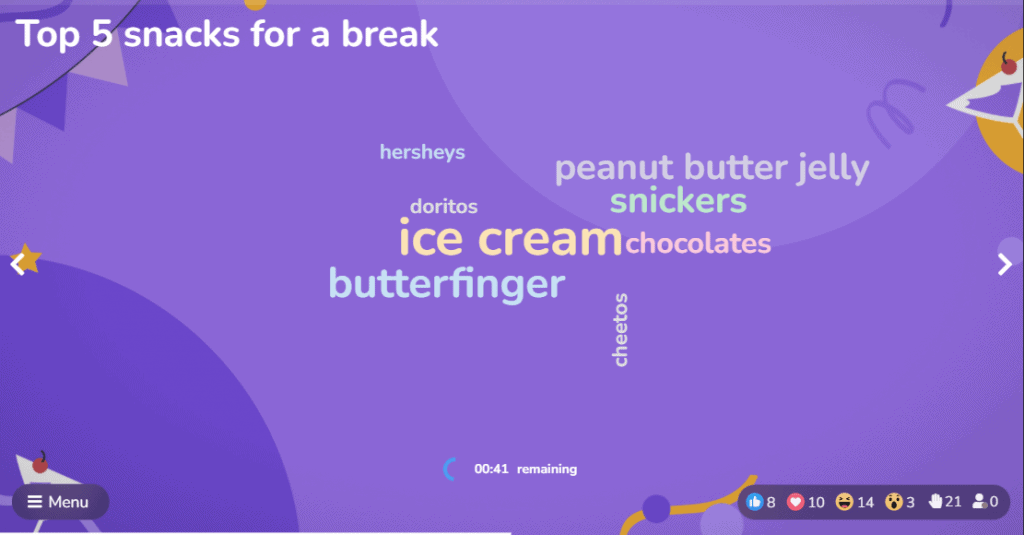
You can build both in AhaSlides med spinnerhjul and word cloud slide types, and the free plan covers up to 50 participants, which is plenty for a class or team meeting.
Tips to make names stick
- Say it back immediately. "Nice to meet you, Priya" costs nothing and counts as the first retrieval.
- Use it twice in the first minute. Weave it into a question.
- Pair the name with one fact. A hobby or a city gives the name something to hold on to.
- Kom tillbaka till det. Ask for the name again after a few minutes, then again later, as the Landauer and Bjork study suggests.
- Håll det med låga insatser. If forgetting a name feels embarrassing, people stop trying. Let anyone ask for a reminder.
For more ways to start a session, see our guide to isbrytarspel.
Vanliga frågor och svar
What are good games to remember names?
The ball-toss name game, action syllables, in three words and name bingo all work, because each one asks people to say and hear names more than once.
How do you remember names in a big group?
Split it into circles of 6 to 12, play a name game in each, then rotate people between circles. Repeating the names to a new set of people is another retrieval.
Why do we forget names so quickly?
Names carry little meaning and are hard to retrieve. Cohen and Burke's review found that proper names are forgotten more often than other words, so you need extra cues such as a fact or gesture.
How long should a name game take?
Five to ten minutes. Longer than that and the energy drops before the names are secure.
Källor
- Cohen, G. and Burke, D. M. (1993). Memory for proper names: a review. Minne, 1(4), 249 to 263.
- Landauer, T. K. and Bjork, R. A. (1978). Optimum rehearsal patterns and name learning. I Practical aspects of memory, Akademisk förlag.