

Debate assignments have a reputation problem. Ask a class to argue an issue cold and you often get silence, one confident student doing all the talking, or an argument that goes nowhere fast.
Turning debate into a game fixes that quickly. When researchers ran a competitive, gamified debate format in a university human resources course, more than 90% of the 33 students who answered the survey scored it above the midpoint for entertainment, and about a third said they would attend the class more than before [1]. The structure does the work: a game format gives quieter students a reason to speak up, and a bit of competition gives everyone a reason to have an opinion.
These 13 games work in classrooms, youth groups and training sessions alike, no formal debate training required. Pick one, add a topic from the list near the end, and get started.
13 fun online debate games for students
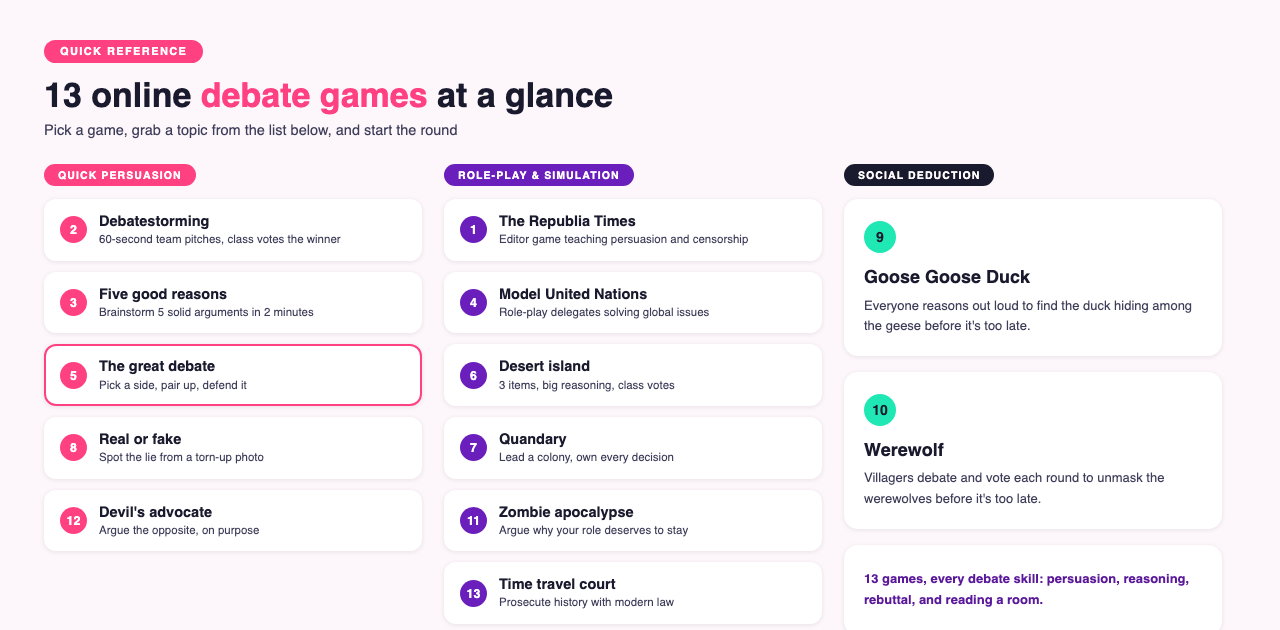
1. The Republica Times
Cumhuriyet Zamanları is a free browser game from Lucas Pope, the creator of Papers, Please. Set in a fictional dystopia, it casts students as a newspaper editor who has to balance publishing pro-government stories against juicier gossip that boosts readership.
It doesn't lean hard on formal debate structure, but it's a sharp lesson in persuasion and the politics behind every editorial choice. Let students play at their own pace, or run it together and discuss the choices as a class.
Neden onu seviyoruz:
- It's free, runs in any modern browser and works well as a 10-minute warmup or break-time activity.
- Students grapple with real issues like censorship and practice justifying their choices with reasoning.
2. Tartışma Fırtınası
A silent room after you pose a debate question is the fastest way to kill momentum. Debatestorming fixes that with a built-in deadline and a competitive edge.
Split the class into small groups and give each one a debate question. Groups have 60 seconds to write down their opinion and justify it. Whichever group convinces the rest of the class and wins the most votes takes the round.
Kullan AhaSlides beyin fırtınası slayt to collect every group's opinion in seconds and let the class vote for the best argument live.
Neden onu seviyoruz:
- Students submit and vote from their phones, so every group's argument gets seen, not just the loudest one.
- Pairs easily with poll or quiz slides to keep the format fresh.
3. Beş iyi neden
Give students a prompt such as “give me five good reasons students should wear uniforms” or “give me five good reasons people love red pandas.” In two minutes, they have to brainstorm five reasonable arguments.
Neden onu seviyoruz:
- The goal isn't the most correct answer, it's practicing how to think on your feet under mild pressure.
- Easy to adapt for ESL classes, adult training sessions or any group that needs a fast argument-building drill.
4. Model Birleşmiş Milletler
Model United Nations (MUN) is an educational simulation where students role-play as delegates from different countries, working together to solve a global problem such as climate change, wildlife conservation or human rights.
Students prepare a position, present their resolutions and debate other delegates to win majority support. It doesn't have to be heavy going: hand students a lighter prompt like “should we have an international secret handshake day?” to keep the format playful while they practice the same skills.
Neden onu seviyoruz:
- A genuine opportunity for students to understand current world issues in depth.
- Students get to role-play as world figures while debating real topics.

5. Büyük tartışma
Split the room into two sides: strongly agree and strongly disagree. Make a statement and have students move to the side that matches their view, then pair each student with someone from the opposite side and ask them to justify their position.
Neden onu seviyoruz:
- Forces students to form an opinion and build the reasoning behind it on the spot.
- Add a “gray area” middle ground for students who genuinely see both sides. It's often the group that ends up uniting the room.
6. Issız ada
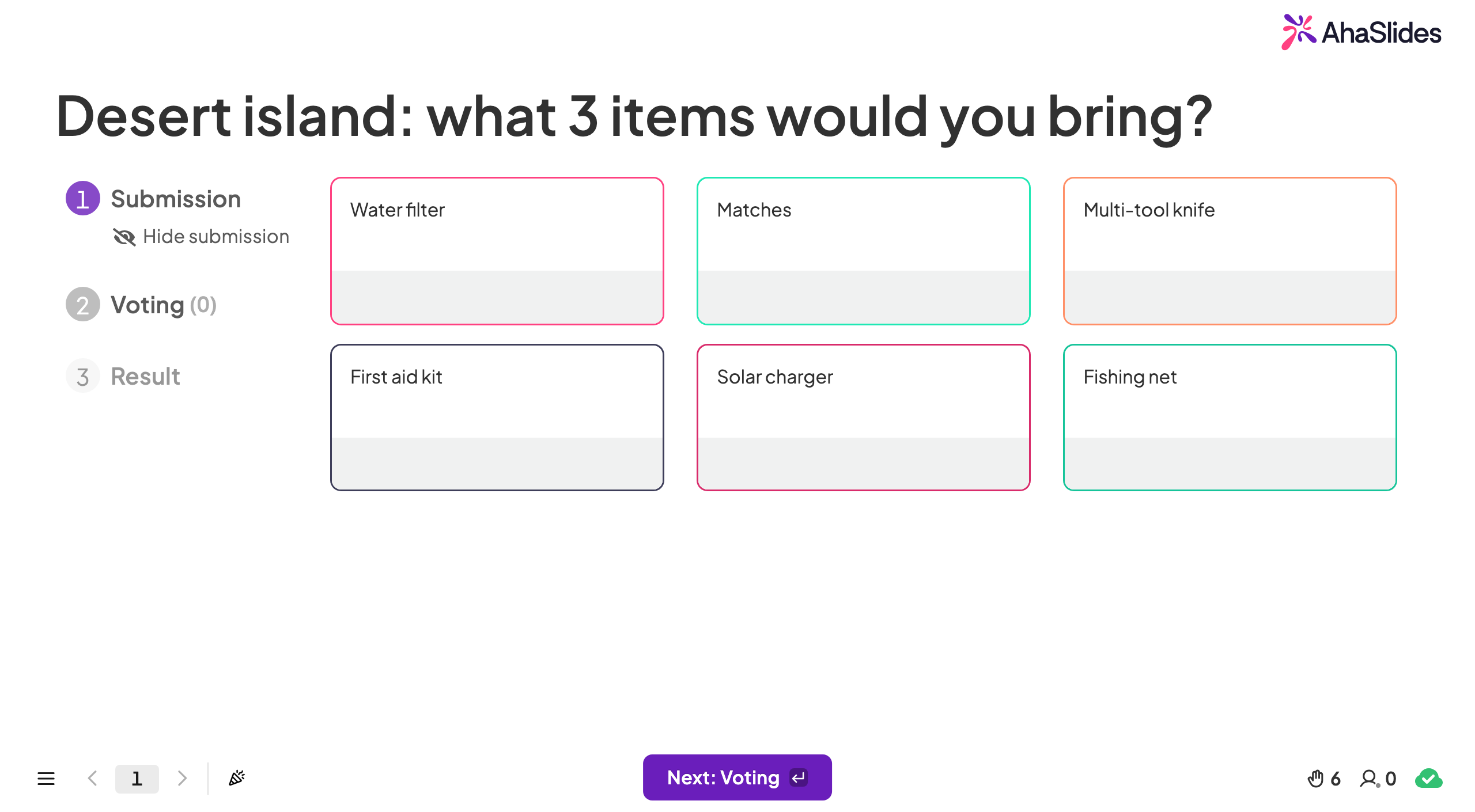
Everyone in the class is stranded on a desert island: what three items would they bring, and why? Let students submit their choices and reasoning, then have the class vote for the answers that make the most sense. It's a great remote-friendly game for teams to share opinions without needing to be in the same room.
Neden onu seviyoruz:
- A fun way to learn about your students' priorities and personalities through their choices.
- Builds the skill of defending a creative or unconventional solution under scrutiny.
7. İkilem
In ikilem, a free, nonprofit learning game, students play the captain of a new colony on the planet Braxos, settling disputes between colonists and shaping the future of their society.
Let students play solo or in pairs, then run a group discussion afterward. Ask questions like “why did you choose that solution?” or “what could you have done differently for the colony?”
Neden onu seviyoruz:
- A distinctive comic art style that keeps students engaged.
- No right or wrong answers: students are fully in control of the decisions.
- The Quandary website has an educators section with curriculum options to help you plan lessons around the game.
8. Real or fake
Helping students spot misinformation is a skill worth teaching directly, and this game builds it through debate:
- Print a picture of an object, for example a dog.
- Cut it into small pieces, each one unrecognizable on its own.
- Split the class into teams of three: one judge, one “truth” debater and one “lie” debater.
- Show both debaters the full picture, then hand each one a piece of it. The truth debater has to make an honest case that helps the judge guess the object correctly. The lie debater argues it's something else entirely.
Neden onu seviyoruz:
- Students practice persuasion and learn to weigh evidence critically before deciding what to believe.
9. Kaz Kaz Ördeği
kaz kaz ördek is an online social deduction game where players are geese working together to complete missions while trying to identify the duck hiding among them. Everyone has to reason out loud, question each other and defend their own innocence.
It's free to play on PC and mobile: download it, create a private room and invite the class in.
Neden onu seviyoruz:
- A cartoonish, lighthearted take on the game Among Us, with customizable characters students love.
- Students practice reasoning and counterargument in real time as they debate who's lying.
Aklında tut: it's rated 13+ on the App Store, has proximity voice chat and in-app purchases, so it suits older students. Use a private room so students only hear their classmates, and check the game's terms and your school's policy before you play.
10. Kurt Adam
Werewolf is a classic social deduction game: villagers have to identify who among them is secretly a werewolf, while the werewolves try to pick off villagers each night without getting caught.
Each round, villagers debate and vote on who to eliminate, using persuasion and deduction to win the game. It ends when the villagers exile every werewolf, or the werewolves outnumber the villagers.
Neden onu seviyoruz:
- Requires social skills, teamwork, critical thinking and strategy all at once.
- Easy to add more roles and rules as students get more experienced.
11. Zombi kıyameti
Set the scene: the class is the last community standing after a zombie apocalypse, and food is running short. One person has to be exiled to make the resources last. Assign each student a role such as teacher, chef, musician, politician or journalist, and have them argue why their position is essential to keep.
Neden onu seviyoruz:
- A creative twist on classic debate that keeps energy high.
- Builds quick thinking and rebuttal skills as students respond to each other's arguments live.
12. Devil's advocate
Playing devil's advocate means arguing the opposite of a claim, purely for the sake of debate. Students don't have to believe what they're saying. The goal is to generate discussion and pressure-test the issue. Run it in pairs or small groups, with one student assigned as the “devil” who asks provocative questions.
Neden onu seviyoruz:
- Useful for classes where students are hesitant to disagree with each other openly, since the game gives them permission.
- Teaches students that starting a debate is a legitimate way to dig deeper into a topic, not a confrontation.
13. Zaman yolculuğu mahkemesi
Students apply modern legal standards to historical events, turning a history lesson into a courtroom drama where they prosecute or defend historical figures. To set it up:
- Assign historical figures and time periods.
- Provide research guidelines and a legal framework.
- Create case packets with historical context.
- Set courtroom procedures and rules.
- Design an evaluation rubric.
Neden onu seviyoruz:
- Creates a genuine intersection of historical knowledge, legal reasoning and ethical analysis.
- Gives students a real feel for how courtroom argument actually works.
Debate topics to try with these games
A game only comes alive with the right prompt. Here are 10 topics matched to the games above, so you're not starting from a blank page:
- For Debatestorming, try: should AI tools like ChatGPT be allowed in academic assignments?
- For Debatestorming, try: should social media companies regulate political speech?
- For Five good reasons, try: give me five good reasons standardized testing should be eliminated from schools.
- For Model United Nations, try: should developed countries pay reparations for climate change?
- For Model United Nations, try: should we prioritize Mars colonization over Earth's problems?
- For The great debate, try: should the voting age be lowered to 16?
- For The great debate, try: is universal healthcare a human right?
- For Devil's advocate, try: is cancel culture beneficial or harmful to society?
- For Devil's advocate, try: are participation trophies harmful to child development?
- For Real or fake, try: is traditional media more trustworthy than social media for news?
Need more topics than this? Student debate topics has a full bank organized by age group, and tartışmalı tartışma konuları covers sharper subjects for older students and adult groups.
Sık Sorulan Sorular
Bir tartışmada ilk konuşmacı kim olmalıdır?
In most formats, the first speaker for the affirmative (or proposition) side opens the debate.
Bir tartışmayı kim kontrol ediyor?
A moderator keeps a neutral perspective, holds participants to time limits and keeps the discussion on topic.
Tartışmak neden bu kadar korkutucu?
Debating requires public speaking skills, which is intimidating for a lot of people. Games like the ones above lower the stakes by making the format fun and low pressure.
Tartışmanın öğrencilere nasıl faydası olur?
Debate builds critical thinking skills, raises confidence and teaches students to respect opposing viewpoints.
kaynaklar
[1] Competitive debate: a successful inter-team gamification experience in the human resources subject, Frontiers in Psychology, 2021