Picking a debate topic is like picking a coin to toss: every issue has two sides, and a good debate topic makes both of them worth arguing. The hard part for teachers is matching the topic to the room. A question that lands perfectly with a class of 16-year-olds can fall flat with 8-year-olds, and vice versa.
This guide organizes student debate topics by grade band, elementary, middle school, high school, and college, so you can pick something your students can actually sink their teeth into, whatever age they are.
Why debate matters for students
Debate is not just an activity that fills a class period. A decade-long study of the Boston Debate League, tracking students from 2007 to 2017, found that debaters graduated high school at a rate of 80%, compared with 68% of non-debaters, and enrolled in college at nearly a 30% higher relative rate than their peers, according to Educación siguiente. Reading comprehension gains were largest for students who started with the lowest scores.
Debate also builds skills that transfer well beyond the classroom: critical thinking, research, public speaking, and the ability to argue a position you may not personally hold. Rowland Hall's guide to the benefits of debate covers this in more depth if you want to make the case to a principal or parent group.
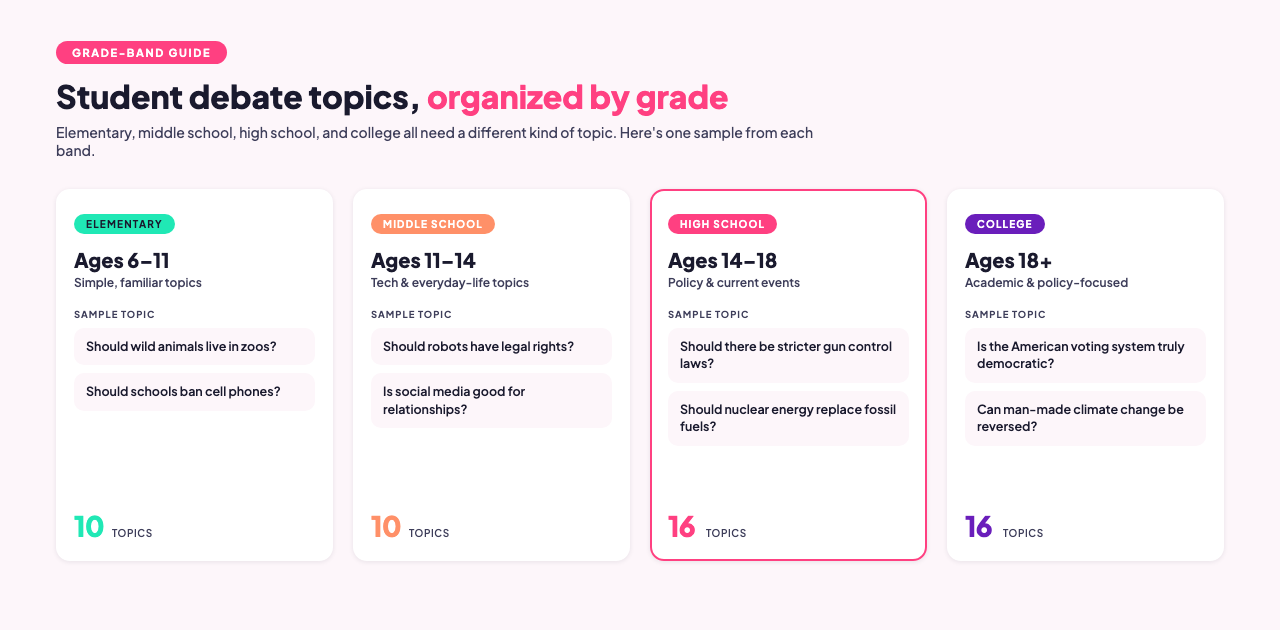
Debate topics for elementary school
Younger students do best with concrete, familiar topics they already have an opinion about. Keep the language simple and the stakes low.
- Should wild animals live in zoos?
- Should children have the right to vote?
- Should school hours be changed?
- Should school lunches be planned by a dietitian instead of a standard cafeteria menu?
- ¿Tenemos suficientes modelos a seguir para esta generación?
- ¿Debería permitirse la experimentación con animales?
- Should schools ban cell phones during the school day?
- Should schools use AI tools alongside traditional teaching methods?
- Should the curriculum be built around what kids actually need, rather than a fixed standard?
- ¿Por qué es importante explorar el espacio?
Debate topics for middle school
Middle schoolers can handle more abstract questions, especially ones tied to technology and everyday school life. This is a good age to introduce structured formats, since students are ready to research both sides.
- Should single-use plastics and plastic bags be banned?
- Is organic farming better than conventional farming?
- ¿Deberían los humanos invertir en tecnología para colonizar otros planetas?
- Have technological advances done more good than harm?
- Does technology help protect nature, or does it do more damage?
- Is technology making people smarter, or dumber?
- Has social media improved people's relationships?
- Should robots have legal rights?
- Can graffiti be considered fine art, the same as a painting in a museum?
- Should schools restrict social media sites like YouTube, Facebook, and Instagram on school computers?

Debate topics for high school
High schoolers can take on current events and policy questions, including some genuinely divisive ones. These topics work well for formal debate club competitions as well as one-off class exercises.
- Should parents give their children an allowance?
- Should parents be held responsible for their children's mistakes?
- Should schools require a second language as a compulsory course alongside English?
- Can all cars realistically become electric?
- Does technology intensify human communication, or dilute it?
- Should governments invest more in alternative sources of energy?
- ¿Es la educación pública mejor que la educación en el hogar?
- Should history be an elective course in every grade?
- Should there be stricter gun control laws, and would they reduce mass shootings?
- Should compulsory military service apply to women as well as men?
- Should political discussions be avoided in the classroom?
- ¿Debería la energía nuclear reemplazar a los combustibles fósiles?
- Should cities limit the use of private cars to reduce congestion and pollution?
- Are drone cameras a useful public safety tool, or a violation of privacy?
- Should internet service providers be required to follow net neutrality rules?
- Is there too much pressure on teenagers to have the "perfect" body?
Debate topics for college and university
College debaters can handle nuance, competing data, and questions without a clean answer. These topics lean academic and policy-focused rather than shock-value controversial, since we cover broader hot-button issues separately in our controversial debate topics guide.
- Should the United Nations remove Russia from its Security Council seat?
- Is the four-year U.S. presidential term too short, and should it be extended to six years?
- Do electronic voting machines make elections more efficient, or less trustworthy?
- Is the American voting system truly democratic?
- Should religious institutions be required to pay taxes like other organizations?
- Should undocumented immigration be treated as a criminal offense?
- Are wealthy nations more responsible for environmental damage than poorer ones?
- Can human-caused climate change still be reversed?
- Are farmers paid fairly for the food they produce?
- Is global overpopulation actually a myth?
- Is online education more effective than in-person education?
- Does religion do more harm than good in modern society?
- Should feminism place more focus on men's issues too?
- Does family structure meaningfully affect a child's life outcomes?
- Should health insurance cover elective cosmetic procedures?
Tips for running a successful student debate
Match the topic to the room. A topic that feels urgent to a college senior can feel abstract to a 10-year-old. Use the grade bands above as a starting point, then adjust based on what your specific class already cares about.
Give students a structure to follow. A debate without a format turns into cross-talk fast. If you need a starting point, we put together a typical debate structure you can adapt for your class.
Vet your sources. Especially for topics involving statistics or historical claims, ask students to bring a source they can point to, not just an opinion. This is where debate quietly becomes a research skill exercise.
Rotate the format. Straight up-down debates get repetitive. Mix in fishbowl debates, four-corners activities, or a quick live poll to open the class before diving into arguments.
For a full walkthrough of setting one up, see our guide on cómo realizar un debate estudiantil, and for more topic ideas across age groups, browse 13 online debate games for all ages.
Preguntas frecuentes
¿Por qué el debate es bueno para los estudiantes?
Debate builds critical thinking and public speaking skills, and research shows structured debate programs are linked to higher graduation and college enrollment rates.
¿Por qué a la gente le gusta debatir?
Debate gives people a structured chance to exchange ideas and hear a viewpoint they might not otherwise consider.
Why do some people get nervous while debating?
Debate requires public speaking under pressure, which is a common source of anxiety, especially for students who are new to it.
What is the purpose of a debate?
The goal of a debate is to persuade an audience, or a judge, that your side of the argument is the stronger one.
Who speaks first in a debate?
The first speaker for the affirmative side, the team arguing in favor of the motion, typically opens.
Who started debate as a practice?
There is no single confirmed origin. Formal argumentation is generally traced back to scholars in Ancient India and Ancient Greece.
Fuentes
- Resolved: Debate programs boost literacy and college enrollment - Education Next
- Benefits of debate - Rowland Hall