
Persuasion is power, and you do not need twenty minutes to use it. A well-built short speech can change a mind, win a vote or get a room to sign up before anyone has checked their phone.
The catch is that brevity leaves no room for waffle. Every sentence has to earn its place. Below are seven short persuasive speech examples with full scripts you can adapt, followed by a simple method for writing your own.
Datos Rápidos
De un vistazo4 respuestas rápidas
¿Cuántos ejemplos hay aquí?
Respuesta7 full scripts
¿Cuánto miden?
RespuestaSix take under a minute to read aloud; one takes just under two minutes
What makes a speech persuasive?
RespuestaA clear position, one call to action, and a mix of credibility, emotion and evidence
Can I test how persuasive I was?
RespuestaYes, run a quick live poll before and after you speak
What is a persuasive speech?
Think of a speaker who had you hanging on every word and left you wanting to act. That is persuasion at work.
A persuasive speech is a talk designed to change what an audience thinks or does. It argues for one specific idea or course of action, and it does so by appealing to both logic and emotion: clear reasons on one hand, and the listener's values and feelings on the other.
The short version is harder than the long one. You have no time for a slow build, so you state your position early, give one or two strong reasons, and finish with a single, concrete ask.
One-minute persuasive speech examples
A one-minute speech works a lot like an elevator pitch, which Princeton's Center for Career Development describes as a brief introduction of around 30 seconds that gets "a key point or two" across. Each of the six examples below sticks to one compelling call to action and takes under a minute to read aloud at a relaxed pace.
One-minute speeches6 guiones
1"Go meatless on Mondays"
ScriptGood afternoon, everyone. I'm asking you to join me in one simple change that is good for both our health and the planet: going meatless one day a week. On Mondays, leave meat off your plate and choose a vegetarian option instead. The World Health Organization classifies red meat as "probably carcinogenic to humans", so cutting back a little is a sensible place to start, and it lightens your environmental footprint too. Meatless Mondays fit into almost any lifestyle. So starting next week, I hope you'll help raise awareness of sustainable eating by taking part. Every small choice matters. Will you make this one with me?
2"Volunteer at the library"
ScriptHello, everyone. I'm here to tell you about a great way to give back to the community. Our public library needs more volunteers to help visitors and keep its services running. As little as two hours a month would make a real difference. Tasks include shelving books, reading to children and helping older visitors with technology. Volunteering builds your skills while giving you the satisfaction of serving others. Please consider signing up at the front desk. Our library brings people together, so help keep it open for everyone by offering your time and talents. Thank you for listening!
3"Invest in your career with continued education"
ScriptFriends, to stay competitive today we have to commit to lifelong learning. A degree alone is no longer enough. That's why I'm encouraging you all to consider an extra certification or a part-time course. It's a great way to sharpen your skills and open new doors, and just a few hours a week can make a big difference. Employers notice people who take the initiative to grow. So let's support each other along the way. Who wants to start building their career together this autumn?
4"Spring clean your social media"
ScriptHey everyone, social media can be fun, but it eats up a lot of our time if we're not careful. I know from experience: I was constantly scrolling instead of doing the things I enjoy. So last week I did a digital spring clean and unfollowed every account that didn't add anything to my day. Now my feed is full of people who inspire me instead of distracting me, and I feel more present. Who's with me in lightening your online load so you can spend more quality time in real life? It takes a few minutes to unfollow, and you won't miss the stuff that doesn't serve you.
5"Visit your local farmers' market"
ScriptHave you been to the farmers' market in town on a Saturday? It's one of my favourite ways to spend a morning. The fresh vegetables and local produce are brilliant, and you get to chat with the people who actually grew them. I always walk away with meals sorted for days. Even better, buying directly from farmers keeps more money in our community. It's a fun outing too, and I bump into neighbours there every weekend. So this Saturday, let's go and see it for ourselves. Who wants to join me in supporting local growers? I promise you'll leave full and happy.
6"Reduce food waste through composting"
ScriptHow can we help the planet and save money at the same time? By composting our food scraps. Food thrown into landfill rots and gives off methane, and in the US, landfills are the third-largest source of human-related methane emissions. Compost those scraps instead, and they turn into rich soil for your garden. Getting started is easy: a bin in the garden, or a community scheme if you don't have outdoor space. Apple cores, banana peels, coffee grounds, you name it, can all go in. Your garden, or your community garden, will thank you. Who will start composting with me this week?
Sources for the facts in examples 1 and 6: the Organización Mundial de la Salud, which classifies red meat as Group 2A, "probably carcinogenic to humans", based on limited evidence; and the Agencia de Protección Ambiental de los Estados Unidos, which puts municipal solid waste landfills at about 14.4% of US human-related methane emissions in 2022, the third-largest source.
A longer persuasive speech example (under two minutes)
Once you have a little more time, you can build a proper argument: a hook, a problem, a reason to care and a call to action. This example on living in the moment takes just under two minutes to read aloud. To stretch it to a full five minutes, add a short personal story to each of the middle paragraphs rather than more abstract points.
Under two minutes1 guion
7"Live life to the fullest"
ScriptWe've all heard the saying "you only live once". But how many of us truly live by it and make the most of each day? I'm here to persuade you that carpe diem should be our motto. Life is too precious to take for granted.
Too often we get caught up in routines and small worries, and we forget to experience each moment. We scroll through our phones instead of engaging with the people and places around us. We work long hours without making time for the relationships and hobbies that feed our souls. What is the point of any of it if we are not finding some joy each day?
The truth is, none of us knows how much time we have. Yet we move through life on autopilot instead of taking opportunities as they come. Why not commit to living consciously in the present rather than in a hypothetical future? Let's make a habit of saying yes to new adventures, meaningful connections and the simple pleasures that make us feel alive.
So let this be the moment we stop waiting to live. Each sunrise is a gift. Let's open our eyes and experience this wonderful ride called life to the full, starting today.
Need a framework for a longer talk? See our guide on how to make a 5-minute presentation.
How to stretch a short persuasive speech to 3 minutes
A 3-minute persuasive speech is the two-minute example above with more room to breathe. At the same pace it comes to roughly 450 words, about half as long again, so you are adding material, not talking faster. Build it in this order:
- Keep the hook and the ask. Your opening line and closing call to action stay exactly as they are.
- Add a second reason. If you have one strong reason, give it a partner with its own fact or figure.
- Tell one short story. A single real moment, told in four or five sentences, does more than another abstract point.
- Answer the obvious objection. Name what a sceptic would say and reply to it in two sentences.
- Recap before the ask. One sentence that pulls your reasons together lands the call to action harder.
Read it aloud with a timer. If you run past three minutes, cut the weakest reason rather than speeding up.
Cómo escribir un discurso persuasivo
1. Investiga el tema
Knowing your topic well is half the battle. The more you research, the more naturally the details will come out when you speak.
Lean on peer-reviewed research, reputable organisations and expert opinion to build a solid foundation. Good sources also show you the opposing views, so you can answer the obvious objections before anyone raises them. A herramienta de mapas mentales helps here: map each of your points against its likely counterargument.
2. Cut the fluff
A persuasive speech is not the place to show off your vocabulary. It has to sound natural out loud, so you never trip over a word mid-sentence.
Avoid long, winding constructions and chop sentences down into short, clear pieces. Compare these two:
- It could be said that in light of the presently existing circumstances which are currently surrounding us at this moment in time, there may potentially exist certain conditions that might feasibly be conducive towards potentially providing an optimum environment for potentially achieving desired outcomes.
- The current circumstances could help us get the results we want.
The second version makes the same point in a fraction of the words, with simpler phrasing and an active structure.
3. Build your structure around ethos, pathos and logos
Your outline needs to be clear and logical. The classic framework comes from Aristotle's Retórica, which, as the Stanford Encyclopedia of Philosophy explains, identifies three means of persuasion: the character of the speaker, the emotional state of the listener, and the argument itself.
- Ethos (credibility). Convince the audience you are a trustworthy, knowledgeable source. Mention relevant experience or credentials, and be genuine. People are more easily persuaded by someone they see as credible.
- Pathos (emotion). Connect on a human level. Stories, anecdotes and vivid language make the topic feel personal and relevant, which builds empathy and buy-in.
- Logos (logic). Back your claims with facts, figures and clear reasoning, so the audience can follow you to your conclusion. The WHO and EPA citations in examples 1 and 6 above are logos at work.
The strongest short speeches use all three: credibility to earn attention, emotion to make people care, and evidence to justify the ask.
4. Check whether it worked
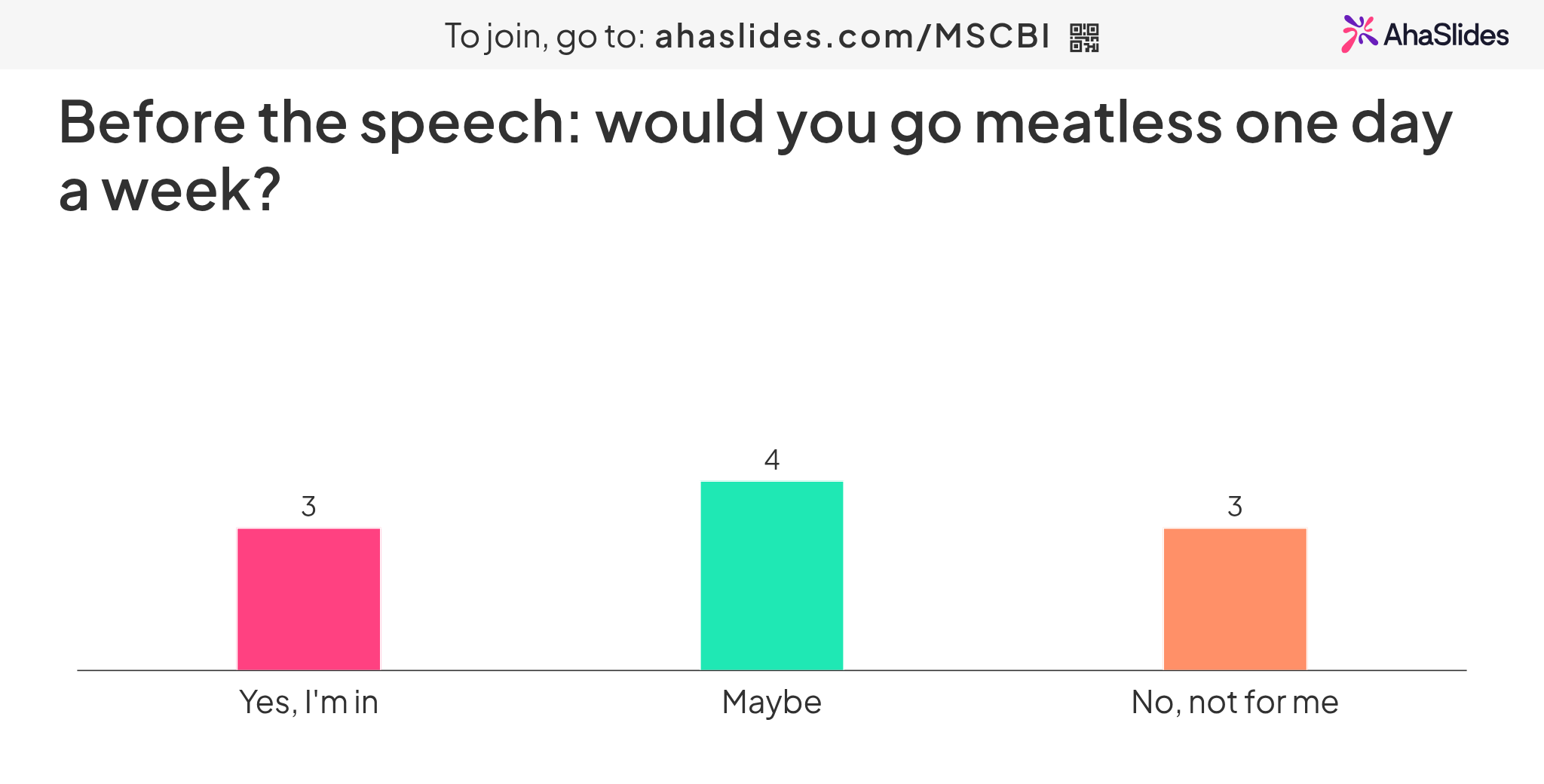
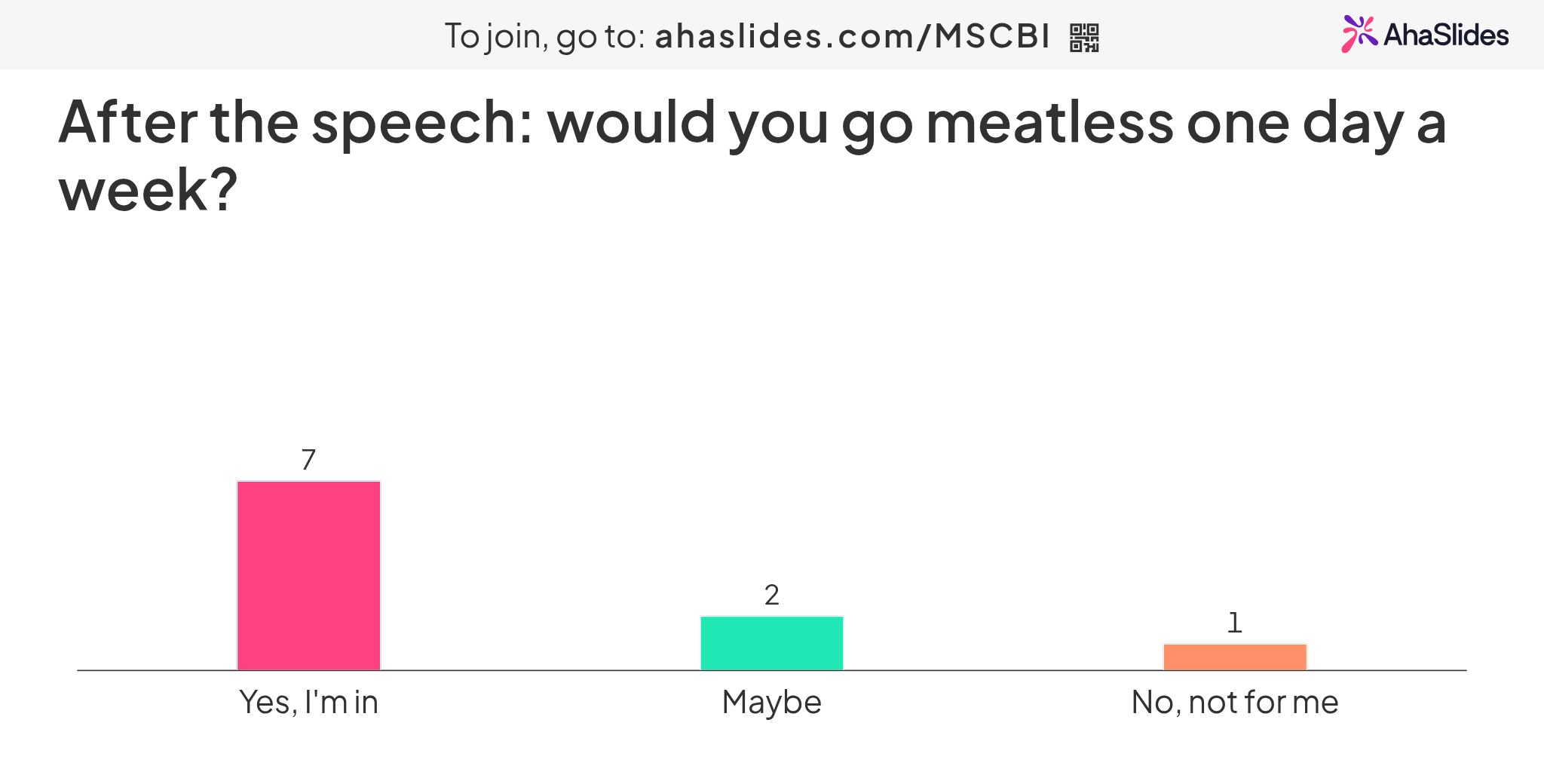
The simplest way to find out whether you persuaded anyone is to ask. Put the same question to the room before and after you speak with a live encuesta, and the shift in the bar chart tells you how far you moved people. It takes seconds, and the audience answers from their own phones.
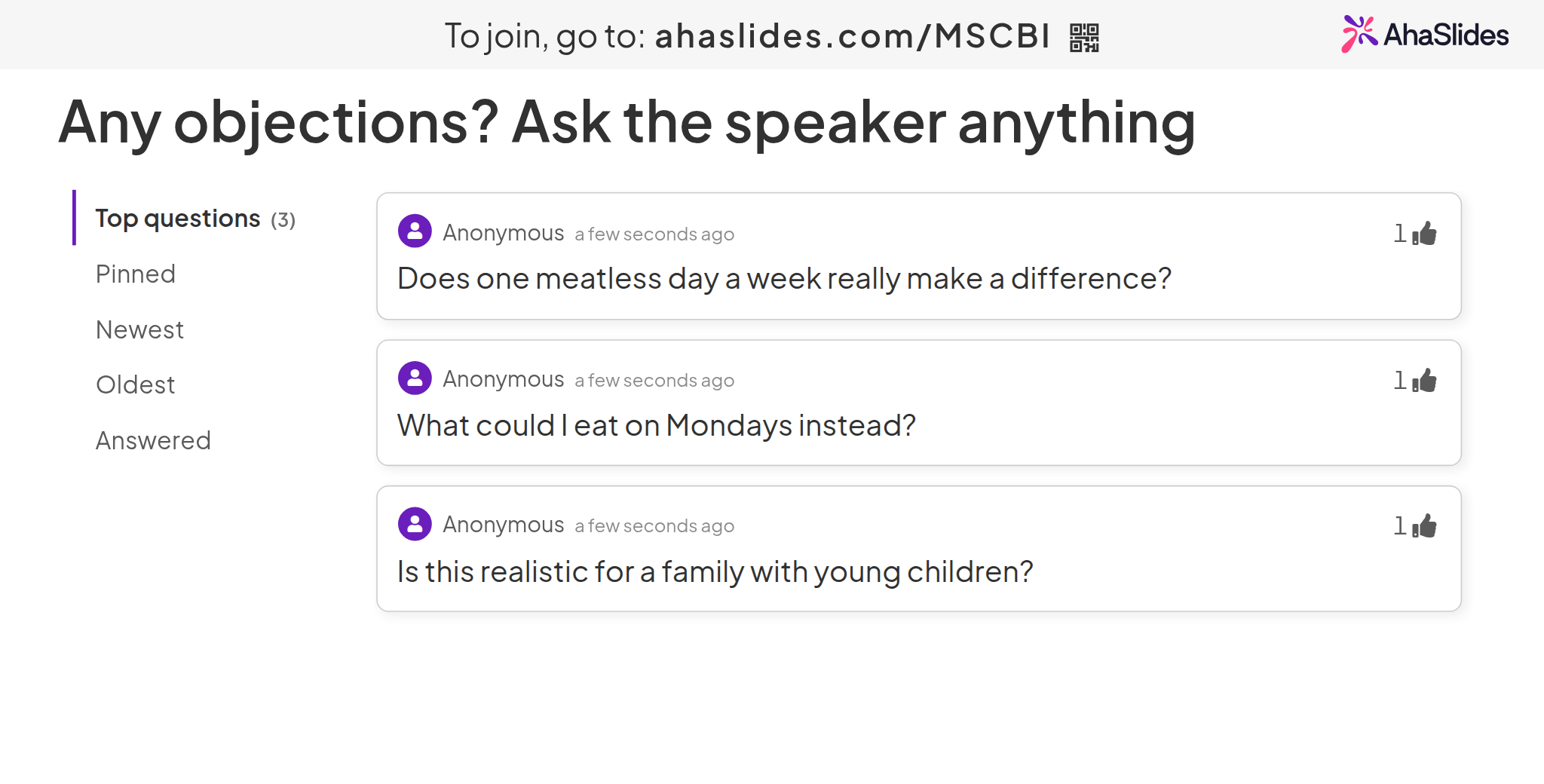
If you are speaking to a larger group, an anonymous Q&A at the end lets sceptics raise objections they would never voice out loud, which gives you a chance to answer them.
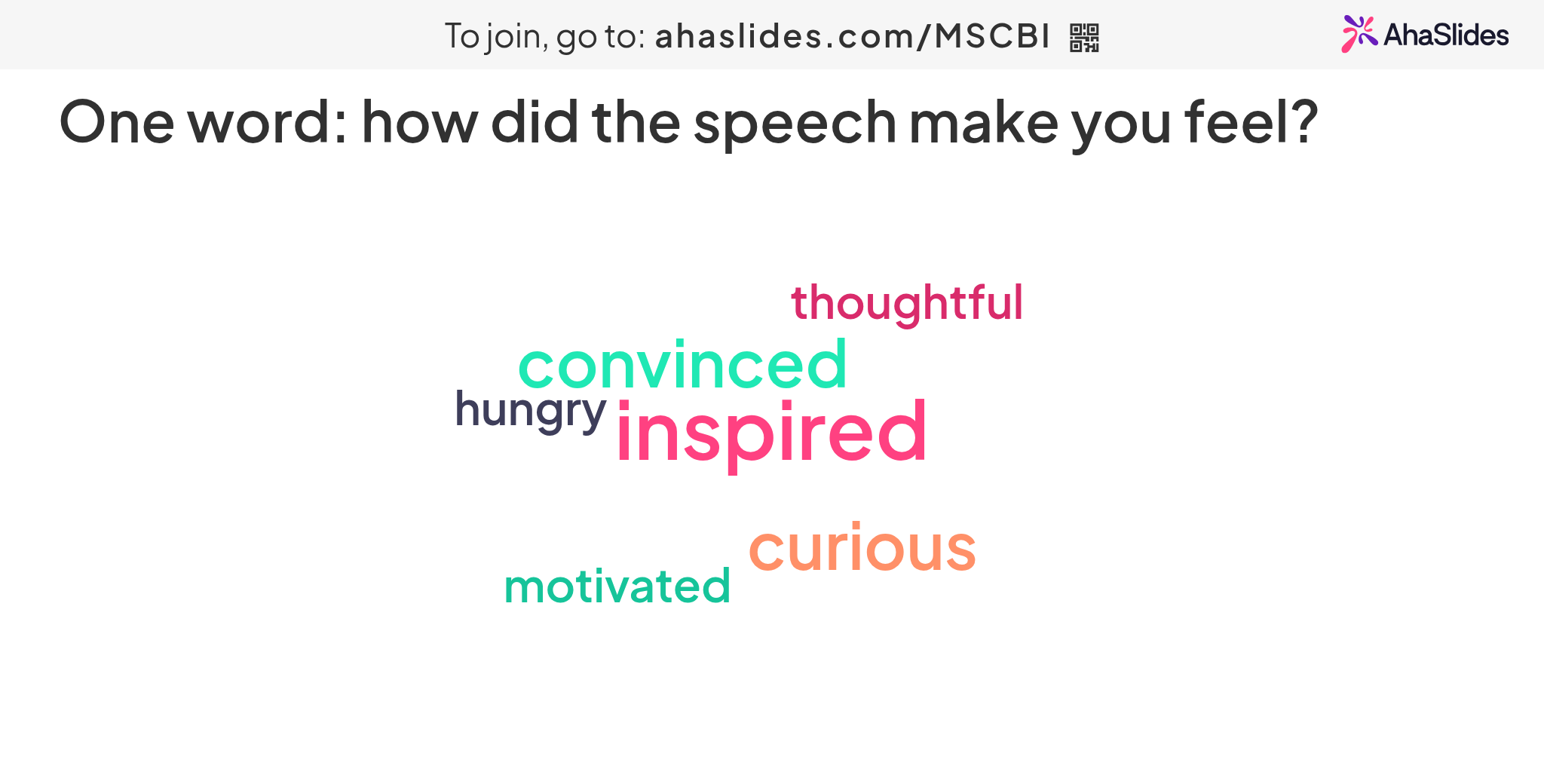
For a quick read on the mood, ask for one word from everyone with a nube de la palabra. If "convinced" and "inspired" show up large, the speech landed.
En pocas palabras
A short persuasive speech lives or dies on focus: one position, one or two strong reasons, and one clear call to action. Use the seven examples above as templates, swap in your own topic, and rehearse out loud until it fits your time slot comfortably.
Preguntas frecuentes
What is an example of a persuasive speech?
A persuasive speech takes a clear position and uses arguments, facts and reasoning to convince the audience to accept it. For example, a speech urging local voters to approve funding for park upgrades and maintenance, or any of the seven scripts above.
¿Cómo se escribe un discurso persuasivo de 5 minutos?
Choose a topic you are passionate and knowledgeable about. Write an attention-grabbing opening, then develop two or three main arguments that support your position, each with a piece of evidence and a short story. Finish with one clear call to action. Time your practice runs and cut content until it fits comfortably within five minutes.
How long is a one-minute speech?
It depends on how fast you speak, but the one-minute scripts above run to roughly 85 to 110 words each. Time yourself reading one aloud at a relaxed pace, then use that as your benchmark.