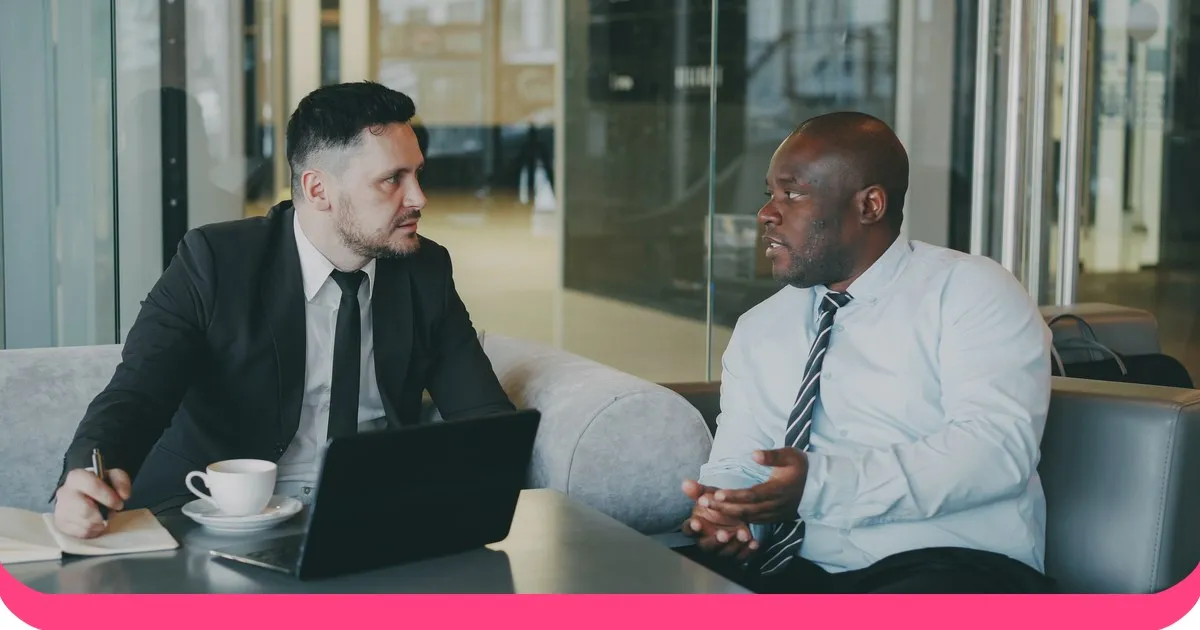
Before anyone says a word, their eyes have already said something. Where someone looks, for how long, and how often they look away shapes whether we read them as confident, interested, nervous or evasive.
This guide explains what eye contact is, why it matters in conversations, interviews and presentations, the four most common types, and how the rules change between cultures and on video calls.
What is eye contact in communication?
Eye contact is looking directly at another person's eyes while they look at yours. It is one of the main channels of nonverbal communication. A classic research review by Chris Kleinke (1986) groups its jobs into five: giving information, regulating the flow of a conversation, expressing intimacy, exercising social control, and helping a service or task get done.
Three things carry most of the meaning:
- Duración: how long a look is held
- Frecuencia: how often contact is made and broken
- Franqueza: whether the gaze is straight on or sideways
Short, fleeting looks tend to read as shy or unsure. Steady gaze tends to read as confident. Looking away constantly can make a speaker seem distracted, while a fixed stare can feel like pressure. Researchers Michael Argyle and Janet Dean proposed in 1965 that people balance eye contact against distance and other signs of closeness: if one goes up, others adjust to keep the exchange comfortable. Sit very close and most people look at each other less. Stand further apart and they look more.
Why eye contact matters in communication
It shows you are listening. Looking at the person who is talking tells them you are following, which encourages them to keep going. Looking at your phone tells them the opposite.
It affects how believable you seem. En un estudio de 2016 en PLoS ONE, Kreysa, Kessler and Schweinberger found that listeners were more likely to believe statements of uncertain truth when the speaker looked straight at them. That is a reason to look at your audience when you share a key claim, but it is not a reason to trust a stare: the same study suggests direct gaze can make us slower to say we disagree.
It builds closeness. In a well-known 1989 experiment, Kellerman, Lewis and Laird asked pairs of strangers to hold each other's gaze for two minutes. Those pairs reported stronger feelings of affection than pairs who looked at each other's hands. Two minutes is far longer than any normal conversation, so treat it as a lab result, not a tip.
Missing it can cost you. A speaker who never looks up can seem unprepared or disengaged, even when the content is excellent. That is why eye contact is a standard part of interview coaching and public speaking training.
Common types of eye contact
1. The glance
A brief look is usually an acknowledgement: I have noticed you. It carries little pressure, which is why it works for passing colleagues, a quick check on whether a listener is following, or a nod across a meeting room.
2. Sustained eye contact
Holding someone's gaze signals focus and, in the right setting, trust or closeness. It works best when it is mutual and when it is broken naturally, for example when you pause to think. Held too long with someone who has not invited it, it can feel intense or confrontational.
3. The narrowed gaze
Narrowed eyes and a fixed look are often read as scepticism, annoyance or concentration. The cause may be none of those, since people also squint in bright light or when they are working out a problem. Check the rest of the face and the situation before you decide what it means.
4. Averted gaze
Looking away is not always a bad sign. People naturally look away when they are thinking, recalling something or giving a long answer, and returning to eye contact when they finish. Constant avoidance is what tends to be read as shyness, discomfort or distraction.
Eye contact is not the same everywhere
The advice to look people in the eye comes mainly from Western settings. In a 2013 study comparing Finnish and Japanese participants, Akechi and colleagues found that Japanese participants rated faces with direct gaze as angrier, less approachable and less pleasant than Finnish participants did. The authors put this down to cultural display rules rather than a difference in basic reactions.
Neurodivergence also matters. Many autistic people find eye contact uncomfortable or distracting, and forcing it can make it harder to listen. If you manage or teach people, judge their engagement by what they say and do, not only by where they look.
The practical rule: aim for a natural, comfortable level, and take your cue from the other person.
Tips for better eye contact
- Look for a thought, not a stopwatch. Hold someone's gaze for a sentence or a complete idea, then move on or look away naturally.
- Spread it around the room. When presenting to a group, speak to one person at a time, then move to another part of the room. This stops you scanning over heads.
- On video calls, look at the camera when you speak. Looking at faces on screen makes it seem as if you are looking slightly down. Glance at the lens at key moments and use the screen to read reactions when you listen.
- If direct eye contact is hard, soften it. Look at the bridge of the nose or the forehead, or look at the person's face rather than into their eyes. It can feel more comfortable, and it is hard for others to notice.
- Do not stare. Break contact now and then, especially when you are thinking.
Reading the room when eye contact is not enough
In a large room, or on a call where people turn their cameras off, you cannot meet everyone's eye. A quick encuesta en vivo gives you the answer that eye contact would have given you, from everyone at once. Ask a one-question check, such as which option the group prefers, and watch the results come in on screen while you keep your eyes on the room.
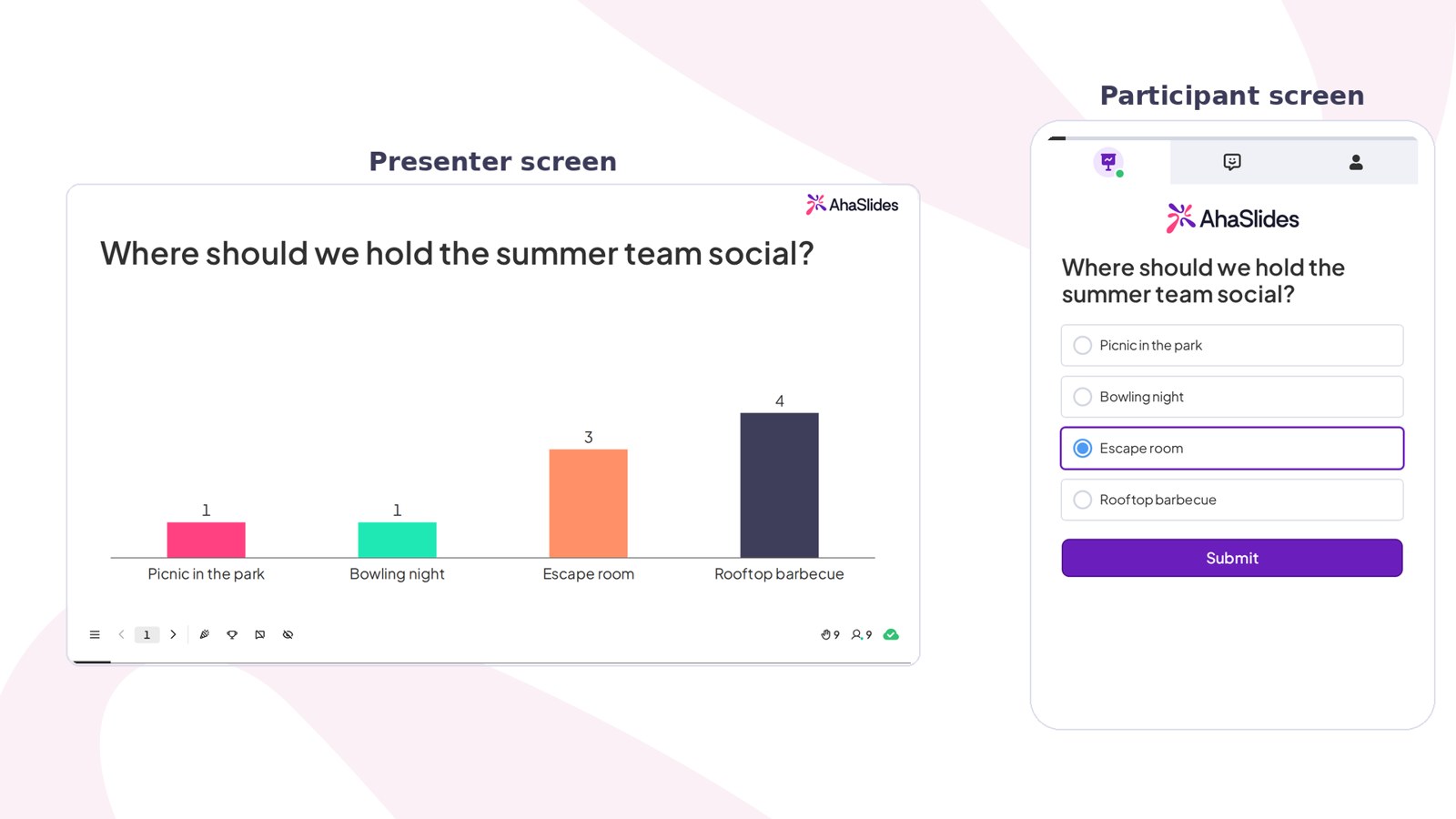
On the free plan, AhaSlides supports up to 50 participants per session. For more ideas on how to keep an audience with you, see our guides to ending a presentation y a habilidades de comunicación asertiva.
En pocas palabras
Eye contact is a signal, not a rule. It tells people you are listening, helps them judge how sure you are, and sets the pace of a conversation. Use enough of it to connect, adjust to the culture and the person in front of you, and do not read too much into any single look.
Preguntas frecuentes
What is an example of eye contact in communication?
In a job interview, looking at the interviewer while they ask a question and while you answer shows you are engaged. In a presentation, a speaker who looks at different people across the room makes the audience feel included.
¿Es el contacto visual una habilidad de comunicación?
Yes. Eye contact is a core nonverbal skill: you can learn when to hold a gaze, when to look away and how much is comfortable for the person you are talking to.
¿Por qué es importante el contacto visual en un discurso?
It helps the audience feel spoken to rather than read to, lets you see whether people are following, and can make your points seem more credible.
How long should you hold eye contact?
There is no fixed number. Most people hold a gaze for a sentence or a complete idea, then look away naturally. Take your cue from how the other person responds.
Is it rude to avoid eye contact?
Not always. In some cultures prolonged direct gaze is considered impolite, and some people find it uncomfortable for personal reasons. Treat it as a cue to check in, not a verdict.
Fuentes
- Kleinke (1986), Gaze and eye contact: a research review, Psychological Bulletin
- Argyle and Dean (1965), Eye-contact, distance and affiliation, Sociometry
- Kreysa, Kessler and Schweinberger (2016), Direct speaker gaze promotes trust in truth-ambiguous statements, PLoS ONE
- Kellerman, Lewis and Laird (1989), Looking and loving, Journal of Research in Personality
- Akechi et al. (2013), Attention to eye contact in the West and East, PLoS ONE