
Most managers know feedback matters. What trips them up is the moment they're actually sitting across from someone who missed three deadlines, talks over colleagues, or keeps producing work that needs heavy rework. The words come out wrong, the person gets defensive, and nothing improves.
The solution isn't a different attitude. It's a better structure.
Research from the American Psychological Association found that people consistently underestimate how much their colleagues want honest, critical feedback. The desire for candid input is real — the delivery method is what determines whether it lands as useful or as an attack [1]. A 2021 survey found that 69% of employees say they'd work harder if their efforts were recognized and feedback was actionable [2].
This post lays out 15 constructive criticism examples organized by situation, followed by a practical framework you can use to build your own.
What makes criticism "constructive"
Criticism becomes constructive when it does three things: names a specific behavior (not a personality trait), explains the real-world impact of that behavior, and points toward a better path. Vague feedback like "you need to be more professional" checks none of those boxes. Specific feedback like "when you reply to client emails two days late, they escalate to me, which puts the relationship at risk" checks all three.
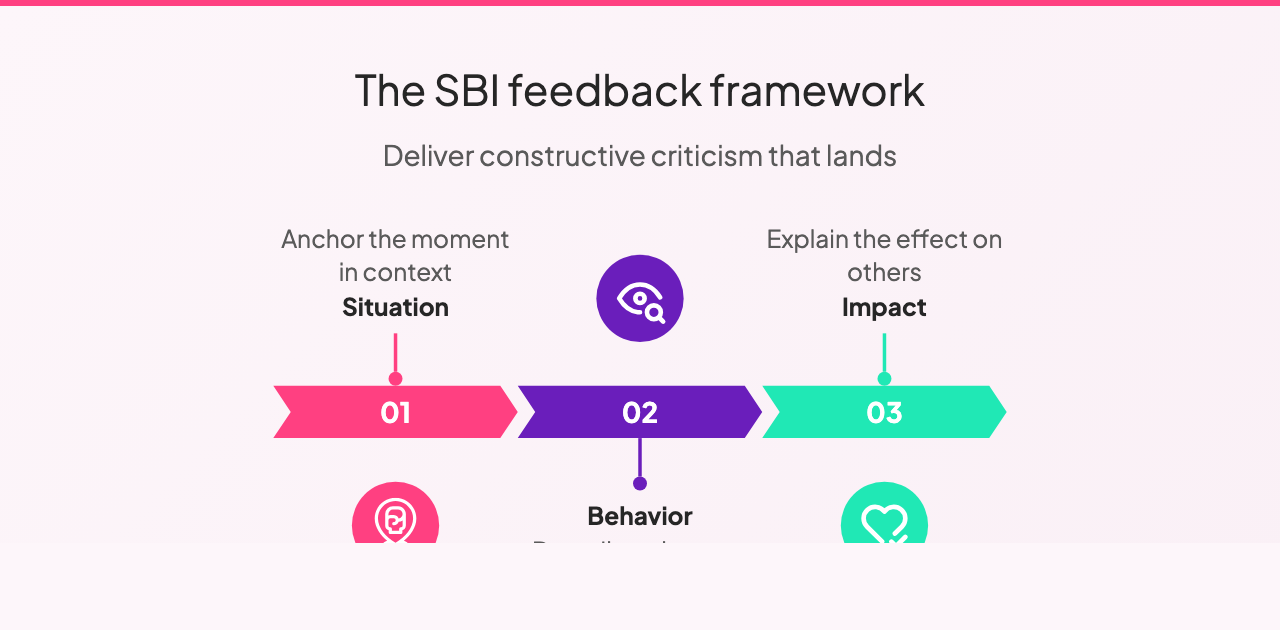
The Center for Creative Leadership developed a model called SBI — Situation, Behavior, Impact — to give this structure a name [3]. It's one of the most widely used feedback frameworks in corporate L&D because it keeps the conversation grounded in observable facts rather than interpretations.
SBI in practice:
- 状況: When [specific context]...
- 動作: ...you [specific, observable action]...
- 影響: ...which causes [concrete consequence for the team, project, or client].
The examples below follow this logic, even when they're not explicitly labeled.
カテゴリー別の例
締め切りに間に合わなかった
例
"In the last sprint, two of your assigned tasks weren't ready by the review date. The rest of the team was blocked on those deliverables, and we pushed the client demo back by a week. I'd like to understand what got in the way and figure out if the timelines are realistic or if we need to adjust how we scope your work."
例
"You submitted the quarterly report two days after the board meeting. The executives didn't have the data they needed to make a decision in the room. Going forward, can we put an internal deadline a day earlier so you have buffer time if anything comes up?"
例
"I've noticed this is the third time this quarter that a deliverable has slipped past the agreed date. I'm not questioning your intentions — the finished work is strong. But the pattern is creating friction with other teams. Let's look at your workload together and see if something needs to come off your plate."

コミュニケーションと応答性
例
"In Tuesday's client call, you gave a revised timeline without checking with the project team first. The timeline you quoted is more aggressive than we can actually deliver, and we had to walk it back. When there's a scope question on a live call, it's fine to say you'll follow up — that's often better than committing on the spot."
例
"Your response time on Slack has been running at 4-6 hours during core hours. A few team members have mentioned they're waiting on answers before they can move forward. I'm not asking you to be available constantly, but could we agree on a two-hour window during the day where you check messages?"
例
"During the all-hands last week, you cut off two colleagues mid-sentence. I don't think you noticed, but it stopped both of them from finishing their points. These are people whose input we need in those conversations. Being mindful of pausing before responding would make a real difference."
Work quality and attention to detail
例
"The proposal you sent to the client had three pricing errors in the figures. Fortunately, we caught them before they responded. This is the second time this month a document went out with errors that a second read-through would have caught. Before you send anything externally, can we build in a step to review with a fresh set of eyes?"
例
"Your presentation slides are visually well-organized, but the data on slides 8 and 9 wasn't referenced or sourced. When leadership asks where the numbers come from and we can't answer immediately, it undermines the credibility of the whole deck. Adding a source note at the bottom of each data slide would fix this."
例
"The code you pushed last Thursday broke the staging build, and we spent two hours tracing it. You weren't running the test suite before committing. I know the pressure to ship fast is real, but a build failure costs the team more time than the tests take. Let's make running tests a required step before any push."
コラボレーションとチームワーク
例
"I've noticed you tend to work on your tasks independently and present them as finished rather than sharing them while they're in progress. That means the team is finding out about problems late — sometimes too late to fix them without cost. Even a brief status share midway through would let people weigh in earlier."
例
"In the planning meeting, you disagreed with the approach but didn't say anything in the room, then pushed back after decisions had been made. That timing makes it hard to incorporate your perspective. We want your disagreement — please bring it into the room when we're still in the decision phase."
例
"You've been cc'ing me on every email between you and the marketing team. I appreciate you keeping me in the loop, but it creates an impression that you need sign-off before communicating, which slows things down and isn't how I want to work. You have the authority to handle that relationship directly."
主導権と所有権
例
"Your technical work is solid, but in the last two months I haven't seen you bring forward any ideas or flag problems you've spotted. I'd expect someone at your level to be proactively identifying improvements, not just completing assigned tasks. What would help you feel more confident doing that?"
例
"The client came to me directly last week with a question that you were fully equipped to answer. When customers reach out to you, you don't need to escalate everything — you can resolve it and let me know afterward. Routing standard questions through me adds a round-trip delay that frustrates the client."
例
"You've been waiting for explicit sign-off before moving to the next phase on several recent projects, even when the previous phase was complete and the path forward was clear. That hesitation is adding days to our timelines. I'd like you to use your judgment to proceed and flag me only if something unexpected comes up."

よくある間違いは避けるために
Saving it for the performance review. Feedback given months after the fact is nearly useless for behavior change. Deliver it within a day or two of the event, while details are still fresh [3].
Sandwiching criticism between excessive praise. The "compliment-criticism-compliment" structure is so well-known that people tune out the positive parts waiting for the "but." Be direct, be respectful, and skip the packaging.
Making it about personality. "You're disorganized" puts the person in a box. "The status doc you're maintaining hasn't been updated in three weeks" gives them something to act on.
Delivering it in front of others. Constructive criticism is almost always a one-on-one conversation. Public feedback, even when phrased carefully, triggers defensiveness and embarrassment that shuts down the learning.
Following up zero times. Feedback without a check-in is just venting. Set a concrete follow-up — "let's revisit this in two weeks" — so the person knows you're invested in the outcome, not just recording a complaint.
Using feedback data across your team
Individual feedback conversations are valuable, but patterns across a team or cohort tell a different story. When multiple managers independently flag communication issues or missed deadlines in written feedback, that's a training gap, not an individual problem.
のようなツール AhaSlides let HR teams and L&D professionals run structured peer-feedback rounds or post-training evaluations and see aggregated results in real time. Rather than collecting responses and building a report after the fact, facilitators can surface common themes during the session itself. That immediacy makes it easier to connect feedback data to development decisions — whether that's designing a follow-up module, adjusting role expectations, or identifying which managers need support in delivering feedback themselves.
よくある質問
How do you give constructive criticism to someone who gets defensive?
Defensiveness is usually a signal that the person feels judged rather than helped. A few adjustments reduce that reaction. First, lead with curiosity rather than a verdict: "I want to understand what happened on the deadline" lands differently than "you missed the deadline again." Second, separate the behavior from the outcome and make clear you're not questioning their character or effort. Third, give them space to respond before you move into solutions. People who feel heard are significantly less likely to shut down. If defensiveness is a consistent pattern with one individual, a private conversation about how they prefer to receive feedback can also help, since some people respond better to written comments than verbal ones, and some prefer more time to process before discussing.
What is the difference between constructive criticism and negative feedback?
The difference is in the direction, not the tone. Negative feedback points out what went wrong and stops there. Constructive criticism does that too, but it adds context (why it matters) and a path forward (what to do differently). Both can be delivered with a calm, respectful tone, but only one of them gives the recipient something to act on. In practice, managers who think they are giving constructive criticism are sometimes stopping at the problem description without realizing they have not yet offered the "so here is what I'd suggest" part. If your feedback session ends with the other person knowing something was wrong but not knowing what to change, it has stayed in negative territory.
How often should managers give constructive criticism?
Often enough that it is not a big event. When feedback is rare, any critical comment gets amplified and feels like a formal warning even when it is not intended that way. Organizations that build feedback into regular one-on-ones, brief project retrospectives, or peer-review cycles tend to see lower defensiveness because the conversation is normalized. A rough benchmark from L&D research is that employees benefit from at least monthly specific feedback on their work, not just annual or semi-annual review cycles. That frequency does not mean every conversation has to carry critical content, but managers should not wait for a performance issue to become serious before naming it. Small, timely corrections are easier to act on and far less uncomfortable than a formal review conversation where months of concerns surface at once.
ソース
[1] American Psychological Association. Underestimating others' desire for constructive feedback. パーソナリティと社会心理学のジャーナル。 https://www.apa.org/pubs/journals/releases/psp-pspi0000393.pdf
[2] ThrivesSparrow. Employee feedback statistics: 25+ facts and trends. https://www.thrivesparrow.com/blog/employee-feedback-statistics
[3] 創造的リーダーシップセンター Use SBI (Situation-Behavior-Impact) to understand intent. https://www.ccl.org/articles/leading-effectively-articles/closing-the-gap-between-intent-vs-impact-sbii/