
What you wear changes how your talk lands before you say a word, and it changes how you feel while you give it. This guide gives you a simple way to choose a presentation outfit: start from the audience and the setting, check fit and comfort, keep colours and details calm, and finish with a short checklist for the day.
Why your presentation outfit matters
Audiences form an impression quickly. In a well-known Princeton study, people’s judgements of a stranger’s face after just 100 milliseconds closely matched their judgements with no time limit (Willis and Todorov, Psychological Science, 2006). That study looked at faces, not clothes, but it shows how little time a first impression needs, and your outfit is part of what people see as you walk up.
Clothes can also affect the person wearing them. Researchers at Northwestern University found that people who wore a white coat described as a doctor’s coat did better on a sustained-attention task than people who wore the same coat described as a painter’s coat, an effect they named ‘enclothed cognition’ (Adam and Galinsky, Journal of Experimental Social Psychology, 2012). The lesson for speakers is modest: an outfit you are comfortable in is one less thing to think about, and one that itches, pinches or distracts you works against you.
How to choose a presentation outfit in five steps
1. Know your audience and the setting
Ask what the room will wear and match it, then go one step smarter. A board meeting or investor pitch usually calls for a suit or a tailored blazer. A creative workshop or a classroom can be more relaxed, so smart trousers and a clean shirt or knit work. If the dress code is unclear, ask the organiser, because that one question removes most of the guesswork.
Think about the format too. On a stage you are seen from a distance, so clean lines and solid shapes read best. On a video call only your top half shows, so check the camera framing in advance and choose a top that sits well in it.
2. Choose fit and comfort over trends
Clothes that are too tight restrict your breathing and your gestures, and clothes that are too loose can look untidy and need constant adjusting. Pick something that fits well, lets you raise your arms and stand for a long time, and feels good on you. Try the whole outfit on days before the event and walk around in it, sit down in it and reach with your arms, so the first time you notice a problem is not on stage.
3. Keep colours and patterns calm
Solid colours that suit you are a safe base, and they keep attention on your face and your message. Very busy patterns and large logos can pull the eye away from what you are saying, especially on camera. Check the colour against your slides and the background too: a pale top against a white wall, or a dark top in front of a black screen, can make you fade into the scenery.
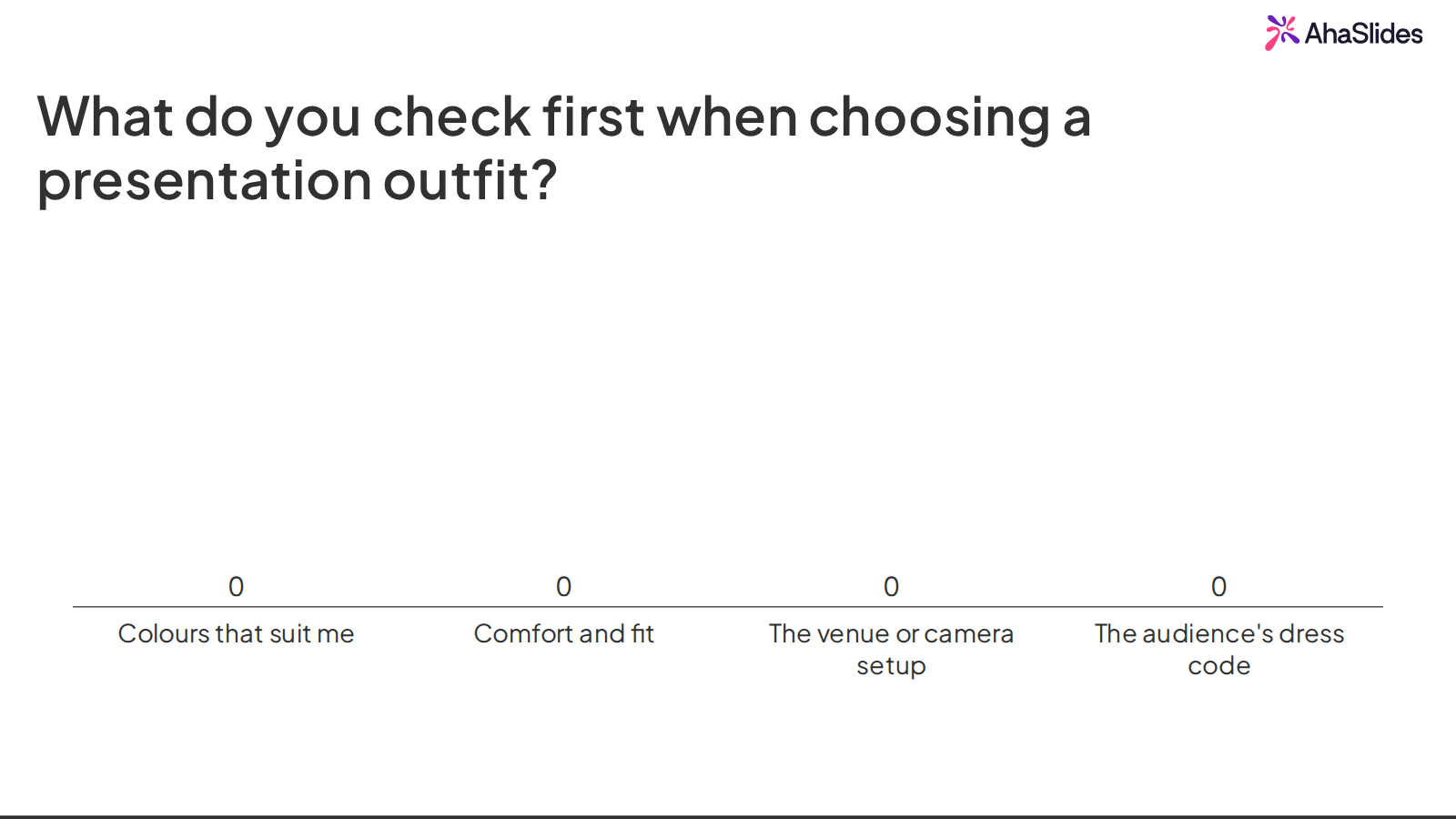
4.細部に注意を払う
- 清潔さ: check for stains, loose threads and lint before you leave.
- 押す: iron or steam the collar, cuffs and hems so the outfit looks cared for.
- アクセサリー: keep jewellery, watches and ties simple. Bracelets that jangle can be picked up by a microphone, and a swinging necklace pulls the eye.
- シューズ: choose a pair you can stand in for the full session, and break new ones in beforehand.
- Mic and badge: if you will wear a lapel or headset microphone, wear something with a place to clip it, such as a collar, belt or waistband.
5. Dress so you feel like yourself
The tips above do not mean much if the result feels like a costume. If you are naturally bold, show it through one colour or accessory. If you prefer plain, keep it plain and tidy. The aim is an outfit you forget about once you start talking, so your attention stays on the audience.
A quick checklist for the day
- Confirm the dress code and the format (stage, classroom or video call).
- Try the full outfit on, sit in it and raise your arms.
- Check it for stains, creases and loose threads.
- Pack a spare layer, a lint roller and a safety pin.
- Check where your microphone will clip on.
Make the rest of your talk feel as good as your outfit
Once you are comfortable on the outside, the next job is keeping the room with you. Polls, quizzes and a live 単語の雲 in AhaSlides let the audience answer from their phones, which gives you something to respond to and takes the pressure off just talking at people. You can start from the オンライン投票メーカー または オンラインクイズクリエーター. If nerves are the real worry, read our guide to overcoming stage fright, and for ideas on opening your talk, see プレゼンテーションを開始する方法.
主要な取り組み
- Start from the audience, the dress code and the format, then work out the outfit.
- Fit and comfort come before trends: you should be able to breathe, move and stand in it.
- Calm colours and simple details keep attention on your message.
- Try the outfit on in advance and check the details on the day.
- Wear something that lets you stop thinking about your clothes once you begin.
よくある質問
プレゼンテーションに最適な服装は何ですか?
Match the audience and the setting, wear something that fits and feels comfortable, and keep colours and details simple. When in doubt, dress one step smarter than your audience.
What colours are best to wear when presenting?
Solid colours that suit you and contrast with your background work well. Very busy patterns and large logos can distract, especially on camera.
What should I wear for a video presentation?
Choose a solid top that frames well on camera, check how it looks against your background, and avoid noisy jewellery that a microphone can pick up.
Does what I wear affect my presentation?
Audiences form impressions quickly, and research on enclothed cognition suggests clothes can affect how the wearer pays attention. Neither is a reason to overthink it: comfort and confidence matter most.