
SWOT analysis is one of the most widely used strategy tools in the world, and also one of the most misused. Teams fill in the four boxes, nod, and move on without doing anything with the results.
The framework itself is straightforward. What trips people up is knowing what good SWOT outputs actually look like, and how to turn them into decisions. This guide works through real examples at the company level and at the HR and L&D level, explains where the tool works well, and covers how to run a SWOT session that produces something actionable.
SWOT works well as one stage in a broader ideation process. See how it fits alongside other techniques in our complete guide to brainstorming.
What SWOT analysis is (and where it came from)
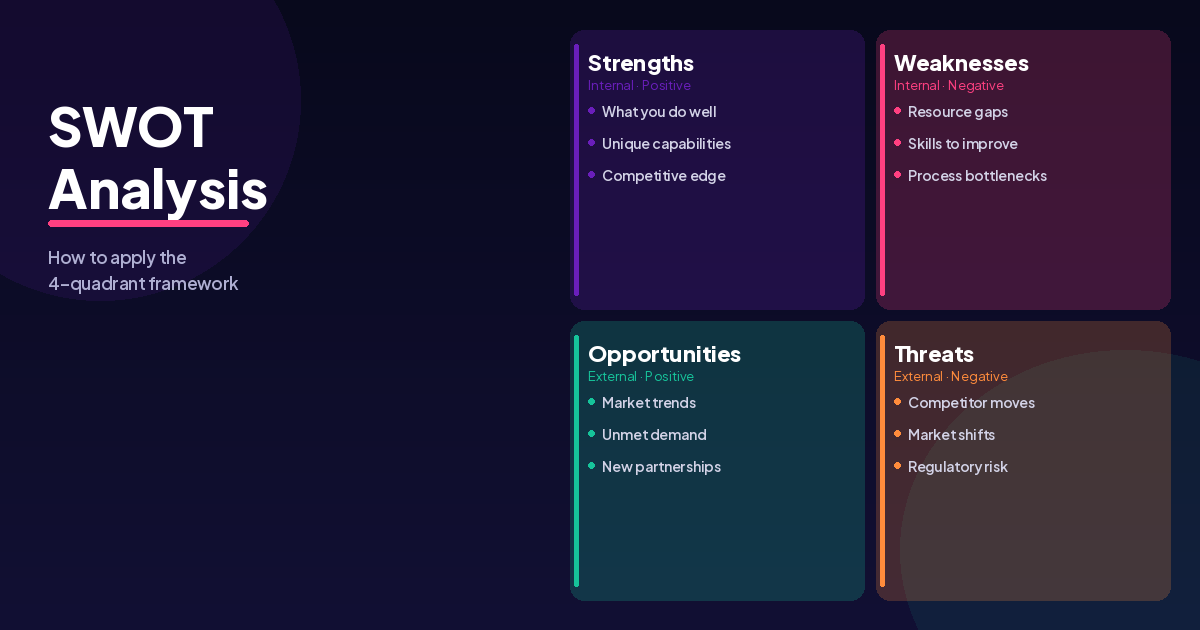
SWOT stands for Strengths, Weaknesses, Opportunities, and Threats. The first two are internal factors — things your organization controls. The second two are external — conditions in the market or environment that you don't control but need to respond to.
The framework was developed at the Stanford Research Institute in the 1960s by a team led by Albert Humphrey, originally under the name SOFT analysis. It was renamed SWOT sometime around 1964 when it was presented at a seminar in Zurich [1]. That framing has stayed largely intact for sixty years, which speaks to its utility as a thinking structure, even if the execution varies widely.
The core logic is simple: before you make strategic decisions, you should know what you have going for you (strengths), where you're exposed (weaknesses), what external conditions you can take advantage of (opportunities), and what could hurt you (threats). Understanding all four categories together is what makes the analysis useful, not examining each in isolation.
Real company SWOT examples
The following examples draw from publicly analyzed companies. They're useful as reference points when building your own analysis, because they show what concrete, specific SWOT items look like compared to vague generalizations.
Nike
Stiprās puses: Nike's brand value was ranked 9th globally by Interbrand, with an estimated value of $53.7 billion [2]. Its direct-to-consumer channel generates higher margins than wholesale and gives the company first-party data on how customers actually shop and buy. Product innovation in performance footwear creates a consistent competitive advantage.
Vājās puses: Revenue is heavily concentrated in footwear, which creates vulnerability if consumer preferences shift. Nike has faced sustained criticism over labor practices in its supply chain, which periodically resurfaces as a reputational risk.
Iespējas: Athleisure has expanded the occasions where athletic apparel is socially acceptable, broadening the addressable market. Growth in India and Southeast Asia represents a significant long-term opportunity as middle-class incomes rise.
Draudi: Competition from Adidas, Under Armour, On Running, and Hoka has intensified, with newer brands gaining share in running and outdoor categories. Counterfeit products dilute brand equity and divert revenue, particularly in markets with weaker intellectual property enforcement.
Manzana
Stiprās puses: Apple held the top spot in Interbrand's global brand rankings for ten consecutive years, with a brand value of $488.9 billion [2]. The tight integration between hardware, software, and services creates high switching costs and strong customer retention. Gross margins significantly exceed the industry average for consumer electronics.
Vājās puses: Premium pricing limits Apple's reach in price-sensitive markets, particularly in emerging economies. The closed ecosystem restricts compatibility with third-party products, which some enterprise buyers find constraining.
Iespējas: Augmented and mixed reality represents a significant development area, as shown by Apple's Vision Pro launch. Continued growth in digital services (Apple TV+, Apple Music, iCloud) adds recurring revenue on top of device sales.
Draudi: Currency fluctuations affect profitability when the US dollar strengthens, since most of Apple's revenue comes from outside the US. Antitrust scrutiny in the EU and US around App Store practices creates regulatory exposure.
Amazone
Stiprās puses: Amazon Web Services is the global market leader in cloud computing and contributes a disproportionate share of the company's operating profit, subsidizing thin margins in retail. Amazon's fulfillment and logistics infrastructure is one of the most sophisticated distribution networks ever built.
Vājās puses: Retail margins remain thin by design, leaving Amazon heavily dependent on AWS for profitability. The company has faced persistent criticism over warehouse working conditions, generating negative press and labor organizing activity in multiple countries.
Iespējas: Expansion into healthcare, media production, and digital advertising gives Amazon additional high-margin revenue streams that aren't dependent on the retail business. Emerging markets in Latin America and Southeast Asia represent significant untapped e-commerce potential.
Draudi: Regulatory scrutiny over antitrust concerns has intensified in both the US and EU. Microsoft Azure and Google Cloud are both investing aggressively in cloud infrastructure, applying competitive pressure on AWS.
HR and L&D SWOT examples

SWOT analysis applies just as readily to internal functions as to whole organizations. HR and L&D teams use it for workforce planning, program evaluation, and identifying where to invest limited training budgets.
HR department SWOT example
Stiprās puses: A well-established onboarding process that consistently shortens time-to-productivity for new hires. A strong internal employee referral network that reduces cost-per-hire.
Vājās puses: Performance management system is outdated and widely resented by managers, resulting in low completion rates during review cycles. Limited capacity to analyze people data, with most reporting done manually in spreadsheets.
Iespējas: Adoption of HRIS tools could free HR staff from administrative work and shift capacity toward strategic workforce planning. Growing employee interest in flexible working arrangements creates an opportunity to differentiate the employer value proposition without increasing base compensation.
Draudi: A tight labor market in technical roles makes talent acquisition difficult and expensive. Competitors have announced enhanced parental leave and remote work policies that could draw candidates away.
L&D program SWOT example
Stiprās puses: Subject matter experts across the business are willing to contribute to internal training content, reducing dependency on external vendors. A recent move to a learning management system has made course completion data available for the first time.
Vājās puses: Most existing content is slide-heavy and passive, with low engagement scores on post-training surveys. L&D team lacks instructional design expertise in-house, so new program development is slow.
Iespējas: Rising interest in microlearning and on-demand content creates a chance to update the delivery format without rebuilding every course from scratch. AI-assisted content authoring tools can accelerate production for a small team.
Draudi: Budget pressure may reduce the headcount available for program facilitation. Rapid change in the skills required for key roles means content can become outdated quickly, creating a maintenance burden.
Personal and team SWOT examples
SWOT analysis scales down effectively for individual career planning and team-level assessment.
Individual career SWOT
A project manager preparing for a promotion discussion might structure it this way:
This framing turns the analysis into a preparation tool: fill the weakness gap before the role opens, position for the opportunity while it's available, and be ready to differentiate against external competition.
Team SWOT
An L&D team running a strategic planning offsite might assess its own capabilities:
The value here is getting the team to an honest shared view of its position before trying to plan what it should do next.
How to run a SWOT session that produces results

The analysis is only useful if the people in the room are honest and the output gets used. A few practical points:
Set a clear scope before you start. SWOT analysis at the level of "the whole company" produces vague outputs. SWOT analysis for "our onboarding program" or "our sales team's performance in the APAC region" produces specific, actionable ones. Narrow the scope before the meeting starts.
Generate items individually, then discuss as a group. If you go straight to group discussion, the most senior person's view tends to dominate and people pile on early contributions without critically evaluating them. Give participants five minutes to write their own SWOT items first, then share and cluster.
Push for specifics. "Strong brand" is not useful. "Our NPS is 72, compared to an industry average of 45, which gives us a referral advantage we haven't fully leveraged" is useful. When a vague item comes up, ask: what's the evidence? How do we know?
Cross-analyze the quadrants. The real analytical work happens when you compare quadrants rather than treat them separately. An SO strategy uses strengths to exploit opportunities. A WT strategy minimizes weaknesses and avoids threats. A WO strategy addresses weaknesses to pursue an opportunity. A ST strategy uses strengths to defend against threats. Most teams skip this step entirely, which is why SWOT sessions often produce nothing actionable.
Assign owners and deadlines to the priorities that come out. End the session with three to five prioritized items and a clear owner and timeline for each. Without that, the analysis stays in a shared drive and nothing changes.
Common SWOT mistakes
Listing too many items. A SWOT matrix with 15 items in each quadrant is not a strategy, it's a brainstorm. Keep it to the five or six most significant factors per quadrant and be ruthless about what actually matters.
Treating weaknesses as shameful. Teams often avoid putting real weaknesses on the board because it feels like criticism. A useful SWOT requires an honest internal audit. Weaknesses that don't appear in the analysis don't get addressed.
Focusing only on the present. SWOT should capture both current reality and likely trends. An opportunity that exists today might close in 12 months. A threat that seems distant might arrive faster than expected. Use available data to assess timing, not just existence.
Confusing internal and external factors. Strengths and weaknesses are things within your control; opportunities and threats are external conditions. A common error is putting market shifts in the weaknesses box or internal problems in the threats box. The distinction matters because the responses are different: you can fix a weakness, but you can only respond to a threat.
Running SWOT sessions with AhaSlides
SWOT workshops work better when everyone contributes, not just the loudest voices. AhaSlides lets you run the item-generation phase as an anonymous poll or open-text brainstorm, so participants submit their own SWOT inputs without group pressure affecting what they write.
You can display the collected inputs in real time, then use the session to cluster, discuss, and prioritize together. For L&D and HR teams running planning offsites or strategy days, this approach consistently surfaces items that would never come up in a standard whiteboard session, particularly around weaknesses and threats, where people are often reluctant to speak first.
After the session, results export directly so the prioritized outputs can go straight into planning documents rather than being retyped from photos of a whiteboard.
Avoti
[1] Humphrey, A. (2005). "SWOT Analysis for Management Consulting." SRI Alumni Newsletter. RapidBI summary of SWOT history
[2] Interbrand. Best Global Brands 2023 Rankings. https://interbrand.com/best-global-brands/
[3] AIHR. "How To Perform an HR SWOT Analysis." https://www.aihr.com/blog/hr-swot-analysis/