A spelling bee tests one child while the other 29 wait their turn. A spelling game can test all 30 at once, and nobody has to spell out loud in front of the class.
That matters more than it sounds. In a study of how students learn foreign-language vocabulary, repeatedly studying words they already knew had no effect on how many they recalled later, but repeatedly testing them had a large positive effect (Karpicke and Roediger, 2008). Every time a student has to pull a spelling out of memory, it helps that spelling stick.
Below are seven spelling games that give every student a go, each with a paper version and a version for the board. Then come 30 ready-to-play words in 3 rounds, each split into 2 sets of 5, with a clue and the letters to hide. Every round has an Nasz wybór, the word we would play first.
7 spelling games every student can play at once
1. Missing letters
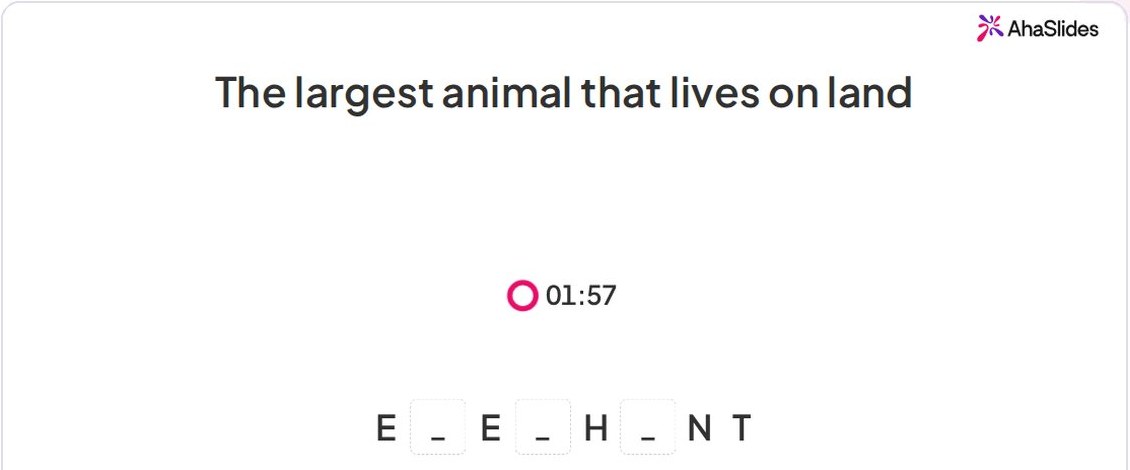
Show a word with a few letters taken out, plus a clue, and students fill the gaps. "E _ E _ H _ N T, the largest animal that lives on land." It works on the letters students get wrong, such as the double s in "necessary", and the clue checks they know what the word means too.
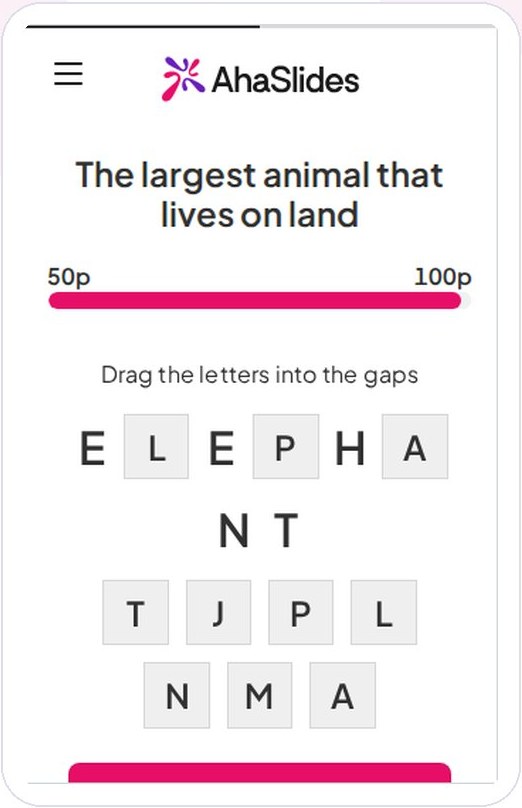
On AhaSlides to Brakujące litery slide. Students drag letter tiles into the gaps on their phones, so nobody has to type, and faster correct answers score more.
On paper: write the word with gaps on the board and give everyone a mini whiteboard.
2. Spot the correct spelling
Give four versions of a word, one spelt correctly: "seperate", "separate", "separete" or "seprate"? Students pick the right one. On AhaSlides to Wybierz odpowiedź ślizgać się.
On paper: write the four versions on the board as 1, 2, 3 and 4, and students write their number on a mini whiteboard.
3. Right or wrong
Show one spelling and ask if it is right. "Tommorow" is a good start. On AhaSlides to Prawda czy fałsz ślizgać się.
On paper: students write R or W on a mini whiteboard.
4. Spell it from the clue
Give only the clue, "The day after today", and students write the whole word with no hints. This is the hardest game here, so save it for words the class has already practised. On AhaSlides to Krótka odpowiedź ślizgać się.
On paper: a classic quick-fire test, but swap papers and mark each other's.
5. Dokończ zdanie
Show a sentence with one word missing: "Please write your ___ on the envelope." Students fill in "address". On AhaSlides to Wypełnij puste miejsca ślizgać się.
On paper: read the sentence aloud and pause at the gap.
6. Sort by spelling pattern
Give a mix of words and two groups, such as words ending in "-tion" and words ending in "-sion", or a silent k and a silent w. Students put each word in the right group. On AhaSlides to Kategoryzować ślizgać się.
On paper: two columns on the board and a sticky note for each student.
7. Word cloud warm-up
Ask "Type a word with a silent letter" and watch the answers grow on screen. The most common words appear biggest, and misspellings often show up as separate words, which gives you something to talk about. On AhaSlides to Chmura słów ślizgać się.
On paper: students call out words while you write them up.
Round 1: everyday words
Ten words for younger learners, on animals and things around the home. Each one has a clue, the word, and how it looks with the letters hidden.
Set A: animals
- Clue: the largest animal that lives on land. Word: elephant. Show: E _ E _ H _ N T
- Clue: the tallest animal in the world. Word: giraffe. Show: G I R _ F F _
- Clue: a bird that swims but cannot fly. Word: penguin. Show: P E N G _ I N
- Clue: an insect with large, colourful wings. Word: butterfly. Show: B U T T _ R F L _
- Clue: an animal with long ears that hops. Word: rabbit. Show: R A _ B I T
Set B: around the home
- Clue: the room where you cook. Word: kitchen. Show: K I _ C H E N
- Clue: you look through it to see outside. Word: window. Show: W I N D _ W
- Clue: you open it when it rains. Word: umbrella. Show: U M B R E _ _ A
- Clue: it has two wheels and pedals. Word: bicycle. Show: B I _ Y C L E
- Clue: you write with it and can rub out your mistakes. Word: pencil. Show: P E N _ I L
Our pick: word 6, kitchen. Many learners leave out the t in "kitchen" because it is silent. Hiding the t shows who has spotted it.
Round 2: words people often get wrong
Ten words for older students and adults: double letters, tricky vowels and silent letters.
Set A: double letters
- Clue: needed, you cannot do without it. Word: necessary. Show: N E _ E S _ A R Y
- Clue: to have enough room for someone. Word: accommodate. Show: A C _ O M _ O D A T E
- Clue: the day after today. Word: tomorrow. Show: T O M O R _ O W
- Clue: where you live. Word: address. Show: A D _ R E S _
- Clue: the start of something. Word: beginning. Show: B E G I N _ I N G
Set B: tricky vowels and silent letters
- Clue: the beat in a piece of music. Word: rhythm. Show: R _ Y T H M
- Clue: to keep things apart. Word: separate. Show: S E P _ R A T E
- Clue: without any doubt. Word: definitely. Show: D E F I N _ T E L Y
- Clue: the day in the middle of the working week. Word: Wednesday. Show: W E _ N E S D A Y
- Clue: the shortest month of the year. Word: February. Show: F E B _ U A R Y
Our pick: word 12, accommodate. It has two double letters, and it is easy to remember only one of them. Hiding one c and one m checks both in a single question.
Round 3: topic words and workplace terms
Ten words for a science lesson or a training session. Trainers can swap in their own product names or team terms using the same pattern: a plain clue, then the tricky letters hidden.
Set A: science words
- Clue: the gas we need to breathe. Word: oxygen. Show: O X _ G E N
- Clue: all the bones in your body. Word: skeleton. Show: S K E L _ T O N
- Clue: how hot or cold something is. Word: temperature. Show: T E M P _ R A T U R E
- Clue: when water heats up and turns into a gas. Word: evaporation. Show: E V A P _ R A T I O N
- Clue: how plants make food from sunlight. Word: photosynthesis. Show: P H O T O S _ N T H E S I S
Set B: workplace terms
- Clue: a person you work with. Word: colleague. Show: C O L L E _ G U E
- Clue: a plan of when things will happen. Word: schedule. Show: S C _ E D U L E
- Clue: a set of questions people fill in. Word: questionnaire. Show: Q U E S T I O _ N A I R E
- Clue: the slip that proves you paid. Word: receipt. Show: R E C E I _ T
- Clue: the link that keeps two teams in touch. Word: liaison. Show: L I A I _ O N
Our pick: word 29, receipt. It is easy to leave out the p, so a quick round on it shows who has been spelling it right all along.
Tips for running spelling games in class
- Play the same words again next week. Karpicke and Roediger found that testing words again had a large positive effect on later recall, while studying words they could already recall had no effect. A five-word set at the start of every lesson is an easy way to put that to work.
- Hide the letters students get wrong. Hiding the first letter of "rabbit" tests nothing. Hide one of the double letters, the silent letter or the vowel people swap.
- Always give a clue. A clue turns a spelling drill into a vocabulary check, because students have to know the word before they can fill the gaps.
- Start easy, then add wrong letters. Begin with no extra wrong letters so everyone gets a few right. Add more once the class is warmed up.
- Talk about the near misses. When the answer appears, ask what people tried. The most common wrong spelling is usually your next lesson.
Ways to host spelling games on AhaSlides
AhaSlides is an all-in-one engagement platform for teams and classrooms. You put the words on slides, show the board, and students join from a phone or tablet with a code, so everyone answers at once without you collecting a single sheet of paper.
Missing Letters: the letter tile game
Missing Letters is in beta and available on every AhaSlides plan, including the free one.
Add a new slide, search "Missing Letters", and you will find it in the Quiz group. Type the clue, enter the word, then click the letters you want to hide. Set the extra wrong letters between 0 and 8: 0 makes an easy round, more makes students think harder. Here is how word 1 from Round 1 looks on the big screen:
On their phones, students see the same clue, the word with its gaps and a tray of letter tiles. They drag a tile into each gap and tap Submit. Each player submits once, the answer only scores when every gap is right, and faster correct answers earn more points (a setting that is on by default). A leaderboard slide follows automatically.
Six more slides for the other games
- Pick Answer: spot the correct spelling. Use word 17 with "seperate", "separate", "separete" and "seprate".
- True or False: right or wrong. "Tommorow is spelt correctly" (word 13).
- Short Answer: spell it from the clue. "The beat in a piece of music" (word 16).
- Fill in the Blanks: finish the sentence. "Please write your ___ on the envelope" (word 14).
- Categorise: sort by pattern. Sort words 11 to 15 into "one double letter" and "two double letters".
- Word Cloud: the warm-up. "Type a word with a silent letter."
The quickest way to start is to open the ready-made Missing Letters game below and play it as your next lesson's warm-up. For every setting, from the hidden letters to the time limit, see the Missing Letters guide.
PYTANIA I ODPOWIEDZI
What are some fun spelling games for the classroom?
Missing letters, spot the correct spelling, right or wrong, spell it from the clue, finish the sentence, sorting by spelling pattern and a word cloud warm-up. They all let the whole class answer at once, so nobody waits for a turn.
How do you make spelling practice fun?
Turn it into a short game with a clue, a timer and points. Fill-the-gap games such as missing letters feel like a puzzle rather than a test, and a leaderboard adds a little friendly competition.
How many spelling words should you practise at once?
Around 5 for a game. That is why the 30 words above come in sets of 5: one set fits the start or end of a lesson, and you can play it again the next week.
What is a missing letters game?
A word game where some letters of a word are hidden and players fill the gaps. On AhaSlides it is the Missing Letters slide: players drag letter tiles into the gaps on their phones, and faster correct answers score more.
Can adults play spelling games too?
Yes. Round 2 and the workplace terms in Round 3 are built for older students and adults. Trainers can use the same game for product names or team terms that people often misspell.
More word games for your class
For more ideas, try these gry lekcyjne ze słownictwem, Nasz Gry klasowe ESL or a round of the wypełnij pustą grę. If you want games beyond spelling, see our fajne gry do grania w klasie.