
Poor onboarding costs more than most organizations want to admit. SHRM estimates that up to 20% of employee turnover happens within the first 45 days [1], and BambooHR research puts the average window for making a lasting impression at just 44 days [2]. When that window closes badly, replacing the person costs anywhere from $7,500 to $28,000 in hard costs alone [1].
Digital onboarding is the use of technology to deliver, manage, and track the onboarding process for new employees. That includes digital paperwork, self-paced training modules, automated task workflows, video content, virtual introductions, and live online sessions. The goal is the same as traditional onboarding: get people productive, connected, and confident faster. The difference is that digital tools let you do it at scale, across locations, with consistent quality.
This post covers what digital onboarding actually involves, why it outperforms paper-and-in-person processes on most measures, what good looks like in practice, and where HR and L&D teams typically go wrong.
What digital onboarding includes
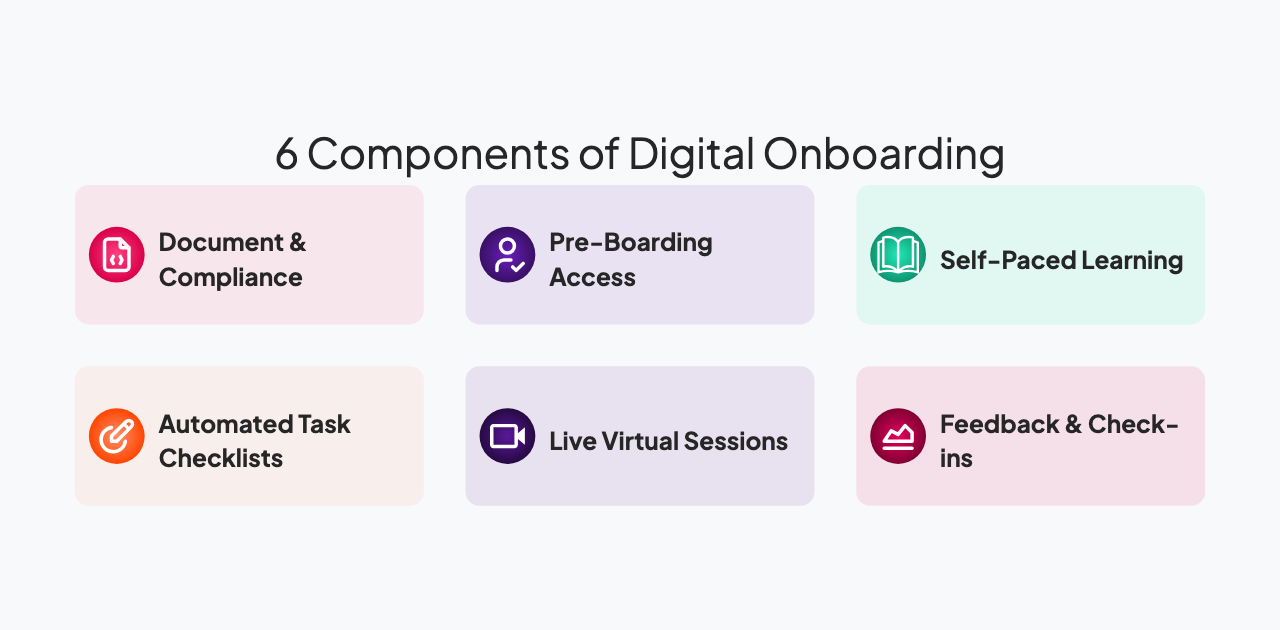
Digital onboarding is not just scanning forms and emailing a welcome packet. A complete digital onboarding program typically spans several categories.
Document and compliance management. E-signature tools handle contracts, tax forms, and policy acknowledgments before day one. Automated reminders follow up on anything incomplete. This alone removes the most common friction point in the first week.
Pre-boarding access. Sending login credentials, a company handbook, and an introductory video in the week before a hire starts reduces day-one confusion significantly. GitLab, which operates as a fully distributed company, gives new hires early access to its comprehensive team handbook so they arrive already familiar with how the organization works.
Self-paced learning modules. HR and L&D teams build role-specific training that new hires complete at their own pace. This replaces day-long orientation sessions where information is forgotten almost immediately. Research from the AIHR suggests that video-based content improves information retention by up to 67% compared to static materials [3]. AhaSlides' online kursusopretter is one way to build these modules without standing up a dedicated LMS.
Automated task checklists. Workflow automation tools assign tasks to both the new hire and their manager, with due dates and completion tracking. Nothing falls through the cracks because the system follows up rather than a person having to remember.
Live virtual sessions. Team introductions, Q&As with managers, culture sessions, and role walkthroughs happen over video. Zapier schedules brief virtual coffee meetings during pre-boarding so new hires already have relationships before their start date [4].
Feedback and check-ins. Pulse surveys at the end of week one, week four, and the 90-day mark give HR data on how new hires are actually experiencing the process, rather than assumptions.
Why digital onboarding outperforms traditional approaches
The comparison data is consistent across multiple sources. Organizations that use structured digital onboarding see:
- 69% higher likelihood that new hires stay for at least three years [3]
- 50% higher retention in the first 18 months compared to traditional onboarding [3]
- Up to 54% greater productivity among new hires in the early months [3]
The mechanism is straightforward. Traditional onboarding is heavily dependent on individual managers, who vary enormously in how much time and attention they give new hires. Digital onboarding moves the core process into a system that runs consistently regardless of which manager is involved or how busy that week happens to be.
There is also a timing advantage. Traditional onboarding often compresses too much information into the first one or two days, which is ineffective from a learning standpoint. A digital program spreads content across the first 30 to 90 days, pacing new hires through information as they need it rather than all at once.
Hybrid (digital plus human) programs consistently outperform purely digital ones in satisfaction scores. The research is not an argument for removing human contact; it is an argument for using technology to make the human touchpoints count, rather than spending manager time on paperwork and logistics that a system can handle.
A real-world example: Shopify's distributed onboarding
Shopify operates across dozens of countries with a large remote workforce. Its digital onboarding program includes a $1,000 home office stipend and company-issued equipment shipped before day one, structured 30-60-90 day plans that give new hires clear milestones, and a real project with defined deliverables in the first 90 days [4].
The project component is particularly notable. Rather than treating the first quarter as purely observational, Shopify has new hires contribute real work early. That approach serves two purposes: new hires gain confidence faster, and managers get an accurate read on where someone is actually performing well and where they need more support.
The 30-60-90 day structure also makes the feedback cycle meaningful. Check-in conversations happen against a written plan, not just general impressions. That specificity makes both praise and correction more actionable.
Common mistakes in digital onboarding programs
Treating it as a document delivery problem. A lot of organizations digitize their existing onboarding paperwork and call it a digital program. That eliminates friction but does not actually improve how new hires learn the role, understand the culture, or build relationships. The document layer is table stakes, not the whole solution.
Overbelastning i uge et. The instinct to front-load information is understandable but counterproductive. BambooHR found that 70% of new hires decide whether a job is the right fit within the first month, with 29% making that call in the first week [2]. Overwhelming people with content in week one does not accelerate confidence; it produces anxiety.
No human anchor. Purely self-service digital onboarding leaves new hires feeling like they are processing HR requirements in a vacuum. A dedicated buddy, a scheduled manager check-in on day three, or even a short welcome video from the team leader changes the experience significantly.
Skipping the feedback loop. Completing the onboarding checklist is not the same as knowing whether it worked. Pulse surveys at set intervals tell you whether new hires feel prepared, connected, and clear on expectations. Without that data, you are running the same program for years without knowing where it is failing.
Assuming one program fits every role. A digital onboarding program for a sales hire and one for an engineering hire will look different in terms of tools, systems, key contacts, and success metrics. Generic programs that do not account for role-specific needs leave new hires uncertain about what good performance looks like in their specific context.
Building feedback into the process with AhaSlides

One of the gaps in many digital onboarding programs is the check-in. Email surveys sent at the 30-day mark have low completion rates, and the results land in a spreadsheet that a busy HR manager reviews weeks later.
Running onboarding check-ins as live sessions changes the dynamic. HR teams use AhaSlides to run structured 30- and 90-day check-ins with cohorts of new hires, using rating scales to measure how prepared, connected, and clear on expectations people feel, with open-ended word clouds and Q&A to surface specific issues. Because results appear in real time and are visible to the group, new hires can see that their experience is not unique, and the conversation that follows tends to be more candid than a private survey would produce.
The same format works for manager-led team introductions and role-specific Q&A sessions during the first week, where polling and anonymous questions make it easier for people to ask things they would hesitate to raise in a one-on-one.
What a 90-day digital onboarding timeline looks like
A practical structure for most roles:
Before day one: Send equipment and access credentials, pre-boarding module covering company handbook and culture, brief welcome video from the team lead, introductory virtual coffee scheduled with a buddy or peer.
Uge et: Orientation session (virtual or in-person) covering the big picture, access walkthroughs for core tools, 1:1 with direct manager to align on 30-day goals, end-of-week pulse check.
Dage 8-30: Role-specific learning modules paced across the month, weekly 1:1 with manager, introductions to key cross-functional contacts, 30-day check-in survey.
Dage 31-90: Project-based work with defined deliverables, declining frequency of formal check-ins as the person becomes independent, 90-day review conversation against the original plan.
The 90-day mark is where most digital onboarding programs formally end. In practice, the work of integrating a new hire into a team takes longer. Building a lightweight continuation into the program, such as a six-month survey and manager conversation, captures issues that emerge after the formal process closes. It also signals to new hires that the organization's investment in their success did not expire when the checklist did.
Ofte stillede spørgsmål
How is digital onboarding different from remote onboarding?
Remote onboarding refers to onboarding a person who works from a location away from the main office. Digital onboarding refers to the tools and methods used to run the onboarding process. A remote hire almost always goes through a digital onboarding program, but so does an in-office hire at a company that has digitized its process. The distinction matters because some teams assume digital onboarding is only for distributed workforces. In practice, the benefits of structured digital programs, including consistency, trackability, and self-paced learning, apply regardless of where the person is physically located.
How long should a digital onboarding program run?
Most programs are structured around a 30-, 60-, or 90-day framework, with 90 days being the most common endpoint. That said, research on time-to-productivity for complex roles suggests that true performance ramp can take six months to a year. A 90-day program is a reasonable starting point, but HR teams that add a lightweight six-month check-in, a brief survey and a manager conversation, often catch problems that only surface after the formal program closes. The goal is not just completing the program; it is knowing whether the person is actually set up to succeed.
What tools do you need to run digital onboarding?
The short answer is fewer than most vendors will suggest. The core requirements are an e-signature tool for compliance documents, an LMS or similar platform for structured learning content, a task management system that can assign and track completion for both the new hire and their manager, and a video tool for live sessions. Many HR teams start with the systems they already have, such as their HRIS, a basic LMS, and a video conferencing tool, before investing in a dedicated onboarding platform. A well-designed program with simple tools will outperform a poorly designed one running on expensive software. The decision to add a purpose-built onboarding platform makes more sense once you have a clear picture of where your current process is breaking down, since buying software before diagnosing the problem tends to result in a more expensive version of the same gaps.
Kilder
[1] SHRM. New employee onboarding guide. https://www.shrm.org/topics-tools/news/talent-acquisition/new-employee-onboarding-guide-talent-acquisition
[2] BambusHR. Førstehåndsindtryk er altafgørende: 44 dage til at sikre eller ødelægge en nyansættelse. https://www.bamboohr.com/resources/data-at-work/data-stories/2023-onboarding-statistics
[3] AIHR. 27+ employee onboarding statistics and trends you must know in 2026. https://www.aihr.com/blog/employee-onboarding-statistics/
[4] EMHub. Remote onboarding at scale: The Shopify Way. https://emhub.io/articles/remote-onboarding-at-scale-the-shopify-way; About Hire. Remote onboarding best practices for 2025 success. https://abouthire.com/remote-onboarding-best-practices/