
Corporate training budgets are significant. The global workplace training market reached $401 billion in 2024 [1], but money alone doesn't determine outcomes. A week-long leadership retreat can produce nothing measurable, while a well-designed 45-minute compliance module can measurably cut incident rates. What separates effective programs from expensive ones is usually clarity: a clear audience, a clear skill gap, and a clear way to measure whether the training worked.
The stakes are higher than most budget conversations acknowledge. AhaSlides investigacion found that 69.8% of professionals say poor attention during training and meetings directly affects their productivity, and 33.3% say it reduces job satisfaction. Training programs that fail to engage don't just waste budget; they actively cost organizations in output and retention.
This guide covers the most common corporate training types, with concrete examples of each and notes on format, delivery, and measurement.
What counts as corporate training?
Corporate training is any structured learning activity an organization runs to develop employee capabilities, meet regulatory requirements, or support business performance. That's a wide net. It includes everything from a new-hire's first week of orientation to a VP's executive coaching program. What ties these together is intention: the organization has identified something employees need to know or be able to do, and has built a program to close that gap.
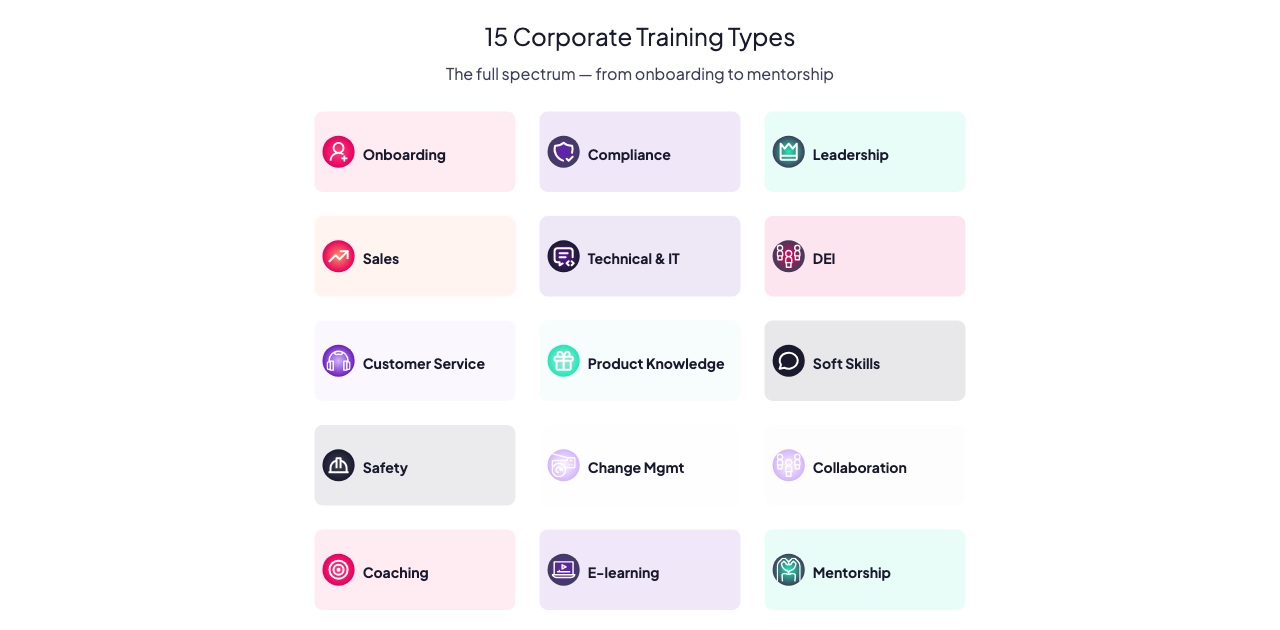
1. Onboarding and new-hire orientation
Onboarding is where most organizations have the highest leverage because the cost of early turnover is steep. Replacing an employee can cost anywhere from 50% to 200% of their annual salary [2], depending on the role. Strong onboarding compresses the time it takes new hires to become productive and signals that the company takes development seriously.
A structured onboarding program at a mid-size SaaS company, for example, might combine a 3-day instructor-led orientation (company values, systems access, team introductions) with a 30-60-90 day plan built around role-specific checkpoints. Weekly manager check-ins during the first 90 days let both parties spot gaps early.
Onboarding takes a meaningful slice of training budgets, around 11% in 2024, behind the largest categories of compliance and management development, which are tied at 13% [3].
2. Compliance and regulatory training
Compliance training covers legal obligations: workplace safety, data protection (GDPR, HIPAA), anti-harassment, code of conduct, and industry-specific regulations. For many organizations it's non-negotiable: failing to demonstrate that employees were trained can result in regulatory fines or liability.
Despite its mandatory nature, compliance training has a low satisfaction rate. Only 23% of employees rate their compliance training as 'excellent' [3], and many programs run far longer than the role actually requires. The fix is usually modularization: short, role-specific courses that cover only what's relevant to each employee's job, rather than one-size-fits-all e-learning marathons.
Delivery is predominantly online: 91% of organizations deliver at least some compliance training via e-learning [3].

3. Leadership development
Leadership programs target current and future managers. They typically cover decision-making, strategic thinking, coaching, performance conversations, and cross-functional communication. The business case is well-supported: 70% of the variance in team engagement is attributable to the manager [4], so improving manager capability has a multiplier effect across the organization.
A common format is a cohort-based program running over 3-6 months, mixing workshops, peer learning, and individual coaching. IBM's leadership development curriculum, for example, uses a blend of in-person labs, online modules, and 360-degree feedback tools, with participants working on real business challenges as part of the program rather than simulations.
4. Formación en ventas
Sales training targets the skills that directly affect revenue: product knowledge, consultative selling, objection handling, negotiation, and pipeline management. Unlike some training types, sales training has relatively direct metrics: quota attainment, average deal size, ramp time for new reps.
A well-structured example: a B2B software company might run a two-week new-rep ramp program combining product certification (self-paced), sales methodology training (instructor-led), and live call coaching with recordings reviewed in small groups. After the initial ramp, ongoing training is monthly, tied to specific deal patterns spotted in the CRM.
5. Technical and IT skills training
Technical training covers software, tools, programming languages, data systems, and engineering practices. It's often delivered just-in-time, with employees learning a tool when they need to use it rather than front-loaded in a catalog.
Microsoft's internal training model for its engineering teams uses a mix of internal documentation, hands-on labs, and peer-led sessions for new platform rollouts. For external-facing certifications (Azure, AWS, etc.), companies often cover exam costs and provide study time as part of a skills-development benefit.
6. Diversity, equity, and inclusion (DEI) training
DEI training ranges from awareness sessions (understanding bias and representation) to structured skill-building (inclusive hiring practices, managing across difference). The more effective programs move beyond one-off workshops and build DEI into ongoing processes: interview calibration, promotion reviews, and meeting facilitation norms.
A credible example: Starbucks closed all US stores in 2018 for a single day to deliver mandatory anti-bias training to 175,000 employees following a widely publicized incident. While the single session was largely symbolic, it was followed by longer-term curriculum changes to hiring and management development, which represents a more sustainable approach.
7. Customer service training
Customer service training equips frontline employees with the product knowledge, communication skills, and problem-solving approaches needed to handle customer interactions effectively. In sectors like retail, hospitality, and financial services, this training has a direct line to customer satisfaction scores and retention.
Zappos is a widely cited example: new customer service employees go through a four-week onboarding program that immerses them in company culture and customer philosophy before they take a single call. The program includes an offer at the end of the first week, a cash payment (around $2,000) to leave or stay.
The opt-in structure filters for cultural fit.
8. Product and knowledge training
Product training ensures employees understand what the company sells well enough to explain, recommend, or support it. This applies to sales, customer support, and technical teams.
Format varies by complexity. For a software product, this might be a combination of sandbox environments where employees can test features, internal wikis, and short recorded walkthroughs. For a physical product line, training might use hands-on product demonstrations alongside guided scenarios based on real customer questions.
9. Soft skills training
Soft skills, such as communication, time management, conflict resolution, emotional intelligence, and presentation skills, are consistently flagged in workforce surveys as gaps that technical hiring can't fill. They're also harder to train because they require behavioral change, not just knowledge transfer.
The most effective soft skills programs combine instruction with structured practice. A communication skills course that includes recorded role-play exercises reviewed with a coach, for example, tends to produce more lasting behavior change than a lecture-based session alone.
10. Safety training
Safety training is legally required in most industries and operationally critical in construction, manufacturing, healthcare, and logistics. OSHA in the United States mandates specific safety training for high-hazard work, and organizations are required to document who was trained and when.
Effective safety training is not just about passing a test; it's about ensuring the training is retained and applied. Simulation-based training, regular drills, and job-site coaching produce better safety outcomes than annual e-learning modules completed as a checkbox.
11. Change management training
When an organization undergoes a major shift, such as a system migration, restructuring, merger, or strategic pivot, change management training helps employees understand what's changing, why, and what's expected of them. Without it, change initiatives frequently stall because employees revert to existing behaviors.
A typical program for a CRM rollout might include: a kick-off session explaining the business case, role-specific training on new workflows, manager briefings on coaching employees through the transition, and a feedback mechanism so implementation issues surface quickly.
12. Cross-functional and collaboration training
As organizations become more matrix-structured, collaboration across teams with different functions and priorities becomes a skill in itself. Training in this area might cover project management basics, facilitation, conflict resolution across reporting lines, and communication norms in distributed teams.
Remote-first companies like GitLab have built this into their operating handbook, documenting how decisions are made, how meetings should run, and how disagreements should be escalated, with training integrated into onboarding and reinforced through manager development.
13. Coaching and mentoring programs
Coaching-based development pairs employees with internal mentors or external coaches to work on specific goals. Unlike training courses, coaching is individualized and typically tied to a specific career challenge or development priority.
LinkedIn's 2024 Workplace Learning Report found that 94% of employees would stay longer at a company that invests in their learning and development, with coaching and mentoring among the factors they value most [5]. Organizations increasingly formalize mentoring through structured matching, conversation guides, and defined program timelines to get consistent outcomes rather than relying on informal relationships.
14. E-learning and self-paced programs
Self-paced e-learning allows employees to complete training on their own schedule, in the flow of work. It's the dominant delivery mode for compliance training and is growing for skills development as learning platform technology (LMS, LXP) has improved.
The risk with self-paced e-learning is completion. Without scheduled sessions and social accountability, many employees don't finish voluntary courses. Effective self-paced programs use short modules (10-15 minutes), apply learning in real tasks rather than isolated quizzes, and integrate progress visibility into manager dashboards. Many L&D teams now build these modules directly in an creador de cursos en línea, which keeps content creation and completion tracking in one place instead of splitting them across separate authoring and LMS tools.
15. Mentorship and peer learning communities
Peer learning is one of the most underused formats in corporate training. It leverages the expertise already inside the organization and builds cross-team relationships at the same time. Communities of practice, structured groups around a shared skill or domain, give employees a regular venue to share knowledge and solve problems together.
Microsoft uses internal communities of practice extensively, with thousands of employee-led groups covering technical disciplines, product areas, and soft skills. These run alongside formal training, not instead of it, but they keep skills current between formal learning events.
Cómo elegir el formato correcto
Training format should follow the learning objective, not the other way around.
ObjectiveFormat that fitsMeet a legal requirementSelf-paced e-learning with trackingBuild a behavioral skillWorkshop + practice + coachingTransfer complex knowledgeInstructor-led with case studiesSupport a system rolloutBlended: instructor-led + job aidsDevelop future leadersCohort program with peer learningScale product knowledgeSelf-paced + sandbox environment
The biggest error in L&D is treating all training as equivalent in format: assuming that an e-learning module can do what a coaching conversation requires, or scheduling a full-day workshop for something a 15-minute guide would handle. Matching format to objective is where most of the ROI comes from.
Medir si la capacitación funcionó
Kirkpatrick's four-level model is the standard framework for training evaluation [6]. Level 1 measures reaction (did participants find it useful?), Level 2 measures learning (did they gain knowledge or skill?), Level 3 measures behavior (are they applying it on the job?), and Level 4 measures results (did it affect business metrics?).
Most organizations measure Level 1 through post-training surveys. Fewer get to Level 3 or 4, which requires manager observation, performance data, or follow-up assessments weeks after training. The gap between Level 1 satisfaction scores and Level 3 behavior change is where most training programs lose their claimed ROI.
Running training with AhaSlides
Live training sessions, whether onboarding, leadership workshops, or compliance reviews, tend to lose participants when they're one-directional. This isn't a small problem: AhaSlides investigacion found that 70.2% of corporate trainers now use interactive tools as a standard part of their sessions, reflecting how central engagement has become to effective delivery. AhaSlides adds live polls, quizzes, Q&A, and word clouds to any session, letting trainers check comprehension in real time and surface questions from employees who wouldn't speak up otherwise.
For L&D teams running knowledge checks during a product training module, or facilitators running post-workshop reflections, AhaSlides gives you immediate data on where the group is rather than waiting for a follow-up survey that arrives days after the session.
Results are visible to everyone in the room, which changes the dynamic: participants see where their understanding aligns with or diverges from peers, and trainers can adjust the session on the spot rather than discovering gaps in a post-event report.
The tool goes beyond those four formats. AhaSlides ships 30+ interactive slide types and adds new ones roughly every month. The formats that suit corporate training span standard types, including Pick Answer (multiple-choice quiz), Categorise, Match Pairs, Correct Order, Type Answer, Word Cloud, Open Ended, Q&A, Rating Scale, Spinner Wheel, Brainstorm and Idea Board, alongside newer ones like True or False, This or That, Fill in the Blanks, Draw Answer, 2x2 Matrix, Split the Points, Duck Race and a YouTube-to-quiz tool. A few of the newer ones fit the training types above:
- Dibujar respuesta lets participants sketch on their phones, with results shown live on screen. Use it as a comprehension check in product training by asking people to diagram how a feature works; more creatively, have a safety session sketch the correct evacuation route before you reveal it.
- Matriz 2x2 plots items on two axes as a quadrant grid. Use it in leadership development to map initiatives by effort versus impact; more creatively, have a change-management group place stakeholders on an influence-versus-support grid to plan communication.
- Repartir los puntos gives each person a pool of points to allocate across options, showing priorities rather than a single choice. Use it to decide which compliance topics need the deepest coverage; more creatively, have sales teams distribute a fixed budget across competing enablement ideas to reveal trade-offs.
- Tablero de ideas collects free-text ideas into columns the group can vote on. Use it for a structured brainstorm during a cross-functional workshop; more creatively, run a keep/stop/start retrospective after onboarding and vote the top fixes into a plan.
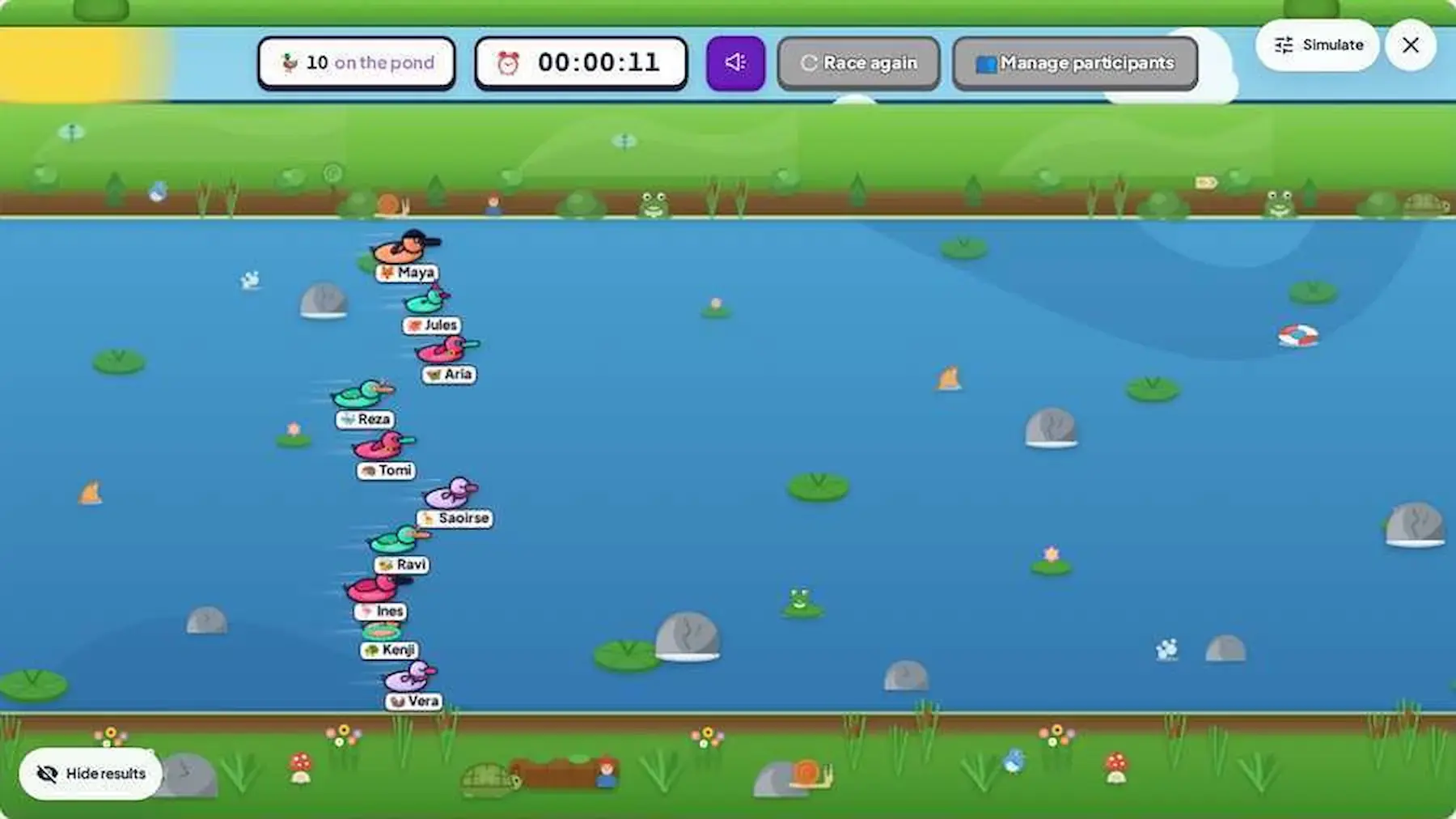
- Carrera de patos es un juego de selección aleatoria lúdico: una fila de patos de dibujos animados corre por la pantalla y uno gana al azar. Es una forma divertida y sin riesgos de romper el hielo, asignar una tarea, dar una recompensa o simplemente elegir un ganador, y está en vivo en AhaSlides now. Use it to choose which group presents first or to draw the winner of a training-quiz leaderboard; more creatively, run it as a mid-session energizer or to hand out a small prize, resetting attention without derailing the agenda.
Fuentes
[1] Training Industry. Informe del sector de la formación 2024. https://trainingindustry.com. Global workplace training market size data.
[2] SHRM. Measuring the ROI of Your Training Initiatives. https://www.shrm.org/labs/resources/measuring-the-roi-of-your-training-initiatives. Replacement cost estimated at 50 to 200% of annual salary.
[3] Training Orchestra. 80+ Corporate Training Statistics that Matter for 2026. https://trainingorchestra.com/employee-training-trends/. Compliance delivery data, budget allocation percentages, employee satisfaction rates.
[4] Gallup. Informe sobre el estado del lugar de trabajo mundial. https://www.gallup.com/workplace/349484/state-of-the-global-workplace.aspx. Manager influence on team engagement variance.
[5] LinkedIn Learning. Informe sobre el aprendizaje en el lugar de trabajo 2024. https://learning.linkedin.com/resources/career-development/develop-employees. 94% of employees would stay longer at a company that invests in learning; coaching and mentoring as retention factors.
[6] Kirkpatrick, D.L. & Kirkpatrick, J.D. Evaluating Training Programs: The Four LevelsEditorial Berrett-Koehler. https://www.kirkpatrickpartners.com/the-kirkpatrick-model/. Standard framework for training evaluation.