
Most organisations say they value continuous improvement. Far fewer run it as a habit rather than a slogan. The ones that do, from Toyota to a school district in New York, tend to share one trait: the people closest to the work are trusted to spot problems and fix them, and the fixes are checked before they are repeated.
This guide covers what continuous improvement is, the four frameworks behind it, six real examples with the lessons they offer, and how to get a cycle running in your own team.
Kas ir nepārtraukta uzlabošana?
Continuous improvement is the ongoing effort to make processes, products or services a little better, again and again. It is not a project with a finish line. The idea rests on two beliefs: no current process is as good as it could be, and the people doing the work are usually best placed to see where it breaks down.
The Japanese word for it is Kaizen, meaning "change for the better" [1]. Management consultant Masaaki Imai brought the term to a global business audience with his 1986 book Kaizen: The Key to Japan's Competitive Success, based on what he had seen at Toyota and other Japanese manufacturers.
The PDCA cycle behind most improvement work
Almost every improvement method runs on the same four-step loop, known as PDCA or the Deming cycle [2]:
- Plāns. Define the problem, the goal and how you will measure success.
- Ceturtdienu Try the change on a small scale, so a failure costs little.
- Check. Compare the results with the goal. Did the measure move?
- Rīkojies. If it worked, make it the standard way of working. If not, adjust the plan and go round again.
The loop never ends. Each "Act" becomes the starting point for the next "Plan".
Four continuous improvement methods
- Kaizen: small, frequent changes suggested by the people doing the job, usually with little or no capital spend.
- Lasīt: a way of working that removes anything that does not add value for the customer, such as waiting, rework and unnecessary handoffs.
- Six Sigma: a data-led approach, often organised as Define, Measure, Analyse, Improve and Control (DMAIC), that aims to cut defects and variation [3].
- Veikls: short delivery cycles with regular retrospectives, so the team learns and adjusts as the work goes on.
These are not rivals. Many organisations borrow from all four.
6 continuous improvement examples
1. Toyota: any worker can stop the line
Toyota's production system is the most cited example of continuous improvement, and for good reason. Any worker can pull an "andon cord" to stop the line when they spot a defect. The problem is dealt with straight away and the lesson goes back into the process so it does not return. Catching a fault at the source costs far less than finding it at the end of the line, or after delivery.
Small fixes count just as much. At Toyota's Tsutsumi plant, a tour guide disliked putting her bag on the floor while she spoke to visitors, so she suggested hooks on a catwalk railing. Her manager agreed and a colleague fitted them. It is a tiny change, but it shows the pattern: the person with the problem proposes the fix, and it is approved and made quickly [4].
Nodarbība: make it safe and easy to raise a problem, and thank the person who does.
2. Amazon: pulling the cord on customer complaints
Amazon borrowed the andon idea for customer service. According to Marc Onetto, then Amazon's head of worldwide operations and customer service, an agent who hears about a repeated defect can "stop the line" by taking the product off the website until the defect is fixed [5]. The company is also known for its "working backwards" habit of writing the customer-facing press release for a new product before building it, which forces the team to define what the improvement means for the customer.
Nodarbība: push the decision to the people who hear the problem first.
3. Virginia Mason Medical Center: stopping the line in a hospital
In 2002 the Seattle hospital Virginia Mason began adopting the principles of the Toyota Production System across the medical centre [6]. Its Patient Safety Alert system, modelled on the andon cord, lets staff raise the alarm about anything that could harm a patient. Improvement work also targeted everyday processes, including the time it took to get medication to patients [7].
Nodarbība: the method travels. Mapping a process, finding the delay and testing a fix works as well in a ward as on a factory floor.
4. Pearl River School District: PDCA in education
Pearl River School District in New York was one of the first education winners of the Malcolm Baldrige National Quality Award, in 2001. The district used the PDCA cycle to define most of its work, from the boardroom to the classroom. Between 1996 and 2001 the share of students graduating with a Regents diploma rose from 63% to 86% [8].
Nodarbība: decide what you will measure, and who owns the next iteration.
5. Software teams: the retrospective
Agile software teams build improvement into the calendar. At the end of every sprint, the team holds a retrospective: what went well, what did not, and which one or two changes to try next. Because the cycle is short, a bad idea is cheap to abandon and a good one compounds quickly.
Nodarbība: put improvement in the diary, so it does not depend on someone remembering.
6. Training teams: closing the feedback loop
Training departments that run post-session evaluations are already using PDCA: they plan the session, deliver it, check the feedback and adjust. The weak spot is usually Check. Forms get collected but rarely change the content.
A more deliberate approach:
- Define what good looks like before the session, such as a specific change in behaviour, not only satisfaction scores.
- Collect feedback during the session as well as after it.
- Pick the one or two changes with the biggest likely effect.
- Run the updated session and measure again.
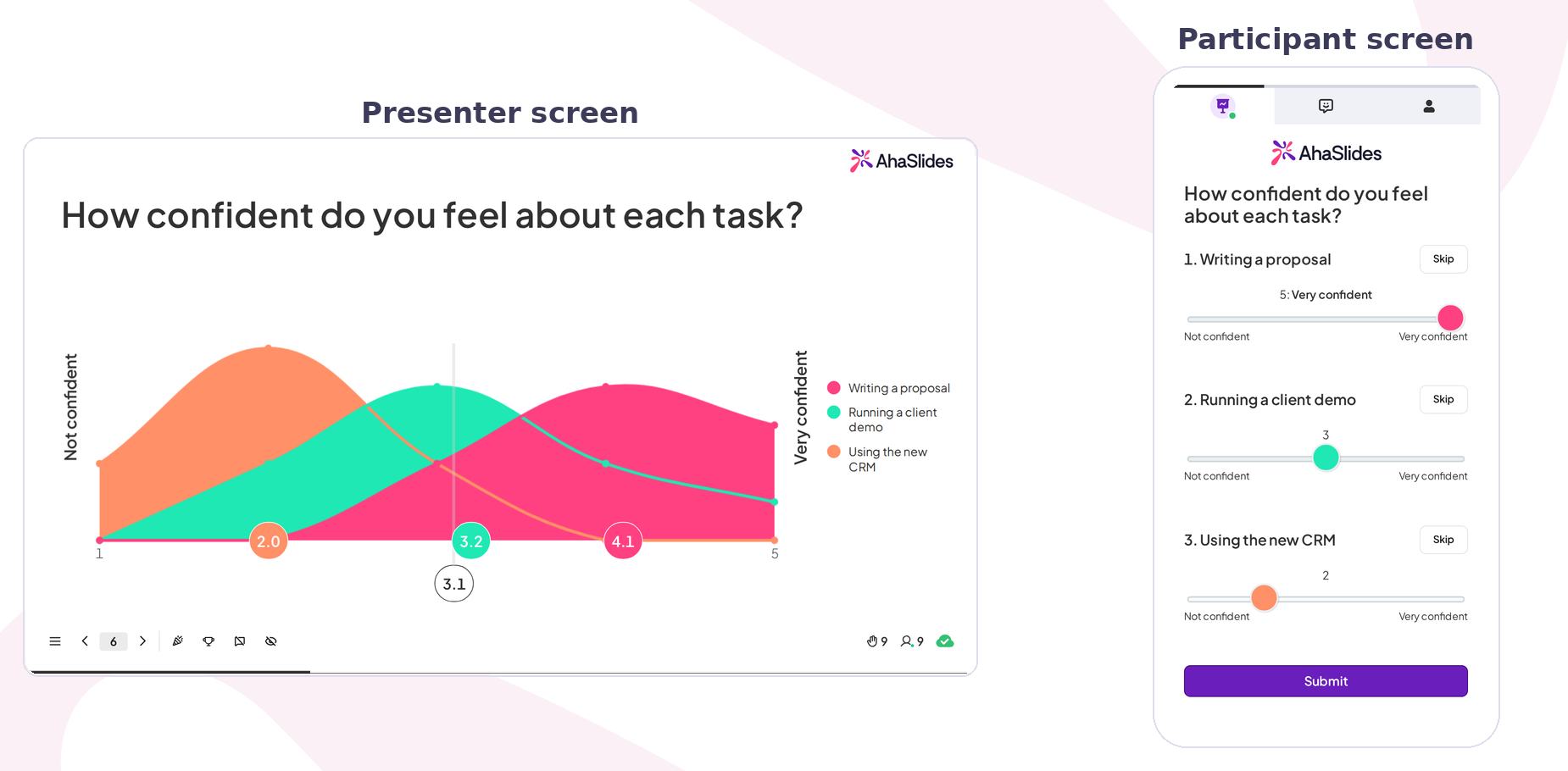
Asking during the session shortens the time between feedback and action. A rating scale slide in AhaSlides, for example, lets participants score several items at once and shows the group's spread on screen straight away, so the discussion starts from real numbers. You can also use a tiešraides aptauja for quick yes or no checks. For more on running sessions like this, see our guide to interaktīva apmācība.
Nodarbība: feedback only counts as improvement once it changes what you do next.
How to start your own improvement cycle
- Pick one process that causes regular friction, such as onboarding, handovers or meeting follow-ups.
- Ask the people who do the work where it slows down. A zivju kaula diagramma is a useful way to sort the causes.
- Choose one change and one measure, such as time taken or error rate.
- Try it on a small scale for a set period, then check the measure.
- Keep what worked, write it into the standard process and choose the next problem.
Common mistakes that stall continuous improvement
Treating it as a one-off project. A kaizen event delivers early gains, then the habit fades. Build improvement into weekly reviews, retrospectives and post-delivery debriefs instead.
Measuring effort, not outcomes. The number of workshops held says little. Track defect rates, cycle time or time to competence.
Skipping the Act step. Without updating the standard process, the next team that meets the same problem starts from scratch.
Leaving out the people who do the work. Improvements handed down from managers get compliance rather than commitment. Toyota's andon cord works because the line worker pulls it, not a quality manager.
Biežāk uzdotie jautājumi
What is the difference between continuous improvement and innovation?
Innovation is a big change, such as a new product or a redesigned process. Continuous improvement is many small changes made consistently. They work together: innovation sets a new baseline, and continuous improvement raises performance from there.
How do you know if a continuous improvement effort is working?
Check whether the loop is closing. Are problems raised at the source? Are changes tested and measured? Do the results feed the next cycle? If you are unsure about any of these, the Check or Act step has probably broken down. Run one full cycle on one process and use it as your reference.
Can small teams use continuous improvement?
Yes. With fewer approval layers between spotting a problem and fixing it, small teams often move faster. A five-person team can run a full PDCA cycle on one process in a few weeks.
Avoti
[1] ASQ. What is Kaizen? https://asq.org/quality-resources/kaizen
[2] ASQ. PDCA cycle: what is the Plan-Do-Check-Act cycle? https://asq.org/quality-resources/pdca-cycle
[3] ASQ. What is Six Sigma? https://asq.org/quality-resources/six-sigma
[4] Graban, M. Our Toyota tour guides' kaizen. Lean Blog. https://www.leanblog.org/2014/11/our-toyota-tour-guides-kaizen/
[5] Onetto, M. (2014). When Toyota met e-commerce: lean at Amazon. McKinsey Quarterly. https://www.mckinsey.com/capabilities/operations/our-insights/when-toyota-met-e-commerce-lean-at-amazon
[6] AHRQ Patient Safety Network. Innovation and lean thinking: mutually supportive partners in the transformation of health care. https://psnet.ahrq.gov/perspective/innovation-and-lean-thinking-mutually-supportive-partners-transformation-health-care
[7] LCMD. Kaizen examples: continuous improvement across industries. https://www.lcmd.io/en/blog/kaizen-examples-continuous-improvement-across-industries
[8] SSTI. Baldrige awardees include first in education category. https://ssti.org/blog/baldrige-awardees-include-first-education-category