
Ready-to-use wording for telling your manager what is working and what is not, plus how to do it without damaging the relationship.
Feedback only works when it flows both ways. Yet managers usually find it easier to give feedback than to receive it, and employees worry that honest comments will be heard as criticism. If that sounds familiar, this guide gives you the principles, the wording and a way to make it safer for everyone.
Why feedback to managers matters
Gallup's analysis of its engagement data found that managers account for at least 70% of the variance in employee engagement scores. Whatever your manager does, your team feels it. Upward feedback is one of the few ways to influence that.
When it is done well, it:
- Shows managers their blind spots. They often cannot see how their decisions land with the team.
- Bygger förtroende. When people can say what they think safely, decisions, problem-solving and ideas improve.
- Raises engagement. Managers who act on feedback show they care about their team's growth.
- Supports continuous improvement. A team that talks openly about how it works can fix problems early.
How to give feedback to your manager
Giving feedback upwards is awkward, but a few habits make it far easier to hear.
- Choose the right time and place. Pick a moment when neither of you is rushed or stressed, and somewhere private.
- Be clear and specific. Describe what happened, when, and how it affected you or the team. Stick to what you observed and avoid assumptions.
- Focus on behaviour, not character. "The deadline moved twice last week" is about an action. "You are disorganised" is about the person.
- Använd "jag"-uttryck. "I felt unsure about priorities when the brief changed" lands better than "You never give clear instructions".
- Lyssna på deras sida. Leave room for a reply. There may be context you have not seen.
- Suggest a way forward. A problem with a proposed fix is far easier to act on than a complaint.
- End on a positive note. Name something that is going well so the conversation closes constructively.
Manager feedback examples for common situations
Adapt the wording to your own situation. Each is written to name the issue and ask for a conversation, not demand a change.
Otydliga instruktioner
"When I receive tasks from you, I often feel unsure what you expect from me. Could we spend a few minutes agreeing the goals and what a good result looks like?"
Erkännande
"Our team worked hard on the last project and we would value some acknowledgement. Could we talk about how to celebrate it, or how contributions get recognised more often?"
Kommunikation
"I think our communication could be more effective. I would appreciate more timely, direct feedback on my work, and perhaps regular check-ins to review progress and blockers."
Workload and boundaries
"I would like to talk about my current workload. I am finding it hard to balance work and personal life. Could we prioritise my tasks and set realistic deadlines?"
Mental hälsa
"I have been dealing with some health issues that have affected my focus. I am getting support, but I wanted you to know in case you notice a dip in my output."
Mikroförvaltning
"I would like more ownership of my projects. Could we talk about how I can build your trust in my work, so I can work more independently?"
Lagkonflikt
"I have noticed some unresolved tension in the team. I think addressing it early would protect morale. Could we talk about how?"
Resurser
"A shortage of [specific resource or tool] is making it hard to finish tasks efficiently. Could we talk about how I can get what I need?"
Konstruktiv kritik
"I would appreciate more constructive criticism on my work. Knowing exactly where I can improve would help me progress in my role."
Delegation
"Work does not feel evenly shared at the moment. Some of us are overloaded and others have more capacity. Could we talk about how to delegate more fairly?"
Positive feedback to your manager
Upward feedback is not only for problems. Specific praise tells a manager which behaviours to keep doing.
- "I really appreciate how you listen to my thoughts and worries. It helps me feel valued."
- "Since joining the team I have learned a great deal from you. Your experience has been invaluable for my development."
- "Thank you for encouraging a healthy work-life balance. Having time away from work has been good for my wellbeing."
- "Your calm leadership through the recent crisis kept the team focused and on track."
- "Thank you for your support on the last project. Your guidance helped me do my best work."
- "Thank you for checking in last week when I seemed overwhelmed. I felt seen and heard."
- "Thank you for recognising our hard work. It shows that our effort is appreciated."
- "I appreciate your trust in me with new challenges. It has built my confidence."
- "Your clear and concise communication makes our goals and expectations easy to understand."
- "You have created an inclusive environment where teamwork and respect are the norm, and it shows in how we work."
Constructive feedback examples, by category
Raising problems with leadership
The goal is to start a conversation, not to point fingers.
- Resistance to new ideas: "I have noticed that suggestions from the team are not often explored. A more open approach to new ideas might bring fresh perspectives to our projects."
- Lack of recognition: "The team values encouragement. More frequent feedback on our work, positive and constructive, would boost morale and motivation."
- Poor conflict resolution: "I think conflict resolution within the team could be improved. Perhaps training or clearer protocols for handling disputes would help."
- Lack of direction: "A clearer view of the company's long-term goals, and how our work contributes to them, would help us focus."
- Close oversight: "Many of our tasks have close oversight, which can feel like micromanagement. With a little more autonomy, and your guidance when we need it, I think the team would feel more empowered."
Work-related issues
Be specific and bring a possible solution.
- Work overload: "My workload has increased significantly and I am concerned about the quality of my work. Could we discuss delegating or adjusting deadlines?"
- Resursbrist: "We are often short of [specific resource], which is slowing the team down. Could we look at better resource management?"
- Teamdynamik: "I have seen some challenges in [specific area]. Addressing them could improve collaboration. Might team-building or conflict-resolution support help?"
- Ineffective processes: "The current [process or system] seems to be causing delays and extra work. Could we review and streamline it?"
- Lack of training: "I need more training in [specific skill] to do my job well. Are there development or mentoring opportunities I could use?"
Missförstånd
Keep the tone collaborative and aim for shared clarity.
- Projektförväntningar: "There was some confusion about expectations for [project]. A short written brief with requirements and deadlines would help us stay aligned."
- Oklara instruktioner: "Some of the instructions in our last meeting were unclear, particularly about [task]. Could we go over them again?"
- Kommunikationsbrister: "Gaps in communication sometimes cause misunderstandings, especially over email. Could we agree a clearer format, or hold short follow-up meetings?"
- Inkonsekvent information: "I have seen inconsistencies in recent briefings about [topic]. Could we confirm the correct, current information?"
- Meeting follow-up: "After our last team meeting I think there may have been a misunderstanding about [point]. Could we revisit it and confirm next steps?"
Be om vägledning
Showing that you want to learn makes the request easy to say yes to.
- Karriärutveckling: "I am keen to progress. Could we schedule time to discuss my career path and which skills to build?"
- A hard project: "I am finding [specific part] of [project] challenging. I would value your advice on how to approach it."
- Prestanda: "I want to improve in my role. Where do you think I could do better, and which skills should I focus on?"
- Teamdynamik: "I have been trying to improve how the team works together. From your experience, what would you suggest?"
- Arbetsbelastningshantering: "I am finding it hard to manage my workload. Could you share techniques for prioritising or managing my time?"
Make upward feedback safer with anonymous collection
Most of the fear around feedback comes from attribution. If a comment can be traced to you, it carries a risk. If it shows up as part of a pattern across a team, it is much easier for a manager to take seriously.
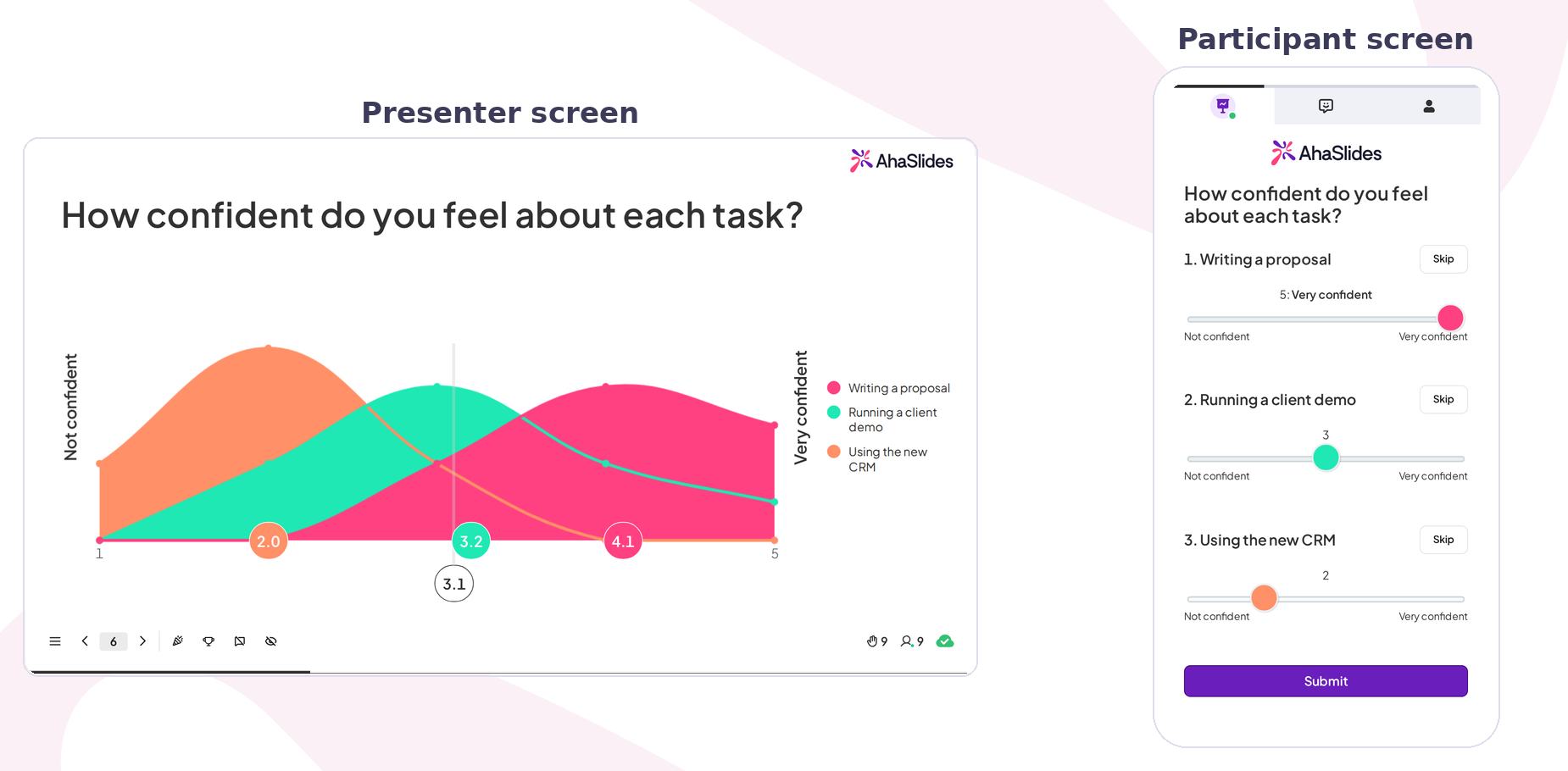
You can run this in a team meeting with AhaSlides. En bedömningsskala slide lets everyone score statements such as "I get clear direction" or "I get useful feedback" from their phone, and the spread of answers appears on screen. Because the team sees the results as a pattern, a lower score reads as a team signal, not a complaint from one person.
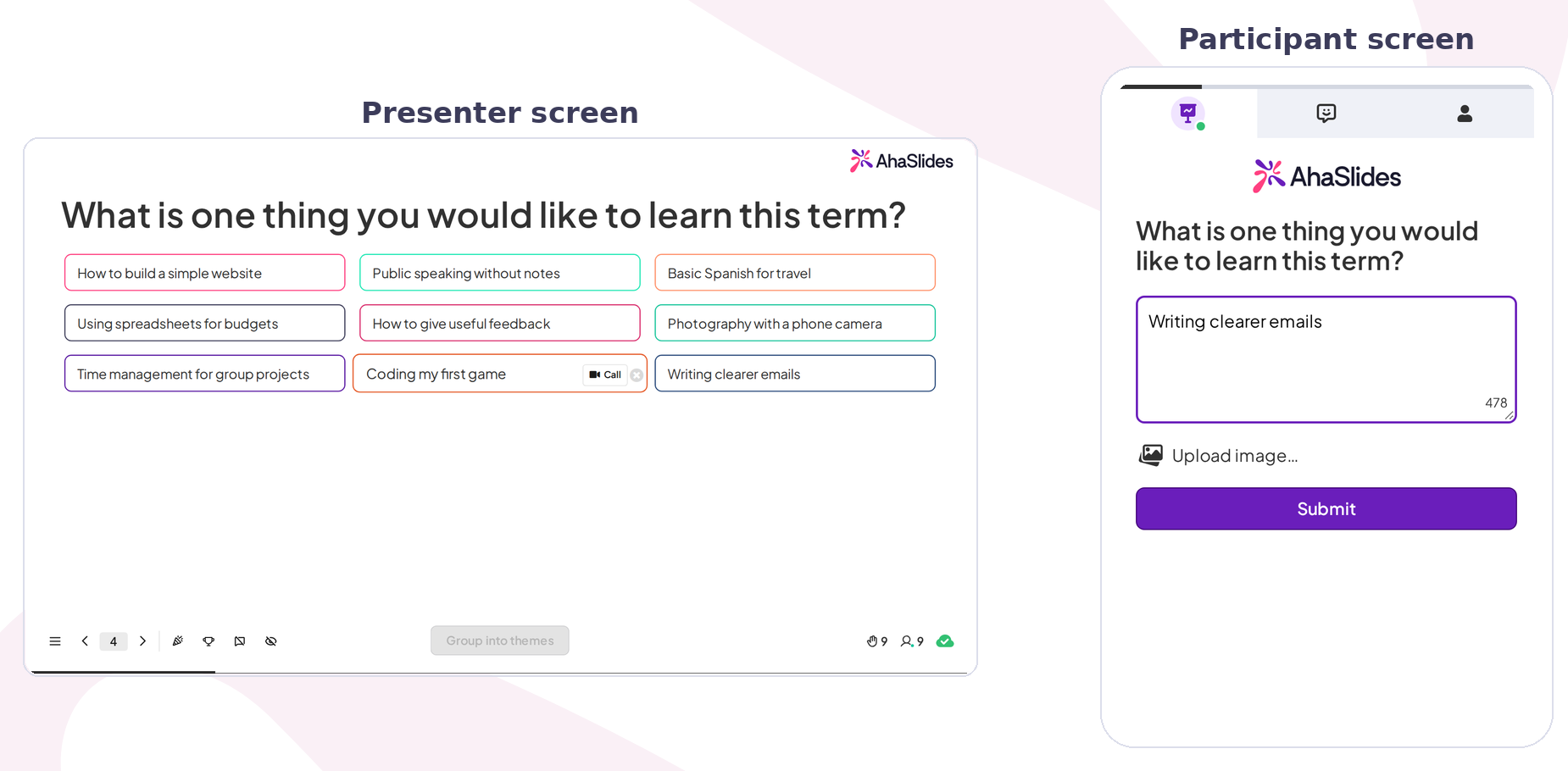
An Öppna Avslutat slide then collects suggestions in people's own words, such as "What is one thing I could do to support you better?". The comments appear together on screen, so the manager reads themes rather than individual messages. Check your join settings before the session so participants are not asked for their names.
If you would rather gather answers over a few days, the gratis undersökningsskapare works as a self-paced survey. The free plan supports up to 50 participants, so it fits a typical team. For more rating-scale wording, see our Exempel på Likertskala.
Vanliga frågor och svar
How do I give feedback to my manager? Choose a private moment, describe a specific situation and its impact, use "I" statements, listen to their view and suggest a way forward.
What is upward feedback? Feedback that flows from employees to their manager, as opposed to the usual manager-to-employee direction.
What are examples of positive feedback for a manager? "Thank you for checking in when I seemed overwhelmed" or "Your calm leadership through the recent crisis kept the team on track". Specific praise works better than general thanks.
How can employees give feedback anonymously? Use an anonymous survey or a live rating scale and open-ended slide in a team meeting, so the manager sees patterns rather than names.
How often should teams give feedback to managers? Regularly, not only at annual reviews. A short pulse check each quarter, plus informal check-ins, keeps issues small.