
10种游戏化学习游戏

Blog 缩略图

Students forget up to 70% of new information within 24 hours without reinforcement, a phenomenon researchers call the "forgetting curve" [3]. Traditional review methods such as re-reading or re-listening do little to slow it down. Game-based learning takes a different approach: it embeds content into an activity that demands active participation, immediate decisions, and repeated retrieval. The result is stronger retention and higher engagement, without sacrificing curriculum goals.

A meta-analysis of 65 studies found that game-based learning produced significantly better learning outcomes than conventional instruction, with particularly strong effects for motivation and long-term retention [1].

This post covers 10 types of game-based learning games and the top platforms where you can run them, whether you teach kindergarten, university, or corporate learners.

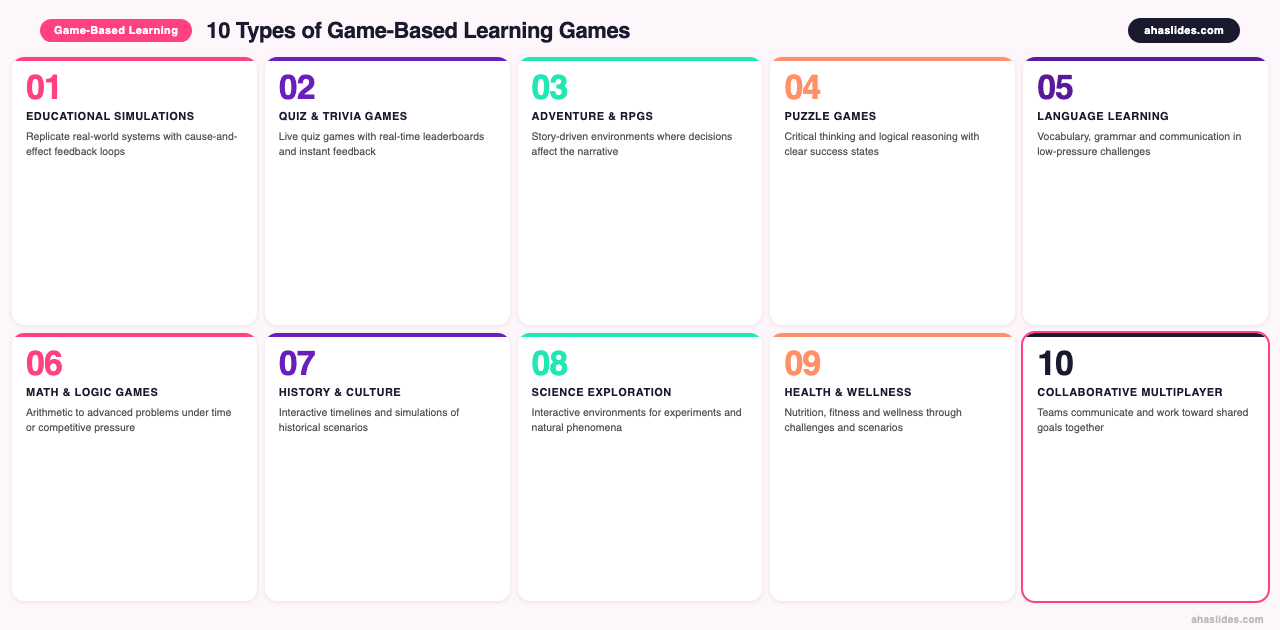
10 types of game-based learning games infographic

什么是基于游戏的学习?

Game-based learning (GBL) is an educational approach that integrates learning objectives into game mechanics. Rather than treating games as a reward bolted onto the end of a lesson, GBL places the learning inside the game itself: players solve problems, make decisions, and receive feedback as part of the gameplay loop.

This is different from gamification, which applies game-like elements (points, badges, leaderboards) to non-game activities. GBL uses actual games. The distinction matters because the mechanics of a well-designed game (challenge, immediate feedback, and mastery progression) directly support how people learn.

4 benefits of game-based learning games

Game-based learning works because it puts learners in an active role rather than a passive one. Four benefits show up consistently across research and practice.

First, stronger retention. Active retrieval during gameplay encodes information more deeply than re-reading or passive review. The act of recalling an answer under mild competitive pressure is itself a learning event.

Second, higher motivation. Games create intrinsic motivation through challenge, progress, and immediate feedback. Learners who are engaged stay longer and try harder than those who are not.

Third, lower anxiety. The game frame reduces the social stakes of getting something wrong. A wrong answer in a quiz game costs points. A wrong answer in front of the class costs face. That difference matters, especially for learners who disengage in traditional formats.

Fourth, real-time data for teachers. Live game platforms surface who knows what in real time, which lets teachers identify gaps and adjust instruction immediately rather than discovering them on a test two weeks later.

10种游戏化学习游戏

1. Educational simulations

Simulations replicate real-world systems and let learners interact with them in a controlled environment. A medical student can practice a diagnosis. A business student can run a simulated company. A chemistry student can carry out virtual experiments without safety risks.

The learning value comes from the cause-and-effect feedback loop: the learner makes a decision, sees the consequence, and adjusts. PhET Interactive Simulations from the University of Colorado Boulder is a well-established free resource in this category, offering hundreds of interactive science and math simulations for all ages at no cost.

2. Quiz and trivia games

Quiz games reinforce facts and test knowledge with immediate feedback, which is what makes them effective as review tools. A 2019 survey found that 88% of students recognized quiz-based classroom games as both motivating and useful for learning, and 100% said quiz games helped them review lesson content [2].

Live quiz platforms let everyone play simultaneously on their own devices, with scores and leaderboards visible in real time.

3. Adventure and role-playing games (RPGs)

In adventure and RPG games, learners take on characters and navigate a story-driven environment. Decisions affect the narrative, so learners must apply knowledge and judgment rather than just recall facts.

These games are especially effective for subjects where understanding 'why' matters as much as knowing 'what.' A learner navigating a simulated civil rights era decision, or managing a patient conversation in a healthcare training scenario, builds judgment alongside knowledge in a way a multiple choice question cannot.

4. 益智游戏

Puzzle games work on a simple principle: present a problem with a clear solution, let the learner figure it out, and give immediate confirmation when they do. That feedback loop, try, solve, know, is one of the most reliable mechanisms for building procedural fluency. Particularly effective for STEM subjects, but honestly useful for any content where there is a right answer to find.

5. Language learning games

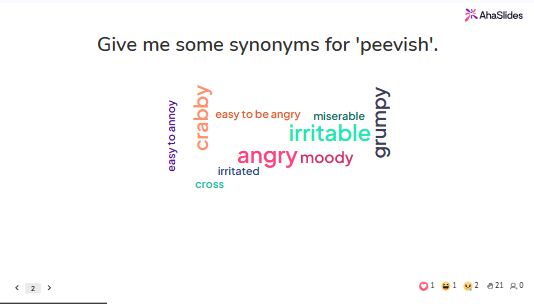
Language games integrate vocabulary, grammar, and communication practice into interactive challenges. Games like word chains, vocabulary races, or sentence construction activities make repetitive practice feel purposeful by embedding it in a game structure.

For ESL and foreign language classrooms, the low-pressure environment reduces the anxiety that often accompanies speaking practice in a formal setting.

6. Math and logic games

Math games cover a range from basic arithmetic to advanced problem-solving. Number-based games work because they require learners to apply mathematical operations under time pressure or competitive conditions, which strengthens both fluency and conceptual understanding.

Games like 101 and Out or Guess My Number require no tech and almost no preparation, yet deliver genuine math practice in a fast-paced format.

7. History and culture games

History and culture games make the past tangible. Learners explore events, figures, and cultural contexts through interactive timelines, simulations of historical scenarios, or trivia challenges tied to specific periods.

When learners are actively navigating historical content rather than reading about it, they tend to retain more and develop a clearer sense of chronology and causation. A simulation that puts a learner in the position of a colonial-era merchant deciding whether to join a trade route, or a trivia challenge built around the causes of World War I, turns passive knowledge into active decision-making. That shift is what moves history from memorized dates to understood context.

8. Science and nature exploration games

Science games put learners in the role of experimenter rather than observer. Instead of reading that changing a pendulum's length affects its period, a learner adjusts the variable in a simulation and watches it happen. The understanding that comes from doing is different from the understanding that comes from reading about it.

This type of game works especially well for concepts that are difficult to demonstrate in a physical classroom due to cost, time, or safety constraints.

9. Health and wellness games

Health games let learners make choices and see consequences in a space where getting it wrong costs nothing. A game that shows a teenager the compounding effects of different dietary choices over a simulated month teaches something a nutrition handout cannot: what the decision actually feels like. That experiential quality is what makes games particularly well-suited to behavior-change topics.

10. Collaborative multiplayer games

Multiplayer games require teams to communicate, divide responsibilities, and work toward shared goals. The collaboration is built into the mechanics, not just suggested. This makes them effective for developing interpersonal skills alongside subject-area knowledge.

Platforms like AhaSlides support team-mode quiz games where groups strategize together before submitting answers, combining competitive energy with cooperative learning.

Top platforms for game-based learning games

The right platform depends on your subject area, learner age group, and available technology.

AhaSlides supports live quizzes, polls, word clouds, spinner wheels, and sorting games across in-person, hybrid, and remote settings. It has a free plan and paid options for larger groups. Kahoot! focuses on gamified quiz-based assessment and is widely used across K-12 and corporate training. Quizizz supports both live and self-paced gameplay with adaptive learning paths and is particularly strong for K-12 review. Both Kahoot! and Quizizz offer free plans with paid subscriptions for extended features.

For subject-specific tools: Prodigy Education wraps math and language content in an RPG-style narrative for K-8 learners, adapting to individual levels as students progress. Minecraft Education Edition supports open-ended STEM and creative projects with a large library of curriculum-aligned lesson plans. Duolingo uses streaks, bite-sized lessons, and competitive elements to drive language learning for all ages. PhET Interactive Simulations from the University of Colorado Boulder provides a library of research-based science and math simulations that are entirely free, with no paid tier.

What to consider when choosing a platform

Age group and subject area matter first. A spinner wheel activity works well for a kindergarten class. A branching simulation works better for a medical school cohort. Start with what your learners actually need to do, not what looks impressive.

Tech access is the next constraint. Some platforms require devices for every learner. Others work with a single shared screen. Know what your classroom or training room can support before you commit to a platform.

Assessment integration is worth checking. Some platforms export quiz results automatically. Others give you a leaderboard and nothing else. If you need to track performance over time, confirm the data is accessible before you build a course around the tool.

Finally, consider the setup time honestly. A platform that takes three hours to configure is a platform that gets used once. The best tools for most educators are ones that go from idea to live activity in under ten minutes.

Using AhaSlides for game-based learning

The forgetting curve problem that opens this article has a well-evidenced solution: spaced retrieval. Asking learners to actively recall information at intervals after instruction is one of the most reliable ways to slow forgetting. Live quiz games are a practical way to build that into a lesson or training session without it feeling like homework.

AhaSlides runs live quizzes, spinner wheel activities, word clouds, and team-mode games from a single platform. Learners join on their phones with no app download. Teachers or trainers see results in real time and can address misconceptions before the session ends rather than discovering them on a test. For hybrid or remote groups, every learner participates in the same activity simultaneously regardless of where they are.

Building a quiz or interactive activity takes under five minutes. Free templates are available for common subjects and training scenarios.

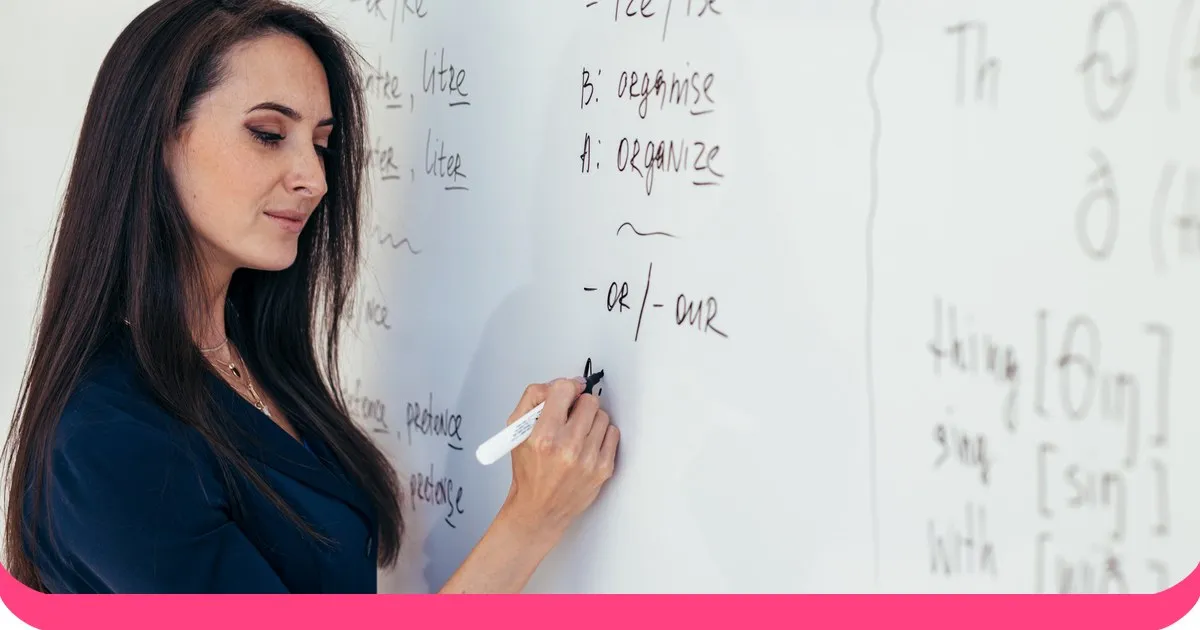
AhaSlides use in a classroom setting

常见问题

什么是基于游戏的学习?

Game-based learning is an educational approach that builds learning objectives into game mechanics. Playing the game is the learning activity, not a reward added after instruction.

How is game-based learning different from gamification?

Gamification applies game-like elements such as points, badges, and leaderboards to non-game activities. Game-based learning uses actual games. The distinction matters because well-designed games create learning conditions (challenge, immediate feedback, mastery progression) that surface-level gamification does not.

What age groups benefit most from game-based learning?

Research supports game-based learning across age groups, from early childhood through adult professional training. The game format and mechanics need to match the learner. Fast-paced competitive quizzes work well for school-age learners. Branching simulations and scenario-based games tend to be more effective for adult and professional audiences.

How do you assess learning outcomes from game-based activities?

Most live platforms export quiz results and participation data. For deeper assessment, pair game-based activities with a short post-game reflection or a brief quiz a week later to test retention. The combination of immediate engagement data and delayed recall testing gives a more complete picture than either alone.

Can game-based learning replace traditional instruction?

It works best as a complement rather than a replacement. Games are highly effective for retrieval practice, application, and motivation. Direct instruction still has a role for introducing new concepts clearly. The strongest learning designs use both.

来源

[1] Vogel, J. J., Vogel, D. S., Cannon-Bowers, J., Bowers, C. A., Muse, K., & Wright, M. (2006). Computer gaming and interactive simulations for learning: A meta-analytic review. 教育计算研究杂志, 34(3), 229-243. https://doi.org/10.2190/FLHV-K4WA-WPVQ-H0YM

[2] Licorish, S. A., Owen, H. E., Daniel, B., & George, J. L. (2018). Students' perception of Kahoot!'s influence on teaching and learning. Research and Practice in Technology Enhanced Learning, 13(1), 9. https://doi.org/10.1186/s41039-018-0078-8

[3] Ebbinghaus, H. (1885). Über das Gedächtnis: Untersuchungen zur experimentellen Psychologie. Duncker & Humblot. (The original forgetting curve research; widely cited in educational psychology literature.)

订阅即可获取提升观众参与度的技巧、见解和策略。
谢谢! 您的提交已收到!
糟糕! 提交表格时出了点问题。

查看其他帖子

AhaSlides 已被福布斯美国 500 强企业所采用。立即体验互动的力量。

立即探索
© 2026 AhaSlides 私人有限公司