

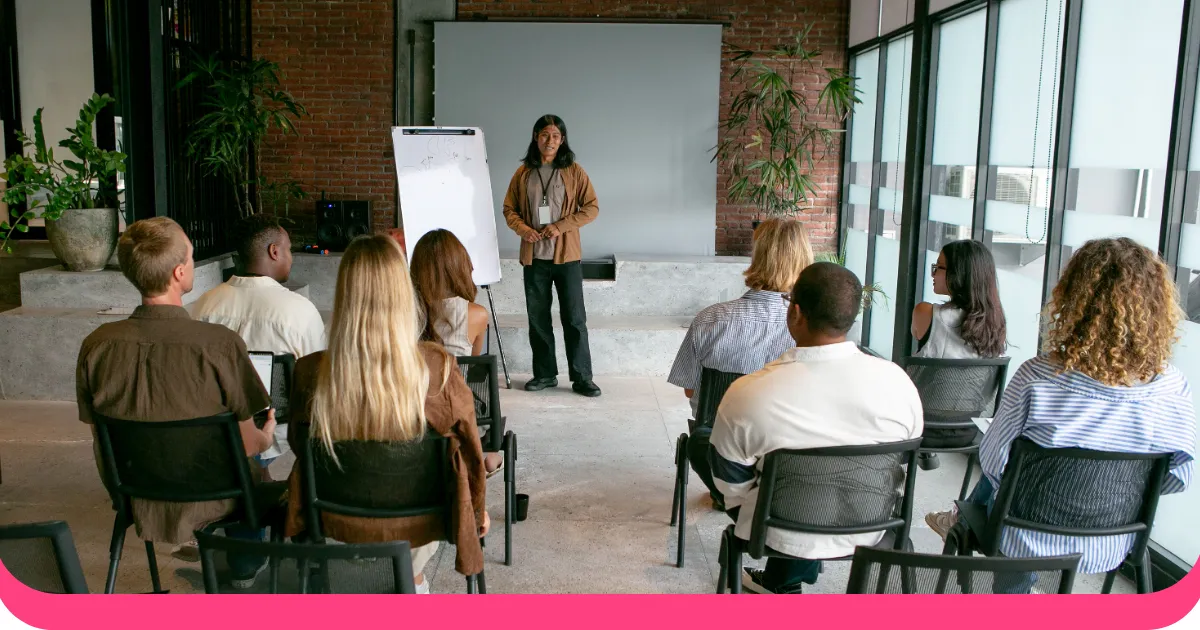
Think about the last training session you attended. Not the one you ran. The one you sat in.
Did you have a question you didn't ask? A thought you held back? A moment where you wanted to push back but decided it wasn't worth the risk?
Maybe you weren't sure if your question was "smart enough." Maybe you didn't want to be the one slowing things down. Maybe you glanced around, saw nobody else raising their hand, and figured it was safer to stay quiet.
Now multiply that by every person in the room.
That's the cost of low psychological safety. Not disengagement. Not lack of interest. Just a quiet, rational calculation that speaking up carries more risk than staying silent.
We've all done it
This isn't about weak participants or bad facilitators. It's human. Research by Karin Hurt and David Dye with the University of Northern Colorado found that 49% of employees say they're simply not asked for their input regularly. 56% believe they wouldn't get credit for their ideas even if they shared them. And 50% feel nothing would happen with their suggestion anyway.
These aren't disengaged people. They're people who've learned, through experience, that the safest move is to nod along.
Harvard professor Amy Edmondson, who coined the term "psychological safety" in 1999, defines it as a shared belief that it's safe to take interpersonal risks. To ask the "obvious" question. To say "I don't understand." To disagree with the person leading the room. When that belief is missing, people self-edit. They give you the answer they think you want, not the one that's true.
Why this matters for learning
Learning requires vulnerability. Admitting you don't know something. Getting it wrong in front of others. When people don't feel safe, they perform instead of learn. Surface-level answers, polished examples, high feedback scores, zero behaviour change.
Edmondson's research found something counterintuitive: high-performing hospital teams didn't make fewer mistakes. They reported more, because staff felt safe to speak up. Google's Project Aristotle found the same pattern across 180 teams: psychological safety was the single strongest predictor of team performance. Stronger than experience, skills, or credentials.
Every training session is a micro-team. The same dynamics apply.
The questions your audience is silently asking
Before anyone speaks up, they're running a quick mental calculation: Will I look foolish? Has everyone else figured this out already? Does anyone actually want to hear what I think?
If the answer is uncertain, most people choose silence. Not because they don't care. Because they're protecting themselves.
PwC's 2025 Global Workforce Survey found that employees with the highest levels of psychological safety are 72% more motivated than those who feel the least safe. Yet McKinsey found that only 26% of leaders create psychological safety for their teams. If leaders struggle with this in ongoing teams, imagine how much harder it is in a training room full of people who barely know each other.
Building safety into your slides, from first click to last
Psychological safety isn't a switch you flip at the start of a session. It's something you build slide by slide, and can lose at any point. It comes down to three key moments in your session, and the slide design choices you make at each one
The first 5 minutes: make or break. Start with a low-stakes anonymous input before anything else. A word cloud asking "one word to describe how you're feeling about today?" gives you a real-time read on the room and shows participants their input is welcome and untraceable. That first anonymous contribution is the lowest-risk way to break the silence. What to avoid: jumping straight into a named icebreaker or a knowledge check. The room hasn't decided it's safe yet, and you've already asked them to perform.
The middle: where safety gets tested. This is where people retreat to safe mode. Your session design choices matter here. A confidence poll with named responses will get you a room full of 4s and 5s. The same poll run anonymously gives you the truth. Same question, completely different data. If you're running a quiz mid-session, consider placing an anonymous reflection question right before it. "What's one thing from this section that didn't fully click?" normalises not knowing and takes the pressure off what follows. The order of your slides changes the room's emotional state.
The close: reinforce or undo. Ending with a high-pressure test pushes people back into performance mode right when you want honest reflection. Instead, close with an anonymous check-out: "how safe did you feel sharing honestly today?" And how you respond to those final answers matters. If you skip over critical feedback, you've just taught the room that honesty wasn't really welcome after all.
The through-line: anonymous before named, low-stakes before high-stakes, curiosity before evaluation. Each slide is either building trust or spending it.
How to start
You don't need to redesign your whole programme. Before your next session, try seeing it from the audience's perspective. Ask yourself: if I were sitting in this room, would I feel safe enough to say "I don't understand" out loud?
If the answer is anything less than a confident yes, you have a design opportunity.
Start with one anonymous question that has no wrong answer. Respond to the first few contributions with genuine curiosity. And at the end, ask what felt safe and what didn't.
Because every person in your room is running that silent calculation. Your job as a designer isn't just to build great content. It's to make the math work in favour of speaking up.
What's your experience?
What's one thing you do to make your sessions feel safe enough for honest participation?
References
- Edmondson, A.C. (1999), "Psychological Safety and Learning Behavior in Work Teams," Administrative Science Quarterly, Harvard Business School
- Google re:Work, Project Aristotle (2015) — rework.withgoogle.com
- McKinsey, "What is Psychological Safety?" — mckinsey.com/featured-insights/mckinsey-explainers/what-is-psychological-safety
- PwC, "Global Workforce Hopes and Fears Survey 2025" — pwc.com/gx/en/issues/workforce/hopes-and-fears.html
- Hurt, K. & Dye, D., "Courageous Cultures," research with University of Northern Colorado
- American Psychological Association, "2024 Work in America Survey: Psychological Safety in the Changing Workplace" — apa.org/pubs/reports/work-in-america/2024/psychological-safety