



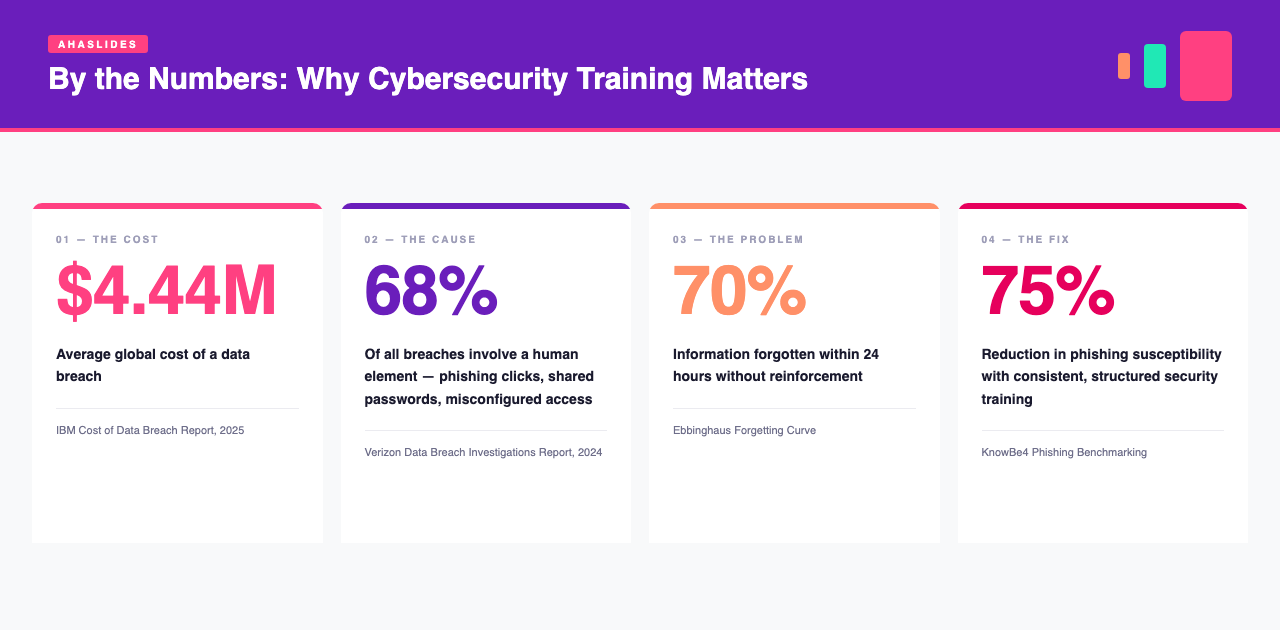
The average data breach now costs $4.44 million globally, according to IBM’s 2025 Cost of a Data Breach Report. And in most cases, the weakest link isn’t the firewall — it’s a person. The 2024 Verizon Data Breach Investigations Report found that 68% of breaches involve a human element: a phishing click, a shared password, a misconfigured access control.
Training can fix this. But most organizations deliver it in a way that doesn’t work.
This guide covers why traditional cybersecurity training fails, what research says actually changes behavior, and which tools make it possible — for live, hybrid, and async teams.
Why Most Cybersecurity Training Fails

Ask yourself honestly: does your team remember last year’s annual security training?
If the answer is “probably not,” the Ebbinghaus Forgetting Curve explains why. In Ebbinghaus's classic experiments, a day after learning lists of nonsense syllables, he needed about two-thirds of the original effort to relearn them. Real workplace knowledge is more meaningful than nonsense syllables, but without reinforcement, much of it still slips away. A one-hour annual compliance session — no matter how well designed — is no match for how human memory actually works.
Three compounding problems make this worse:
- Short attention spans. Passive, content-heavy sessions lose employee attention within minutes. Once attention drops, critical details — the exact red flags that distinguish a phishing email from a legitimate one — get filtered out.
- No active processing. Watching a slide deck is not the same as learning. Knowledge that isn’t applied, tested, or retrieved after the session fades quickly.
- No reinforcement loop. Most organizations run cybersecurity training once a year with no follow-up. Employees revert to unsafe habits between sessions — not because they don’t care, but because there’s nothing keeping the knowledge active.
The result: employees who have technically “completed” security training and remain just as vulnerable as before.
What Actually Changes Security Behavior
Make live sessions interactive

The most effective shift in live training is moving from passive delivery to active participation. Instead of explaining what phishing looks like, put employees in a scenario: “You just received this email. What do you do?” Let them vote. Show the real-time results. Discuss why the wrong answers are so tempting.
This is active recall — retrieving knowledge rather than receiving it — and it significantly improves what people retain compared to listening or re-reading.
Scenario-based polls also surface real knowledge gaps that self-reported surveys never will. When half your team picks the wrong answer in real time, you know exactly where your highest risk is. That’s far more useful than a post-training satisfaction score.
Use anonymous Q&A
Employees often know where they’ve cut corners — shared credentials, unpatched devices, weak passwords. They rarely admit this publicly. Anonymous Q&A gives people a safe channel to surface what’s actually happening in your organization, giving trainers a far more accurate picture of real-world risk.
Keep compliance checklists live, not static
Security checklists handed out as PDFs get filed and forgotten. Running them as live polls — with employees voting Yes, No, or N/A to each item — turns a compliance exercise into a team conversation. This free cybersecurity checklist template covers physical access, data handling, and disposal procedures — ready to run with no setup.
👉 Free cybersecurity checklist template
Hybrid and Async Training: The Spaced Repetition Model
Live sessions are powerful, but they can’t carry the full weight of behavior change on their own. The forgetting curve doesn’t pause between training days.
Spaced repetition — revisiting material at increasing intervals over time — is one of the most well-supported principles in learning science. A large-scale study published in the Journal of the American Board of Family Medicine, covering over 26,000 professionals, found that spaced repetition produced significantly higher retention scores than no repetition at all (58% vs 43%).
Applied to cybersecurity training, this means replacing or supplementing the annual session with shorter, more frequent touchpoints:
- Week 1: Live or hybrid training session, run as interactive scenarios
- Week 2: 5-question async quiz covering the same material, accessible via link or QR code
- Month 2: A short module on a new topic — password hygiene, physical security, or incident response
- Quarter 2: A refresher poll embedded into a team meeting
For remote and hybrid teams, async access is essential. Employees complete a 5-minute quiz on their own schedule rather than blocking out a full afternoon. The key is that every module ends with a question — not a summary slide — so knowledge is always being tested, not just reviewed.
Best Tools for Cybersecurity Awareness Training
No single tool does everything. Here’s an honest look at what each one is actually good for — and where it falls short.
Kahoot
The go-to for gamified quizzes. Works well as a standalone knowledge check or end-of-session activity, but not built for full presentation and content delivery — you still need a separate deck to run the actual training around it.
Pros: Fun, competitive format that drives participation. Low barrier to entry — most employees already know it.
Cons: Limited to quizzes and gamification. Not a presentation tool. Needs to be paired with other software to run a full training session.
Mentimeter
A solid live polling and presentation tool. Good for making a static deck more interactive with polls and word clouds, but stops there — no gamification, no competitive elements, no quiz scoring.
Pros: Clean interface, easy for any audience. Good range of poll types. No participant account needed.
Cons: No gamification or quiz mechanics. Async and tracking capabilities are limited. Pricing scales steeply with audience size.
Quizlet
Focused purely on self-paced study through flashcards and multiple choice quizzes. Useful for individual reinforcement between sessions but narrow in what it does.
Pros: Strong spaced repetition mechanics. Good for async individual study. Large existing content library.
Cons: Only multiple choice quizzes — no other interaction types. Not built for live team delivery or trainer-led sessions.
Genially
A content creation tool for building interactive presentations and microlearning modules. Quality depends heavily on which template you start from, and building something polished from scratch takes real time and effort.
Pros: Visually rich output. Good for self-paced async modules when set up well.
Cons: Steep learning curve. Heavy dependence on templates to get good results. No real-time audience participation.
AhaSlides
Where the others each cover one piece of the training workflow, AhaSlides covers the whole thing — live sessions, hybrid delivery, and async follow-up — without switching tools. Each interaction type is its own slide format: quiz, poll, word cloud, Q&A, spinner wheel, rating, open-ended — straightforward to build, no learning curve. Post-session reports show individual scores and knowledge gaps by question, so follow-up is targeted rather than guesswork. Integrates natively with Zoom, Teams, PowerPoint, and Google Slides.
Pros: All interaction types in one tool, each as a simple slide format. No learning curve — trainers get started without a manual. Suits live, hybrid, and async equally well. Works across training, meetings, onboarding, and events. Transparent pricing that doesn’t scale unpredictably.
Cons: Smaller brand recognition than Kahoot or Mentimeter. Less competitive-feeling gamification than Kahoot’s format.
Free cybersecurity training templates ready to run:
- Cybersecurity Checklist Part 1
- Cybersecurity Checklist Part 2
- Cybersecurity Training 1
- Cybersecurity Training 2
- Cybersecurity Training 3
A Simple Framework to Start With
You don’t need to overhaul your entire training program. Start here:
- Replace one slide block with a live scenario poll. Pick a real phishing example your team has received and run it as a multiple-choice question.
- Send a 5-question follow-up quiz within the week. Don’t wait a month — the forgetting curve is steepest in the first 24 hours.
- Rotate topics quarterly. Phishing one quarter, physical access the next, password hygiene the next. Each session refreshes and builds on the last.
- Track what your team gets wrong. Use that data to decide where to spend more time — not intuition.
KnowBe4’s Phishing Benchmarking research, covering over 9.5 million users across 30,000+ organizations, found that consistent, structured security awareness training reduces phishing susceptibility by up to 75% — with the biggest gains appearing within the first 90 days of a new program.
That’s not a marginal improvement. That’s a structural change in your organization’s risk profile.
Sources
- IBM Cost of a Data Breach Report 2025
- Verizon 2024 Data Breach Investigations Report
- Ebbinghaus Forgetting Curve — Hoxhunt
- KnowBe4 Phishing Industry Benchmarking — HIPAA Journal
- Keepnet Labs Security Awareness Statistics 2026
- Spaced repetition study — Journal of the American Board of Family Medicine