

You hit your Duolingo streak at 11pm so it doesn't reset. You fill in the last two fields on your LinkedIn profile because the completion bar is sitting at 90% and it bothers you. You order a slightly larger coffee because you're twelve Stars away from a free one.
None of those decisions feel like marketing. They feel like your own choices. That's what good gamification does: it borrows the motivational mechanics of games and embeds them so naturally into an experience that the design disappears.
The term was coined by programmer Nick Pelling in 2002 and broke into mainstream business use around 2010 [1]. Since then it has moved from loyalty programs and consumer apps into corporate training, employee engagement, health tech, and HR platforms. The underlying logic is the same everywhere: apply game design elements to non-game contexts to motivate behavior toward a specific goal.
This guide covers what those elements actually are, where gamification works and where it doesn't, and six real-world examples that show the mechanics in action.
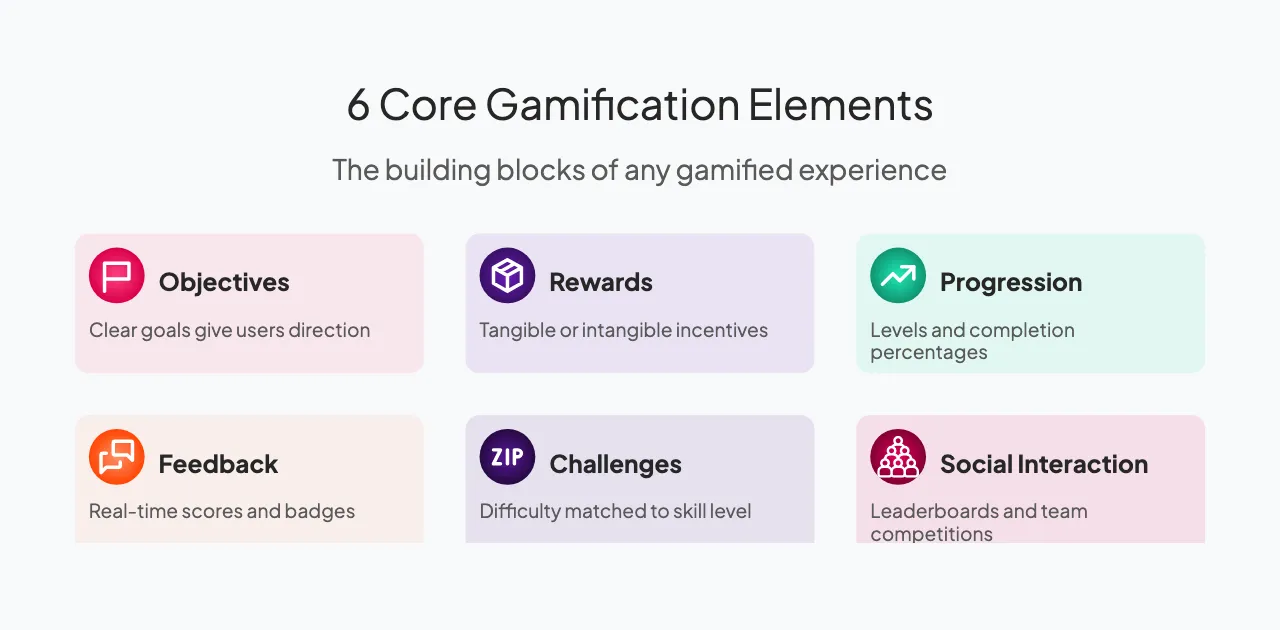
The six core elements
Most effective gamification systems combine several of these. The ones that don't work usually have the mechanics without the meaning: points for their own sake, badges nobody sees, leaderboards that reset to silence.
Objectives. A clear goal gives users direction. Without it, the other mechanics lose meaning. Players need to know what they’re working toward.
Rewards. These can be tangible (discounts, prizes) or intangible (recognition, status). Rewards work best when they’re tied to real effort rather than handed out automatically.
Progression. Levels, tiers, and completion percentages give users a visible sense of movement. The progress bar is one of the simplest and most effective gamification tools in existence.
Feedback. Real-time signals like scores, completion confirmations, badges, tell users whether their actions are working. Without feedback loops, engagement drops quickly.
Challenges and obstacles. Difficulty that’s matched to skill level keeps people in what psychologist Mihaly Csikszentmihalyi called the "flow state", meaning neither bored nor overwhelmed [2].
Social interaction. Leaderboards, team competitions, and shared achievements add a social dimension. Public recognition often motivates more than private rewards do.
Where gamification gets used
Learning and development
Training is where gamification shows the clearest business case. When learning feels like a game, people finish more of it. Research consistently shows that gamified training produces better completion rates and longer knowledge retention than passive instruction [3].
For L&D professionals, the practical applications include scenario-based simulations where learners make decisions and see consequences, quiz competitions run live in a training session, progress tracking across a course curriculum, and badges or certifications tied to skill milestones.
Workplace engagement
Employee engagement programs increasingly rely on gamification to make routine tasks feel less routine. Recognition systems that award points for completed goals, peer-to-peer acknowledgment features, and performance dashboards that show personal bests over time are all common formats.
A note of caution here: gamification that feels manipulative, where employees sense they’re being watched and scored rather than genuinely recognized, tends to backfire. The design has to feel voluntary and fair.
Marketing and customer loyalty
Loyalty programs are the oldest and most commercially proven form of gamification. Airlines have run points-based systems since the 1980s. The mechanics are familiar enough that customers understand them immediately, which lowers the barrier to participation.
6 real-world examples
1. Duolingo (education)
Duolingo is the most-cited gamification success story in consumer tech, and the numbers justify the attention. The app had 40.5 million daily active users in Q4 2024, a 51% year-over-year increase [4]. The mechanics driving that are relatively simple: streaks that reset if you miss a day, XP points for completed lessons, weekly leaderboards, and a virtual currency (Gems/Lingots) for in-app rewards.
The streak mechanic deserves particular attention. Duolingo’s own internal data found that users with active streaks are significantly more likely to return daily. When the company redesigned its gamification system in 2022, the share of "power users" climbed from 20% to over 30%, and churn dropped from 47% to 37% [5].
2. Starbucks Rewards (marketing)
Starbucks Rewards is a masterclass in tiered gamification. Customers earn Stars with every purchase, and Stars unlock escalating benefits across two membership tiers: Green and Gold. The program also uses personalized challenges that use purchase history to target offers customers are likely to take.
The program has over 34 million active members in the US, and Starbucks reports that members spend roughly three times more per year than non-members [6].
3. Nike Run Club (fitness)
Nike Run Club uses achievement badges, personal records, and social challenges to turn solo running into a community experience. Runners log workouts, earn badges for distance milestones, and can join guided challenges against other users globally. The app also lets friends compete on the same routes, adding the social pressure element that solo fitness apps often lack.

4. Salesforce Trailhead (corporate training)
Salesforce built its entire learning platform around gamification. Trailhead assigns points and badges to every completed module, organizes learners into "Trailblazers" ranks, and publishes a public profile where users can display their credentials. For sales professionals and Salesforce admins, a strong Trailhead profile has become a genuine signal of competence that matters in hiring.
Trailhead has over 4 million registered learners, and the platform drives meaningful product adoption: users who complete Trailhead content are more likely to use Salesforce features they wouldn’t have explored otherwise [7].
5. Deloitte Leadership Academy (L&D)
Deloitte’s corporate learning platform introduced gamification in 2012. After adding badges, leaderboards, and mission-based learning paths, the company reported a 37% increase in the number of users returning to the site each week and a significant drop in time-to-completion for core modules [8]. This case is frequently cited in L&D literature because it was one of the first enterprise-scale examples from a major professional services firm.
6. Headspace (health and wellness)
Headspace uses streaks and completion rates to build the daily meditation habit that the product depends on. Users see how many consecutive days they’ve meditated, receive milestone rewards at 10, 30, and 100 days, and can join group challenges with friends. The design goal is habit formation rather than competition, so Headspace deliberately avoids leaderboards. The gamification is personal rather than social.
What makes gamification work (and what makes it fail)
The research is consistent on this: gamification works when it reinforces something that already matters to the person doing it. It fails when the points become the point.
A salesperson chasing leaderboard position instead of customer relationships, or a learner clicking through slides to earn a badge without retaining anything, is a gamification system that hit its metrics and missed its goals. The mechanics should be invisible scaffolding, not the main event [9].
Three conditions separate gamification that sustains engagement from gamification that produces a short-term spike and then silence. The rewards have to feel meaningful. Not a badge nobody sees or points that can't be redeemed for anything real, but recognition or progress that connects to something the person actually cares about. The difficulty has to scale: systems that keep introducing new challenges retain users; systems that let people hit a ceiling and run out of things to achieve collapse quietly. And participation has to feel voluntary. Gamification imposed on employees without their buy-in doesn't feel like motivation. It feels like monitoring. The systems that generate authentic engagement are the ones people feel they chose to join.
Common mistakes to avoid
Even well-intentioned gamification programs run into the same predictable problems. Here are four worth knowing before you design anything.
Rewarding activity instead of outcomes. It’s easy to set up a system that awards points for completing tasks regardless of quality, finishing an e-learning module, submitting a form, attending a session. The problem is that people optimize for the metric, not the goal. A sales rep who earns points for logging calls has no reason to make those calls count. Tie rewards to results or demonstrated competence, not just participation. In an L&D context, this might mean awarding a badge only after a learner passes an assessment, not simply after they click through all the slides.
Ignoring the people who don’t engage. Leaderboards and public rankings work well for people near the top. For everyone else, seeing the same five names dominate every week can feel discouraging rather than motivating. Consider systems that let people compete against their own past performance, or segment leaderboards so participants are grouped with others at a similar level. This keeps the competitive element without driving away the majority of your audience. Some programs run parallel tracks: one competitive leaderboard for those who want it, and a personal progress view for those who don’t.
Overcomplicating the mechanics. More elements don’t mean more engagement. Programs that layer points, badges, tiers, streaks, missions, and multipliers on top of each other often confuse users more than they motivate them. If someone can’t explain how the system works after two minutes of use, it’s too complicated. Start with one or two mechanics, get those right, and add complexity only if the data supports it. The most durable gamification systems (Duolingo’s streak, LinkedIn’s profile completion bar, for example) are built on a single, well-executed idea.
Launching without a plan for what happens next. Gamification creates expectations. Once users have a streak, a rank, or a point balance, they expect the system to keep running. Programs that launch with enthusiasm and then go unmaintained, with broken badges, outdated leaderboards, and expired challenges, erode trust faster than having no gamification at all. Build in a maintenance plan before you launch, and set a realistic timeline for how long you’re committing to run the program. If you’re running a time-limited initiative, make that clear upfront so participants know what they’re signing up for.
Frequently asked questions
Is gamification the same as game-based learning?
No, though the two overlap. Game-based learning uses actual games as the vehicle for learning: simulations, role-playing scenarios, purpose-built educational games. Gamification borrows individual mechanics from games (points, badges, leaderboards) and applies them to activities that aren’t games. A quiz competition in a training session is gamification. A full business simulation where learners run a virtual company is game-based learning. Both have their place; the right choice depends on the learning objective, the available budget, and how much time learners have.
Does gamification work for all audiences?
Not equally, and the mismatch can do real damage. Heavy gamification in a leadership development program for senior professionals tends to land as patronizing rather than motivating. The rule of thumb is simple: the more routine or repetitive the underlying task, the better gamification tends to work. Compliance training, onboarding checklists, product knowledge updates, those are all good candidates. Strategic decision-making workshops and executive development programs are usually not. Read the room before you add a leaderboard.
How do you measure whether gamification is working?
Start with the metrics the gamification was designed to move: completion rates, return visits, assessment scores, time-on-task. Compare against a pre-gamification baseline or a control group if you can run one. Then watch for the sign that something is off: people accumulating points without actually engaging. A learner who clicks through every slide in thirty seconds to collect a badge isn't learning. They've just found the shortest path through your reward structure. That behavior tells you the mechanics need recalibrating before the next cycle.
Running gamified sessions with AhaSlides
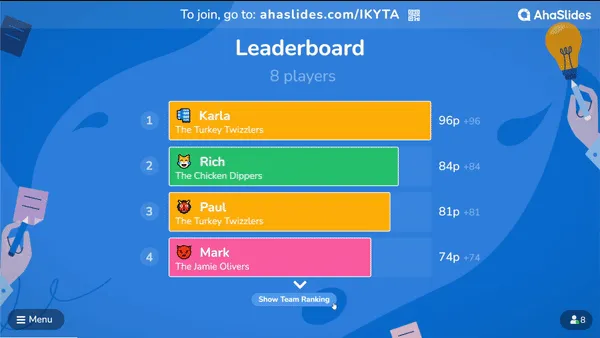
There's a moment in live training that experienced facilitators recognize immediately. You ask a question, the room goes quiet, and then the leaderboard updates. The person in third place who was just two points behind first suddenly has a reason to care about the next question in a way they didn't thirty seconds ago.
That's not a trick. It's the flow state Csikszentmihalyi described: challenge matched to skill, feedback immediate, stakes just high enough to focus attention without triggering anxiety. The difference is you didn't need to design a game to get there. You just needed the right question and a live leaderboard.
AhaSlides lets facilitators run quiz competitions with real-time leaderboards, live polls, word clouds, and open Q&A in a single session. No separate platform, no app download, no login required for participants. The mechanics that make gamification work in consumer products are available in a training room in about five minutes of setup.
One practical note on design: the leaderboard works best when it resets between topics rather than running as a single cumulative score across the whole session. Participants who fall behind early tend to disengage if they can't realistically close the gap. Shorter bursts with fresh starts keep more of the room competitive longer, which is the same principle behind Duolingo's weekly leaderboard reset rather than an all-time ranking.
Sources
[1] Walz, S. P., & Deterding, S. (Eds.). (2011). From game design elements to gamefulness: defining "gamification". Association for Computing Machinery. https://dl.acm.org/doi/10.1145/2181037.2181040
[2] Csikszentmihalyi, M. (1990). Flow: The Psychology of Optimal Experience. Harper & Row.
[3] Hamari, J., Koivisto, J., & Sarsa, H. (2014). "Does gamification work? A literature review of empirical studies on gamification." 47th Hawaii International Conference on System Sciences. https://ieeexplore.ieee.org/document/6758978
[4] Duolingo Q4 2024 earnings report. Duolingo, Inc. https://investors.duolingo.com
[5] Mazal, J. "How Duolingo reignited user growth." Lenny’s Newsletter. https://www.lennysnewsletter.com/p/how-duolingo-reignited-user-growth
[6] Starbucks Q4 FY2024 Earnings Call. Starbucks Corporation. https://investor.starbucks.com
[7] Salesforce Trailhead. "About Trailhead." https://trailhead.salesforce.com
[8] Meister, J. (2013). "How Deloitte Made Learning a Game." Harvard Business Review. https://hbr.org/2013/01/how-deloitte-made-learning-a-g
[9] Deci, E. L., Koestner, R., & Ryan, R. M. (1999). "A meta-analytic review of experiments examining the effects of extrinsic rewards on intrinsic motivation." Psychological Bulletin, 125(6), 627–668.