

Every L&D team has the same problem: more topics worth training on than time, budget, or attention to cover them.
The list has also gotten harder to prioritize. AI has reshuffled skills requirements across nearly every function. Compliance pressure is rising. Mental health and soft skills have moved from the optional column to the essential one. And employees who don't see relevant, timely learning opportunities are increasingly voting with their feet. 76% say they're more likely to stay at an organization that invests in their ongoing development [1].
So the question isn't whether training matters. It's which training matters right now.
This guide answers that. Six categories, the data behind each one, and notes on how to deliver them in a way that actually sticks.
Why the topic list matters more than the format
Before getting into the list: L&D teams often spend more time debating delivery format (in-person vs. e-learning, synchronous vs. asynchronous) than they spend on whether the content is actually the right content.
LinkedIn's 2025 Workplace Learning Report found that 91% of L&D professionals agree continuous learning is more critical than ever, yet only 36% of organizations have fully embraced career-driven learning as a strategy [1]. The gap between recognizing learning's value and choosing the right topics is where training programs go wrong.
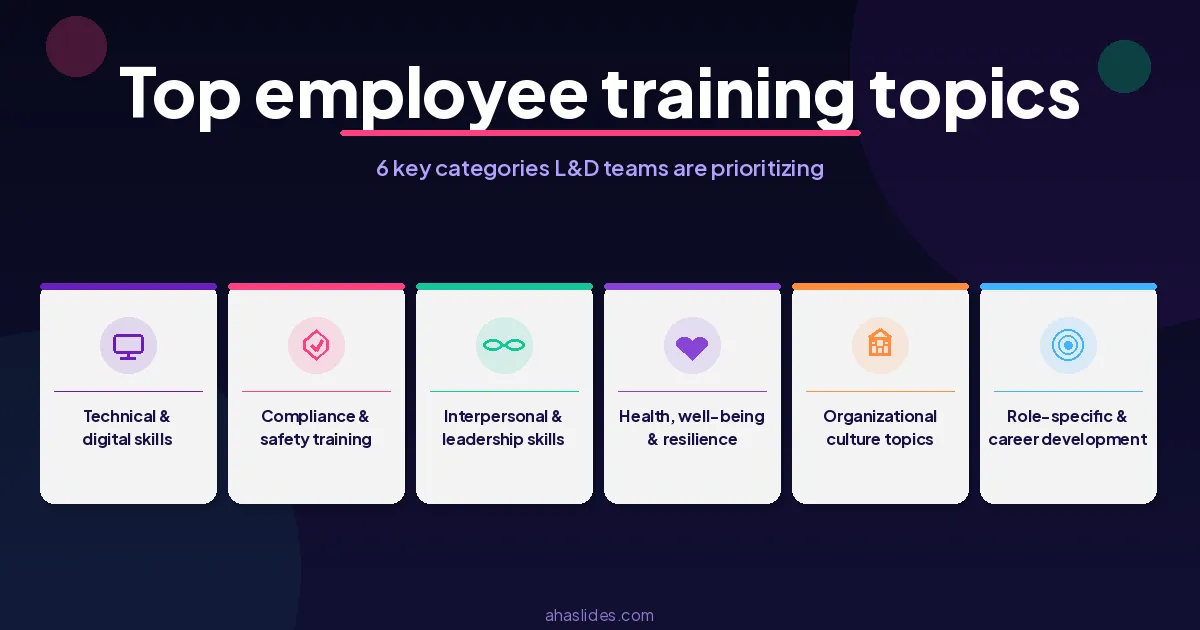
The topics below are grouped into six areas: technical and digital skills, compliance and safety, interpersonal and leadership skills, health and well-being, organizational culture, and role-specific development.
Technical and digital skills
AI and automation literacy
Four in five employees say they want to learn more about how to use AI in their work [1]. The challenge is that most organizations have moved faster on deploying AI tools than on training people to use them well. Only 25% of employees strongly agree their employer has a clear vision for AI use, even at companies that already provide AI tools [1].
Effective AI training covers more than tool operation. It addresses prompt design, output evaluation, knowing when not to rely on AI, and understanding the data privacy implications of using third-party models with company information. A team at a mid-sized financial services firm, for example, found that employees were pasting client data into public AI tools without understanding the compliance risk, a problem no amount of tool-access training had addressed.
Data literacy
Analytical thinking ranks as the number one skill employers will prioritize for future hiring, according to LinkedIn's 2025 skills data [1]. Data literacy training does not mean turning every employee into a data analyst. It means ensuring that people can read a dashboard, interrogate a chart, and ask the right questions before acting on a number.
Digital tools and systems
Onboarding employees to new software is a recurring cost that most organizations undercount. Role-specific training on CRMs, project management tools, and communication platforms saves hours per employee per week and reduces errors that create downstream rework.
Compliance and safety training
Cybersecurity awareness
The global baseline phishing click rate before training sits at 33.1%. After 90 days of security awareness training, that figure drops by 40%. After 12 months of ongoing training, the reduction reaches 86% [2].
Despite that, 2 million small businesses in the UK alone provide no cybersecurity training even though 42% experienced attacks in the past year [2]. Cybersecurity awareness training is one of the highest-ROI training investments an organization can make, and it requires regular reinforcement. Annual modules are not sufficient.
Core topics include phishing recognition, password hygiene, social engineering tactics, safe remote work practices, and incident reporting procedures.
Regulatory and legal compliance
Requirements vary by industry and geography, but the cost of non-compliance consistently exceeds the cost of training. This category includes anti-bribery and anti-corruption, data privacy (GDPR, CCPA), workplace harassment prevention, financial regulations, and sector-specific requirements in healthcare, finance, and manufacturing.
Workplace health and safety
For organizations with physical work environments, safety training is non-negotiable. For knowledge workers, it increasingly covers ergonomics, safe remote work environments, and emergency procedures.
Interpersonal and leadership skills
Leadership and management development
71% of organizations now offer structured leadership training programs [3]. The reason is not abstract: managers account for at least 70% of the variance in employee engagement scores, according to Gallup research [3].
Strong management training covers performance conversations, running effective meetings, giving and receiving feedback, and coaching direct reports. New managers need foundations: how to have a performance conversation, how to run a meeting, how to give feedback without it landing as an attack. Experienced leaders need something different: change leadership, executive communication, managing through ambiguity. Treating both groups the same is one of the most common ways leadership development budgets get wasted.
Communication and presentation skills
This is consistently one of the most requested training topics by employees themselves. Effective communication covers written communication, meeting facilitation, cross-functional collaboration, and increasingly, communication in hybrid and remote environments where tone and clarity are harder to convey.

Emotional intelligence (EQ)
Organizations that invest in EQ training report lower turnover and better team cohesion. The training focuses on self-awareness, managing reactions under pressure, reading others' emotional states, and adapting communication style to the person and situation. It is particularly valuable for customer-facing roles and for managers.
Conflict resolution
Unresolved workplace conflict costs US businesses an estimated $359 billion annually in lost productivity [4]. Training employees and managers to recognize early signs of conflict, facilitate productive disagreements, and de-escalate situations is cheaper than the alternative.
Negotiation and influencing skills
Useful beyond sales roles. Internal negotiation demands influencing without authority, getting buy-in for projects, managing up. It is a skill gap in most organizations that rarely gets addressed through formal training.
Health, well-being, and resilience
Mental health awareness and support
88% of organizations cite employee retention as a primary concern, and learning investment is the leading retention strategy [1]. Mental health training has become part of that picture. This includes training managers to recognize early signs of stress or burnout, destigmatizing conversations about mental health, and ensuring employees know what support resources are available.
Stress management and resilience
Training on practical techniques gives employees tools they can apply immediately. It performs better when it is concrete and behavior-based rather than conceptual: time management, workload prioritization, boundary-setting, recovery practices.
Financial wellness
An often-overlooked category. Financial stress is a significant driver of distraction and disengagement at work. Training that covers budgeting basics, retirement planning, and benefits utilization is increasingly popular as a retention tool.
Organizational culture topics
Diversity, equity, and inclusion (DEI)
DEI training has matured significantly from the compliance-checkbox era. Effective programs now focus on specific behaviors: inclusive meeting practices, equitable feedback delivery, recognizing and interrupting bias in hiring decisions, and building psychologically safe teams.
The difference between DEI training that lands and DEI training that backfires usually comes down to one thing: specificity. Tell people what to believe and you get resistance. Give people specific practices: how to run a more inclusive meeting, how to spot bias in a hiring decision, how to deliver equitable feedback. This is how you get behavior change. One is a values lecture. The other is a skills program.
Unconscious bias
Closely related to DEI but worth treating as its own topic. Training on cognitive biases (affinity bias, recency bias, halo effect, for example) helps people understand that bias is not a moral failing but a function of how brains process information quickly. That framing tends to reduce defensiveness and increase engagement.
Ethics and corporate values
Especially important during periods of rapid organizational change, mergers, or leadership transitions. Training that makes organizational values concrete through scenarios and real decisions rather than abstract principles is more likely to shape actual behavior.
Role-specific and career development topics
Onboarding and role orientation
New employee onboarding is the most under-invested training in most organizations. Research consistently shows that structured 90-day onboarding programs improve retention significantly compared to informal "shadow a colleague for a week" approaches. A thorough onboarding program covers role expectations, tools, key relationships, decision-making authority, and cultural norms.
Sales skills and customer service
For customer-facing teams, ongoing training on objection handling, discovery questioning, customer empathy, and product knowledge drives measurable revenue outcomes. This is one of the few training categories where direct ROI attribution is relatively straightforward.
Project management and agile methodologies
As more organizations run cross-functional initiatives, project management skills have moved from a specialist domain to a general requirement. Training covers planning, prioritization frameworks (OKRs, Kanban, Scrum basics), stakeholder management, and retrospectives.
Learning agility and growth mindset
The ability to learn new skills quickly has become more valuable than mastery of any specific skill set. Training on growth mindset and learning strategies helps employees approach unfamiliar challenges more productively. Organizations that develop learning agility across the workforce tend to adapt faster to market and technology shifts.
Writing and content skills
Remote and async work has made written communication the default collaboration layer for most teams. A poorly written brief, an ambiguous Slack message, or a document that requires three follow-up questions to interpret creates friction that compounds across every project it touches. Training on clear writing and async communication is one of the highest-leverage investments a distributed team can make, and one of the most consistently underfunded.
How to decide which topics to prioritize
With this many options, the practical challenge is sequencing. A few decision rules that L&D teams use:
Start with a skills gap assessment. 74% of HR professionals identify internal skills gap assessments as the most essential L&D activity [1]. Without a baseline, training investments are driven by trend-chasing rather than actual organizational need.
Connect topics to business outcomes. Training that can be tied to a measurable outcome such as reduced incident rate, lower churn, faster onboarding time, is easier to resource and sustain. Training that is justified purely on the basis of "this is a good thing to know" tends to get cut when budgets tighten.
Sequence foundational before advanced. Communication skills before leadership development. Basic data literacy before advanced analytics. Rushing employees to advanced topics before foundations are in place produces poor transfer and wastes facilitation time.
Plan for reinforcement from the start, not as an afterthought. A single training event almost never produces lasting behavior change. People need repeated exposure, practice, and feedback over time. 76% of employees say they're more likely to stay at an organization that invests in ongoing learning rather than one-off events [1]. The organizations that get real ROI from training aren't running better workshops. They're building better systems around them.
Running training sessions with AhaSlides
Selecting the right topics is half the work. The other half is delivery that keeps people engaged long enough to actually learn. That second half is where most training programs quietly fail.
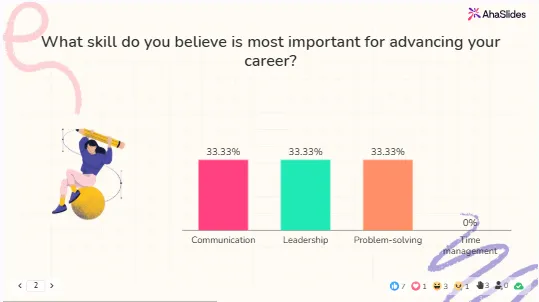
Here's what that looks like in practice. You're running a cybersecurity awareness session. Forty employees, remote, cameras mostly off. You've just covered phishing tactics and you think it landed. Then you run a quick scenario poll: 'Which of these four emails contains a phishing attempt?' Thirty percent of the room picks the wrong one. You didn't need to wait for a post-training quiz to find that out. You found out in the room, with time left to fix it.
That's the difference between training that gets delivered and training that actually transfers.
AhaSlides lets L&D facilitators embed live polls, knowledge checks, word clouds, and open Q&A directly into any session: in person, virtual, or hybrid. Run scenario-based checks mid-session to see whether people can apply what they just learned, not just whether they were paying attention. Surface misconceptions while there's still time to address them. For onboarding sessions, a live word cloud asking new starters 'what are you most uncertain about right now?' generates more useful signal in two minutes than any pre-session needs assessment.
Results appear in real time, visible to everyone. That means the conversation starts in the room, not in a follow-up email that arrives three days later and gets skimmed once.
The topics in this guide are a starting point. What turns them into results is creating the conditions where learning actually happens, where people are engaged enough to absorb it, safe enough to ask questions, and supported enough to apply it back on the job. That's not a content problem. That's a delivery problem. And it's a solvable one.
Sources
[1] LinkedIn. (2025). Workplace Learning Report 2025. https://learning.linkedin.com/resources/workplace-learning-report
[2] KnowBe4 / Keepnet Labs. (2025). Security Awareness Training Statistics. https://keepnetlabs.com/blog/security-awareness-training-statistics
[3] Gallup. State of the American Manager. https://www.gallup.com/services/182138/state-american-manager.aspx
[4] CPP Inc. (2008). Workplace Conflict and How Businesses Can Harness It to Thrive. https://www.yumpu.com/en/document/view/30793172/cpp-global-human-capital-report-workplace-conflict