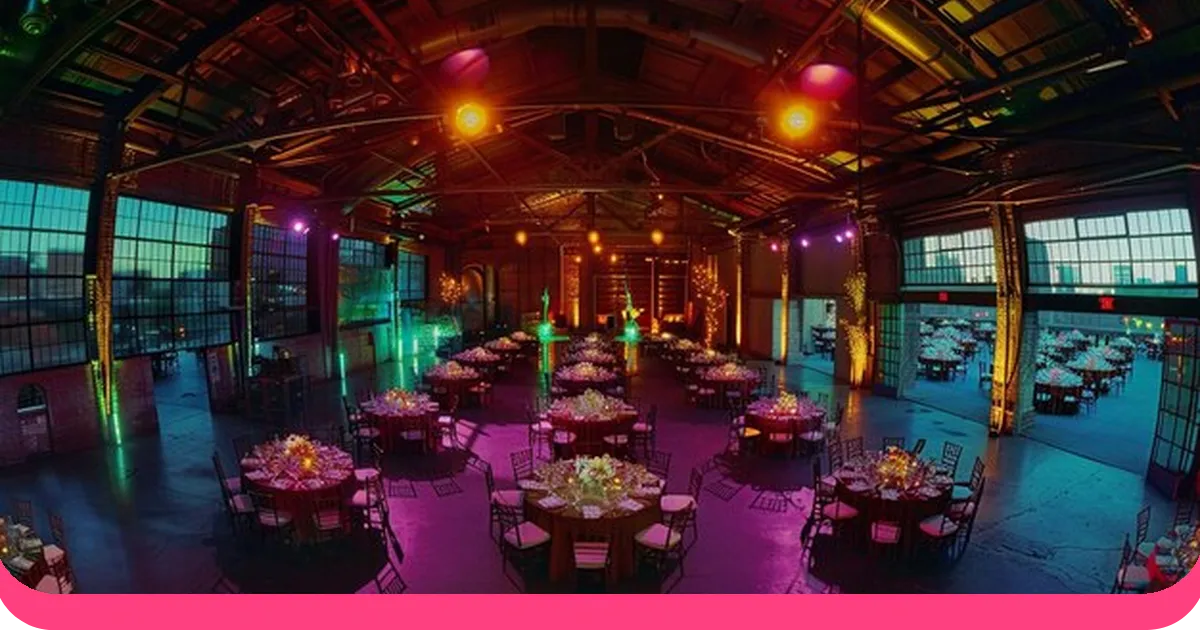


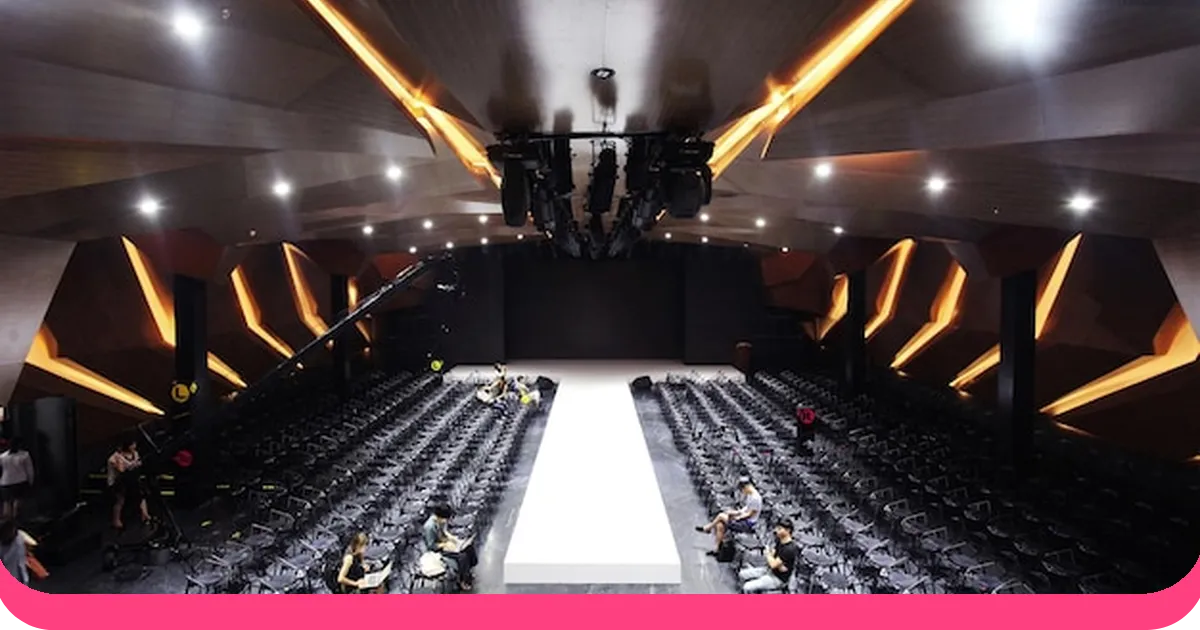
Planning an event looks simple from the outside: book a venue, send invites, show up. Anyone who has run one knows the reality is layered in logistics, dependencies, and decisions that compound quickly. One vendor falls through and the timeline shifts. One miscommunication with AV and the first session runs late. One overlooked registration detail and 40 attendees are standing at the door with no badges.
The global events industry was valued at over $1 trillion in 2024 and is projected to grow to $2.5 trillion by 2035 [1]. Corporate events alone represent a $325 billion market growing at more than 10% per year [2]. That growth is real, but so is the gap between organizers who run events that attendees talk about afterward and those who survive them. This guide covers the full cycle: planning, execution, measurement, and the skills that separate competent organizers from great ones.
The five phases of event management
Most successful events follow a recognizable structure. The details vary by event type and scale, but the underlying phases are consistent.
Phase 1: Concept and scoping
Before any logistics, you need clarity on what the event is actually for. A product launch, a leadership offsite, a company all-hands, and an industry conference each require different approaches even if they share the same venue.
Define these before anything else:
What is the event for, stated as a single outcome sentence. Who is the audience and what do they need from the experience. What does success look like, and how will you measure it. What is the budget ceiling, and who has sign-off authority. What is the date, and are there conflicts with holidays, competing events, or internal calendars.
This phase ends with a one-page brief that everyone on the organizing team can reference. Without it, scope creep starts the moment planning does.
Phase 2: Planning and procurement
Planning is where most of the event's outcome is determined. What happens on the day is largely a function of decisions made weeks or months earlier.
Work backward from the event date to set hard deadlines for each dependency:
Venue contract signed and deposit paid. Speakers and facilitators confirmed with bios and AV requirements collected. Catering headcount submitted. Registration open and confirmation emails set up. Run-of-show drafted and shared with AV team. Final attendee list locked. All printed materials finalized and ordered. Tech tested with actual presentation files.
Budget management deserves its own attention. Build in a contingency of 10-15% for items that typically run over: catering, AV, and last-minute printing. The biggest budget mistakes usually happen at the beginning (underestimating) or the end (scrambling to fill gaps).
A detailed event project plan reduces execution bottlenecks significantly [3]. The mechanism is simple: when everyone knows the dependencies and owns their tasks, fewer things fall through the gaps on the day.
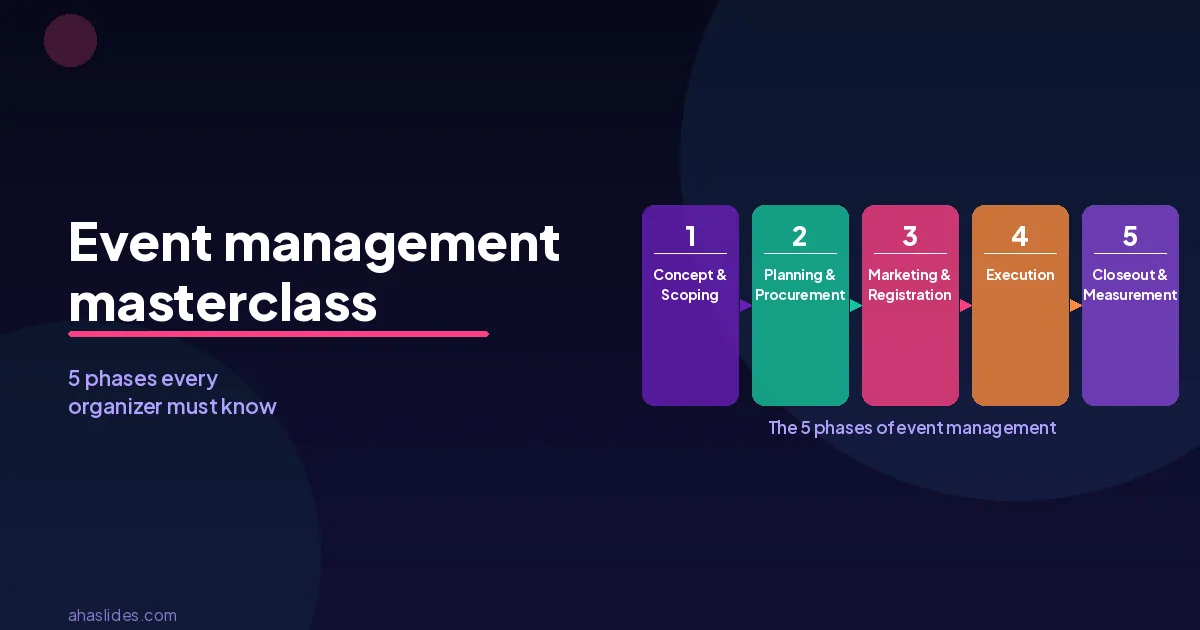
Phase 3: Marketing and registration
For external events, getting the right people in the room is as important as the program itself. Even for internal events, low registration or no-shows signal a problem with relevance or communication.
Effective event marketing does a few things well:
It leads with what attendees will get out of attending, not what the organizer wants to announce. It gives people enough information to decide whether the event is relevant to them. It sends reminders at the right intervals: one week out, two days out, and morning-of. And it makes registration or RSVP as frictionless as possible, one click from the email to the confirmation.
For internal events, the same principles apply. A one-line calendar invite with no agenda or context produces lower engagement and more last-minute dropouts than a brief that explains what the session is for and what attendees should prepare.

Phase 4: Execution
All the planning converts into execution on the day. The most important principle here is that the event manager's job during the event is to manage exceptions, not participate.
A well-run event day depends on:
A printed run-of-show in the hands of every person with a role. A single point of contact for each vendor. A clear escalation path for the three most likely failure scenarios. One person whose only job is logistics, not presenting, not networking, not managing stakeholders. And a buffer of at least 15 minutes between major session blocks so that a single delay does not cascade into the rest of the day.
The most common execution failures are not logistical surprises: they are foreseeable problems that nobody planned for. Running a tabletop walkthrough of the schedule 24-48 hours before the event is one of the highest-return things you can do.
Phase 5: Closeout and measurement
The event ends and the temptation is to call it done. The organizers who improve fastest treat closeout as a phase with its own deliverables:
Attendee survey sent within 24 hours. Budget reconciled against actuals. Vendor performance notes documented while the details are fresh. A written debrief covering what worked, what broke, and what to change. Results shared with stakeholders in a format that connects back to the KPIs set in phase 1.
Skipping this phase means starting the next event from the same baseline as the last one.
Skills that matter most in event management
Event management draws on a wide range of competencies. These are the ones that consistently separate good outcomes from mediocre ones.
Project management
Events are projects with fixed deadlines and cascading dependencies. Organizers who treat events like projects, with a real plan, clear ownership, and milestone tracking, consistently outperform those running on memory and email threads. The tool matters less than the discipline. A spreadsheet used rigorously beats expensive software used loosely.
Budget control
Delivering a strong experience within a fixed budget is one of the hardest parts of the job. The practical skill is building a budget that front-loads all known costs, tracks actuals against estimates in real time, and reserves contingency for the predictable unknowns. Budget surprises at an event are almost never truly surprising: they trace back to a cost that was underestimated or not tracked during planning.
Communication
Event managers communicate with clients, venues, vendors, speakers, and attendees, often simultaneously and under time pressure. The skill is clarity: short, specific, and in writing. Verbal agreements feel efficient until something goes wrong and nobody can remember what was actually decided. Every important instruction should exist somewhere in writing, even if it started as a two-minute conversation.
Problem-solving under pressure
Something goes wrong at nearly every event. What matters is not whether problems arise but how quickly they are resolved. This requires both preparation (a backup plan for likely failures) and composure (the ability to make a calm decision when the AV goes down 10 minutes before doors open). Teams that debrief honestly after events and document what broke build this capacity systematically rather than hoping for better luck next time.
Vendor management
Most events involve multiple external vendors. Good vendor management means clear contracts with deliverable specifications, a single point of contact on both sides, and early communication when anything changes. The relationship built before the event determines how responsive a vendor is when something needs to change on short notice.
Attendee experience design
The logistics are infrastructure. The experience is what people remember. Organizers who think explicitly about the attendee journey, from registration email through arrival through each session to departure, tend to catch friction points that a logistics-first mindset misses. Where do people wait? What do they do during breaks? How are they welcomed?
Measuring event success
Only 23% of companies can effectively track event ROI [2], which means most organizers don't know with any precision whether their events are working. This is largely a measurement design problem, one that is easier to solve than most assume.
Define KPIs before the event
Measuring success after the fact, without pre-defined criteria, produces post-hoc rationalization more than insight. Name your KPIs during the scoping phase. Typical categories include:
Attendance rate against target. Session satisfaction scores from post-event surveys. Net Promoter Score for the event overall. Business outcomes where applicable: pipeline generated, deals closed, skills assessed. For internal events: engagement scores, action items committed to, and follow-through rate at 30 days.
For internal events, engagement and satisfaction metrics carry the most weight. For external events, business outcome metrics typically take priority for leadership audiences.
Post-event surveys
Post-event surveys are the most widely used measurement tool: 76% of event teams use them to measure ROI [1]. Sending the survey within 24 hours of the event produces significantly higher completion rates than waiting longer.
Keep surveys short: 5-7 questions for most events. A mix of rating scales for quantitative tracking and one or two open-ended questions for diagnosis gives you both a number to track over time and the context to understand what's driving it.
The most useful single question for benchmarking: "How likely are you to recommend this event to a colleague?" (0-10 scale). This is the Net Promoter Score methodology, introduced by Fred Reichheld in a 2003 Harvard Business Review article [4]. It provides a single comparable number across events and over time.
Segment before you summarize
An aggregate satisfaction score across all attendees hides the useful signal. A 4.2 average tells you very little. A 2.8 from first-time attendees and a 4.8 from returning attendees tells you something actionable. A 3.1 from people in the afternoon sessions and a 4.6 from the morning sessions tells you where the energy dropped. A 2.4 from remote attendees and a 4.7 from in-person attendees tells you the hybrid experience needs work. Split survey data by attendee segment, session type, or role whenever sample size allows.
Close the loop
Sharing aggregated results with attendees, even a brief summary, increases response rates for future surveys and signals that the feedback is actually being used. A five-minute recap of the event survey results at the next all-hands or kickoff costs almost nothing and pays forward into the next round of data collection. Something as simple as 'last time you told us the breaks were too short, so we built in an extra 15 minutes this time' signals that the feedback loop is real.
Using AhaSlides in event management
One of the most practical improvements event organizers can make is building feedback and interaction directly into the event experience rather than treating them as afterthoughts.
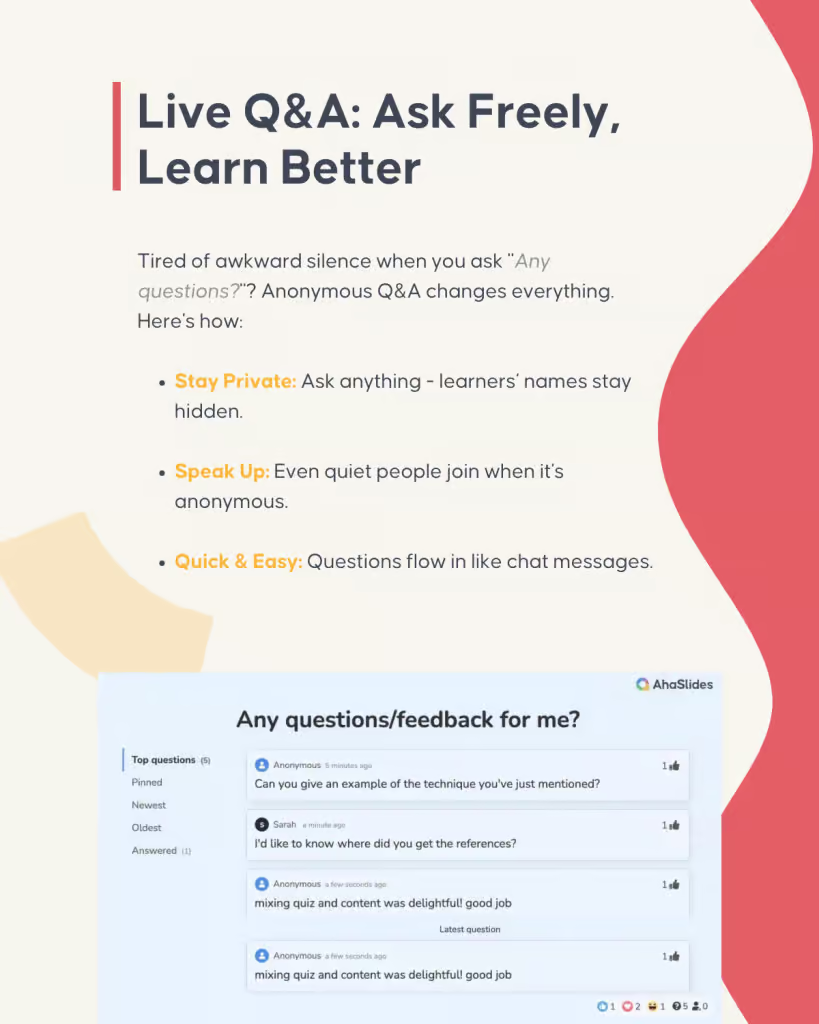
For hybrid events, where in-room and remote attendees often have different experiences, a shared live Q&A and polling tool on AhaSlides creates a single engagement layer that works for both audiences simultaneously. Remote attendees who can participate in the same polls and Q&A as in-room attendees report higher satisfaction and engagement than those who watch passively.
AhaSlides combines polls, rating scales, Q&A, word clouds, and quizzes in a single platform, which means you can run live audience response during sessions and send asynchronous post-event surveys from the same tool. For event managers, this removes the need to bolt a separate survey platform onto an already complex logistics stack.
A common setup: use a live poll at the end of each session to capture an immediate rating while the session is still in progress. Attendees respond on their phones in under 30 seconds. The session host sees the results in real time, can address concerns on the spot, and the data feeds directly into the post-event analysis without a separate data collection step.
Common mistakes worth avoiding
Even experienced organizers fall into the same traps. These are the ones that cause the most avoidable problems.
Over-programming the agenda. Back-to-back sessions with no buffer create compounding delays and leave no time for the informal conversations that attendees often value most. Build 15-minute transitions between major sessions and at least one unstructured networking break per half-day block.
Skipping the run-of-show walkthrough. The run-of-show is only useful if the people executing it have read it and worked through the transitions. A 30-minute walkthrough with AV, registration, and session leads on the morning of the event catches most day-of problems while there is still time to fix them.
Sending feedback surveys too late. Every day of delay between the event and the survey reduces completion rates and the accuracy of recall. Within 24 hours is the standard. Within two hours of the event closing is better for shorter events where the experience is still vivid.
Treating budget contingency as slack. A 10% contingency buffer exists for genuine unknowns, not for scope additions during planning. Spending contingency during procurement leaves nothing for actual execution surprises.
Not documenting what happened. Without a written debrief, institutional knowledge lives in the heads of the organizing team. When any one person leaves or moves on, it goes with them. A short debrief document, what worked, what broke, what to change, is the cheapest investment in the quality of your next event.
Sources
[1] Cvent. 390 Event Statistics Shaping the Industry in 2026. https://www.cvent.com/en/blog/events/event-statistics
[12] Grand View Research. U.S. Event Management Market Size. https://www.grandviewresearch.com/industry-analysis/us-event-management-market-report
[3] Eventtia. Event Planning Checklist: 7 Phases to Ensure Event Success. https://www.eventtia.com/en/event-planning-checklist/
[4] Reichheld, F. (December 2003). "The one number you need to grow." Harvard Business Review. https://www.researchgate.net/publication/8927283_The_One_Number_you_Need_to_Grow