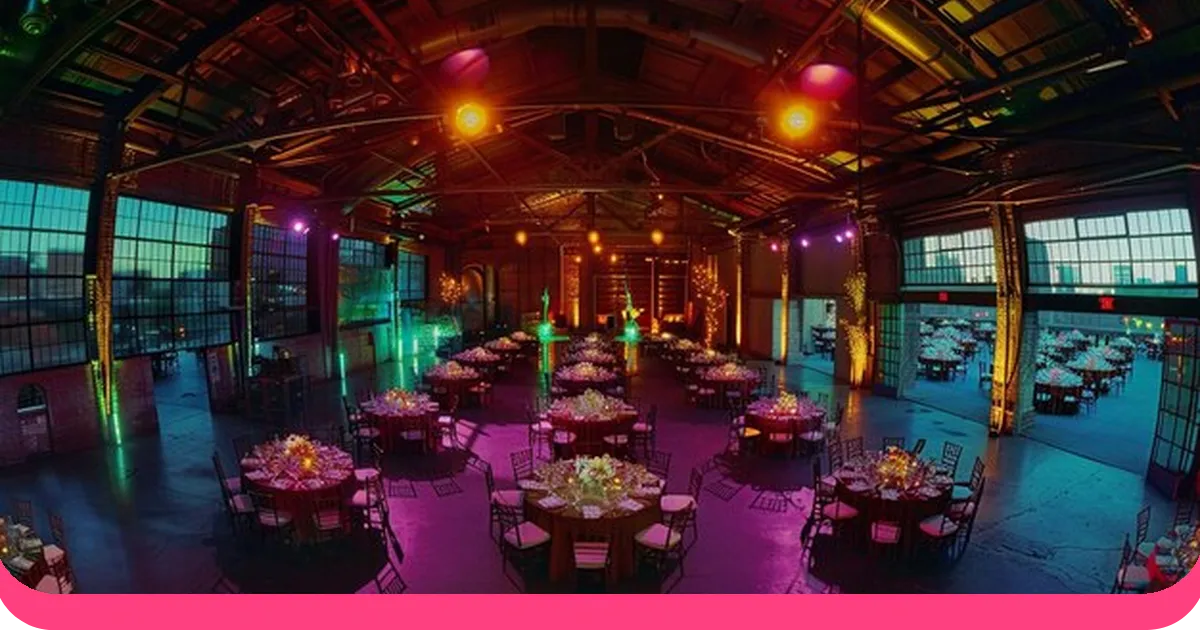


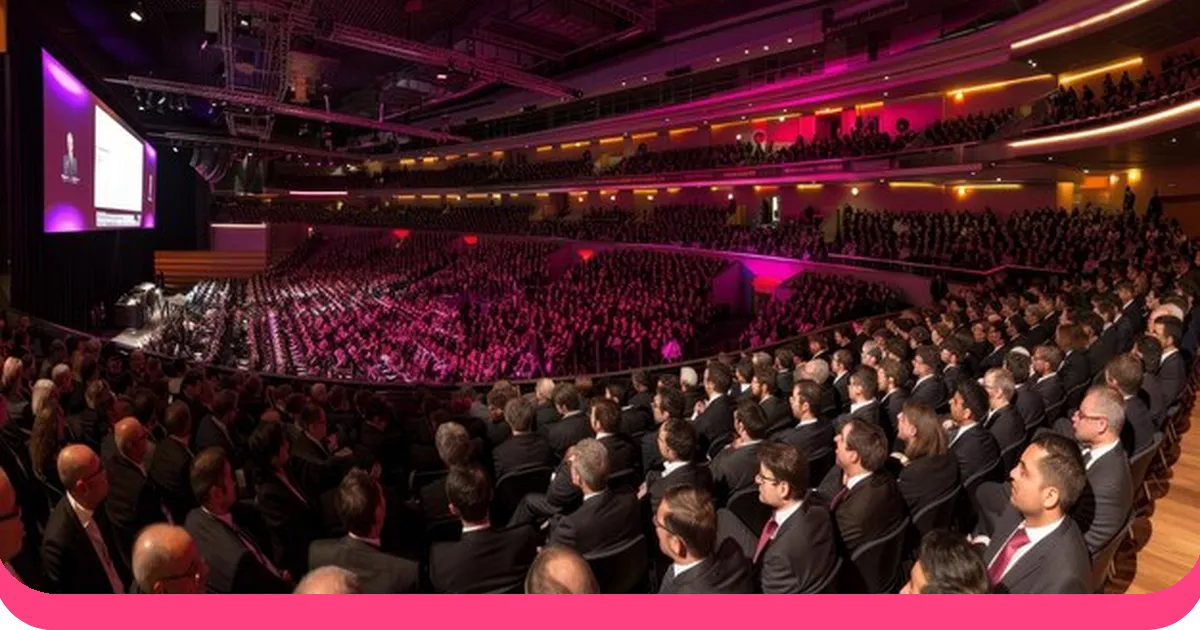
The events industry is growing, and corporate budgets are following. More companies are running more in-person gatherings than they were three years ago, and that trend is accelerating rather than reversing.
That growth makes solid execution more important, not less. When competitors are running more events, a poorly organized one stands out. This guide covers every phase of corporate event planning, from setting the objective to analyzing the post-event data, in a format you can actually use.
Step 1: Define the objective before anything else
Every other decision in this guide flows from one question: what does this event need to accomplish?
Corporate events tend to fall into a few categories. Team-building events aim to improve trust and collaboration. Training events transfer specific skills or knowledge. Client events strengthen relationships or generate pipeline. Conferences and summits position the company, attract talent, or generate press. Hybrid or all-hands meetings align distributed organizations around strategy.
Write down a single sentence that describes the outcome a successful event produces. "Attendees leave with a working knowledge of our Q3 product roadmap and three concrete follow-up actions" is a usable objective. "Have a great company event" is not.
This objective also determines your success metric. If the event is training-focused, you might measure knowledge retention with a post-session quiz or a 30-day behavior survey. If it's a client event, pipeline generated or meeting-booking rate may be the right number. Pick the metric before you pick the venue.
Step 2: Set the budget with a contingency built in
Budget is the constraint that shapes every other decision. Get it established early and make sure you have sign-off from whoever controls the money before you commit to any vendor.
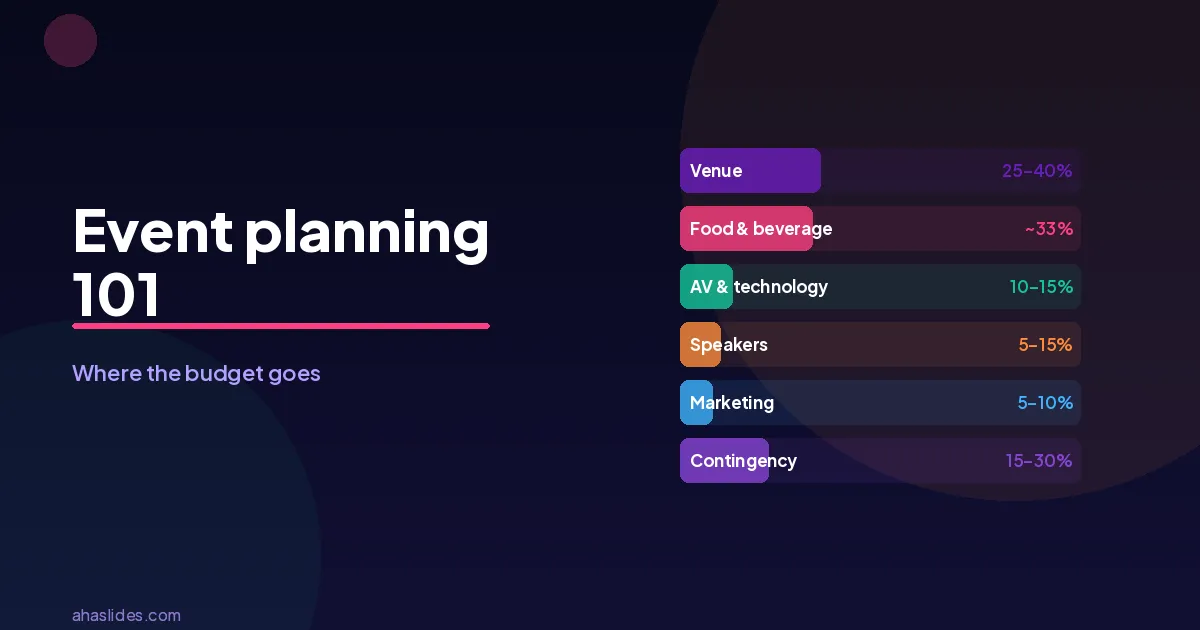
A typical corporate event budget breaks down roughly like this:
Venue rental typically accounts for 25-30% of total spend. Catering and beverages run 30-35%. AV and technology sits at 15-25%. Speakers, entertainment, and facilitation combined usually land at 5-10%. Marketing and printed materials take another 5%. The remaining 10-15% should be held as contingency and treated as a non-negotiable line item, not an optional buffer.
That last line is the one most new planners skip. Equipment breaks, caterers cancel, attendance exceeds projections, the venue charges for parking you didn't know about. Build the contingency into the budget from the start rather than scrambling for approvals when something goes wrong.
Also distinguish fixed costs (venue rental, speaker fees) from variable costs (catering per head, printed materials per attendee). Fixed costs hit whether you have 50 attendees or 150. Variable costs scale. If your attendance estimate is uncertain, model both scenarios before committing to a venue size.
Step 3: Build the planning timeline
For large conferences, trade shows, or multi-day company events, 10–12 months of lead time is realistic. For smaller internal meetings or workshops, 5–6 weeks is often workable. The general rule: the more vendors involved, the more lead time you need.
Three to six months out, lock in the date and venue, confirm budget and internal sign-off, and identify and contract speakers, facilitators, or entertainment. Open registration or send save-the-dates once those anchors are confirmed.
Six to eight weeks out, finalize the agenda and run-of-show, confirm catering headcount and dietary requirements, brief the AV team on technical requirements, and send full invitations or registration reminders.
Final two weeks, confirm all vendor deliverables and contacts, finalize the attendee list and logistics details, and prepare any materials, slides, or printed collateral. Conduct a site visit if you have not done one recently.
Final 48 hours, do a full walkthrough with on-site staff, test all AV and tech before anyone arrives, and brief all team members on their roles and escalation paths.
Step 4: Choose and confirm the venue
Venue selection is where budget and logistics collide. A few things to verify before you sign anything:
Capacity. Most venues publish maximum capacity, which refers to fire codes, not comfortable occupancy. For seated events, subtract roughly 20–25% from the stated maximum to get a realistic working number.
AV and tech infrastructure. Find out what's included in the rental versus what you'll need to bring in. WiFi bandwidth matters a lot if attendees will be using devices or you're running interactive elements.
Catering policy. Some venues require you to use their in-house catering. Others allow outside vendors. Know which before you budget F&B.
Accessibility. Confirm physical accessibility for attendees with disabilities, and check whether the venue has accessible restrooms, parking, and entrances.
Cancellation and force majeure terms. Read the deposit structure and cancellation penalties before signing. Know what happens if the event needs to be postponed.
Get everything confirmed in writing. A verbal agreement about included tables or a promised tech package has no legal standing.
Step 5: Manage vendors like a project
Corporate events typically involve multiple vendors: catering, AV, décor, photography, transportation, security, and often a third-party event management platform. Each is a dependency with its own timeline.
The approach that works: treat vendor management the same way you'd treat project management. Each vendor gets a clear brief that includes deliverables, timeline, contact information, and escalation paths. You schedule check-ins proportional to the risk: weekly for the venue and catering company two months out, more frequent in the final two weeks.
Build a single-page vendor contact sheet with name, role, mobile number, and a one-line summary of what they're responsible for. This document is what your on-site team uses when something goes wrong at 7am on event day.
Ask every vendor explicitly: what do you need from me, and by when? Vendor failures are often caused by the event organizer missing a deadline (headcount confirmation, floorplan sign-off, menu selection), not the vendor.
Step 6: Build the on-site logistics plan
Logistics is the gap between a good plan and a good event. The elements most organizers underestimate:
Registration and check-in. A 200-person event with a single check-in station creates a 20-minute line. Either have multiple stations or use a mobile check-in app. Test the process in advance.
Run of show. A detailed, time-coded document covering every element of the event from load-in to breakdown. Includes who is responsible for each transition, what happens if a speaker runs long, and when vendors are scheduled to arrive and depart.
Contingency protocols. Identify the three most likely failure points (AV failure, no-show speaker, catering delay) and have a written contingency for each. Brief your team on them before the event starts.
Attendee experience details. The friction points attendees notice: unclear signage, long registration lines, bad WiFi, no water during breaks, hard-to-find restrooms. These are the details that shape how people remember the event.
A useful checklist for the day-of plan:
Arrive at least 90 minutes before doors open. Walk every space: registration area, main room, breakout rooms, catering setup, and restrooms. Confirm catering delivery matches the order. Test AV with the actual presentation files, not placeholders. Brief the registration team on the check-in process and any VIP arrivals. Confirm all vendor contacts are reachable by mobile. Keep a printed copy of the run-of-show on hand throughout the event.

One thing worth budgeting explicitly: the person managing logistics on the day should not be the same person presenting, facilitating, or managing stakeholder relationships. Dual-tasking those roles reliably produces problems with both.
Step 7: Post-event evaluation
The event is over. Most organizers breathe a sigh of relief and move on. The ones who run consistently better events do one more thing: they close the loop.
Within 48 hours, send an attendee survey. Keep it short: 5 questions maximum. Cover overall satisfaction, the most valuable element, the least valuable element, one thing they'd change, and whether they'd attend again. Response rates drop sharply after 48 hours, so send it quickly.
Review your own performance against the objective you set in Step 1. Did the event accomplish what it was supposed to accomplish? If the goal was skill transfer, what do the assessment scores show? If it was pipeline, what meetings got booked? If it was team cohesion, what does the survey say about connection and trust?
Document what worked and what didn't in enough detail that someone else could use the notes. The run-of-show document, vendor contacts, budget actuals, and attendee feedback should all be archived together.
Finally: debrief the team that ran the event within a week while memory is fresh. The insights that prevent next year's problems come from the people who were on-site, not the post-event survey.
Running interactive corporate events with AhaSlides
The moment most corporate events lose the room is the 45-minute mark of a presentation nobody asked questions during. Building interaction into the program from the start prevents that.
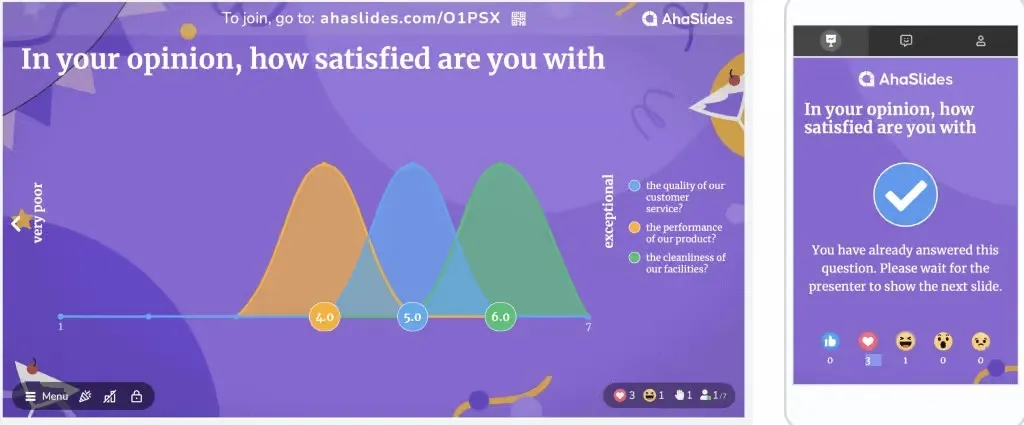
AhaSlides integrates directly into presentations and runs on attendees' phones through a join link, no app download required. Live polls give presenters a real-time read on what the room thinks before they move to the next topic. Word clouds surface what is on people's minds without requiring anyone to speak first. Anonymous Q&A lets attendees ask the questions they would not raise in open discussion, which matters in sessions with a wide seniority range in the room.
For post-event evaluation, running the closing survey on-screen as the last item in the program consistently outperforms the follow-up email. People are still in the room, still paying attention, and response rates reflect that.
Frequently Asked Questions
What is corporate event planning? Event planning is the process of organizing and coordinating all the elements that make up a structured gathering: venue, logistics, vendors, program, and attendee experience; all that it runs smoothly and achieves its intended goal.
What are the 5 Cs of event management? The 5 Cs are Concept, Coordination, Control, Culmination, and Closeout. They describe the full arc of an event from initial idea through execution and post-event wrap-up.
How much does a corporate event cost? A small internal meeting might cost a few thousand dollars. A mid-size conference of 200–500 people typically runs $50,000–$500,000 depending on the city, venue, catering quality, and program. Large-scale events can run into the millions. The biggest variable is venue and F&B, which together often account for 55–75% of total spend.
How far in advance should you plan a corporate event? For large conferences or multi-day events, 10–12 months is realistic. For smaller workshops or internal meetings, 5–6 weeks can work. The key variable is vendor availability: the more vendors involved, the more lead time you need.
What skills does a corporate event planner need? Organization is the foundation, but the skill that separates good planners from great ones is anticipating failure points before they occur and having a plan in place. Every event has something go wrong; the question is whether you've thought about it in advance.