

"I read a book about ___." Give that line to a room of 12-year-olds and you'll get dinosaurs, a cat who robbed a bank, and at least one "my homework, obviously." That's the charm of the complete the sentence game (also called finish my sentence or finish the sentence). It takes 30 seconds to explain, needs almost no prep, and gets every student producing real language instead of watching the same three hands go up.
In this guide, we'll show you how to run it three ways: as a live fill in the blank quiz on AhaSlides, as a no-tech speaking game, and as a printable worksheet. You'll also get 60 sentence starters sorted by level and purpose, plus free templates for your next lesson.
What is the complete the sentence game?
One person (usually you) shares the start of a sentence with a gap, and students fill it in. That's it. The trick is choosing which kind of gap you give them:
- Closed prompts have one right answer and test a specific point. "Where ___ your grandmother live?" (does)
- Open prompts have endless right answers and build fluency and creativity. "Chocolate is ___."
The best lessons we've seen mix both: an accuracy round to lock in the grammar, then a creative round where students use it to say something about themselves.
Why it works (it's more than a filler)
It looks like a simple warm-up, but there's solid learning science behind it:
- The generation effect. People remember words better when they produce them than when they simply read them. Slamecka and Graf showed this back in 1978, and filling a blank is generation in its purest form.
- Retrieval practice. Pulling information out of memory strengthens it more than rereading does (Roediger and Karpicke, 2006). Every blank is a tiny retrieval rep.
- A built-in scaffold. Sentence stems give English learners and shy students a structure to lean on, so they can focus on one new piece instead of building a whole sentence from scratch.
- Everyone answers. When students respond in pairs, on paper, or on their phones, you hear from the whole class, not just the fastest hand.
How to play the complete the sentence game in class
What you need
- A list of prompts (grab ours below)
- A way for students to answer: phones, mini whiteboards, or paper
- 10 to 20 minutes
Step by step
- Pick your target. Choose one grammar point (past simple, modals, adjectives) or one topic (food, routines, summer holidays). Focused prompts make feedback much easier.
- Model it. Complete one example out loud and point out the pattern. "This summer I visited my aunt. Visit becomes visited."
- Set the rules. Full sentences only, a time limit of 20 to 30 seconds, and no copying your neighbor's ending.
- Play an accuracy round. Five or so closed prompts. Reveal answers after each one and fix errors on the spot.
- Play a creative round. Switch to open prompts and let students have fun with the same structure.
- Follow up. Ask "Why?" or have partners ask each other one follow-up question. This is where the real speaking practice happens.
- Wrap up. Share two or three common mistakes you noticed and correct them together, without naming anyone.
Play it live with the AhaSlides fill in the blanks slide
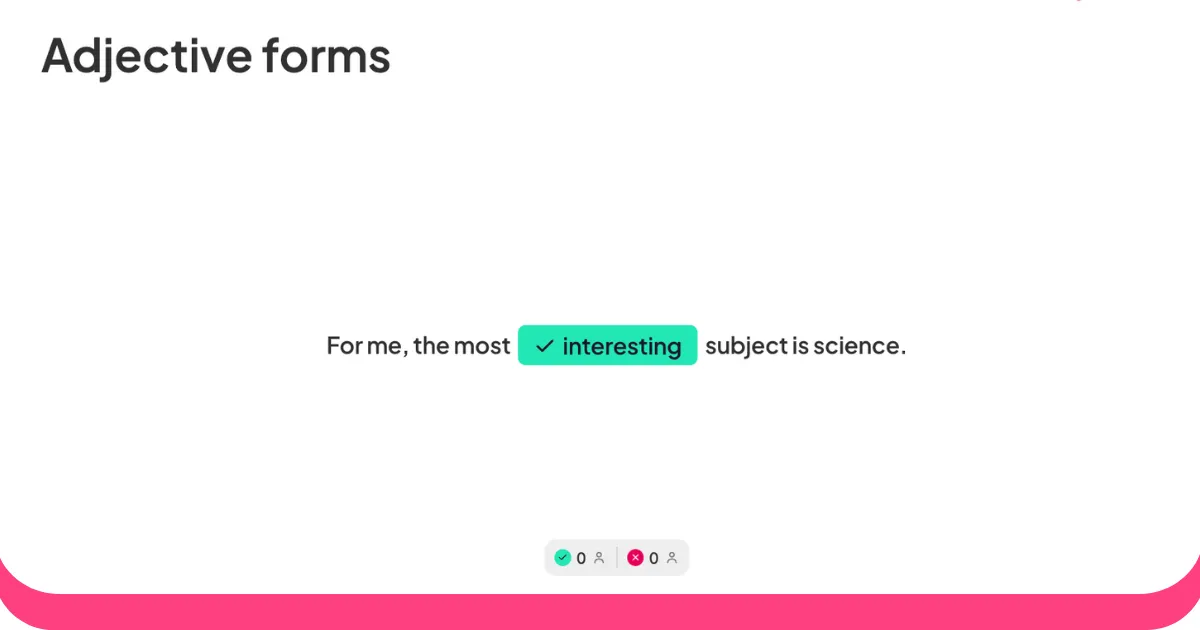
Want the energy of a quiz show without printing a thing? We built a free complete the sentence template on AhaSlides using the fill in the blanks slide. Students join from their phones by scanning a QR code, fill each gap live, and race for the leaderboard.
What's inside the template
- Round 1, type the verb: 5 fill in the blanks slides with typed answers on the past simple, negatives, present simple questions, frequency adverbs, and daily routines.
- Leaderboard: a quick breather (and bragging rights).
- Round 2, pick the word: 4 fill in the blanks slides with drop-down answers on -ing vs. -ed adjectives, good vs. well, modal verbs, and was vs. were.
- Leaderboard: halftime scores.
- Bonus, finish it your way: a word cloud and 2 open-ended slides for creative, personal answers with no wrong answers.
Most quiz slides also include speaker notes with a follow-up question and the most common mistake to watch for, so you can teach while you play.
Why teachers like the fill in the blanks slide
- Typed or drop-down answers. Use typed blanks to practice spelling and drop-down blanks for younger learners or beginners.
- Multiple accepted answers. Add up to four accepted answers per blank, so "didn't travel" and "did not travel" both count.
- Forgiving grading. Answers are checked without caring about capital letters, accents, or stray punctuation, so students are judged on the grammar, not on a missing capital letter.
- Up to four blanks per sentence, with partial credit if a student gets some of them right.
- Speed scoring. Faster correct answers earn more points, which keeps even the back row leaning in.
Make it your own in three steps
- Open the template and save a copy to your account.
- Edit any sentence and type [blank] wherever you want a gap. Add the correct answer (and any alternatives).
- Choose typed or drop-down, set the timer, and hit Present.
Free printable complete the sentence worksheet
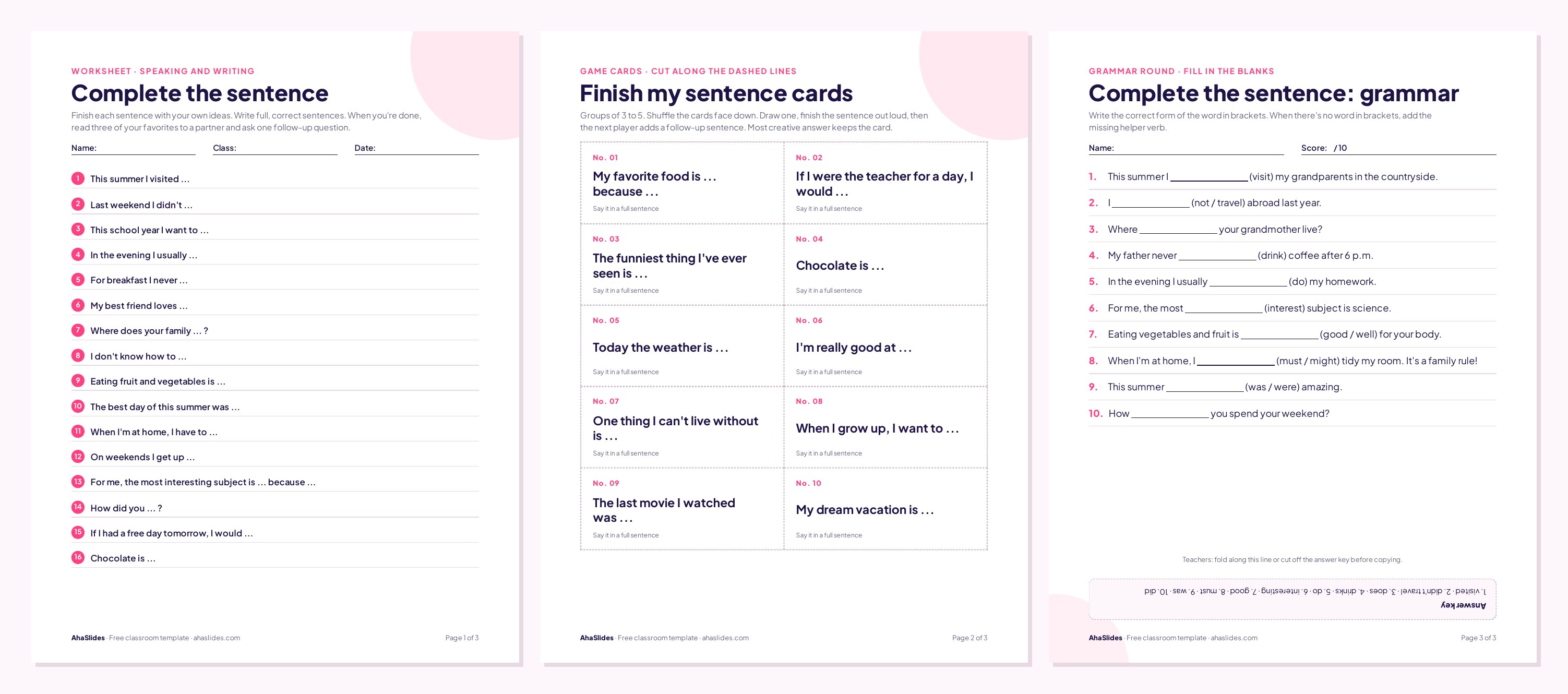
No devices? No problem. Our free 3-page printable covers the same lesson on paper:
- Page 1: Worksheet. 16 sentence starters with writing lines, plus a partner speaking task at the end.
- Page 2: Game cards. 10 cut-out cards for small groups. Draw a card, finish it out loud, and the next player adds a follow-up sentence.
- Page 3: Grammar gap-fill. 10 closed prompts that match the AhaSlides template, with an upside-down answer key you can fold under before copying.
It works well for homework, early finishers, sub plans, or any day the Wi-Fi decides to take a nap.
60 complete the sentence prompts for your class
Beginner (A1 to A2)
- My name is ... and I like ...
- Every morning I ...
- My favorite color is ... because ...
- I have ... in my bag.
- On weekends I usually ...
- My best friend is ...
- For breakfast I eat ...
- I can't ...
- Today the weather is ...
- My favorite animal is ...
- After school I ...
- I don't like ...
- In my bedroom there is ...
- My mom loves ...
- I am good at ...
Intermediate (B1 to B2)
- This summer I visited ...
- If I had a free day tomorrow, I would ...
- The best day of my life was when ...
- I've never ...
- I think that my best friend doesn't like ...
- When I was younger, I used to ...
- By the end of this year, I want to ...
- I don't watch TV news because ...
- The most interesting subject for me is ... because ...
- If I could change one thing about my school, I would ...
- I was really surprised when ...
- I get nervous when ...
- Something I'm proud of is ...
- One thing I can't live without is ...
- I think we all can ...
Grammar-focused (with answers)
- This summer I ___ (visit) my grandparents. (visited)
- I ___ (not / travel) abroad last year. (didn't travel)
- Where ___ your grandmother live? (does)
- How ___ you spend your weekend? (did)
- My father never ___ (drink) coffee at night. (drinks)
- She ___ (be) at home when I called. (was)
- We ___ (study) English for three years now. (have studied / have been studying)
- If it rains tomorrow, we ___ (stay) inside. (will stay)
- This movie is ___ (bore). I'm so ___ (bore). (boring / bored)
- You ___ wear a helmet on a bike. It's the law. (must)
- Eating vegetables is ___ (good / well) for you. (good)
- She speaks English ___ (fluent) than me. (more fluently)
- I'm looking forward ___ seeing you. (to)
- There ___ (be) many people at the party. (were)
- I wish I ___ (can) fly. (could)
Fun and creative
- Chocolate is ...
- If I were the teacher for a day, I would ...
- The funniest thing I've ever seen is ...
- My pet would say ...
- If I found $100 on the street, I would ...
- Aliens visited our class and ...
- The worst superpower would be ...
- If my shoes could talk, they'd say ...
- The perfect sandwich has ...
- My dream vacation is ...
- If I could meet anyone, I'd meet ...
- The weirdest food I've ever tried is ...
- Something that always makes me laugh is ...
- If I lived in a castle, I would ...
- In 20 years, our classroom will ...
5 variations to keep it fresh
- Chain story. Each student finishes the previous student's sentence and starts a new one. Great for narrative tenses.
- Unique answer scoring. Teams write an ending on a mini whiteboard. Answers no other team wrote score the most, a twist ALTopedia teachers report gets classes very competitive.
- Letter or rhyme challenge. Every ending must start with the same letter or rhyme with a word you choose.
- Sentence relay. Two teams line up at the board. Each student adds one word until the sentence is complete and correct.
- Exit ticket. End the lesson with "Today I learned ..." or "One thing I'm still confused about is ..." and read the answers before planning tomorrow.
Common mistakes (and quick fixes)
- Accepting one-word answers: Require a full sentence, or ask "Why?" every time
- Prompts that are too hard: Start with the present simple and build up
- Stopping after the answer: Add a partner follow-up question to turn answers into conversation
- Correcting every error live: Note common mistakes and fix them together at the end
- Same students answering every time: Use phones, whiteboards, or paper so everyone answers at once
FAQs
What is the finish my sentence game?
It's a word game where one person gives the start of a sentence and others complete it. In class, it's used to practice grammar, vocabulary, and speaking.
What age is the complete the sentence game for?
Any age. Use simple present tense prompts for young learners and beginners, and conditionals, opinions, or debate stems for teens and adults.
How long does it take?
About 10 to 15 minutes for 10 prompts, including quick follow-ups. It also works as a 5-minute warm-up or exit ticket.
Can I play it online?
Yes. With the AhaSlides fill in the blanks slide, students join from any device with a link or QR code, so it works in person, online, or in hybrid classes.
What's the difference between complete the sentence and fill in the blank?
They overlap. Fill in the blank usually means one correct answer (a closed prompt), while complete the sentence often allows open, personal endings. Our template includes both.
Ready to play?
One sentence, one blank, and a room full of answers you didn't see coming. Grab the free AhaSlides template for your next lesson, print the worksheet for your no-tech days, and let your students finish the sentence.