


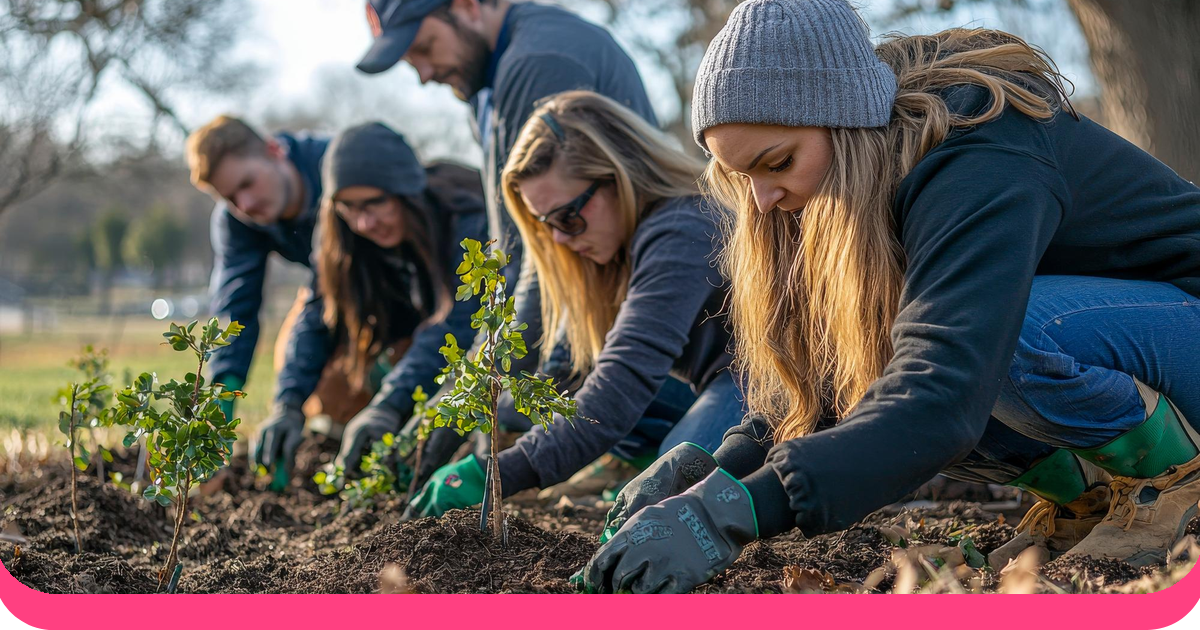
How much do you know about Google Earth Day? Earth Day falls every year on April 22, and this Google Earth Day quiz tests your knowledge of the environment, sustainability, and Google's efforts to mark the occasion with its yearly doodle.
What is Google Earth Day?
Earth Day is an annual event celebrated on April 22, dedicated to raising awareness and promoting action to protect the planet.
It has been observed since 1970 and has grown into a global movement, with various activities, initiatives, and campaigns promoting sustainability and environmental protection.
How to create a Google Earth Day trivia
A Google Earth Day trivia quiz is easy to make. Here's how:
- Step 1: Create a new presentation in AhaSlides.
- Step 2: Explore the different quiz types in the quiz section, or type "earth day quiz" into the AI slide generator and let it build a draft for you (it supports multiple languages).
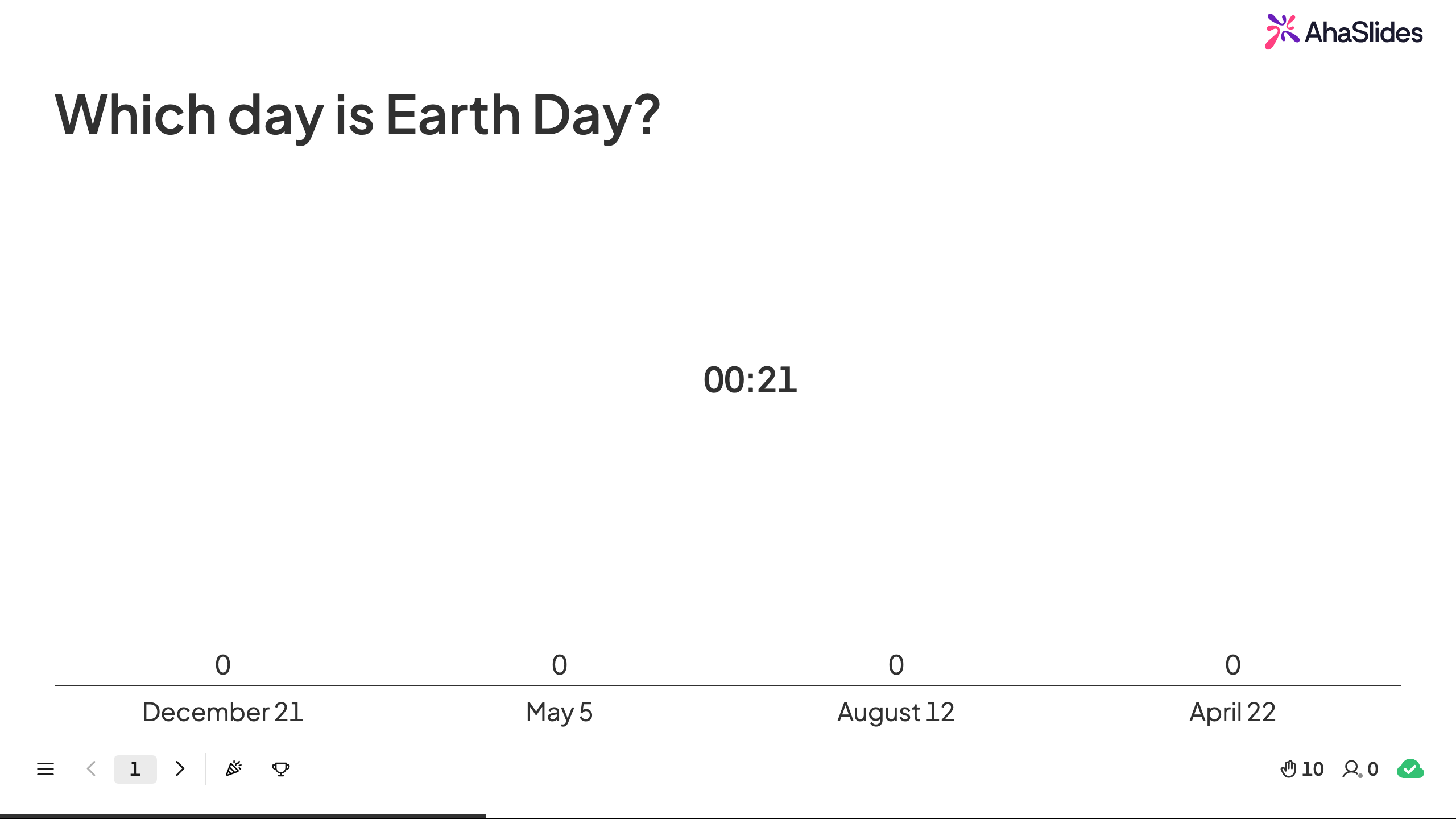
- Step 3: Fine-tune your quiz with designs and timing, then click "Present" to run it live, or set the Earth Day quiz to "self-paced" so participants can play it whenever they like.
Fun Google Earth Day quiz
Ready? It's time to take the Google Earth Day quiz and learn a bit more about our planet.
Question 1: Which day is Earth Day?
A. April 22
B. August 12
C. October 31
D. December 21
Correct answer: A. April 22
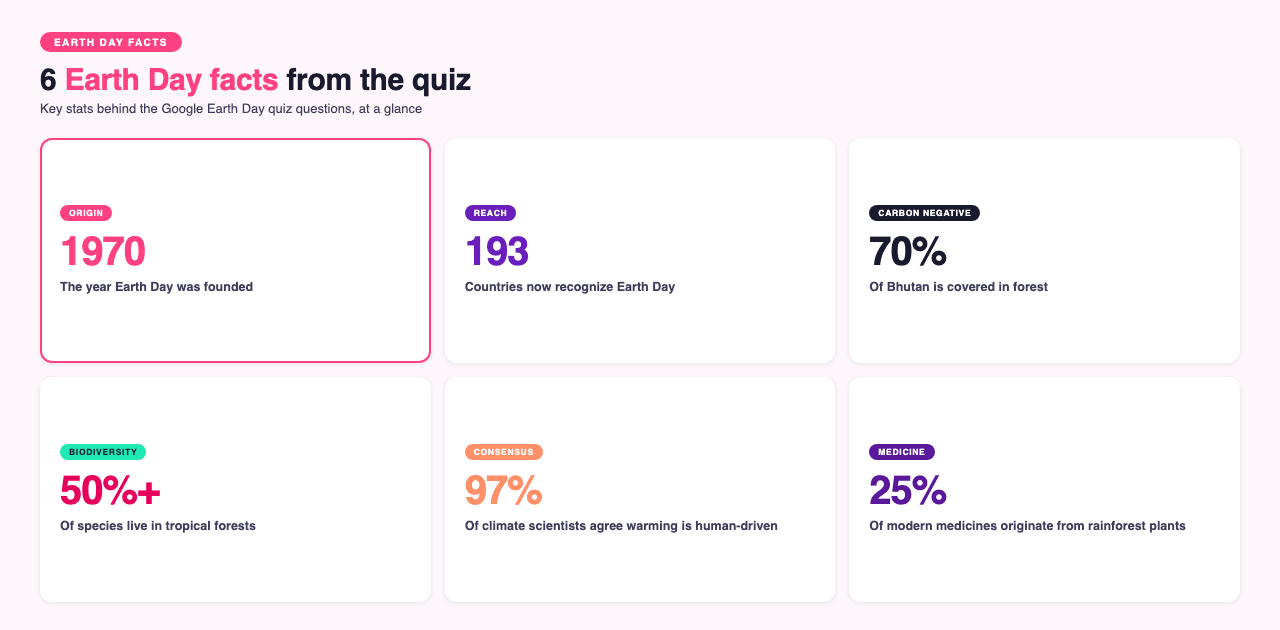
Explanation: Earth Day is held on April 22 every year. The event dates back to 1970, when it was established to bring environmental issues to the forefront of public attention [1].
Question 2: Which bestselling book warned of the effects of pesticides?
A. The Lorax by Dr. Seuss
B. The Omnivore's Dilemma by Michael Pollan
C. Silent Spring by Rachel Carson
D. The Myths of Safe Pesticides by Andre Leu
Correct answer: C. Silent Spring by Rachel Carson
Explanation: Rachel Carson's book Silent Spring, published in 1962, raised public awareness of the dangers of DDT, contributing to its US ban in 1972. Its influence is still felt in the environmental movement today.
Question 3: What is an endangered species?
A. A type of living thing that is at risk of extinction
B. A species found on land and in the ocean
C. A species that is threatened by prey
D. All of the above
Correct answer: A. A type of living thing that is at risk of extinction
Explanation: A landmark UN biodiversity assessment found that current extinction rates are tens to hundreds of times higher than the average over the past 10 million years, driven mainly by habitat loss, climate change, and pollution [8].
Question 4: True or false: the Amazon rainforest produces 20% of the world's breathable oxygen.
A. True
B. False
Correct answer: B. False
Explanation: This is one of the most repeated environmental myths. The Amazon does produce huge amounts of oxygen through photosynthesis, but it also consumes nearly all of it through respiration and decomposition, so its net contribution to the air we breathe is close to zero [2]. Most of Earth's oxygen actually comes from ocean phytoplankton, not rainforests.
Question 5: Which of these ailments can be treated with prescription drugs derived from rainforest plants?
A. Cancer
B. Hypertension
C. Asthma
D. All of the above
Correct answer: D. All of the above
Explanation: Roughly 25% of modern medicines originate from rainforest plants [5], including vincristine, used in cancer treatment and derived from the rosy periwinkle. Rainforest-derived compounds are also used to treat conditions such as hypertension and heart disease.
Question 6: Exoplanets with lots of volcanic activity, in systems full of asteroids, are bad prospects for finding extraterrestrial life.
A. True
B. False
Correct answer: B. False
Explanation: Volcanic activity isn't necessarily bad news for life. On Earth, volcanoes release water vapor and other gases that helped form the atmosphere that supports life today.
Question 7: Small, Earth-size planets are common in the galaxy.
A. True
B. False
Correct answer: A. True
Explanation: NASA's Kepler mission found that small, rocky planets are actually the most common type of planet in the galaxy [3], more common than gas giants like Jupiter.
Question 8: Which of the following is a greenhouse gas?
A. CO2
B. CH4
C. Water vapor
D. All of the above
Correct answer: D. All of the above
Explanation: Greenhouse gases include carbon dioxide (CO2), methane (CH4), water vapor, nitrous oxide (N2O), and ozone (O3). They trap heat in the atmosphere, keeping Earth warm enough to sustain life.
Question 9: The overwhelming majority of scientists agree that climate change is real and caused by humans.
A. True
B. False
Correct answer: A. True
Explanation: Multiple independent surveys of the peer-reviewed literature have found that more than 97% of actively publishing climate scientists agree that recent warming is primarily driven by human activity [4].
Question 10: Which land-based ecosystem holds the most biodiversity?
A. Tropical forests
B. African savannah
C. South Pacific islands
D. Coral reefs
Correct answer: A. Tropical forests
Explanation: Tropical forests cover less than 7% of Earth's land surface but are home to more than half of the world's plant and animal species [6].
Question 11: Gross National Happiness is a measure of national progress based on collective wellbeing. It has helped which country become carbon-negative?
A. Canada
B. New Zealand
C. Bhutan
D. Switzerland
Correct answer: C. Bhutan
Explanation: Rather than tracking GDP alone, Bhutan measures progress through Gross National Happiness, built on four pillars: sustainable socioeconomic development, good governance, environmental conservation, and cultural preservation. Bhutan is one of the few countries verified as carbon-negative, absorbing more carbon than it emits [7].
Question 12: The idea for Earth Day came from Senator Gaylord Nelson.
A. True
B. False
Correct answer: A. True
Explanation: After witnessing the aftermath of the 1969 Santa Barbara oil spill, US Senator Gaylord Nelson proposed a national day of environmental awareness, which became the first Earth Day on April 22, 1970.
Question 13: What happened to the Aral Sea over time?
A. It was polluted with industrial waste
B. It was dammed for power generation
C. It has dramatically shrunk due to water diversion projects
D. It increased in size due to higher rainfall
Correct answer: C. It has dramatically shrunk due to water diversion projects
Explanation: Starting in the 1960s, Soviet irrigation projects diverted the rivers feeding the Aral Sea to water cotton farms in Central Asia, causing the lake to shrink to a fraction of its original size.
Question 14: What percentage of the world's remaining rainforest does the Amazon hold?
A. 10%
B. 25%
C. 50%
D. 75%
Correct answer: C. 50%
Explanation: The Amazon is the world's largest rainforest, covering roughly 2.72 million square miles across South America and accounting for around half of the planet's remaining rainforest [2].
Question 15: How many countries around the world celebrate Earth Day annually?
A. 193
B. 180
C. 166
D. 177
Correct answer: A. 193
Explanation: Earth Day is now recognized in more than 193 countries, coordinated globally by the nonprofit EARTHDAY.ORG [1].
Question 16: What was the official theme for Earth Day 2024?
A. "Invest in Our Planet"
B. "Planet vs. Plastics"
C. "Climate Action"
D. "Restore Our Earth"
Correct answer: B. "Planet vs. Plastics"
Explanation: "Planet vs. Plastics" focused on raising awareness of single-use plastics, the health risks of microplastics, and the environmental cost of fast fashion.
Key takeaways
We hope this quiz taught you a little more about our planet and left you more mindful of protecting it. Want to build your own Earth Day quiz? Sign up for AhaSlides to get free, ready-to-use templates and customize a quiz to fit your classroom, team, or event.
Don't want to write your own questions? Copy the Earth Day quiz trivia and "which animal are you?" template straight into your account and edit it to fit your group.
AhaSlides is a quiz maker built for live groups
Frequently asked questions
Why is Earth Day on April 22?
There were a few key reasons Earth Day landed on April 22:
- Between spring break and final exams: Senator Gaylord Nelson chose a date when most US college students would still be on campus, to maximize participation.
- Arbor Day overlap: April 22 coincided with the already-established Arbor Day, a day focused on planting trees, creating a natural link for the first event.
- No major conflicts: The date didn't clash with major religious holidays or other competing events.
How do you play the Google Earth Day quiz?
Google has run interactive Earth Day quizzes directly in Search in past years. When available, you can search "Earth Day quiz," select "Start quiz," and answer the questions shown.
What was the Google Doodle for Earth Day?
Google marks Earth Day most years with a special animated doodle on its homepage, often built around a theme relevant to that year's environmental focus.
When did Google introduce the Earth Day doodle?
Google's first Earth Day doodle appeared in 2001, created by Dennis Hwang, then a 19-year-old Google intern [9]. Google has released a new Earth Day doodle most years since.
Sources
- Earth Day history and 193-country participation: https://www.earthday.org/history/
- Why the Amazon rainforest matters, WWF: https://www.worldwildlife.org/news/nature-breaking/why-we-should-care-about-the-amazon-rainforest/
- NASA Kepler mission findings on small planet prevalence: https://www.nasa.gov/kepler
- Scientific consensus on human-caused climate change: https://climate.nasa.gov/scientific-consensus/
- Rainforest facts and medicine statistics, Rainforest Alliance: https://www.rainforest-alliance.org/everyday-actions/9-rainforest-facts-everyone-should-know/
- Tropical forest biodiversity concentration: https://www.worldwildlife.org/biomes/tropical-and-subtropical-moist-broadleaf-forests
- Bhutan's carbon-negative status, UNDP: https://www.undp.org/bhutan/news/what-tiny-bhutan-can-teach-world-about-being-carbon-negative
- IPBES Global Assessment on species extinction rates: https://ipbes.net/global-assessment
- History of the Google Earth Day doodle: https://doodles.google/doodle/earth-day-2001/

.png)