


If you've ever watched a room full of healthcare staff click through a 45-slide HIPAA training module with the enthusiasm of someone waiting at the DMV, you're not alone.
Most HIPAA training follows the same tired formula: wall-to-wall text, a quiz at the end, a certificate that disappears into a shared drive, and — if you're honest — almost zero retention by the following Monday.
Here's the uncomfortable truth: checking the compliance box is not the same as building a compliance culture. And the gap between the two can cost your organisation dearly — HIPAA violations resulted in over $141 million in fines and settlements between 2016 and 2023, according to HHS Office for Civil Rights data.
The good news? The science of learning has a clear answer — and it's more engaging than you might think.
Why traditional HIPAA training fails
Before fixing the problem, it helps to understand it.
Passive, one-way training — reading policies, watching videos, clicking "next" — puts learners in the role of spectators. And spectators don't retain much.
A 2019 study published in the Journal of Multidisciplinary Healthcare (Arain, Tarraf & Ahmad) examined IT security and privacy training across a large healthcare organisation with 586 staff members. The results were telling: while 80.9% of participants completed the online training, only 57.5% perceived it as effective — and knowledge gaps remained significant. For instance, only 25.5% of clinical staff knew how to encrypt emails, a basic security behaviour the training was designed to build.
The study did find one bright spot: staff who completed the training were 4.2 times more likely (CI = 2.0–8.8) to correctly respond to a suspicious email compared to those who hadn't trained at all. Training does move the needle — but only when people genuinely engage with it.
That's where interactive tools like AhaSlides come in.
What "sticky" HIPAA training actually looks like
The cognitive science is clear: people learn and remember more when they're active participants — when they're asked questions, forced to make decisions, and given immediate feedback.
Here's how to rebuild your HIPAA training sessions around that principle, using AhaSlides.
1. Replace the opening lecture with a Live Quiz
Before you teach anything, find out what your team already knows — and doesn't.
A quick Live Quiz at the start of your HIPAA session does two things at once. It activates prior knowledge (a proven memory primer), and it immediately flags the misconceptions you actually need to address. No more spending 20 minutes explaining something everyone already knows, and no more glossing over the gaps that matter.
Try questions like:
- "You receive a text from a colleague asking for a patient's room number. What do you do?"
- "Which of the following counts as Protected Health Information (PHI)?"
- "True or false: verbal conversations in a hospital corridor can be a HIPAA violation."
Real-time results show up on screen instantly. Suddenly, your room is alive — people are debating answers, checking their assumptions, leaning in. That's not a side effect. That's the point.
2. Use Word Clouds to surface what your team is actually worried about
HIPAA training works best when it feels relevant to people's daily reality — not a generic policy document that could belong to any organisation.
Open your session with an AhaSlides Word Cloud: ask participants to submit the first word that comes to mind when they hear "HIPAA compliance." Or ask: "What's the trickiest HIPAA situation you've faced in the last month?"
What comes back will tell you everything. Common answers like "texting," "photos," "family members," "hallway" signal where your real training focus needs to be. You're not just training to a rulebook — you're training to your team's actual risk landscape.
Word Clouds also do something subtler: they signal that this session is a conversation, not a lecture. That shift in dynamic changes how people listen for the rest of the hour.
3. Run scenario-based Live Polls throughout
The biggest weakness in most compliance training is the gap between knowing the rule and applying it in context. Staff can recite HIPAA's minimum-necessary standard verbatim and still make the wrong call in a high-pressure, real-world situation.
Live Polls with scenario-based questions close that gap.
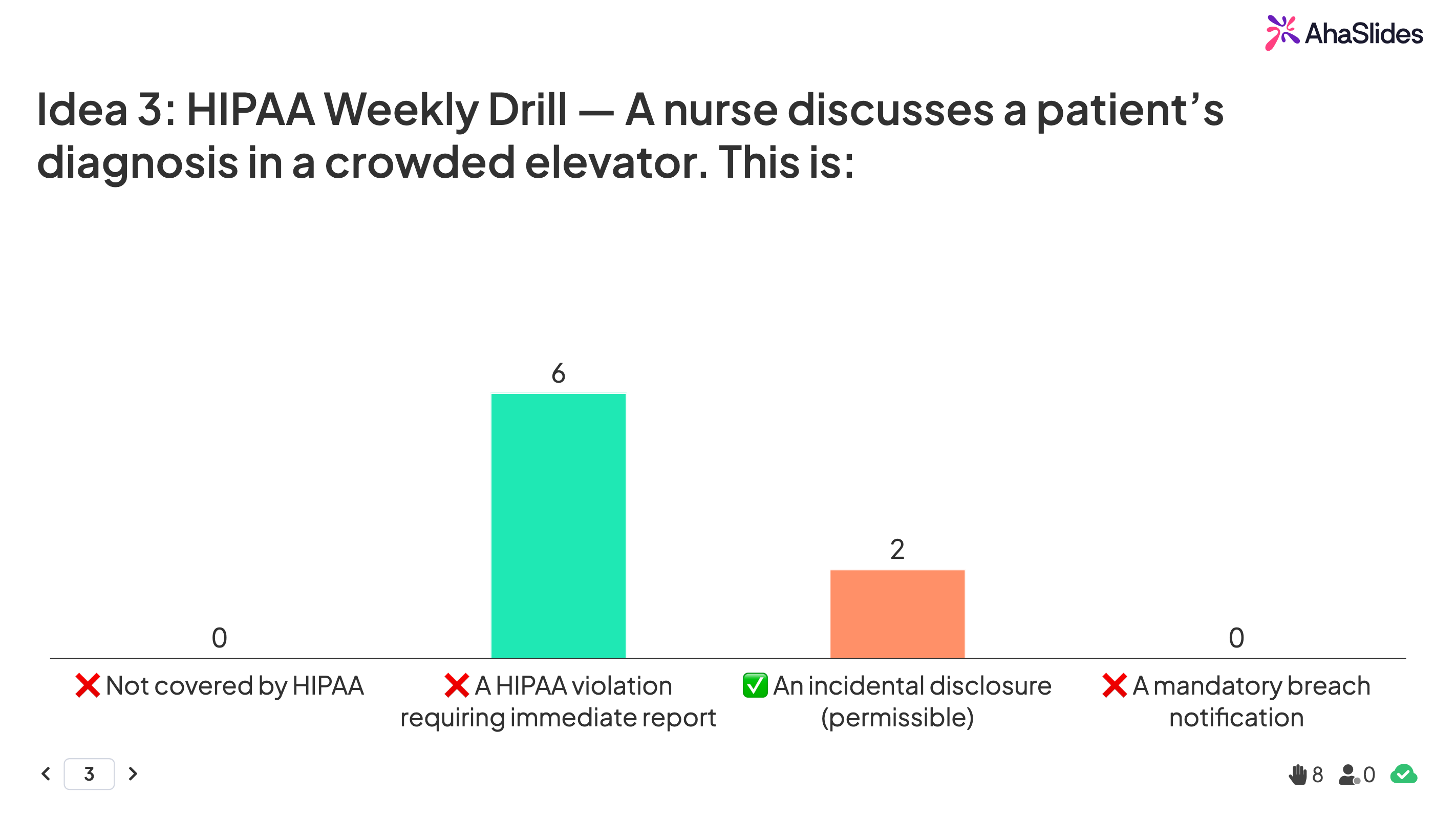
Present a situation — "A patient's spouse calls asking for discharge information. The patient hasn't designated them as an authorised representative. What's your next step?" — and let the room vote in real time before you discuss.
This approach:
- Forces active decision-making, not passive listening
- Creates natural discussion moments when the room splits on an answer
- Gives trainers instant data on which scenarios need deeper coverage
Sprinkle these throughout your training rather than saving everything for a final quiz. Spacing practice across a session significantly improves long-term retention — which, in compliance training, is the whole point.
4. Open the floor with Q&A — anonymously
Here's one of the most underused tools in compliance training: anonymous questions.
Many staff have genuine HIPAA questions they're afraid to ask out loud — because asking might imply they've already done something wrong, or because they don't want to look uninformed in front of a manager.
AhaSlides' Q&A slide lets participants submit questions anonymously during or after the session. The trainer can answer live, upvote the most common questions, and address the room's real concerns — not just the ones people are comfortable raising publicly.
In a compliance context, this matters more than almost any other setting. The questions people are afraid to ask are usually the ones that lead to violations.
A sample 60-minute HIPAA training agenda
Here's how these features might fit into a full session:
| Time | Activity | AhaSlides Feature |
|---|---|---|
| 0–5 min | Pre-assessment: what do you already know? | Live Quiz |
| 5–10 min | What's on your team's mind? | Word Cloud |
| 10–25 min | Core content: PHI, the minimum-necessary rule, breach reporting | Presenter slides |
| 25–35 min | Scenario practice: real-world situations, vote and discuss | Live Poll |
| 35–50 min | Advanced scenarios: social media, family inquiries, texting | Live Poll |
| 50–58 min | Open Q&A — no question too basic | Q&A slide |
| 58–60 min | Post-assessment: measure what changed | Live Quiz |
Running a pre- and post-quiz using the same questions gives you tangible data on knowledge gain — useful for compliance records and for refining future training.
The bigger picture: compliance culture vs. compliance theatre
Ticking a HIPAA training box once a year and calling it done is compliance theatre. It looks like training. It doesn't function like training.
Real compliance culture is built in the moments between mandatory sessions — when a team member pauses before forwarding an email, when a question gets raised in a Slack channel, when someone remembers the scenario from last month's training because they actually had to think through it at the time.
Interactive training doesn't just improve test scores. It builds the kind of muscle memory that kicks in during a real-world moment of pressure — which is exactly when HIPAA violations happen.
Use our ready-made HIPAA training template
We've built a complete 60-minute HIPAA training presentation in AhaSlides — ready to use as-is or customise for your team. It includes all the slide types covered in this article: a pre-assessment quiz, a word cloud warm-up, scenario-based polls, an anonymous Q&A, and a post-assessment to measure knowledge gain.
Ready to run HIPAA training that actually works?
You don't need to rebuild your entire compliance programme from scratch. Start with one session. Swap out a static slide deck for an AhaSlides quiz. Watch the room wake up.
Your team will remember more. Your compliance records will be cleaner. And nobody will leave the room wondering why they had to sit through that.
References:
Arain, M. A., Tarraf, R., & Ahmad, A. (2019). Assessing staff awareness and effectiveness of educational training on IT security and privacy in a large healthcare organization. Journal of Multidisciplinary Healthcare, 12, 73–81. https://doi.org/10.2147/JMDH.S183275
HHS Office for Civil Rights. HIPAA Enforcement Results. U.S. Department of Health & Human Services. https://www.hhs.gov/hipaa/for-professionals/compliance-enforcement/data/enforcement-results/index.html