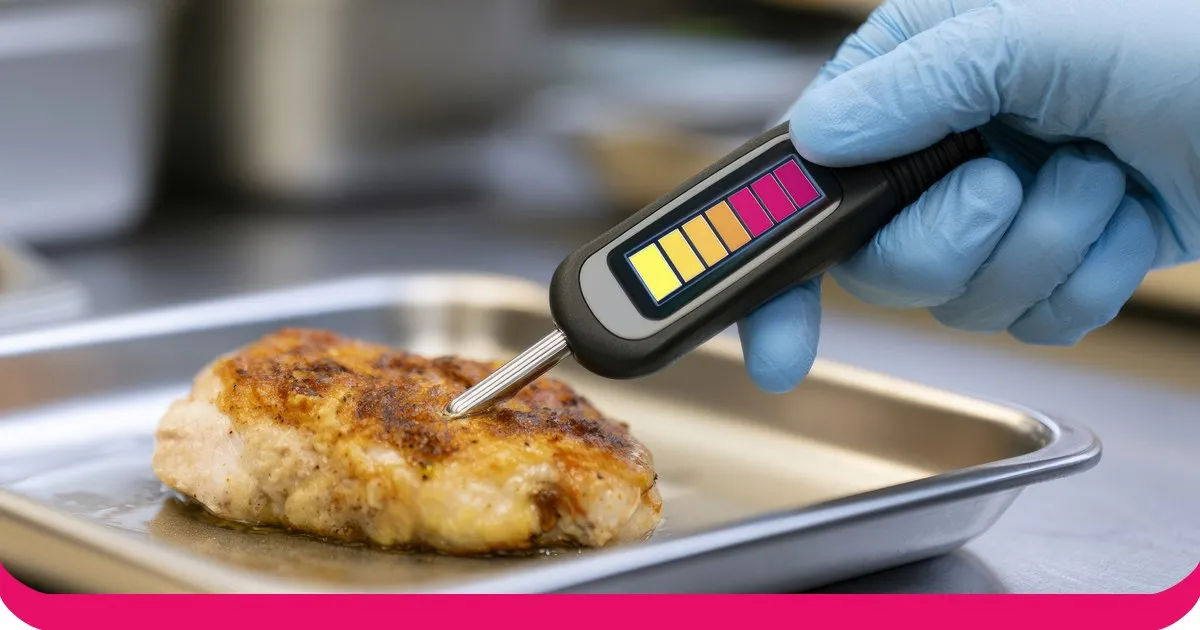
It is 7:40 on a Friday evening and the pass is three tickets deep. A cook plating a batch of chicken thighs for a large booking notices the hot-holding unit has been opened and closed all service. There is no thermometer in sight, the next ticket is already printed and nobody has time to stop. The cook can plate and hope, or break the rhythm to check, and the chef is shouting for the next dish.
This is an illustrative scenario, not a documented incident. It is the situation this guide is about: a person who knows the rule has to apply it when every incentive in the room is to go faster. The guide is for hospitality training directors and restaurant or hotel operations leads. It covers how to diagnose what is going wrong, how to design practice that looks like a real rush, how to score it, and which problems training cannot solve. Have your food safety lead or head chef validate every case and criterion before use, and follow the procedures your local regulator approves.
What the job involves
The task is to apply approved food safety controls under time pressure. That sentence has three parts, and each one can fail on its own:
- Approved controls. The steps come from your food safety management plan, not from individual habit.
- Applied. Knowing the temperature limit is not the same as checking the temperature when a ticket is waiting.
- Under time pressure. Many staff handle a quiet Tuesday perfectly. The risk sits in the busiest hour of the week.
Food safety gets this attention for good reason. The US Centers for Disease Control and Prevention (CDC) estimated, in a 2011 analysis of foodborne illness, that roughly 1 in 6 Americans (48 million people) get sick from foodborne disease each year, with 128,000 hospitalised and 3,000 deaths. Those are national estimates, not figures about any one kitchen, and the method has been updated since. They still explain why a documented system matters more than good intentions.
Diagnose before you train
Training is the right fix only when the gap is skill or habit. Before you build anything, compare what the role must do with how your programme teaches and checks it today.
- Does practice look like the work? If staff learn temperature limits from a slide deck and are tested with a recall quiz, nobody has practised the decision at 7:40 on a Friday. A recall check confirms prerequisites only.
- What is the mental demand? In Bloom's revised taxonomy, noticing that a control is slipping and choosing what to do sits at apply, analyse and evaluate, well above remembering a number. Our guide to matching learning activities to Bloom's Taxonomy shows how to match the activity to the level.
Is something other than skill in the way? Check the environment first:
- Is there a working probe thermometer at every station, with a sanitiser wipe beside it?
- Is the rota thin enough that nobody can leave the line for 30 seconds?
- Does the plan ask for checks that nobody has time to do?
- Do the people who shout loudest at the pass reward speed over safety?
If the answer to any of those is yes, passing it to the people who own staffing, equipment and culture will do more than another training session. A complementary, diagnostic approach is in our learning gap diagnostic for L&D teams.
Know your critical control points
Hazard Analysis and Critical Control Points (HACCP) is a widely used system for building food safety plans. The Codex principles published by the FAO set out seven steps: conduct a hazard analysis, determine the critical control points, establish critical limits, monitor each point, define corrective actions, verify that the system works and keep records.
Three terms are worth explaining to new staff on day one:
- Critical control point (CCP): a step where a control is essential to prevent, remove or reduce a hazard. Cooking poultry through and holding hot food hot are typical examples.
- Critical limit: the line that separates acceptable from unacceptable, such as a temperature.
- Corrective action: what the cook does when the limit is missed. This is the part most often skipped when it is busy.
UK government guidance for food businesses, for example, says hot food must be kept at 63°C or above unless it is served straight away, and may be held below that for up to 2 hours. Limits differ between countries, so use the figures in your own plan, and say who approves changes to them. Small businesses in England and Wales can build their plan from the FSA's Safer food, better business packs, which include a diary for recording daily checks.
Design purposeful practice
Give each stage a distinct job, and keep the rush in the practice stage rather than the preparation stage.
Preparation (self-paced). Staff review the CCPs, limits and corrective actions for their station. A short diagnostic confirms they know the vocabulary. Short, repeatable modules suit this stage, because the content is stable and staff can complete it between shifts.
Practice (facilitated, with time pressure). Present a short case and a clock. Learners decide what to do, say why, and see feedback that links back to the decision they made, not just a score. Raise the pressure in steps: a case with plenty of time first, then a shorter timer, then interruptions such as a second ticket or a noisy line.
Review and transfer (live or asynchronous). A pre-shift huddle works well for live coaching: the shift lead replays one ambiguous decision and asks the team what they would do. Asynchronous review is enough for straightforward cases where the right answer is clear.
Our guides to interactive practice with useful feedback and to connecting self-paced preparation with live coaching go deeper on both.
Work through a realistic example
Use the opening scene as the case. Write it up as one page and give learners the evidence they would have: the hot-holding unit's last logged temperature, the time of the log, how many portions are waiting and what the plan says.
Learner choices.
- Plate from the unit and keep going.
- Take a probe reading of the chicken, then decide.
- Take a reading, and also tell the sous chef that the log is overdue.
- Discard everything in the unit and start again.
Feedback against approved criteria. Choice 1 is not defensible: it skips the check the plan calls for. Choice 2 is defensible but incomplete: it deals with the batch but leaves the missed log unreported. Choice 3 is the strongest response, because it applies the control and escalates the gap. Choice 4 may be right if the reading fails, but it is wasteful and premature if the reading passes, so it should only follow evidence. Your food safety lead should decide where each option sits for your site.
Retry. Change one detail and run the case again: the probe reads 58°C, or the unit has been off for an unknown time. The point of the retry is to see whether the learner changed the decision for the right reason, not whether they remember the first answer.
Assess capability and plan transfer
Score the learner on a new case, not the practice case. A three-criterion rubric, scored 0 to 2, keeps this manageable.
| Criterion | Observable evidence |
|---|---|
| Task execution | Applies the approved control within the time given and records the action and evidence. |
| Reasoning | Explains the constraint, the alternatives considered and what is still uncertain. |
| Boundaries | Escalates to the shift lead or food safety lead when information or authority is not enough. |
Anchors: 0 = absent or unsupported; 1 = partial, with relevant omissions; 2 = complete and justified against the agreed criteria. Define critical errors separately, such as serving food that fails a critical limit. An overall score must not hide a critical failure: a learner who scores 2 on everything except a critical error has not passed.
The rubric is a starting point. It is not a validated readiness standard, so adapt the criteria with your food safety lead before you rely on it.
Follow-up in the workplace. Check transfer after a few real busy shifts. Look at the logs and the observed checks, not only the course score. Our guide to assessing judgment and problem-solving in training covers the method.
How to host it for a team
Run the practice stage live in a pre-shift session, then keep it available for staff who missed it.
- Pick Answer slides for the scenario choices. Show the case, give a short timer and reveal the spread of answers before you debrief.
- Open Ended slides for the reasoning: ask "what would you check first, and why?" and read a few answers aloud.
- Word Cloud slides for a warm-up: "name one thing that slips when the pass is busy".
- Rating Scale slides to gather how confident staff feel about escalating, which tells you where coaching is needed.
Build every slide from the case and rubric your food safety lead has approved. The same deck can then be used live, in a team huddle, or shared for staff to complete in their own time.
What training cannot fix
Even when task performance improves, some constraints stay in place:
- Staffing and layout. A kitchen with too few people or no probe at the pass will keep missing checks.
- Pressure from above. If speed is the only thing praised, safe behaviour will fade after the course.
- Evidence limits. One case tests a few decisions. A good score does not describe a cook's judgement in general.
- Concurrent changes. A new menu, a new supplier or a change in manager can move your results as much as the training does. Look for these before you attribute an improvement to the course.
Name these to sponsors early and plan separate fixes. Training improves what staff can do under pressure. It does not create time, equipment or authority.
What evidence shows learners can do this?
- Their score on a new, unseen case, against agreed criteria.
- A drop in missed or late records, and in corrective actions logged late.
- Observed checks during real busy periods, compared with a baseline you recorded before the training.
Define the population, the number of observations and the timing before you start, so the comparison is fair.
Frequently asked questions
How long does food safety training for kitchen staff take?
A scenario session can be short, such as one case in a pre-shift huddle, with self-paced preparation beforehand. Legal training requirements, such as a recognised food handler certificate, differ by country and employer, so check what your regulator expects first.
How do you keep staff following food safety rules during a rush?
Practise the rule at the speed it will be used. Add a timer and an interruption to the case, and agree one visible stop signal that any cook can call without being blamed for slowing service.
What is the difference between a food safety quiz and scenario training?
A quiz checks recall of limits and terms. Scenario training checks whether a person applies the control and escalates when the situation is unclear. You need the quiz for prerequisites and the scenario for capability.
Who should approve the cases and criteria?
Your food safety lead or head chef, working from your approved HACCP plan and your regulator's requirements.
Where to start
Pick one control that slips during your busiest service, such as hot-holding checks, and write a one-page case around it. Have your food safety lead validate the case and its answer criteria, draft the three-criterion rubric with a list of critical errors, and pilot it with one shift before you roll it out.
To see how a scenario like this could run live with your own team and be reused self-paced afterwards, explore AhaSlides.