


How to introduce yourself to a new team
A 2023 BambooHR study of over 1,500 full-time US employees found that 70% of new hires decide whether a job is the right fit within the first month, and 29% make that call within the first week [1]. Your introduction isn't just a formality. It sets the tone for every working relationship that follows.
This guide covers what to say, what to avoid, and how to adapt your approach whether you're an individual contributor, a new manager, or joining a remote team.
Why the first introduction matters more than people think
Most new hires underestimate how much their early interactions shape long-term perceptions. The same BambooHR research found that 70% of HR professionals agree first impressions are hard to change once formed [1]. That doesn't mean a stumbling first day is permanent damage, but it does mean there's real value in being intentional about how you show up.
What most people want from a new colleague isn't a polished sales pitch. The BambooHR data showed that 87% of new hires hope to make at least one friend at work, and 93% want the chance to shadow a colleague [1]. Connection matters more than credentials in those first days.
What to include in your introduction
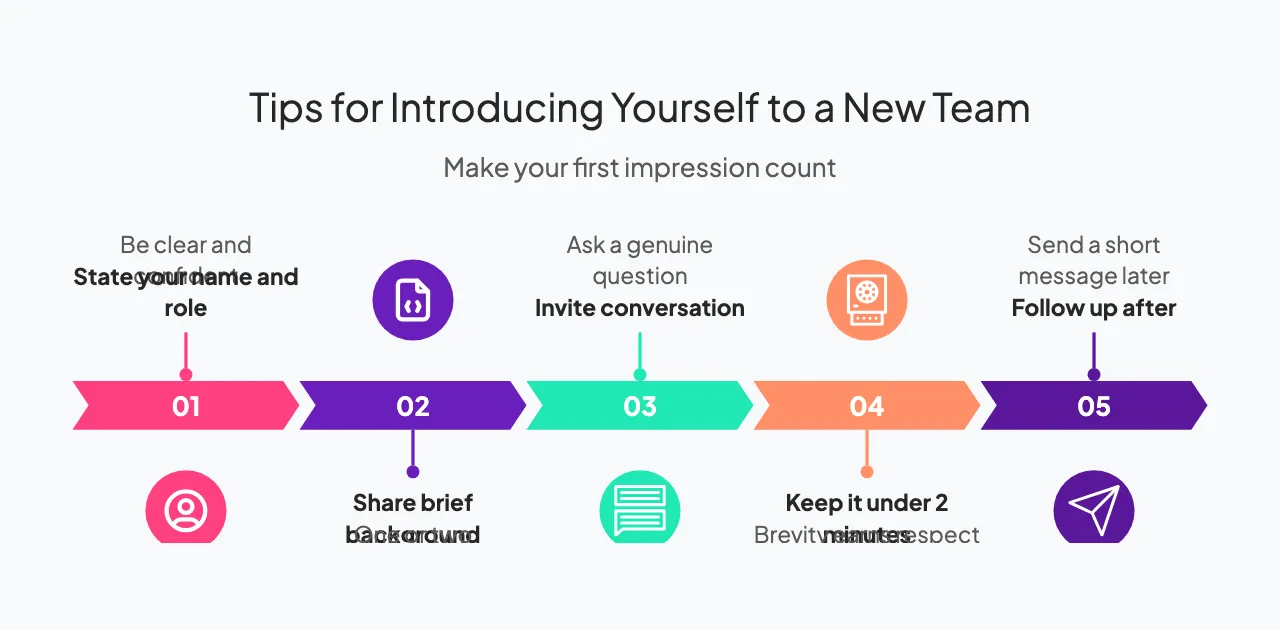
A good self-introduction covers three things, and none of them involve reciting your LinkedIn profile: who you are, what you're there to do, and one detail that makes you easier to remember and approach.
Your name and role. State this clearly even when people already know it from a calendar invite or email. Hearing someone say their own name with confidence is different from reading it on a screen.
Your background, briefly. One or two sentences about where you've come from and what you've worked on. The goal isn't to list credentials; it's to give people a hook for understanding your perspective.
Something that invites conversation. A curiosity about the team's work, a project you're genuinely interested in, or a personal detail that gives colleagues an opening. "I'm also trying to find the best coffee near the office" works better than a rehearsed elevator pitch.
Keep it under two minutes in person, or under five sentences in writing.
How to introduce yourself in different situations
As a new employee to your immediate team
The most common scenario. You'll likely get a few minutes in a team meeting or a quick round of introductions on your first day.
Keep it warm, specific, and human:
When Priya joined a product team at a SaaS company, she introduced herself in the Monday standup by saying she'd spent the last four years in e-commerce, that she was there to work on the growth team, and that her first goal was to understand how the team operated before suggesting anything. That last part, signaling she wasn't there to charge in, immediately lowered defensiveness and opened the door for colleagues to share context with her.
- Mention one specific thing you're curious about or hoping to learn
- Avoid listing achievements in a way that sounds competitive
- Ask a genuine question at the end to shift from monologue to conversation
One thing worth noting: the timing of your introduction matters too. If you're dropped into a standup that's already running late, keep it to three sentences and offer to share more in a separate chat. Reading the room and respecting the team's existing rhythm signals situational awareness, which is itself a strong first impression.
As a new manager meeting your team for the first time
This one has real stakes. The people you're introducing yourself to are trying to figure out whether their work life is about to get harder or easier.
One approach that consistently works: lead with what you're there to learn before stating what you plan to do. Michael Watkins, author of The First 90 Days, recommends that new managers spend their first weeks asking questions rather than announcing answers. Specifically: What's working well? What would you change if you could? What should I know that I probably won't hear through official channels? [2]
A direct example: "I'm here to get up to speed on what the team is working on and what's in your way. I'm not going to pretend I know more about this team than you do after three days. My goal for the first month is to listen." That kind of honesty tends to land well.
A few things that consistently backfire:
- Announcing changes before you understand what's there
- Referencing what you did at your last company as a benchmark
- Skipping one-on-ones in favor of only group introductions
In a written introduction email
When you're joining a distributed team or a large organization, a written introduction often reaches more people than any in-person meeting.
The structure is straightforward. Open with your name and role. Say a sentence or two about what you've been doing before. Name one thing you're looking forward to working on. Close with an invitation to connect.
Example:
Hi all, I'm Jordan, joining the customer success team from a background in B2B support and operations. I'm based in Austin and will be working across the EMEA accounts. I'm looking forward to getting up to speed on the current onboarding process, and I'd love to grab a virtual coffee with anyone who's up for it in my first few weeks. My calendar is open. Feel free to book time.
Short, specific, and actionable. It tells people enough to spark a conversation without reading like a LinkedIn summary.
On a remote or hybrid team
Remote introductions require more deliberate effort because the casual hallway encounter doesn't happen. You have to create the moments that would otherwise occur by accident.
Post a written intro in your team's main chat channel within your first day. If there's a video call, turn your camera on. Ask your manager who the key people are to meet in your first two weeks, and actually schedule those meetings rather than waiting for them to happen organically.
One useful tactic: add a short "working with me" note to your Slack or Teams profile. Include your time zone, your preferred communication style, and one non-work fact. It takes ten minutes and saves hours of ambiguity.
Also, don't rely solely on text-based communication in the first couple of weeks. If your organization uses video calls regularly, proactively suggest a short video call rather than an extended back-and-forth in chat. Seeing someone's face even for fifteen minutes builds more rapport than a dozen messages, and it makes written communication easier afterward because you have a real sense of who you're talking to.

Things that consistently make introductions worse
Talking too much. A two-minute introduction that turns into fifteen minutes of professional biography loses people quickly. Get to the point, then create space for others.
Badmouthing a previous employer. It signals poor judgment and makes colleagues immediately wonder what you'll say about them later.
Downplaying yourself excessively. There's a difference between humility and making it hard for people to understand what you bring. Be clear about your experience.
Ignoring support staff and lower-seniority colleagues. New hires often focus on impressing those above them and underinvest in relationships with peers and support roles. Those relationships often determine how smoothly your first months go.
Treating the introduction as a one-time event. The first-day intro is a starting point. Following up, remembering details from early conversations, and showing consistent interest over weeks matters more than nailing the opening line.
A practical checklist for your first week
These actions build on the initial introduction and help it stick:
- Send a written intro to any channels or groups you weren't formally introduced in.
- Schedule one-on-ones with the people your manager flagged as key contacts.
- Follow up on at least one detail from an early conversation ("you mentioned you were working on X, how did that go?").
- Add a working-with-me note to your Slack or Teams profile.
- Attend at least one informal team moment, a coffee chat, a lunchtime conversation, anything outside a formal meeting.
How AhaSlides can help teams onboard new members
The biggest reason introductions don't stick is that they're one-directional. The new person talks; everyone else half-listens and goes back to their laptop. A short interactive activity in the same meeting changes that completely.
AhaSlides lets teams run live polls, word clouds, and Q&A rounds directly in a meeting. A simple "two truths and a lie" slide, a poll asking the team to share their current project in one word, or an open Q&A for the new hire to ask the team questions, all of these make the introduction a two-way experience rather than a presentation. When people respond in real time, they're more likely to remember the moment and the person at the center of it.
For managers onboarding multiple new hires, this kind of structured interaction scales. You can run the same icebreaker format across teams without it feeling identical each time, because the responses are always different.
Frequently asked questions
How long should a self-introduction be at work?
In person, aim for 60 to 90 seconds, roughly the length of time it takes to say your name, your role, one line of relevant background, and one question for the group. Written introductions can be slightly longer, but four to six sentences is usually enough. People will ask follow-up questions if they want more. The goal of an introduction is to open a conversation, not close it. If you find yourself going over two minutes, that's a signal to pause and invite others to respond rather than continuing.
What if I freeze up or stumble during my introduction?
It happens to almost everyone at some point, especially when a room goes quiet and all eyes turn to you. The most effective recovery is simply to acknowledge it briefly and move on: "Sorry, let me start over" or "I always find first-day introductions a bit nerve-wracking" lands as honest rather than awkward. What people remember is whether you were warm and genuinely interested in them, not whether your sentences were perfectly constructed. Research on impression formation consistently shows that warmth and attentiveness weigh more heavily than verbal fluency. A small stumble followed by a genuine question about your teammates' work will be forgotten within the week.
Should I prepare my introduction in advance?
Yes, but lightly. Write down two or three sentences you want to include and practice saying them out loud once or twice before your first day. Going in completely unprepared means you're improvising under mild social pressure, which is when people tend to ramble or undersell themselves. Going in with a fully scripted speech sounds flat and rehearsed, and it can make you less responsive to the actual conversation happening around you. A few prepared phrases give you an anchor while still leaving room to adapt to whoever is in the room. Pay attention to the tone of the team's existing conversation and match it. A high-energy, informal team will respond differently than a quieter, more reserved group.
Sources
[1] BambooHR. (2023). First impressions are everything: 44 days to make or break a new hire. https://www.bamboohr.com/resources/data-at-work/data-stories/2023-onboarding-statistics
[2] Watkins, M. (2003). The First 90 Days: Proven Strategies for Getting Up to Speed Faster and Smarter. Harvard Business Review Press.