Some puzzles reward step-by-step logic. Lateral thinking puzzles reward the opposite: the moment you stop following the obvious chain of reasoning and look at the problem sideways instead.
We have used a good few of these as warm-ups before AhaSlides quiz nights, and the pattern is always the same: the room goes quiet, then someone blurts out an answer from a completely unexpected angle, and everyone else groans that they did not see it. Below are 30 lateral thinking puzzles with answers, grouped by the kind of trick involved, plus tips on running them as a live game.
Quick facts
| Question | Answer |
|---|---|
| How many puzzles are in this list? | 30, each with an answer |
| Who coined the term "lateral thinking"? | Maltese physician and psychologist Edward de Bono, in 1967 |
| What is lateral thinking, in short? | Solving a problem by questioning an assumption instead of reasoning step by step |
| Can I run these as a live quiz? | Yes, as a free live quiz on AhaSlides |
What is lateral thinking?
Lateral thinking means solving a problem by looking at it from an unusual angle rather than working through it logically, step by step. The term was coined in 1967 by Edward de Bono, a Maltese physician and psychologist, who argued that purely logical thinking can get stuck on a well-worn path and miss a simpler answer sitting just off to the side.
Every puzzle below hides one assumption. Find it, drop it, and the answer is usually simple. If you prefer puzzles with a clear chain of deduction, our logic puzzle questions take that route instead.
Most of these suit teens and adults. For younger children, the word and number puzzles and the family puzzles are the gentlest; skip the three that mention death or burial (the plane crash, the man in the field and the man from Manchester). The list is all word and logic puzzles, so there are no picture puzzles here.
Lateral thinking puzzles for everyday situations
These sound impossible until you spot the missing detail. Ask yourself what the question does not say.
Everyday situations6 puzzles
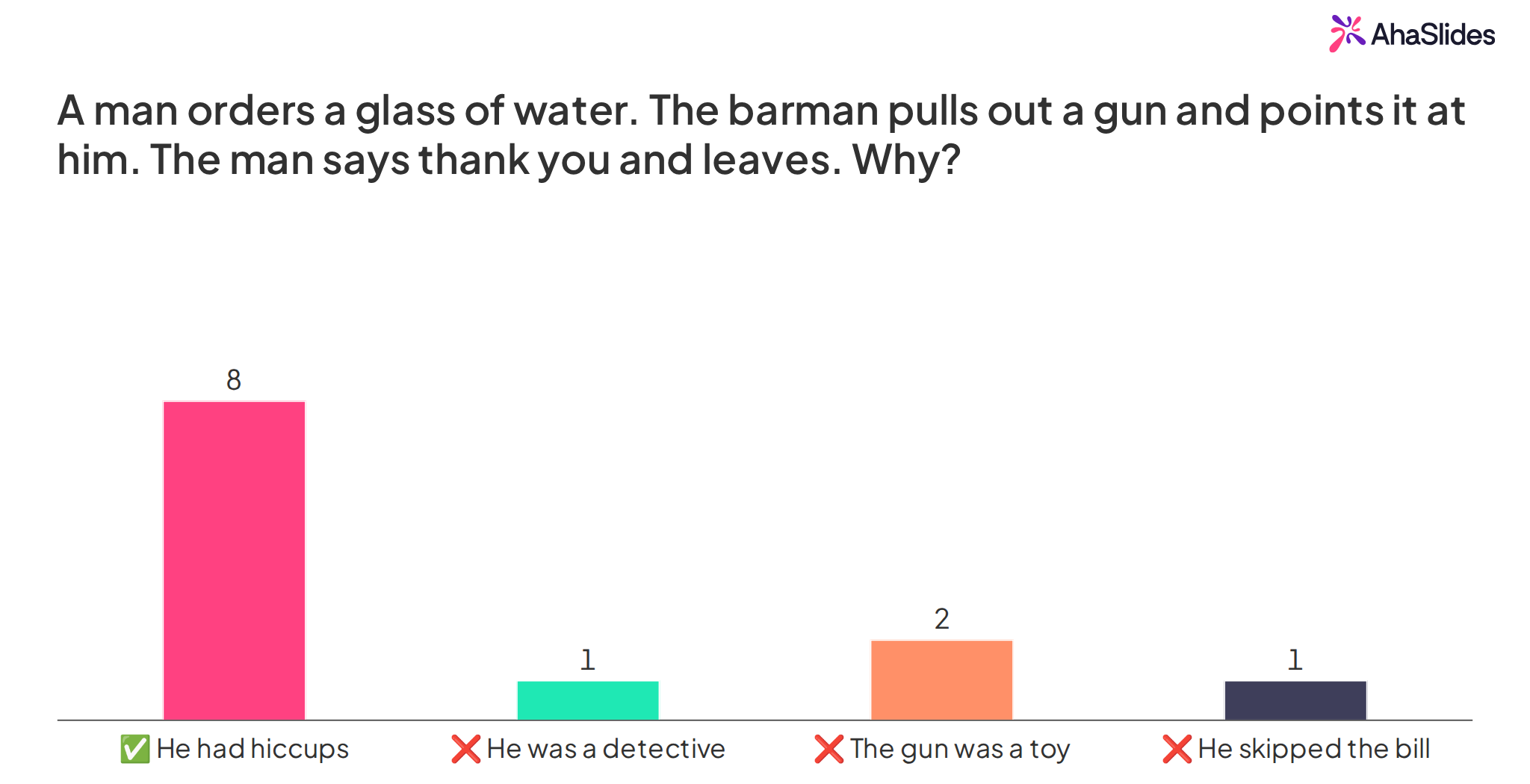
1A man orders a glass of water. The barman pulls out a gun and points it at him. The man says "thank you" and walks out. Why?
AnswerHe had hiccups. The shock of seeing the gun cured them, so he no longer needed the water.
2A man shaves several times a day, yet he always has a beard. How?
AnswerHe is a barber. He shaves other people, not himself.
3A lorry driver goes the wrong way down a one-way street, passing several police officers. None of them stops him. Why?
AnswerHe was walking, not driving. Nothing says he was in his lorry.
4A man leaves home and turns left three times. When he gets back, two masked men are waiting for him. Who are they?
AnswerThe catcher and the umpire. The man is a baseball player running the bases: three left turns take him round to home plate.
5A man married twenty women in his village last year. None of them died or divorced him, and he broke no law. How?
AnswerHe is the celebrant. His job is to marry other people, not to be the groom.
6A town has only two barbers. One has a neat, tidy haircut and the other has a messy one. Which barber should you choose?
AnswerThe one with the messy haircut. With only two barbers they must cut each other's hair, so the messy haircut is the tidy barber's work.
Lateral thinking puzzles with words and numbers
Language is full of loopholes. Read each question for what it literally asks.
Words, numbers and days6 puzzles
1Name three days in a row without using the words Monday, Tuesday, Wednesday, Thursday, Friday, Saturday or Sunday.
AnswerYesterday, today and tomorrow.
2Where does Friday come before Thursday?
AnswerIn the dictionary.
3John's father has five sons: North, South, East and West, and one more. What is the fifth son's name?
AnswerJohn. The first line already told you the father is John's.
4A shop sells house numbers. The number 1 costs £1, the number 12 costs £2 and the number 100 costs £3. What is the shop charging for?
AnswerThe digits. Each digit costs £1, and 1, 12 and 100 have one, two and three digits.
5What five-letter word becomes shorter when you add two letters to it?
AnswerShort. Add "er" and you get "shorter".
6What comes next: O, T, T, F, F, S, S, E, ?
AnswerN. They are the first letters of the numbers one to eight, so the next is nine.
Lateral thinking puzzles about families
Family puzzles hide a person who counts twice. Draw a quick family tree if you get stuck.
Families and birthdays3 puzzles
1Two fathers and two sons go fishing. Each catches one fish, and they bring home only three fish. How?
AnswerThere are three people: a grandfather, his son and his grandson. The middle one is both a father and a son.
2Two girls were born to the same mother on the same day in the same year, but they are not twins. How?
AnswerThey are two of a set of triplets (or more).
3Twin sisters share the same parents and were born minutes apart, yet their birthdays are different. How?
AnswerOne was born just before midnight and the other just after. If it was New Year's Eve, they were even born in different years.
Lateral thinking puzzles that are tricks
These ones punish people who answer too fast. Slow down and check the wording.
Spot the trick7 puzzles
1A farmer has 17 sheep, and all but 9 run away. How many are left?
Answer9. "All but 9" means nine stayed.
2A plane crashes on the border between France and Germany. Where do they bury the survivors?
AnswerNowhere. You do not bury survivors.
3A rooster lays an egg on top of a barn roof. Which way does the egg roll?
AnswerNeither way. Roosters do not lay eggs. Only hens do.
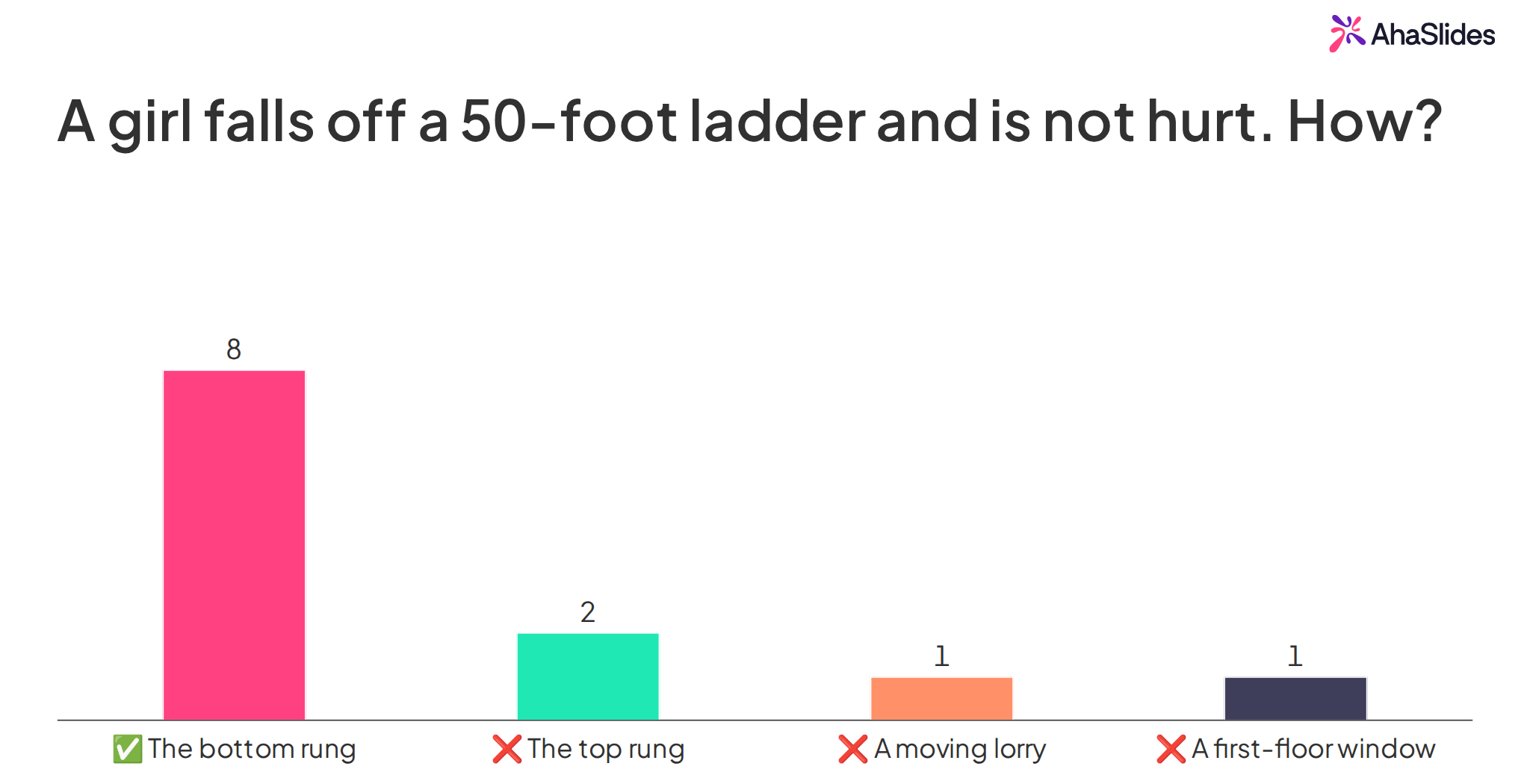
4A girl falls off a 50-foot ladder and is not hurt. How?
AnswerShe fell off the bottom rung.
5How far can a rabbit run into a forest?
AnswerHalfway. After that it is running out.
6Which is correct: "the yolk of an egg are white" or "the yolk of an egg is white"?
AnswerNeither. The yolk is yellow.
7Which is heavier: a kilogram of steel or a kilogram of feathers?
AnswerNeither. Both weigh a kilogram.
Lateral thinking puzzles that need a leap
The last group needs a leap: a different object, a different place or a different way of looking at the problem.
Think outside the box8 puzzles
1A man is found dead in a field with an unopened package beside him. There are no footprints or tracks nearby. What happened?
AnswerHe jumped from a plane, and the package was his parachute, which did not open.
2How can you throw a tennis ball so that it travels a short distance, stops, reverses and comes back to you, without hitting anything and without a string?
AnswerThrow it straight up in the air.
3How can you cut a round cake into eight equal pieces with only three straight cuts?
AnswerMake two cuts straight down, crossing at the centre, to get four equal wedges. Then slice the cake in half horizontally through its side, so each wedge splits into a top and a bottom piece.
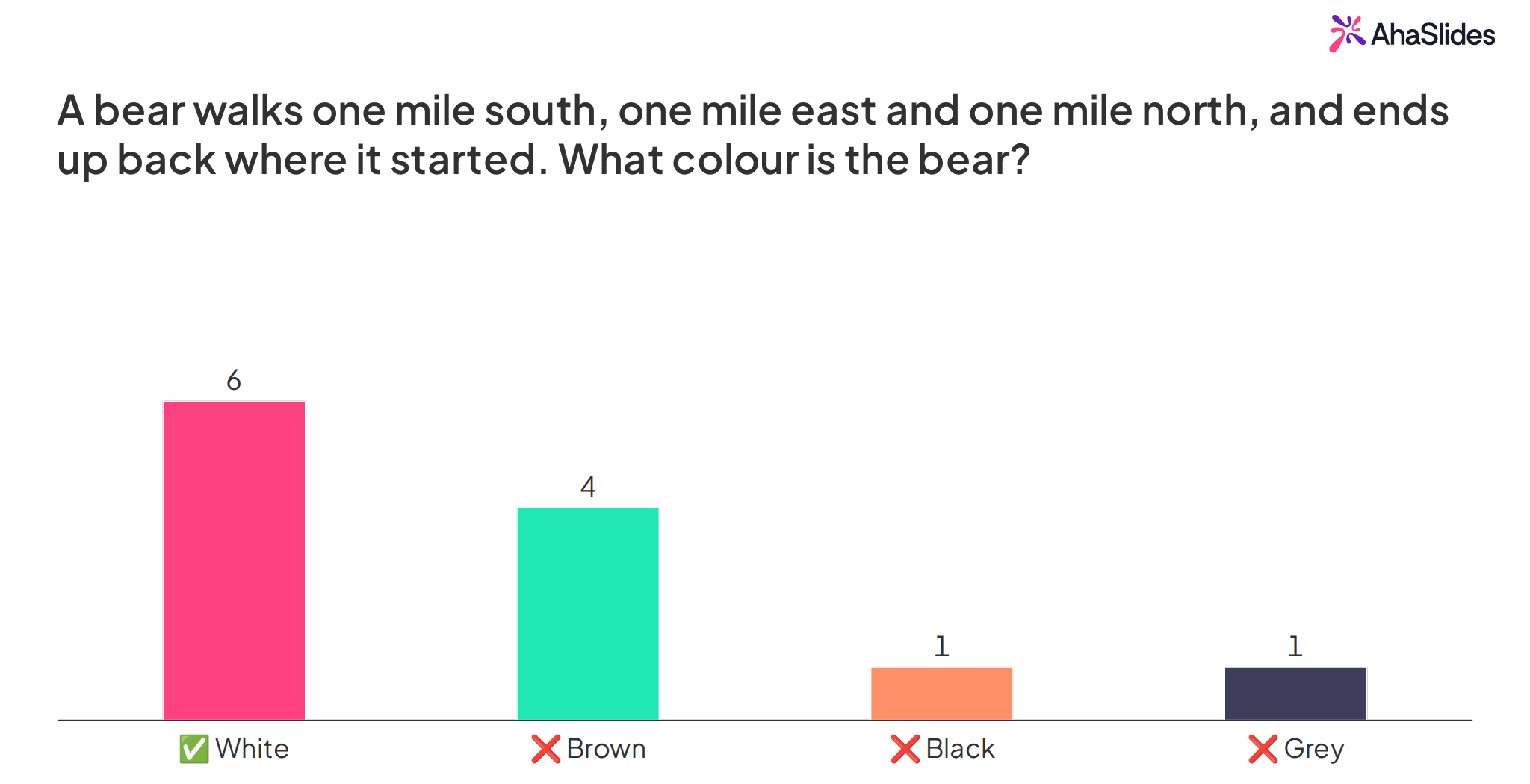
4A bear walks one mile south, one mile east and one mile north, and ends up exactly where it started. What colour is the bear?
AnswerWhite. The walk works from the North Pole. The only other starting points are close to the South Pole, and no bears live there: polar bears are found in the Arctic, not Antarctica, according to Live Science.
5Why can't a man who lives in Manchester be buried in Leeds?
AnswerBecause he is still alive.
6Two people play five games of chess and each wins three games. There are no draws and nobody cheats. How?
AnswerThey were not playing each other. Each played different opponents.
7A ship carries 26 sheep and 10 goats. How old is the captain?
AnswerThere is no way to tell. Nothing in the question relates to the captain's age, so the right answer is that you cannot work it out.
8How can you make seven even without doing any maths?
AnswerTake the letter s off the word "seven" and you get "even".
How to get better at lateral thinking puzzles
- Question the setup. Ask which part of the story you assumed rather than read.
- Take the words literally. Many answers hide in a word with two meanings, such as "rung" or "all but".
- Try the dull explanation first. The answer is rarely clever. It is usually the simplest reading you skipped.
- Ask yes or no questions. In a group, let people question the host one yes or no question at a time until someone cracks it.
Run these as a live game
Read aloud, lateral puzzles work. As a live round they are better, because everyone commits to a guess before the reveal. Build the set with the online quiz creator and players join from their phones.
Offer likely explanations as options. For the barman puzzle, give four possible reasons and let the room vote. The wrong ones are tempting, which sparks the debate.
Mix in tempting wrong answers. For the ladder puzzle, offer the real answer next to a few plausible ones. People who overthink pick the clever options, and the reveal gets a laugh.
Use a quiz slide for puzzles with a one-word answer. The bear puzzle works well: the answer is a single colour, and the chart shows how many people were sure of a different one.
Prefer not to build from scratch? The template library has ready-made quiz sets you can duplicate and edit.
Key takeaways
Lateral thinking puzzles work because the trick is never really a trick. It is a reminder that the simplest reading of a question is often the one you skipped while searching for something clever. For more puzzles in a different style, see our riddles and brain teasers for adults.
Frequently asked questions
What activities help build lateral thinking skills?
Puzzles, riddles and brain teasers are the most direct route, since they force you to look past the first, most obvious reading of a question. Improvisation games, mind-mapping and brainstorming help too, because they reward unexpected connections.
What is the difference between lateral thinking and logical thinking?
Logical thinking moves step by step from known facts to a conclusion. Lateral thinking questions the starting assumptions and looks for a different way in. Most real problems need both.
Are lateral thinking puzzles good for teams?
Yes. They are short, they need no preparation and everyone can contribute a guess, which makes them a good warm-up before a meeting or workshop.