



Most employee surveys have a participation problem. A response rate below 60% is common in large organizations [1], and even when the numbers come in, the findings often sit in a spreadsheet until the next survey cycle rolls around.
The format isn't the problem. Used well, employee satisfaction surveys are one of the cheapest ways HR and L&D teams have to find out what's actually happening — before people leave, before morale collapses, and before the next all-hands meeting turns into an exercise in managed silence.
This guide covers the main types, what to ask, how to get people to respond, and how to make the results useful.
What is an employee satisfaction survey?
An employee satisfaction survey is a structured way for organizations to collect feedback from their workforce about job satisfaction, working conditions, management, and the broader employee experience. The goal is to surface issues that might not come up in one-on-ones or performance reviews — and to spot patterns across teams or departments.
At Spotify, pulse surveys sent after team all-hands meetings helped HR identify which managers were struggling with communication before the problems affected attrition. That kind of early signal is the main value: it's easier to fix a 20% drop in satisfaction scores than to rebuild a team after three people quit in the same month.
Why they matter
Low engagement has a measurable cost. According to Gallup's 2025 State of the Global Workplace report, disengaged employees cost the global economy an estimated $438 billion in lost productivity annually [2]. Separately, 50% of employees globally are actively looking for new work or watching for opportunities [2].
Those numbers don't come from employees who hate their jobs. They mostly come from employees who feel ignored.
Regular satisfaction surveys don't fix that on their own. But they create a feedback loop — a structure that makes it harder for problems to stay invisible. The critical piece is acting on the results. When employees complete a survey and nothing changes, participation in the next one drops sharply [1].
5 main types of employee satisfaction surveys
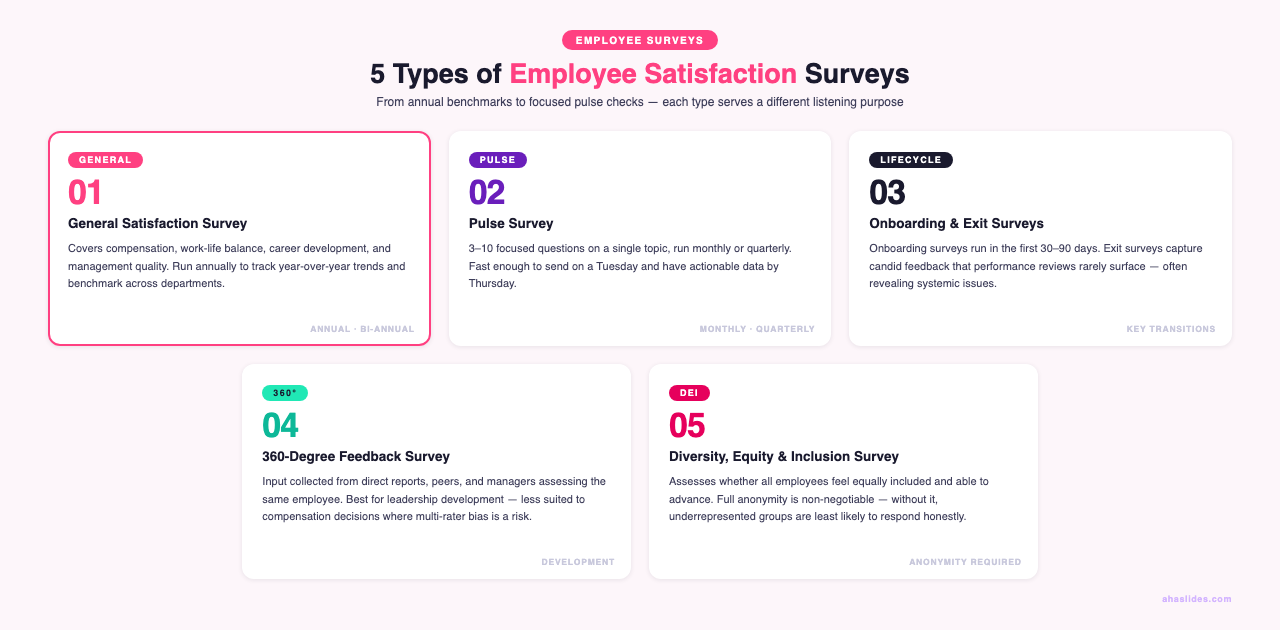
1. General satisfaction survey
The broadest type. Covers compensation, work-life balance, career development, relationships with management, and overall engagement. Typically runs annually or twice a year.
Use it to get a baseline, track year-over-year trends, or benchmark across departments.
- "I have the resources I need to do my job effectively."
- "My work gives me a sense of accomplishment."
- "How satisfied are you with opportunities for career growth here?"
2. Pulse survey
Short, frequent, and focused. Pulse surveys typically run monthly or quarterly and ask 3–10 questions about a specific topic — a recent reorg, a new policy, post-training sentiment, or current workload levels.
The strength of pulse surveys is speed. You can send one on a Tuesday and have actionable data by Thursday. The risk is survey fatigue if you send them too often without closing the loop.
- "How clear is communication from leadership about company priorities right now?"
- "My current workload feels manageable."
3. Onboarding and exit surveys
Onboarding surveys run during a new hire's first 30–90 days. They measure how well the organization delivers on what it promised during recruiting, how useful the onboarding process was, and whether the new employee has what they need to succeed.
Exit surveys collect feedback from departing employees. They're valuable precisely because people leaving often say things they wouldn't say in a performance review. Common themes — friction with a specific manager, unclear promotion paths, workload imbalance — can point to systemic issues no one else is surfacing.
- "My onboarding experience matched what I was told during the hiring process."
- "I feel confident in my understanding of my role and responsibilities."
- "What was the primary reason for your decision to leave?"
- "Would you recommend this organization as a place to work? Why or why not?"
4. 360-degree feedback survey
Unlike the types above, 360-degree surveys collect input from multiple directions: direct reports, peers, and managers all assess the same employee. The term itself was coined by management consultants Mark R. Edwards and Ann J. Ewen in the mid-1990s, though multi-source feedback methods date to military officer evaluation programs from the 1940s [3].
The data is most useful for leadership development and team dynamics — less so for compensation decisions, where multi-rater input tends to introduce bias.
- "This person communicates feedback in a way that helps me improve."
- "This person creates space for different points of view in team discussions."
5. Diversity, equity, and inclusion (DEI) survey
DEI surveys assess whether employees from different backgrounds feel equally included, supported, and able to advance. They're distinct from general satisfaction surveys because they ask about experiences that vary significantly by identity — and because honest responses require a high degree of psychological safety.
Anonymity is non-negotiable here. Without it, response quality drops, and underrepresented groups — the employees whose feedback matters most — are least likely to respond.
- "I have equal access to opportunities for advancement regardless of my background."
- "People at this organization are treated fairly regardless of who they are."
How to write questions that get useful data
A few rules that apply across all survey types:
Ask one thing per question. "My manager communicates clearly and makes me feel valued" is two questions. Split them.
Match the scale to what you're measuring. Use satisfaction scales (Very dissatisfied → Very satisfied) for experience questions. Use frequency scales (Never → Always) for behavior questions. Use agreement scales (Strongly disagree → Strongly agree) for opinion statements. Mixing these without reason creates noise.
Include at least one open text question. Ratings tell you what; comments tell you why. "What would make the biggest difference to your day-to-day work?" produces insights that a five-point scale can't.
Keep it short. Surveys over 15 minutes see significantly lower completion rates. For pulse surveys, aim for under five minutes.
Getting people to respond
The benchmark for a meaningful employee survey is a 70–80% response rate [1]. Smaller teams tend to hit this more easily; organizations with 5,000+ employees average closer to 38% [1].
Three things move the needle:
Timing matters more than most teams expect. Monday and Tuesday see higher response rates than later in the week. Spring (March–May) outperforms other seasons [1]. Avoid survey launches during busy periods like year-end reviews or quarter-close.
Make the purpose explicit. Tell employees what the survey covers, how long it takes, and specifically how the results will be used. "We'll share key findings at the next team meeting and prioritize two action items" is more motivating than "your feedback helps us improve."
Act visibly. The fastest way to kill future participation is to collect data and go quiet. Even acknowledging "we heard X, here's what we're doing about it" closes the loop enough to keep people engaged. According to Simpplr's research, the gap between listening and visible action is the most common reason response rates drop in subsequent surveys [1].
How to run a live satisfaction survey with AhaSlides

Running a survey during a live session — a team meeting, an all-hands, a training wrap-up — removes the friction of async surveys entirely. People respond while the topic is fresh, and the results are immediately visible to the group.
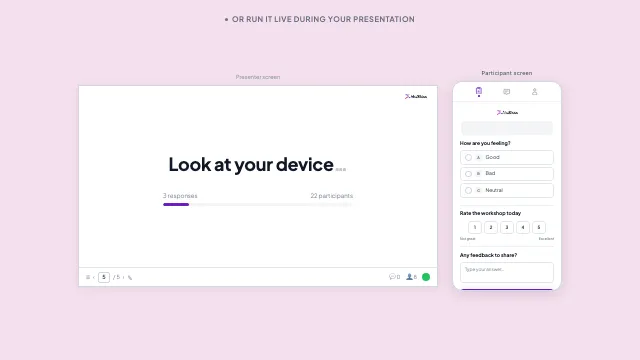
AhaSlides has a built-in Survey system with rating scales, polls, and open text that can be layered into any presentation. You create a Survey slide; and people and response to it live. For an L&D trainer wrapping up a session, that means seeing training satisfaction scores before everyone closes their laptops — and being able to address any red flags in the room rather than in a follow-up email three days later.
For HR teams running recurring pulse surveys, the async option lets you send a survey link that respondents complete on their own time, with results feeding into the same dashboard.
The practical advantage isn't just speed. When people see their responses reflected back as aggregated group data, the conversation that follows the data is often more valuable than the survey itself.
A note on anonymity
Anonymity increases honest responses — especially for questions about management, DEI, and compensation. The tradeoff is that anonymous data can't be segmented by individual, which limits some analyses.
A practical middle ground: make most surveys anonymous by default, but include optional demographic fields (team, tenure, location) that let HR slice the data without identifying individuals. Be transparent about how responses are stored and who has access.
Common mistakes to avoid
Asking too many questions at once
The most common survey mistake is length. When a general satisfaction survey balloons to 40 or 50 questions, respondents either abandon it halfway through or start clicking answers at random to finish faster. Neither produces useful data. A good rule of thumb: if a question's answer won't change what you do, cut it. Aim for 10–20 questions for an annual survey, and 3–8 for a pulse check.
Running surveys with no follow-through plan
Sending a survey without a plan for what happens next is the fastest way to erode trust in the process. Before you launch, decide who will analyze the results, when findings will be shared, and what the team is actually empowered to act on. If certain issues — like compensation structure — are outside your scope to change, be upfront about that rather than letting employees assume their feedback disappeared into a void.
Treating all teams as one audience
Aggregating results across the whole organization can mask serious problems at the team or department level. A company-wide satisfaction score of 7.2 out of 10 might look acceptable while one team is sitting at 4.5. Segment your data by team, tenure, and location wherever sample sizes allow. Even rough cuts reveal patterns that averages hide.
Launching during the wrong moment
Survey timing affects both response rates and data quality. Employees asked about job satisfaction during a round of layoffs, immediately after a product launch crunch, or in the final weeks of the fiscal year are responding to a moment, not their baseline experience. Space surveys away from known high-stress periods. If you have to run one during a difficult time, acknowledge the context when you share results.
Frequently asked questions
How often should employee satisfaction surveys be run?
Most organizations run a general satisfaction survey once or twice a year and layer in pulse surveys monthly or quarterly for shorter, focused check-ins. More frequent isn't always better — what matters is that results get acted on before the next survey goes out. If you can't close the loop on findings within a few weeks, consider spacing surveys out rather than running them on autopilot.
What's a good response rate?
A response rate of 70–80% is considered strong for most organizations. Rates below 50% make it hard to draw reliable conclusions, and they usually signal that employees don't trust the process. Teams of under 50 people tend to hit higher rates naturally; large organizations often need to work harder on communication and follow-through to get there.
Should surveys always be anonymous?
Anonymous surveys produce more honest responses, particularly on sensitive topics like management quality, DEI, and compensation. The tradeoff is that you lose the ability to follow up with specific respondents. For most HR and L&D use cases, the benefit of honest data outweighs that limitation. The exception is developmental surveys — like 360-degree feedback tied to a coaching program — where attribution is part of the design.
To put these into practice, the AhaSlides free survey creator lets you build, share, and analyze surveys in minutes — live in a session or sent as a standalone link. For the full survey creation process from objective-setting to analysis, see: How to create an online survey: the complete guide.
Sources
[1] Simpplr. Employee survey benchmarks: what's a good response rate? https://www.simpplr.com/blog/survey-benchmarks-response-rates/ — includes response rate benchmarks by company size and strategies for improving participation.
[2] Gallup. State of the Global Workplace 2025. https://www.gallup.com/workplace/349484/state-of-the-global-workplace.aspx — source for $438 billion productivity loss figure and 50% job-seeking statistic.
[3] ODRL. The history of 360-degree feedback. https://www.odrl.org/2019/12/27/360-degree-feedback-history/ — covers the origin of the term and military precursors to multi-source feedback.