


Most job satisfaction surveys answer the wrong question. They tell you whether employees are happy. They don't tell you why they're not.
The gap between those two things is where retention problems start, where disengagement compounds, and where HR ends up reactive instead of informed. A well-designed questionnaire closes that gap not by asking more questions, but by asking the right ones, in the right format, with a clear plan for what happens after.
This guide gives you 46 ready-to-use questions organized across seven categories, plus a practical framework for running them in a way that produces honest answers. Use them in a standalone survey, embed them in quarterly reviews, or run them live during a town hall. The format is up to you. Getting real answers is the point.
What is a job satisfaction questionnaire?
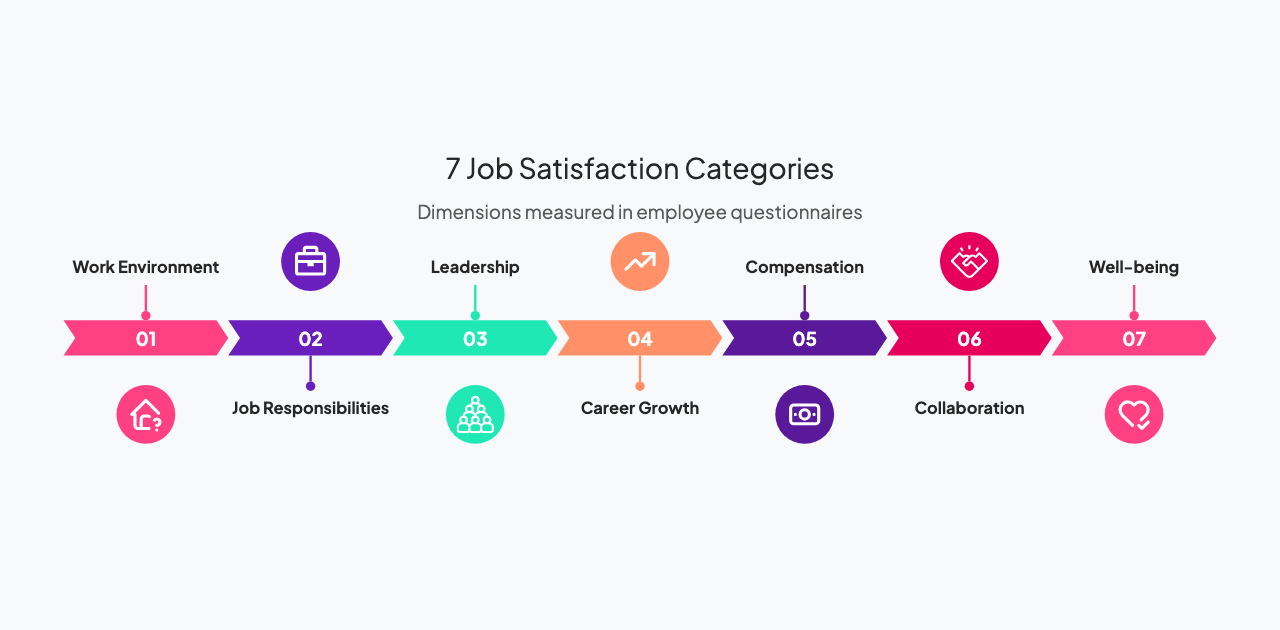
A job satisfaction questionnaire is a structured set of questions that measures how fulfilled employees are across specific dimensions of their work: the environment, their responsibilities, their manager, compensation, growth, relationships, and well-being.
Unlike a general engagement survey, a job satisfaction questionnaire is designed to surface the specifics. It tells you not just that morale is low, but which factor is driving it.
The format matters as much as the questions. A survey sent by email link gets an average internal response rate of 20-30% [1] and often produces hedged answers. The same questions presented anonymously during a live meeting, where results are visible to everyone in real time, tend to produce much more direct feedback, because employees can see that others share their concerns.
Why conduct a job satisfaction survey?
Work isn't just a paycheck for most people. According to a 2023 Pew Research Center survey, 39% of non-self-employed workers say their job is central to their identity, a figure that climbs to 53% among postgraduate degree holders [2]. When work feels meaningless or unsupported, that's not just a productivity problem. It's personal.
That investment cuts both ways. Employees who feel their role is meaningful and well-supported are more likely to stay, contribute, and recommend the organization to others. Employees who feel overlooked are often quietly disengaged long before they hand in their notice.
A well-designed questionnaire gives HR something a general engagement score never can: a specific place to start. Run it well and three things happen. You find out whether the problem is workload, compensation, or management, because those need very different fixes. Employees who see their feedback discussed openly are more likely to show up for the follow-up. And re-running the same questions six months later tells you whether anything you did actually worked.
46 sample questions by category
Here are the questions organized by theme. Each section includes notes on which question formats tend to work best.
Work environment
Format guidance: Rating scales (1-5) work well here. A follow-up word cloud gives you qualitative texture alongside the scores. Presenting these anonymously during an all-hands lets employees rate physical conditions without worrying about being singled out.
- My physical or remote work environment allows me to focus and do my best work.
- The tools and equipment available to me are adequate for the work I'm expected to do.
- I feel physically and psychologically safe in my workplace.
- The overall atmosphere at work is one I find energizing rather than draining.
Job responsibilities
Format guidance: Yes/no polls work for the clarity questions (6 and 12). Rating scales work for the satisfaction questions. An open Q&A at the end allows employees to raise specifics without attribution.
- My role makes good use of my skills and strengths.
- I have a clear understanding of what is expected of me in my role. (yes/no)
- The volume of work assigned to me is manageable within normal working hours.
- My responsibilities feel meaningful, not just busy.
- I have enough variety in my work to stay engaged.
- I feel ownership over the work I'm responsible for.
- My workload is distributed fairly compared to others on my team.
- I know how to prioritize when I have competing demands on my time. (yes/no)
- My day-to-day tasks connect clearly to the goals of the broader team or organization.
Supervision and leadership
Format guidance: Anonymity is especially important in this section. Employees rarely give honest ratings of their manager in named surveys. Anonymous rating scales in a live session, where results appear as aggregate numbers rather than individual responses, remove the fear of career consequences.
- My manager sets clear expectations and follows through on commitments.
- I receive feedback from my manager that is specific and useful, not just evaluative.
- My manager treats me with respect regardless of circumstances.
- I feel comfortable raising concerns or disagreements with my manager.
- Senior leadership communicates honestly about the direction the organization is heading.
- Rank the following in order of importance to you in a manager: Communication, Recognition, Feedback, Autonomy, Support. (ranking)
Career growth and development
Format guidance: A multiple-choice poll works well for question 20 variant: "What type of development would benefit you most?" with options like Leadership training, Technical skills, Certifications, Mentorship, and Lateral moves. This saves HR from spending budget on programs employees don't actually want.
Real-world example: A 200-person technology company ran this section during a quarterly review using live anonymous polling. The results showed 68% of respondents wanted mentorship, while the company had been investing primarily in technical certifications. L&D reallocated a portion of the training budget within the same quarter.
- What type of development would benefit you most right now? (multiple choice: Leadership training / Technical skills / Certifications / Mentorship / Lateral moves)
- I have access to the learning and development opportunities I need to grow in my career.
- My manager actively supports my professional development goals.
- I can see a realistic path for advancement within this organization.
- I feel challenged by my work in a way that helps me grow.

Compensation and benefits
Format guidance: This is where anonymous surveys matter most. Employees are least likely to give honest answers about compensation in a survey they fear is traceable. A live anonymous session in which results appear on screen with no individual attribution tends to surface concerns that would otherwise go unreported. A word cloud for "What one benefit would improve your satisfaction most?" often produces more useful data than any fixed-option list.
- I feel I am compensated fairly for the work I do.
- My pay is competitive relative to similar roles at other organizations.
- The benefits package this organization offers meets my needs.
- I understand how pay decisions are made here.
- I feel the total compensation I receive reflects the value I bring.
- What one benefit would improve your satisfaction most? (word cloud)
Relationships and collaboration
Format guidance: Rating scales for questions 1-3. A frequency question for 4 (Daily / Weekly / Monthly / Rarely / Never) produces cleaner data than a yes/no. Anonymous Q&A allows employees to flag interpersonal issues without naming names.
- I trust the people I work with most closely to do their part.
- My team handles disagreement constructively rather than avoiding it or letting it fester.
- I feel like a valued member of my team, not just a functional one.
- How often do you collaborate with colleagues outside your immediate team? (Daily / Weekly / Monthly / Rarely / Never)
- When something goes wrong, my team focuses on fixing the problem rather than assigning blame.
Well-being and work-life balance
Format guidance: Frequency scales work well here: Never / Rarely / Sometimes / Often / Always. Question 5 is worth presenting as a slider rather than a fixed scale. It produces more nuanced data on stress levels and helps normalize the conversation around burnout. Employees are often reluctant to admit they're struggling; seeing that many colleagues score similarly tends to open the conversation.
- I am able to disconnect from work outside of working hours without feeling penalized.
- How often does your workload require you to work beyond your normal hours to keep up?
- How often do you feel energized rather than depleted at the end of a workday?
- How often do you feel recognized for the effort you put in, not just the outcomes you deliver?
- How often do you feel anxious or stressed about work during personal time?
- How often does your organization demonstrate genuine care for employee well-being beyond policy statements?
- How often do you feel comfortable taking time off without worrying about what you'll come back to?
- How often do you feel your personal workload is sustainable over the long term?
- On a scale of 1-10, how would you rate your current stress level as it relates to work? (slider)
- How often do you feel that your work schedule allows you to maintain a healthy personal life?
Overall satisfaction
This is the Employee Net Promoter Score (eNPS). It uses a 0-10 scale: respondents scoring 9-10 are promoters, 7-8 are passives, and 0-6 are detractors. Your eNPS equals the percentage of promoters minus the percentage of detractors [3]. Scores above 0 are acceptable; above 30 is considered good; above 50 is strong.
Format guidance: If scores are low, follow up immediately: "What is the one thing we could change to improve your score?" Presenting the eNPS live gives leadership a real-time read on overall sentiment and creates the right context for an honest conversation about what needs to change.
- How likely are you to recommend this organization as a place to work to a friend or colleague you respect?
How to run an effective job satisfaction survey
Choose your format
There are three practical approaches:
Live during meetings. Present 8-12 questions during a quarterly all-hands or town hall. Use anonymous mode for sensitive topics. Discuss results with the group before the meeting ends. This works best for building trust and enabling immediate action. You can try AhaSlides, which is a free survey creator with the ability to survey the audience live in a presentation session.
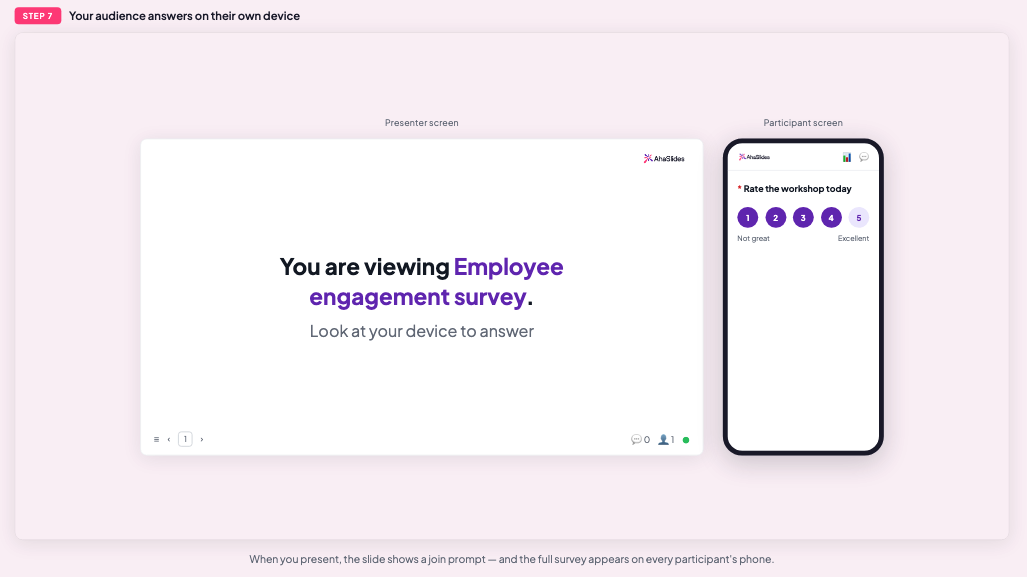
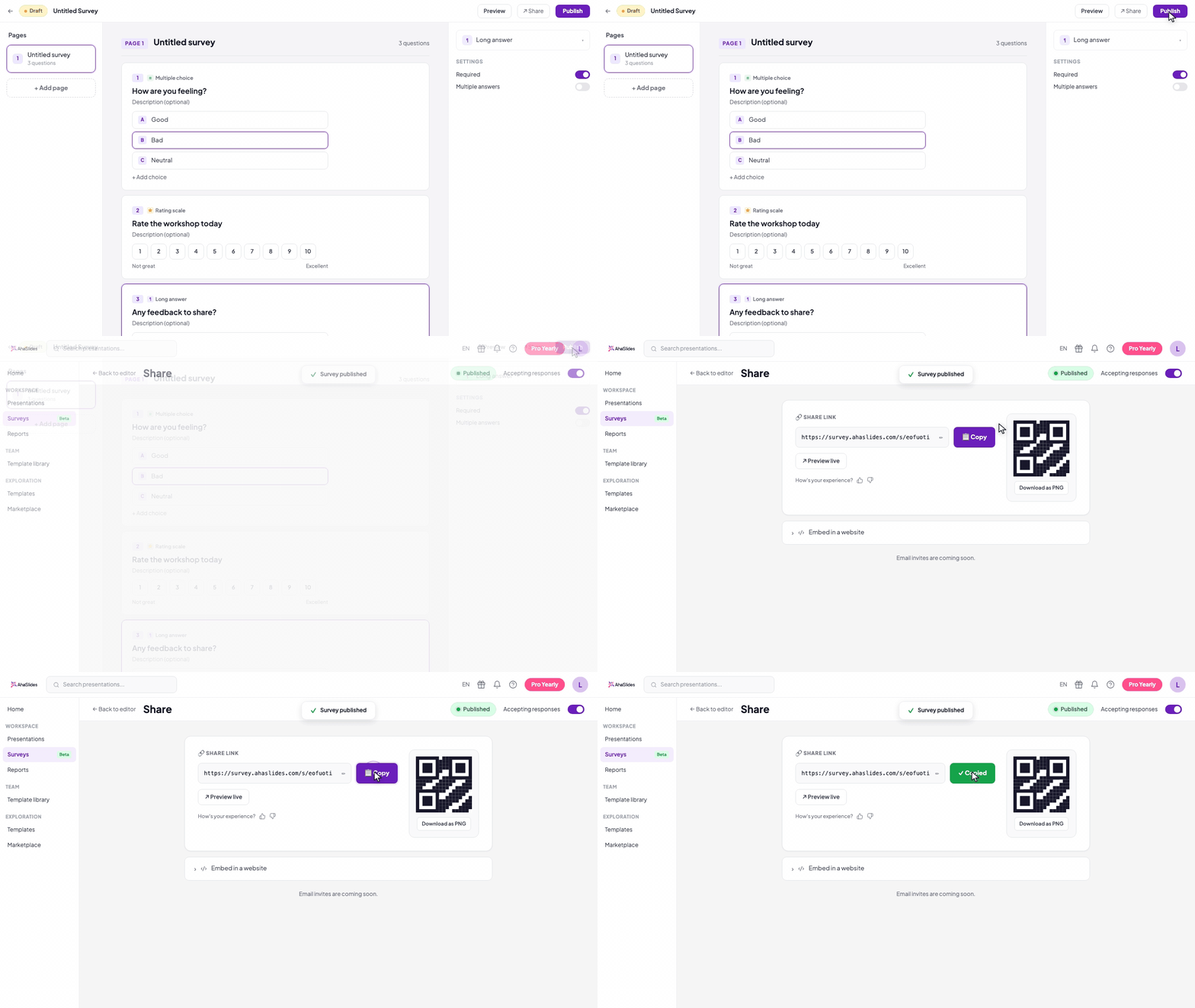
Self-paced link. Share a survey link employees can complete in their own time. Include all 46 questions organized by category. Set a two-week deadline. This works best for comprehensive data collection when scheduling a live session isn't practical.
Hybrid (recommended). Send 5-7 critical questions as a self-paced poll. Present the results and top three concerns at the next team meeting. Use live Q&A to go deeper on specific issues. This combines high participation with meaningful discussion.
Set the context before you launch
Employees are more likely to respond honestly if you explain three things upfront: why you're running the survey, how responses will be used, and what "anonymous" actually means in your system. A brief, plain-language message covering these points is enough. No corporate preamble required.
Act on the results publicly
The biggest predictor of whether employees complete future surveys is whether they saw anything change after the last one. Committing publicly to specific next steps during the session builds more trust than a detailed action plan that arrives six weeks later.
A simple follow-through structure: share full results within 48 hours, identify the top three priorities, form working groups with employee representatives, communicate progress monthly, and re-run the survey in six months to measure change.
Running these questions with AhaSlides
There's a moment that changes how a team thinks about surveys. You're midway through the compensation section of your all-hands. The question is 'do you feel fairly compensated?' and 60% of the room has just rated it a 2 out of 5. Everyone can see it. Nobody has to say a word, but suddenly, everyone wants to.
That's what running a satisfaction survey live does that a Monday-morning email link never will. The data isn't something HR processes in private and presents three weeks later. It's in the room, visible to everyone, and the conversation starts immediately.
AhaSlides lets you build the full questionnaire as a live session: rating scales, multiple-choice polls, open Q&A, and word clouds all in one place. Employees join by phone with no login and no app download. Anonymous mode keeps individual responses invisible, so the compensation section gets honest answers instead of safe ones. And because results update in real time, you can move from data to discussion without breaking the flow of the meeting.
The questions are ready. The framework is here. The part that actually changes anything is running them, and seeing what your team says when they know the answers are safe.
Try AhaSlides free and run your first session in under ten minutes.
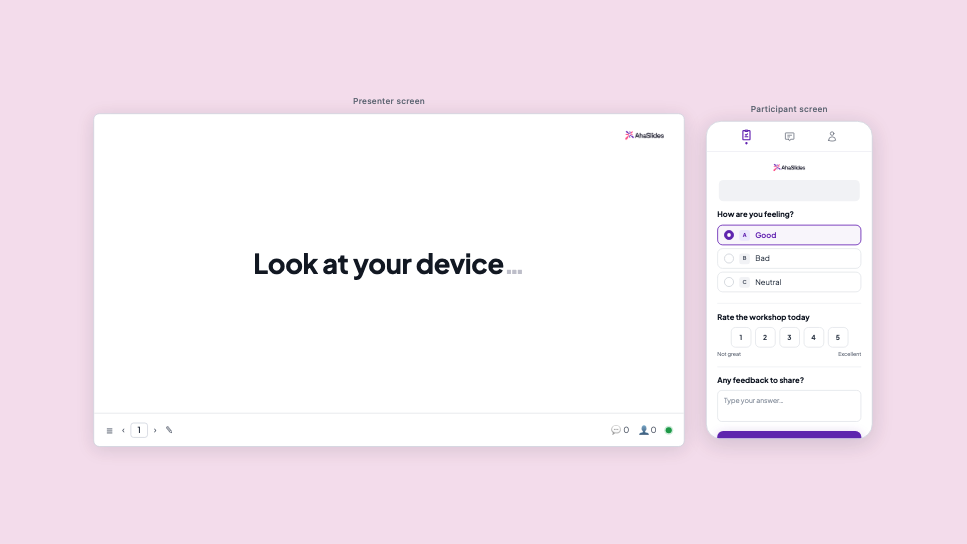
To put these into practice, the AhaSlides free survey creator lets you build, share, and analyze surveys in minutes — live in a session or sent as a standalone link. For the full survey creation process from objective-setting to analysis, see: How to create an online survey: the complete guide.
Sources
[1] Heartcount. "Employee Survey Response Rate: Benchmarks & How to Improve." https://heartcount.com/blog/survey-response-rate/. Cites internal employee survey benchmarks of 20-30%.
[2] Pew Research Center. (March 30, 2023). "How Americans View Their Jobs." https://www.pewresearch.org/social-trends/2023/03/30/how-americans-view-their-jobs. Survey conducted Feb. 6-12, 2023.
[3] AIHR. "Employee Net Promoter Score (eNPS): 2026 Ultimate Guide." https://www.aihr.com/blog/employee-net-promoter-score-enps/. Covers eNPS methodology, scoring categories, and benchmarks.