Every teacher knows the moment: you're mid-lesson, the material is solid, and half the room has mentally left the building. It's not a reflection of your teaching - it's a reflection of how human attention works. And it's a problem you can solve.
This guide covers why interactive activities work, how to choose the right one for the moment, and specific examples you can use for learning, measuring understanding, and keeping energy levels up.
Why interactive activities work: the neuroscience
Neuroimaging studies show that brain connections form more easily when students are relaxed, engaged, and emotionally invested. The dopamine released during enjoyable, active learning literally activates the brain's memory centers - meaning students who enjoy an activity retain it better.
Passive listening, by contrast, produces shallow encoding. Students can hear every word of a lecture and retain almost none of it an hour later. Interactive activities interrupt this pattern by requiring students to process, respond, and produce - all of which create stronger memory traces.
This isn't a case for entertainment over rigor. It's a case that the most rigorous learning - the kind that sticks - requires active cognitive engagement, not passive reception.

Choosing the right activity for the moment
Not every activity fits every purpose. A quick framework:
- For introducing new material: Use activities that activate prior knowledge and create curiosity - polls, prediction questions, brainstorming. Students who are primed are better prepared to receive new information.
- For teaching content: Use activities that require students to process and apply - discussions, collaborative problem-solving, case studies, role play. Passive reception isn't enough; students need to do something with the information.
- For measuring understanding: Use activities that surface what students actually know - quizzes, exit tickets, peer review. The goal is diagnostic data, not performance.
- For maintaining energy: Use brief, competitive, or physical activities - live polls, quiz games, quick debates. These reset attention without losing class time.
Interactive activities for learning
Collaborative discussion and Socratic seminars
Structured discussion is one of the oldest interactive learning formats and still one of the most effective. The Socratic seminar model - where students respond to each other's ideas rather than directing questions to the teacher - builds critical thinking and requires students to engage deeply with the material.
A simpler version: pair-share activities where students discuss a question with a partner before sharing with the class. Even 90 seconds of structured conversation significantly improves the quality of whole-class discussion.

Case study and scenario analysis
Present a real-world problem or historical situation and ask students to analyze it using the concepts they're learning. Case studies work across subjects: a business ethics dilemma in economics, a primary source in history, a patient case in biology, a narrative choice in English literature.
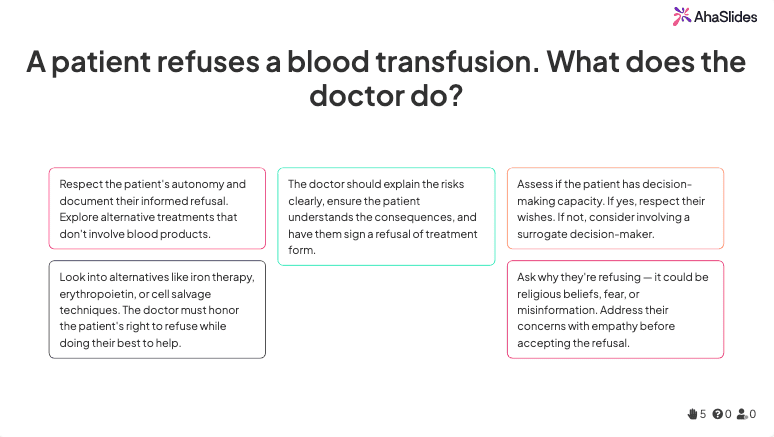
Live polling makes this more interactive: after presenting the scenario, poll students on what they would do, then discuss why responses differ. The gap between how different students interpret the same situation is itself a teaching opportunity.
Concept mapping and visual knowledge building
Students create visual maps showing how concepts relate to each other. This can be done individually, in pairs, or as a whole class. The activity reveals how students are structuring knowledge, which is diagnostic data a quiz won't give you.
Digital tools like collaborative whiteboards let the whole class contribute to a shared concept map in real time, which shows where consensus exists and where confusion remains.
Role play and simulation
Assign students roles in a historical event, business negotiation, scientific debate, or ethical dilemma. When students embody a perspective, they develop deeper understanding of it than when they simply read about it. Role play also builds empathy and communication skills alongside content knowledge.
Even brief, structured role plays (5-10 minutes) can be more memorable than extended passive instruction. The key is clear roles, a specific scenario, and structured debrief time afterward.
Flipped classroom discussion
In a flipped model, students engage with content (video, reading, podcast) before class, which frees class time for discussion, application, and problem-solving rather than transmission. This works best when students understand the purpose: home time is for acquisition, class time is for making sense of it together.
Interactive activities for measuring understanding
Live polls and comprehension checks
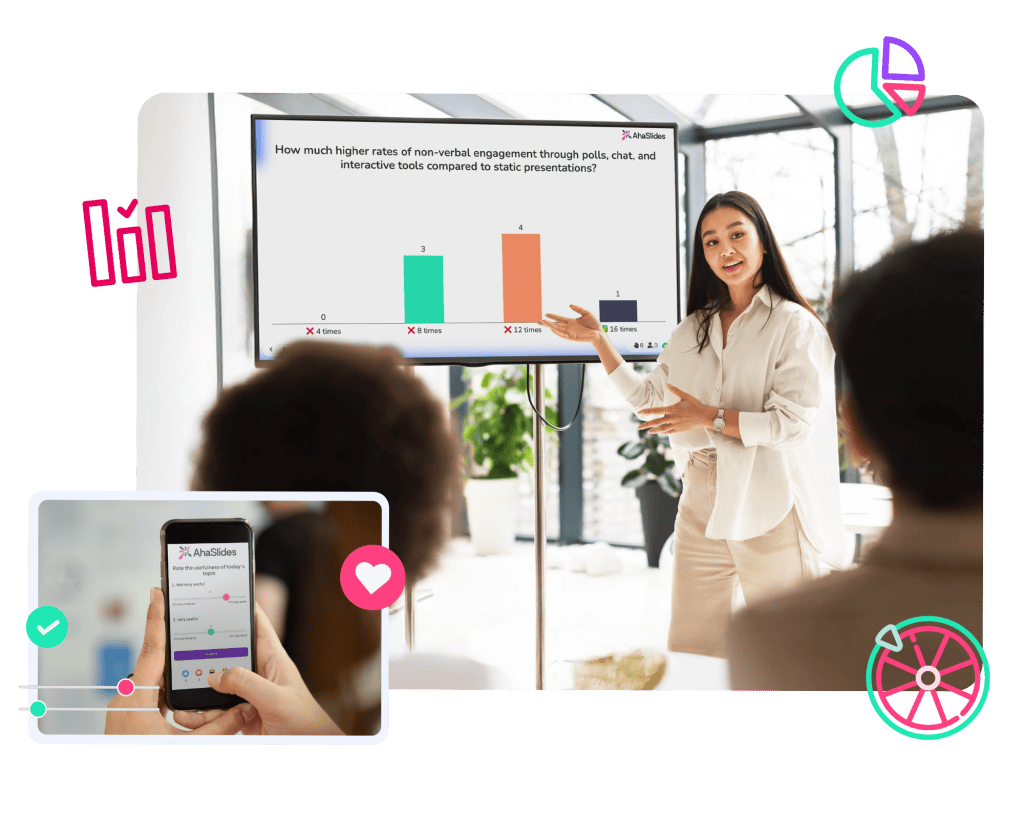
Drop a quick multiple-choice poll mid-lesson: "Which of these best describes X?" Students respond on their devices; results display on screen. You see in seconds how many students understood the concept - and which misconception is most common. This is faster and more accurate than asking "any questions?" to a quiet room.
AhaSlides polls work directly from the students' smartphones and results populate in real time. No separate platform, no login required. You can run a comprehension check in under 2 minutes without breaking the flow of the lesson.

Exit tickets
A 2-question check at the end of class: one question about what was learned, one about what's still unclear. This closes the feedback loop for students and gives teachers specific data to start the next lesson with. An exit ticket doesn't need to be elaborate - even a thumbs-up/thumbs-down poll gives useful signal.
Peer assessment activities
Students review each other's work using a rubric or structured prompts. This simultaneously gives you insight into both the reviewer's understanding of quality criteria and the reviewee's work. Peer assessment works best as formative feedback on work in progress, before final submission.
Think-pair-share with response capture
The classic think-pair-share gets significantly more useful when you add a response-capture step: after pairs discuss, each group submits their key takeaway to a shared board or open-ended poll. You can see patterns across the class and address misconceptions before they calcify.
Interactive activities for engagement and energy
Live quiz competitions
A timed, competitive quiz with a leaderboard is one of the most reliable engagement tools in education. The game layer motivates students who are otherwise disengaged with the content, and the immediate feedback (right/wrong, with explanation) supports learning more than delayed grading.
The key: use quizzes for review and reinforcement, not initial introduction. Students need enough familiarity with the material to engage meaningfully.
Word clouds for collective thinking
Ask everyone to respond simultaneously to an open-ended question. Responses appear on screen as a word cloud, showing the class's collective understanding in seconds. This works as a lesson opener (what do you already know about X?), a mid-lesson check (what's the most important thing we've covered?), or a closing reflection.
Debates and structured controversy
Assign students to argue a position - even one they disagree with. Structured debate builds critical thinking by requiring students to construct evidence-based arguments and respond to counterarguments. Even a 10-minute "mini-debate" with live audience voting on which side made the stronger case creates genuine engagement.
Physical and movement-based activities
For younger students especially, physical movement resets attention effectively. Four Corners (students move to a labeled corner of the room to indicate their response) works for yes/no and opinion questions. Gallery walks (students move around the room to review posted work or questions) add physical engagement to reflective activities.
Tips for making interactive activities work consistently
- Keep it purposeful. Every activity should connect to a learning objective. "Fun" activities that teach nothing frustrate both teachers and students over time.
- Set clear expectations before the activity starts. Students engage more confidently when they understand the goal, the format, and the time limit.
- Build a classroom culture where being wrong is safe. The most powerful interactive activities - honest polls, open brainstorms, peer review - only work when students feel secure.
- Don't over-engineer it. A two-question poll takes two minutes and dramatically changes engagement. You don't need a full lesson redesign to benefit from interactive elements.
- Debrief the results. The data from a poll or quiz is only useful if you discuss it. Show students the results, explain what they reveal, and connect them to the next step in the lesson.
Wrapping up
Interactive classroom activities aren't a compromise between rigor and engagement - they're the mechanism by which rigorous learning happens. Students who actively process, respond to, and apply information learn more and retain it longer than students who passively receive it.
If you're looking to add interactive moments to your lessons without overhauling your curriculum, AhaSlides integrates directly with PowerPoint and Google Slides. Add a poll, quiz, or word cloud in minutes - students join from their phones, no account required.
Frequently asked questions
What are the most effective interactive classroom activities?
Research consistently supports live polls for comprehension checks, peer assessment for formative feedback, collaborative problem-solving for application, and quiz games for review and reinforcement. The most effective activity depends on the learning goal.
How often should I use interactive activities?
A useful guideline: add at least one interactive moment for every 15-20 minutes of instruction. This doesn't need to be elaborate - a quick poll or partner discussion is enough to reset attention and improve retention.
Do interactive activities work online and in person?
Yes. Digital tools like AhaSlides, Padlet, and Mentimeter work equally well in physical classrooms, virtual sessions, and hybrid setups. Physical activities like Four Corners are easier in person, but most digital activities are format-agnostic.