


You spent an hour on it. The slides were clear, people nodded, a few even took notes. Then a week later you ask a simple question about it and get blank stares.
Memory is the culprit. People forget fast when learning stops at hearing, reading, or rereading. The fix is surprisingly low-tech: make them pull the information back out.
That's retrieval practice. Below, we cover what the research says, what we found when we looked at how 12,865 educators build their slides (spoiler: most quizzes ask people to recognize, not recall), and six formats you can use in your next lesson or training session.
What is retrieval practice?
Retrieval practice is any activity where learners bring information to mind from memory, without looking at the answer first. Instead of putting knowledge in one more time, they practice getting it out.
Rereading your notes is review. Closing the notes and writing down everything you remember is retrieval. Same content. A different result a week later.
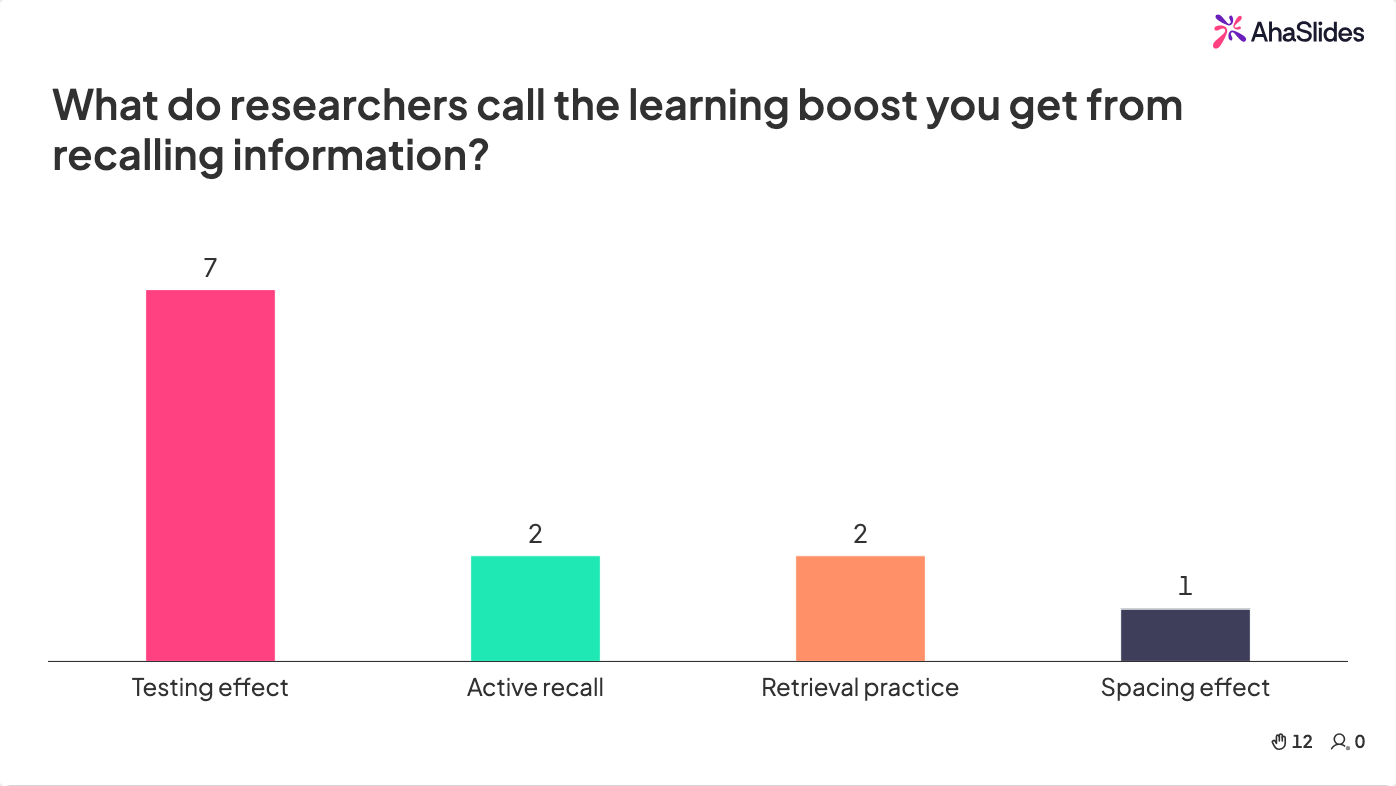
Researchers also call this the testing effect, because the classic way to trigger retrieval is a test. But the "test" doesn't have to be graded, formal, or even written down. A quick question at the start of class, a flashcard, a one-minute brain dump, or a live quiz all count, as long as learners have to dig for the answer.
Think of memory like a path through a field. Every time you walk it, the path gets clearer and easier to find next time. Rereading is looking at a map of the path. Retrieval is walking it.
Why retrieval practice works: what the research shows
Researchers have been replicating this for decades, in labs and in real classrooms. A few studies worth knowing:
Testing beats restudying over time. In Roediger and Karpicke (2006) [1], students read short prose passages and then either restudied them or took free-recall tests with no feedback. On a test five minutes later, restudying came out ahead. But on tests two days and one week later, the students who had practiced recall remembered substantially more. Cramming feels good in the moment. Retrieval pays off later.
Retrieval matters even after you "know" something. In Karpicke and Roediger (2008) [2], published in Science, students learned foreign-language vocabulary. Once they could recall a word correctly, it was either kept in testing or dropped from it. A week later, students who kept retrieving the words recalled about 80% of them. Students whose words were dropped from testing, even if they kept studying them, recalled only about 33 to 36%. Extra study after learning had no measurable effect. Students also predicted they'd remember about 50% either way, so they had no idea which method was working.
Retrieval can beat "deeper" study methods too. Karpicke and Blunt (2011) [3], also in Science, compared retrieval practice with concept mapping, a popular elaborative study technique. On a test one week later, students who practiced free recall learned more, including on questions that required them to make inferences. Many students still believed concept mapping or rereading would work better.
The effect holds up across more than a hundred studies. A meta-analysis by Adesope, Trevisan, and Sundararajan (2017) [4] in Review of Educational Research pooled 272 effect sizes from 118 articles and over 15,000 participants. Practice tests beat restudying (effect size g = 0.51) and beat filler tasks or no activity even more clearly (g = 0.93).
The takeaway for teachers and trainers: people are bad at judging what helps them learn. Rereading feels productive because it's fluent and easy. Retrieval feels harder, and that effort is what makes it stick.

Our research: educators love quizzes, but mostly recognition quizzes
We wanted to know how educators put retrieval practice into their slides. We looked at 12,865 teachers, lecturers, and trainers who built slides in AhaSlides between late June and late September 2026. [9]
Two things stood out.
Quizzes are the most widely used interactive format. 62% of these educators built at least one quiz slide in that period, ahead of opinion slides like polls and word clouds (56%), open-inquiry slides like open-ended questions and Q&A (29%), and static content slides (28%) [9]. Trainers led the way: 69% of them built a quiz, compared with 63% of lecturers and 58% of teachers. So the instinct to test for learning is already there.
But recognition beats recall almost 19 to 1. 6,850 educators built a pick-answer (multiple-choice) quiz. Only 367 built a short-answer quiz, where learners have to produce the answer themselves with no options to choose from [9].
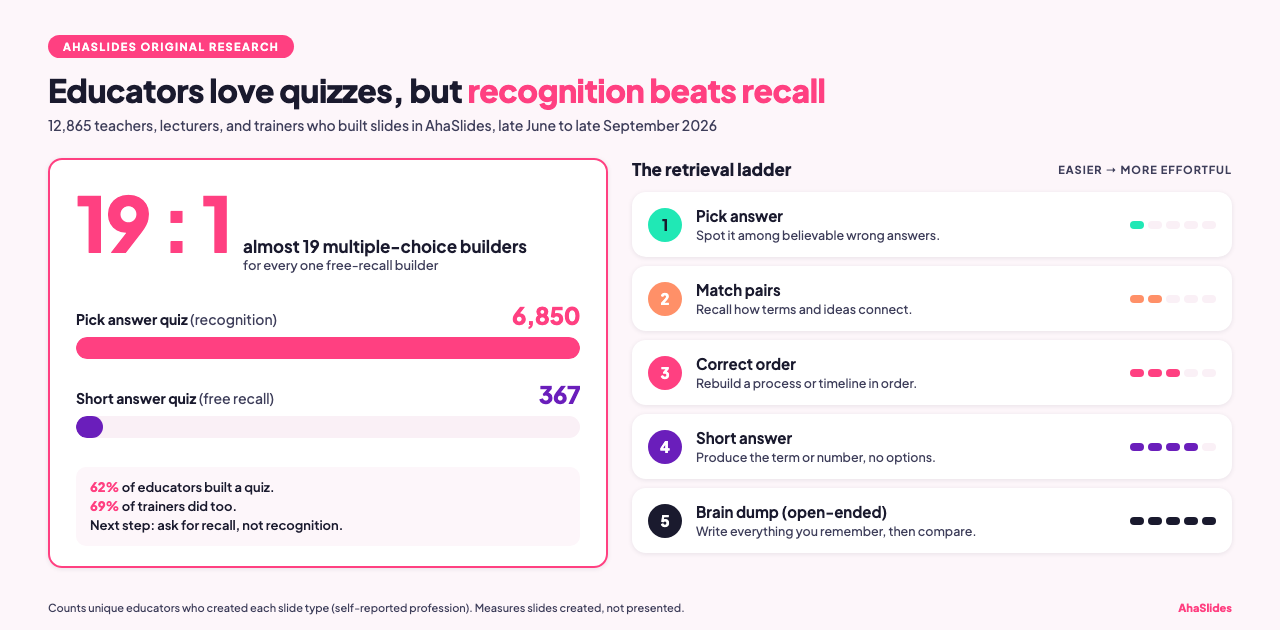
Why does that matter? Multiple choice is a recognition task: the answer is on the screen and learners only need to spot it. Short answer is a recall task: learners have to rebuild the answer from memory. Recall is usually more effortful, and effort during practice tends to produce more durable learning.
To be fair to multiple choice, the research is more nuanced than "recall good, recognition bad":
- In Kang, McDermott, and Roediger (2007) [5], multiple-choice practice led to better final scores than short-answer practice when learners got no feedback. When learners got the correct answers as feedback, the pattern flipped and short-answer practice produced better final recall.
- The Adesope meta-analysis found a larger average effect for multiple-choice practice tests (+0.70) than for short-answer ones (+0.48) [4] across the studies it pooled.
- Little and colleagues (2012) [6] showed that multiple choice with plausible, competitive wrong answers can trigger real retrieval, because learners have to think about why each option is right or wrong.
- A classroom study by McDermott and colleagues (2014) [7] found that both multiple-choice and short-answer quizzes improved later exam performance in middle and high school classes.
The risk is a diet of only easy multiple choice. The best approach is a mix: well-built multiple choice for quick checks, plus regular recall formats that make learners produce answers, followed by feedback.
How we measured this: We counted unique educators who created at least one slide of each type in the AhaSlides presenter app over a 90-day window (June 24 to September 22, 2026). "Educators" means users whose self-reported profession is teacher, professor or lecturer, or trainer/L&D. Limits: profession is self-reported and around 37,000 users with no profession set are excluded; we measured slides created, not slides presented or answered; and the window covers the Northern Hemisphere summer and back-to-school period.
6 retrieval practice formats, from easiest to most effortful
Here's a quick way to plan a retrieval activity: pick a format based on how much effort you want learners to put in, then mix levels across a session.
| Format | Effort level | AhaSlides slide type | Best use |
|---|---|---|---|
| Multiple choice with plausible distractors | Low to medium | Pick answer (text or image options) | Quick checks, warm-ups, spotting common misconceptions |
| True or false with "why?" follow-up | Low to medium | Pick answer + open-ended | Fast checks that push into reasoning |
| Match pairs | Medium | Match pairs | Terms and definitions, cause and effect, tools and uses |
| Put steps in order | Medium | Correct order | Processes, procedures, timelines, safety steps |
| Type the answer | High | Short answer | Key terms, formulas, names, numbers learners must produce |
| Brain dump ("blurting") | Highest | Open-ended, brainstorm | End-of-unit review, before a test, start of a follow-up session |
1. Multiple choice that makes people think
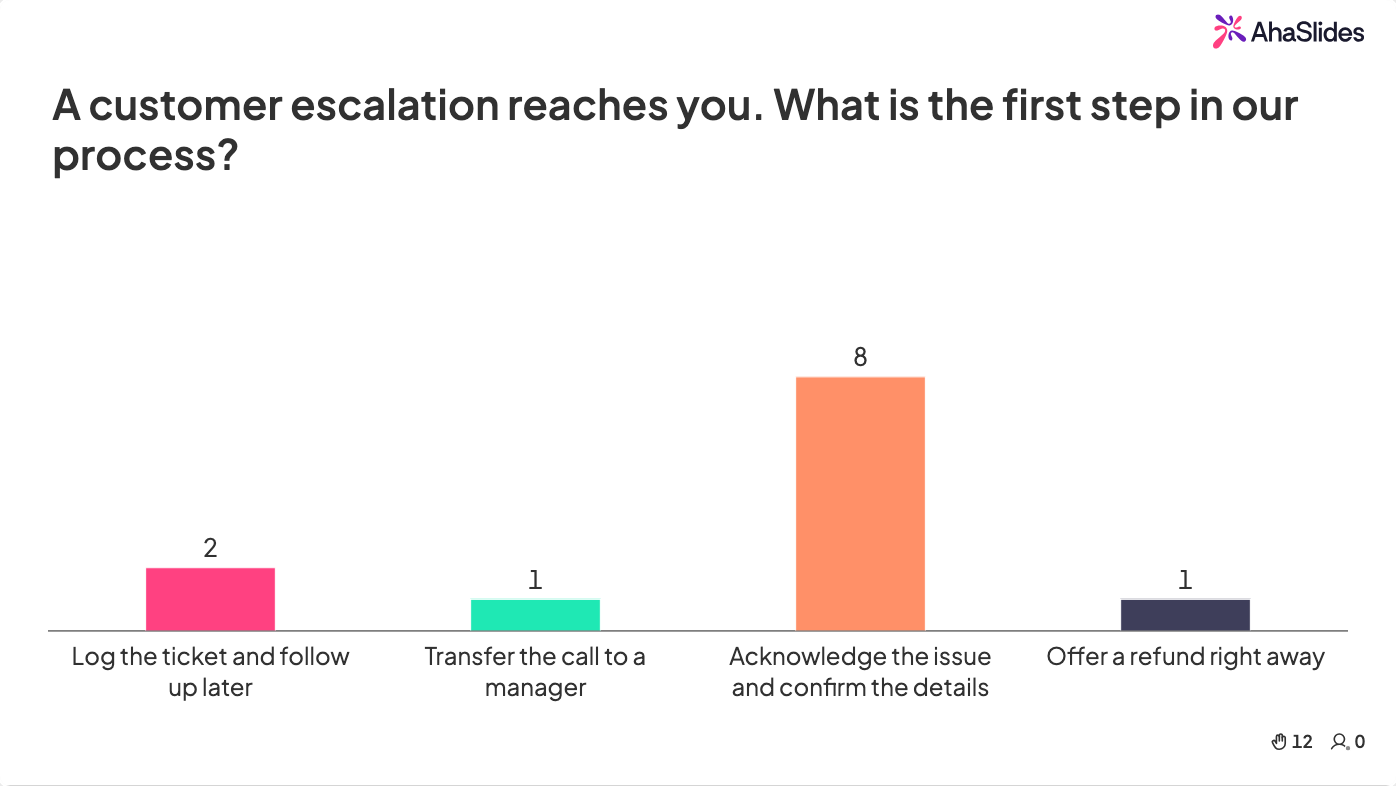
Keep your pick-answer quizzes, but make the wrong options believable. If one answer is obviously silly, learners aren't retrieving anything. Use common mistakes as distractors, then discuss why each wrong answer is wrong.
2. Short-answer questions for the things that matter most
For the handful of facts, terms, or numbers learners must be able to produce on their own (a compliance rule, a formula, a key vocabulary word), switch to a short-answer quiz. There are no options to lean on, so learners have to retrieve it. AhaSlides lets you add several accepted answers, so spelling variants you list still score.
3. Match pairs and correct order
These sit in the middle of the effort ladder. Learners see the pieces but have to recall the relationships between them. A trainer might ask the room to put the five steps of a customer escalation process in order. A teacher might have students match historical events to their causes. A clinical educator might show an unlabelled diagram of the nerves in the arm from the Wikimedia tab in the AhaSlides image picker, and have nursing students match each numbered nerve to its name (see how the image library works).
4. Brain dump (blurting)
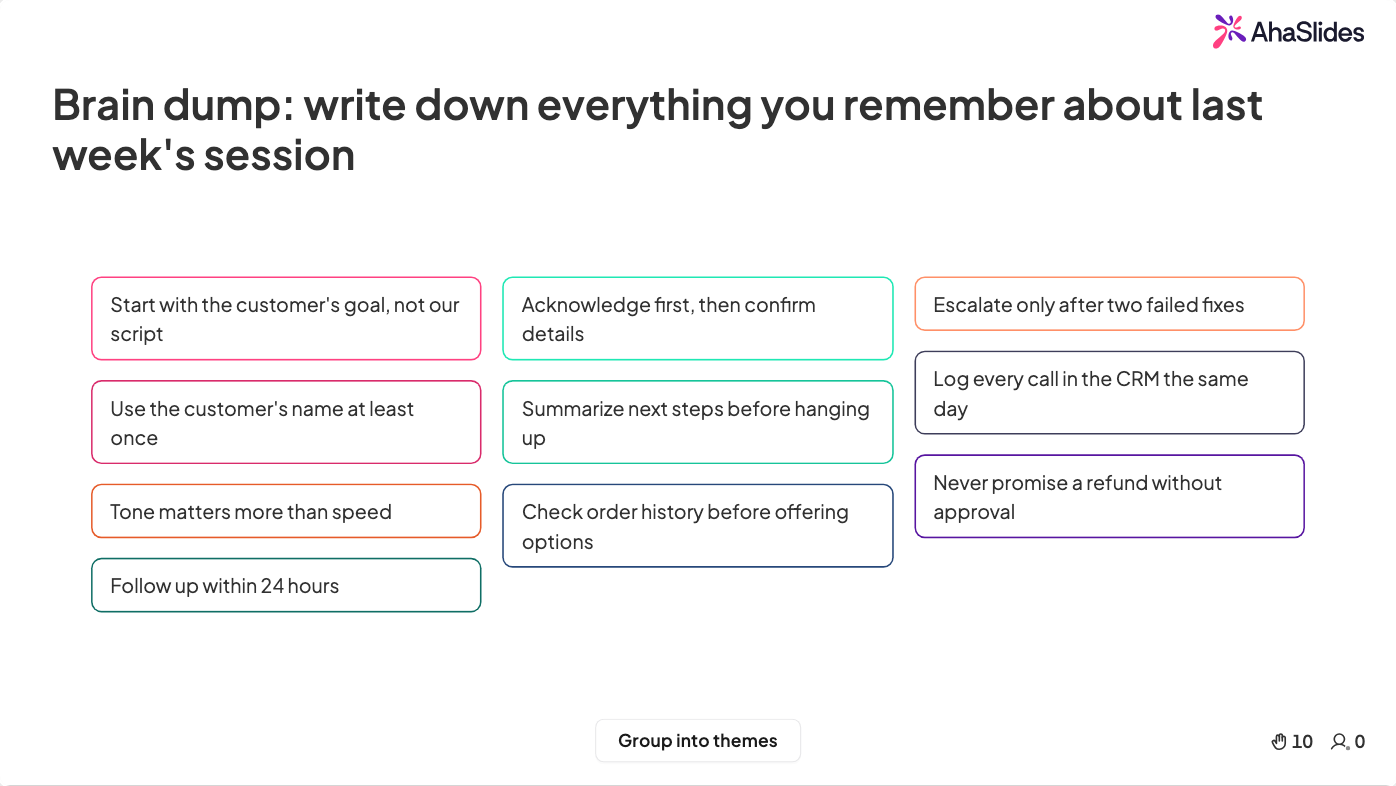
Ask learners to write everything they remember about a topic for two to three minutes, no notes. On an open-ended slide, everyone submits at once and you can see what the group remembered and what's missing. Then show the full picture and let learners compare. It's the purest form of free recall and the closest to what Karpicke and Blunt tested. For more prompts, see our guide to open-ended questions.
5. Retrieval with a twist of explanation
After any quick quiz, add one follow-up: "Explain your answer in one sentence." This turns a recognition check into a recall task and shows you who guessed right versus who understands.
6. Learner-written questions
Have learners write one quiz question on what they just learned. To write a good question and three believable wrong answers, they have to retrieve and organize the material. You get a bank of review questions for next time, too.
How to make retrieval practice work in your sessions
Picking a format is the easy part. These four habits decide whether it works.
Keep it low-stakes. Retrieval practice is for learning, not grading. If every quiz counts toward a score, people get anxious and focus on performance instead of memory. Use leaderboards for energy, not judgment, and remind learners that mistakes during practice are useful.
Always give feedback. Feedback is what turns a wrong answer into learning. Kang and colleagues [5] found that recall formats paid off most when learners saw the correct answers, and Butler and Roediger (2008) [8] found that feedback after multiple choice increased correct answers later and reduced the chance learners picked up the wrong options as "facts." Reveal the answer, then spend 30 seconds on the most common mistake.
Space it out. One quiz at the end of a session is good. The same concepts revisited two days later, then a week later, is much better. Start each session with three to five questions from previous sessions, not just today's content. Our guide to spaced repetition covers how to plan the gaps.
Mix old and new. Interleaving questions from different topics makes learners work out which knowledge to use, not just recall the last thing they heard. It feels slower in the moment. The payoff comes later.
A sample 60-minute session plan
| Time | Activity | Format |
|---|---|---|
| 0 to 5 min | Warm-up on last session's content | 3 pick-answer questions |
| 5 to 20 min | New content, part 1 | Teaching |
| 20 to 25 min | Quick check | 1 short-answer + 1 match pairs |
| 25 to 45 min | New content, part 2 | Teaching |
| 45 to 50 min | Put the process in order | Correct order |
| 50 to 58 min | Brain dump and compare | Open-ended |
| 58 to 60 min | Preview of next session's warm-up | Discussion |
This works for a ninth-grade science class and for a leadership workshop. Only the content changes.
Retrieval practice for corporate trainers
L&D teams have a specific problem: learners often attend once and then go back to their jobs. There may be no "next lesson" to review in.
A few ways to bring retrieval into that reality:
- Build retrieval into follow-ups. Send a short self-paced quiz a few days after the workshop so learners retrieve before they forget. The same works for remote cohorts; see our tips on virtual training.
- Start refresher sessions with recall, not a recap. Instead of summarizing last month's training, ask learners to type what they remember first.
- Use recall for high-stakes knowledge. Safety procedures, compliance rules, and product specs are exactly where recognition isn't enough. People on the job won't have four options to choose from.
- Let teams compete. Team-based quizzes add energy to adult sessions without making anyone feel singled out. See our guides to gamification for learning and game-based learning games for ideas.
For more ways to check understanding during a session, see our list of formative assessment activities.
Frequently asked questions
What is the difference between retrieval practice and active recall?
They mean essentially the same thing. "Active recall" is the term students and study communities often use. "Retrieval practice" is the term most researchers and educators use. Both describe pulling information from memory rather than rereading it.
Is multiple choice a form of retrieval practice?
Yes, it can be. Research shows multiple-choice practice tests improve learning, especially when wrong options are plausible and learners get feedback. But multiple choice is a recognition task, so mix in recall formats like short-answer questions and brain dumps for the knowledge that matters most.
How often should I use retrieval practice?
Short, frequent practice works better than one big review. A few questions at the start of each session, plus a short activity at the end, is a good baseline. Revisit key concepts days and weeks later, not just in the same lesson.
Does retrieval practice work for adults and not just students?
Yes. Much of the core research was done with university students, and the Adesope meta-analysis covered learners of different ages. The principle, that retrieving information strengthens memory, applies to workplace training as much as to classrooms.
Make your next quiz a harder one (in a good way)
Most educators already use quizzes. The next step is to make some of those questions a bit harder: fewer "spot the answer," more "produce the answer." Add one short-answer question, one correct-order activity, and one brain dump to your next session, space them out, and always give feedback.
AhaSlides has all of these formats in one place, from pick-answer and short-answer quizzes to match pairs, correct order, and open-ended slides, with live results so you can see what stuck and what didn't.
Further reading:
- Spaced repetition: how to use it in teaching and training
- Inquiry-based learning
- What is active learning?
- Formative assessment activities
Sources
[1] Roediger, H. L., & Karpicke, J. D. (2006). Test-enhanced learning: Taking memory tests improves long-term retention. Psychological Science, 17(3), 249-255. https://doi.org/10.1111/j.1467-9280.2006.01693.x
[2] Karpicke, J. D., & Roediger, H. L. (2008). The critical importance of retrieval for learning. Science, 319(5865), 966-968. https://doi.org/10.1126/science.1152408 Free full text
[3] Karpicke, J. D., & Blunt, J. R. (2011). Retrieval practice produces more learning than elaborative studying with concept mapping. Science, 331(6018), 772-775. https://doi.org/10.1126/science.1199327 Free full text
[4] Adesope, O. O., Trevisan, D. A., & Sundararajan, N. (2017). Rethinking the use of tests: A meta-analysis of practice testing. Review of Educational Research, 87(3), 659-701. https://doi.org/10.3102/0034654316689306
[5] Kang, S. H. K., McDermott, K. B., & Roediger, H. L. (2007). Test format and corrective feedback modify the effect of testing on long-term retention. European Journal of Cognitive Psychology, 19(4-5), 528-558. https://doi.org/10.1080/09541440601056620
[6] Little, J. L., Bjork, E. L., Bjork, R. A., & Angello, G. (2012). Multiple-choice tests exonerated, at least of some charges: Fostering test-induced learning and avoiding test-induced forgetting. Psychological Science, 23(11), 1337-1344. https://doi.org/10.1177/0956797612443370 Free full text
[7] McDermott, K. B., Agarwal, P. K., D'Antonio, L., Roediger, H. L., & McDaniel, M. A. (2014). Both multiple-choice and short-answer quizzes enhance later exam performance in middle and high school classes. Journal of Experimental Psychology: Applied, 20(1), 3-21. https://doi.org/10.1037/xap0000004 Free full text
[8] Butler, A. C., & Roediger, H. L. (2008). Feedback enhances the positive effects and reduces the negative effects of multiple-choice testing. Memory & Cognition, 36(3), 604-616. https://doi.org/10.3758/MC.36.3.604
[9] AhaSlides (2026). Educator slide-usage data from internal product analytics, June 24 to September 22, 2026 (n = 12,865 self-identified teachers, lecturers, and trainers).