



The best Net Promoter Score survey questions start with the standard scale question — "How likely are you to recommend us to a friend or colleague?" scored 0–10 — followed by a single open-ended follow-up: "What is the main reason for your score?" Promoters (9–10) reveal what to amplify; Passives (7–8) reveal what to improve before they churn; Detractors (0–6) reveal what is actively damaging loyalty. The most effective NPS follow-up is open-ended rather than multiple-choice because it surfaces the specific language customers use to describe value and friction. NPS benchmarks vary by industry: a score above +30 is considered good in financial services, +50 in retail, and +60 in consumer software — always compare against your own historical trend, not just industry averages.
A single question, "How likely are you to recommend us to a friend or colleague?", launched one of the most widely used feedback frameworks in business. Fred Reichheld introduced Net Promoter Score in a December 2003 Harvard Business Review article, reporting that in 11 of 14 industries studied, the "likelihood to recommend" question was the strongest predictor of revenue growth [1]. By the 2010s, two-thirds of Fortune 1000 companies had adopted NPS [2].
The score itself is simple to calculate. It's not always simple to use well. The questions you ask after the rating, and how you act on the answers, determine whether NPS produces insight or just a number on a dashboard.
This guide covers the core NPS question, how scoring works, and 20+ Net Promoter Score survey questions you can use right now, from follow-ups for customers to employee NPS.
How NPS works
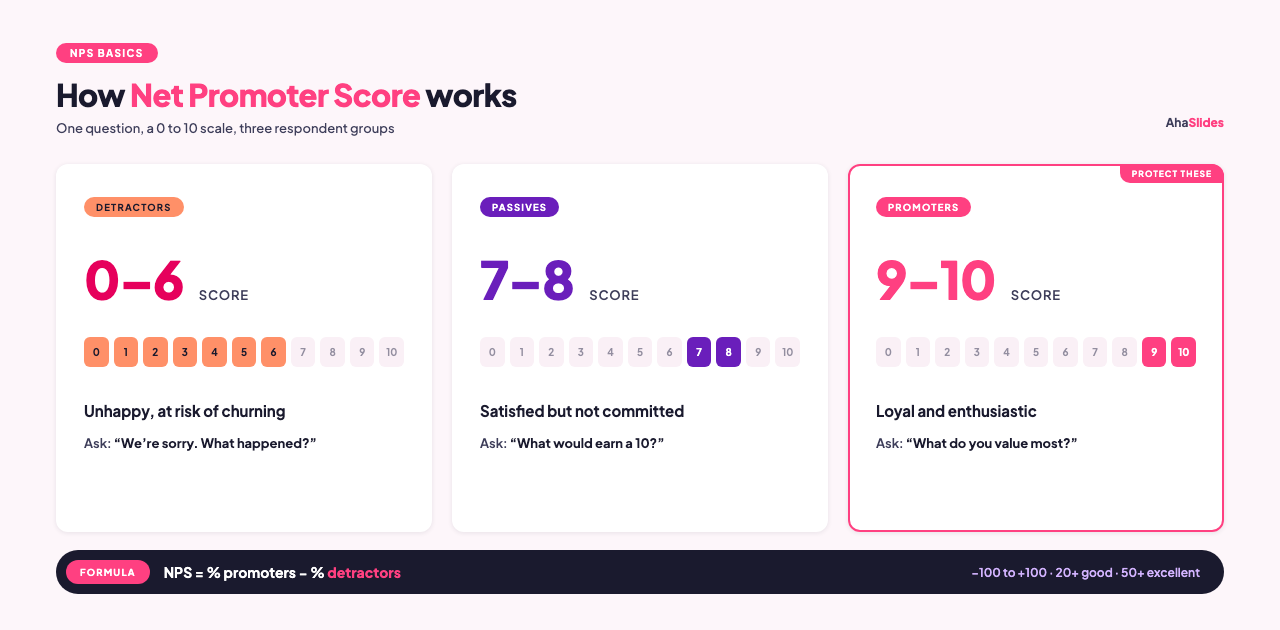
Respondents rate on a 0–10 scale. Their answers put them into one of three groups:
- Promoters (9–10): Loyal and enthusiastic. Likely to recommend and return.
- Passives (7–8): Satisfied but not strongly committed. Vulnerable to competitor offers.
- Detractors (0–6): Unhappy. At risk of churning and may share negative experiences.
The NPS formula is: % Promoters minus % Detractors. Passives count toward the total respondent pool but don't directly affect the score. The result is a number from -100 to +100.
As a rough orientation: scores above 0 mean more promoters than detractors. Above 20 is considered good in most industries. Above 50 is excellent. Average scores vary widely by sector: B2B software companies average around 41, while internet service providers average near 0 [3].
The more useful comparison is against your own previous scores and against close competitors, rather than an abstract cross-industry benchmark.
The standard NPS question
The original question, used almost unchanged since 2003:
"On a scale of 0 to 10, how likely are you to recommend [company/product/service] to a friend or colleague?"
Variations that work for specific contexts:
"Considering your experience with us so far, how likely are you to recommend [company name] to someone in your network?"
"How likely are you to recommend [product name] to a colleague who has the same challenges you do?"
"How likely are you to recommend [event name] to a professional contact?"
Keep the core question consistent across survey cycles. Changing the wording between periods makes it impossible to track meaningful trends.
NPS survey questions by respondent group
The rating question tells you where someone stands. The follow-up question tells you why. Segment your follow-ups by group so that the question is relevant to each respondent's experience.
For promoters (9–10)
Promoters are already positive. These questions help you understand what's working so you can protect and replicate it.
- "What's the main reason for your score?"
- "What do you value most about working with us?"
- "Is there a specific experience or interaction that stands out?"
- "Would you be open to sharing your experience as a brief testimonial?"
- "What would make you even more likely to recommend us, if anything?"
The last question is easy to skip, but it's one of the most useful. Even satisfied customers often have one thing they wish were different.
For passives (7–8)
Passives are your most actionable segment. They're close to becoming promoters but haven't crossed the line.
- "What would it take to earn a 9 or 10 from you?"
- "What's one thing we could do better?"
- "Is there a feature or service you expected but didn't find?"
- "How does our [product/service] compare to alternatives you've used?"
- "What's the main thing holding you back from a higher score?"
This is where patterns hide. A hospitality team reviewing months of passive responses might find the same friction point, like unclear check-in instructions in a confirmation email, repeated across a third of the comments. One copy change can start converting passives into promoters. The rating alone would never surface that.
For detractors (0–6)
Detractors need careful handling. The tone of the follow-up matters as much as the question itself.
- "We're sorry to hear we fell short. What happened?"
- "What was the most frustrating part of your experience?"
- "What would need to change for you to give us a higher score?"
- "Did you reach out for support? If so, how was that experience?"
- "Is there anything we can do to make this right?"
Avoid asking detractors to explain their score in a way that feels defensive. "Why did you give us a low score?" puts the respondent on the spot. "What happened?" invites a story.
Employee NPS (eNPS) questions
eNPS applies the same framework internally. The standard question:
"On a scale of 0 to 10, how likely are you to recommend [company name] as a place to work to a friend or colleague?"
Scores are interpreted the same way. Promoters are engaged employees who would actively recruit others. Detractors are disengaged and a potential retention risk.
Follow-up questions for eNPS:
- "What do you like most about working here?"
- "What's the one thing you'd change about our workplace if you could?"
- "Do you feel like your work is recognized and valued?"
- "How well does your manager support your professional development?"
- "Do you feel you have the tools and resources you need to do your job well?"
- "How clear are you on how your role connects to the company's goals?"
eNPS is especially useful for HR teams running quarterly engagement checks. It's short enough to get high response rates and produces a trackable number, while the follow-up questions generate the qualitative material needed to act.
One important note: eNPS works best when responses are anonymous. If employees suspect their answers can be traced back to them, scores skew positive and open-ended comments become vague. Make anonymity explicit in the survey introduction.

Transactional vs. relational NPS surveys
There are two main contexts in which NPS gets deployed, and the question design differs between them.
Relational NPS measures the overall relationship at a point in time, typically sent quarterly or annually. It reflects how someone feels about the company as a whole. The standard "how likely are you to recommend us" question fits here.
Transactional NPS measures a specific interaction: after a support call, after onboarding, after a purchase. The question anchors to that experience:
"Based on your experience with our support team today, how likely are you to recommend us to a friend or colleague?"
"Following your onboarding with us, how likely are you to recommend [company name] to a peer?"
"How likely are you to recommend our annual conference to a colleague in your industry?"
Transactional surveys should be short: the core rating question plus one or two follow-ups at most. The closer in time to the experience, the more accurate and specific the feedback.
What makes NPS questions go wrong
A few patterns that consistently produce low-quality answers to NPS survey questions:
Asking too many questions. Some teams attach 10 follow-up questions to the rating. Response rates drop, and the answers that do come in are rushed. Limit follow-ups to two or three questions.
Asking the same follow-up to every group. A detractor asking "What do you love about us?" gets a jarring experience. A promoter asked "What went wrong?" is confused. Segment your follow-ups.
Sending surveys too frequently. If employees or customers receive an NPS survey every month, they'll either stop completing them or start scoring by habit rather than reflection. Quarterly for relational surveys is usually the right cadence.
Collecting data and doing nothing. The most common NPS failure. If respondents notice that nothing changes after they give feedback, future response rates fall and scores lose meaning. Closing the loop, even with a brief note saying "here's what we did with your feedback", maintains credibility.
Tips for acting on NPS results
Collecting scores is the easy part. The value of NPS comes from what happens next.
Share results with the teams who can act on them. A low score from customers who had a poor onboarding experience is only useful if it reaches the people responsible for onboarding. NPS data that stays inside a quarterly report seen only by leadership rarely drives change. Route specific feedback themes to the relevant department or team lead so it lands where it can do something.
Set a response threshold for detractors. Many companies operate a "close the loop" process where detractors who leave contact information receive a follow-up within 48 hours. The goal is not to argue about the score but to understand what went wrong and, where possible, make it right. Even customers who remain unhappy tend to respond more positively to a company that reached out than one that ignored the feedback.
Track trends, not just snapshots. A single NPS score tells you almost nothing in isolation. A score that dropped 8 points over three consecutive quarters tells you something is changing. Set up a simple tracking log so you can see movement over time and correlate it with product changes, team transitions, or external events.
Use verbatim comments as training material. Open-ended responses from detractors and passives are some of the most direct feedback your teams will ever receive. In L&D contexts, themes from eNPS comments can feed directly into manager development programs, onboarding redesigns, or communication workshops. The language respondents use to describe problems is often more specific than anything produced in a formal focus group.
Running NPS surveys with AhaSlides
For HR teams and L&D professionals running live training sessions or all-hands meetings, collecting NPS data at the end of a session gives immediate, in-the-moment feedback rather than responses submitted days later when recall has faded.
AhaSlides lets you add rating scale and open-text questions directly into a presentation. Participants respond on their own devices, results appear in real time, and you can show the group a live breakdown before the session ends. That kind of immediate visibility changes the debrief: instead of talking about what might have worked, you're looking at actual data together.
You can also run asynchronous NPS surveys via a shareable link, useful for post-event follow-ups or distributed teams where scheduling a live session isn't practical.
Frequently asked questions
How many follow-up questions should an NPS survey include?
One to three. The rating question plus one open-ended follow-up is the minimum viable survey and will get the highest completion rate. Adding a second follow-up, such as a specific question about a recent interaction, is reasonable if it's directly relevant to the respondent's experience. Beyond three questions, completion rates drop noticeably and the quality of open-ended responses tends to decline.
How often should NPS surveys be sent?
For relational surveys, quarterly is the most common cadence for both customer and employee programs. Annual is acceptable if resources are limited, but it reduces your ability to spot problems early. Transactional surveys can go out after every qualifying interaction (a support ticket resolved, a training session completed) because they are anchored to a specific event rather than the overall relationship. Avoid sending both a relational and a transactional survey to the same person within a short window, as it creates survey fatigue.
What is a good response rate for an NPS survey?
For email-based NPS surveys, response rates between 20% and 40% are typical for B2B customers. Employee NPS surveys sent through internal channels often see higher rates, sometimes 60% or above, particularly when leadership has communicated that the feedback will be acted on. Low response rates are often a sign that employees or customers no longer expect their feedback to change anything, which is a signal worth paying attention to on its own.
To put these into practice, the AhaSlides free survey creator lets you build, share, and analyze surveys in minutes — live in a session or sent as a standalone link.
Sources
[1] Reichheld, F. (December 2003). "The One Number You Need to Grow." Harvard Business Review. ResearchGate
[2] Net promoter score. Wikipedia. https://en.wikipedia.org/wiki/Net_promoter_score
Frequently asked questions
What are the best Net Promoter Score survey questions?
The core NPS question is "How likely are you to recommend us to a friend or colleague?" scored 0–10. The best follow-up is one open-ended question: "What is the main reason for your score?" This combination gives you segmentation data (Promoter/Passive/Detractor) and the qualitative insight needed to act on it. Adding more questions beyond these two dilutes the simplicity that makes NPS effective.
What is a good NPS score?
A score of 0–30 is considered good in most industries; 30–70 is excellent; 70+ is world-class. Industry benchmarks: above +30 in financial services, +50 in retail, +60 in consumer software. Always compare your NPS against your own historical trend first — a score of +20 that is improving is more meaningful than a static +40.
How often should you run an NPS survey?
Run relationship NPS quarterly across your full customer base, and transactional NPS at key touchpoints — post-purchase, post-support resolution, post-onboarding. Running relationship NPS more than quarterly risks survey fatigue without enough time for improvements to show up in scores. Transactional NPS can be sent after every relevant interaction.
What is the difference between NPS and CSAT?
NPS (Net Promoter Score) measures loyalty and likelihood to recommend — a forward-looking metric tied to revenue growth. CSAT (Customer Satisfaction Score) measures satisfaction with a specific interaction — a backward-looking metric. NPS is better for tracking long-term brand health and predicting churn; CSAT for evaluating specific touchpoints like support tickets or onboarding calls.
[3] Retently. "What is a Good Net Promoter Score? (2025 NPS Benchmark)." https://www.retently.com/blog/good-net-promoter-score/