


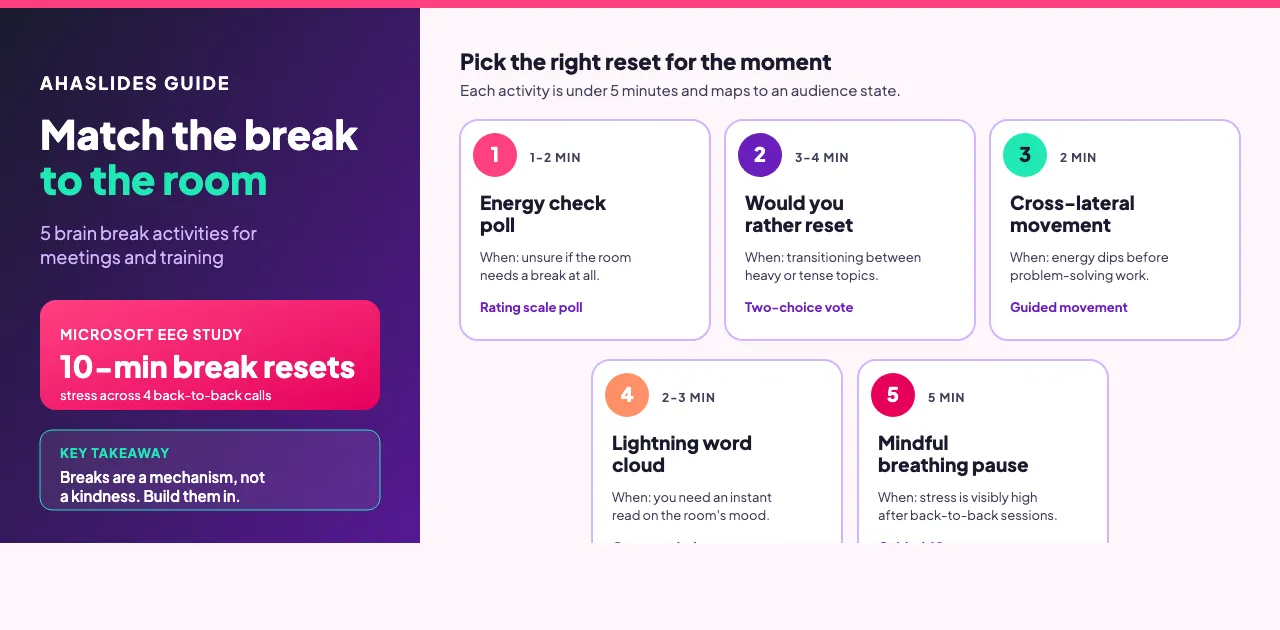
Most facilitators treat brain breaks as a guilty concession to short attention spans. That framing is wrong. When Microsoft researchers fitted 14 employees with EEG headsets and ran them through back-to-back video meetings, stress signals climbed steadily with each session [1]. A 10-minute mindful break between meetings reset that pattern completely, keeping stress levels flat across four consecutive calls. Brain breaks are not a kindness. They are a mechanism for maintaining the cognitive state your audience needs to absorb and retain information.
This guide covers 15 activities designed for L&D trainers and meeting facilitators, with guidance on when to use each one and how to make it interactive.
Why your sessions need them
The human brain was not built for marathon focus. A widely-cited review published in Advances in Physiology Education found that the common claim of a strict 10-15 minute attention ceiling is not well-supported by primary data [2]. Attention is more variable than that. But the practical reality trainers face is that engagement drops measurably when people sit through dense content without a change of pace. TED's 18-minute limit reflects a design choice, not a hard biological rule, but it points in the right direction: format and pacing matter as much as content.
The Microsoft EEG data adds a more specific finding: it is the accumulation of unbroken meetings that causes the problem, not any single session length [1]. Participants who took a break before each meeting stayed calm and engaged throughout. Those who didn't showed increasing stress signals that carried over into subsequent sessions.
That's the case for building breaks into your agenda from the start.
15 brain break activities
1. Live energy check poll
Duration: 1-2 minutes | Best for: Any point when energy is flagging
Instead of guessing whether the room needs a break, ask directly with a live poll: "On a scale of 1-5, how's your energy right now?" The results tell you what kind of break to run. A quick stretch if most people are at 3-4, something more substantial if everyone is at 1-2.
With AhaSlides, a rating scale poll takes about 30 seconds to set up and shows live results as participants respond. The data also gives you a before/after comparison if you run the same poll at the end of the break.
Pro tip: When results show low energy, name it: "I see most of you are at a 2-3. Let's take five minutes before we move on."
2. "Would you rather" reset
Duration: 3-4 minutes | Best for: Transitions between heavy topics
Present two absurd choices and have participants vote. The sillier the options, the better. Laughter does genuinely reduce cortisol [3], which is part of why this works.
Examples:
- "Would you rather fight one horse-sized duck or 100 duck-sized horses?"
- "Would you rather only be able to whisper or only be able to shout?"
- "Would you rather have to sing everything you say or dance everywhere you go?"
This creates a brief moment of genuine connection between colleagues who might otherwise spend the whole session as names on a screen.
3. Cross-lateral movement challenge
Duration: 2 minutes | Best for: Mid-training energy boost
Guide participants through movements that cross the body's midline:
- Touch right hand to left knee, then left hand to right knee
- Draw figure-8 patterns in the air while following with your eyes
- Pat your head with one hand while rubbing your belly with the other
These movements engage both sides of the brain and get blood moving,which is useful before problem-solving or creative work.
4. Lightning round word cloud
Duration: 2-3 minutes | Best for: Topic transitions or quick insight capture
Pose a single open-ended prompt and watch responses populate a live word cloud:
- "In one word, how are you feeling right now?"
- "What's the biggest challenge with the topic we just covered?"
- "Describe your morning in one word."
The most common responses appear largest, giving the room an instant collective read on the mood. AhaSlides' Word Cloud slide type handles this automatically. No setup beyond typing the prompt.
This beats traditional verbal check-ins because it's fast, anonymous, and gives quieter participants an equal voice.
5. Desk stretch with purpose
Duration: 3 minutes | Best for: Long virtual meetings
Not just "stand up and stretch", give each movement a context that connects it to the session:
- Neck rolls: "Roll out the tension from that last section"
- Shoulder shrugs: "Shrug off whatever's been weighing on you"
- Seated spinal twist: "Look away from your screen for 20 seconds"
- Wrist and finger stretches: "Give your hands a break"
For virtual meetings, ask people to keep their cameras on. It normalizes movement and helps distributed teams feel less isolated.
6. Two truths and a meeting lie
Duration: 4-5 minutes | Best for: Building connection in longer training sessions
Share three statements, two true, one false, and have participants vote on the lie. You can keep it personal or tie it to the session topic:
- "I once fell asleep during a quarterly review / I've been to 15 countries / I can solve a Rubik's cube in under 2 minutes"
- "Our team hit 97% of goals last quarter / We launched in 3 new markets / Our biggest competitor just copied our product"
Using a Multiple Choice slide in AhaSlides lets you show live voting before the reveal, which builds a few seconds of suspense that makes the answer land better.
7. One-minute breathing reset
Duration: 1-2 minutes | Best for: After high-stress discussions or difficult topics
Guide the group through box breathing:
- 4-count inhale
- 4-count hold
- 4-count exhale
- 4-count hold
- Repeat 3-4 times
Box breathing is used in clinical and high-performance settings to calm the nervous system and counteract the stress response [4]. In a training context, it takes 60-90 seconds and requires nothing from participants except willingness to follow along.

8. Stand up if...
Duration: 3-4 minutes | Best for: Re-energizing afternoon sessions
Call out statements and have participants stand (or use a reaction in video calls) if it applies to them:
- "Stand up if you've had more than 2 cups of coffee today"
- "Stand up if you're working from your kitchen table right now"
- "Stand up if you've ever accidentally messaged the wrong person"
The physical movement is secondary. The main value is creating shared experience across what might be a distributed or mostly-silent room.
9. 5-4-3-2-1 grounding exercise
Duration: 2-3 minutes | Best for: After intense discussions or before key decisions
Walk participants through sensory awareness:
- 5 things you can see
- 4 things you can physically touch
- 3 things you can hear
- 2 things you can smell
- 1 thing you can taste
This technique is used in anxiety management to anchor attention in the present moment. In a training context, it works well after an emotionally charged discussion before asking people to think clearly about next steps.
10. Quick draw challenge
Duration: 3-4 minutes | Best for: Creative or problem-solving sessions
Give participants 60 seconds to sketch a response to a simple prompt:
- "Draw your ideal workspace"
- "Illustrate how you feel about this project in one doodle"
- "Draw this meeting as an animal"
For in-person sessions, hold drawings up to the camera. For virtual, use AhaSlides' Idea Board so participants can upload a photo. Vote on categories, funniest, most relatable, most accurate, and you have a genuine two-minute laugh.
Drawing activates different cognitive pathways than verbal processing. Running it before a brainstorming segment tends to loosen things up.
11. Desk chair yoga flow
Duration: 4-5 minutes | Best for: Long training days
Lead the group through simple seated movements:
- Seated cat-cow: arch and round your spine with each breath
- Neck release: drop ear to shoulder, hold, switch sides
- Seated twist: hold the chair arm, rotate gently
- Ankle circles: lift one foot, circle 5 times each direction
- Shoulder blade squeeze: pull back, hold, release
Even brief movement breaks have been shown to improve cognitive performance compared to prolonged sitting [5]. Five minutes of this mid-afternoon does more for the rest of your session than pushing through on caffeine.
12. Emoji story
Duration: 2-3 minutes | Best for: Emotional check-ins during difficult training topics
Ask participants to choose emojis that represent their current state:
- "Pick 3 emojis that sum up your week"
- "React to that last section in emojis"
- "How do you feel about learning this new skill? Express it in emojis"
A Word Cloud slide works here. Participants can type emoji characters directly. The result is a quick, low-pressure emotional read on the room that transcends language barriers in multilingual groups.
13. Speed networking roulette
Duration: 5-7 minutes | Best for: Full-day sessions with 15 or more participants
Pair participants randomly for 90-second conversations on a specific prompt:
- "Share your biggest win from last month"
- "What's one skill you want to develop this year?"
- "Tell me about someone who shaped your career"
Rotate pairs 2-3 times. For virtual sessions, use breakout rooms with a countdown timer visible on screen. A short follow-up poll closes the loop and reinforces the value of the exercise, for example "Did you learn something new about a colleague?".
The practical upside for organizations: cross-functional connections made during training days often improve information flow back in day-to-day work.
14. Gratitude lightning round
Duration: 2-3 minutes | Best for: End-of-day sessions or stressful meeting topics
Quick prompts for collective appreciation:
- "Name one thing that went well today"
- "Shout out someone who helped you this week"
- "What's one thing you're looking forward to?"
Gratitude practices increase activity in the brain's reward circuitry, raising dopamine and serotonin levels [6]. In a session context, this works particularly well as a close before participants return to a demanding afternoon. Use the Open Ended response feature in AhaSlides for anonymous submissions, then read five or six aloud.
15. Trivia energy booster
Duration: 5-7 minutes | Best for: Post-lunch slumps or session openers
Three to five quick trivia questions create enough friendly competition to re-engage a drifting room. Pick from in topics such as industry-related, pop culture, or general knowledge. Keep it light: the point is the energy lift, not the learning.
AhaSlides' Quiz feature handles scoring and a live leaderboard automatically. Add a small prize or just bragging rights. Sales teams tend to respond particularly well to this format. The competitive dynamic mirrors what motivates them at work.

How to fit breaks into your agenda without losing momentum
The most common objection: "I don't have time, I have too much content."
The counterargument: without breaks, participants retain less of what you cover anyway. Adding three two-minute breaks to a 60-minute session costs six minutes. If those breaks meaningfully improve retention and engagement for the remaining 54 minutes, the trade-off is obvious.
A workable framework:
Session lengthBreak structure30 minutes1 micro-break (1-2 min) at the midpoint60 minutes2 breaks (2-3 min each)Half-day trainingBreak every 25-30 min + longer break every 90 min
Match the break type to what the room needs:
Audience stateBreak typeMentally exhaustedBreathing or mindfulness exercisePhysically tiredMovement-based activitySocially disconnectedConnection-building activityLosing focusHigh-energy interactive gameEmotionally drainedGratitude or humor-based activity
One practical tip: announce breaks in advance. "In about 15 minutes we'll take a two-minute energy reset before the next section" primes participants to stay with you until then, rather than mentally checking out on their own schedule.
Sources
[1] Microsoft Work Trend Index. (2021). Research proves your brain needs breaks. microsoft.com/en-us/worklab/work-trend-index/brain-research
[2] Bradbury, N. A. (2016). Attention span during lectures: 8 seconds, 10 minutes, or more? Advances in Physiology Education, 40(4), 509–513. doi.org/10.1152/advan.00109.2016
[3] Dunbar, R. I. M., Baron, R., Frangou, A., Pearce, E., van Leeuwen, E. J. C., Stow, J., Partridge, G., MacDonald, I., Barra, V., & van Vugt, M. (2012). Social laughter is correlated with an elevated pain threshold. Proceedings of the Royal Society B, 279(1731), 1161–1167.
[4] Zaccaro, A., Piarulli, A., Laurino, M., Garbella, E., Menicucci, D., Neri, B., & Gemignani, A. (2018). How breath-control can change your life: A systematic review on psycho-physiological correlates of slow breathing. Frontiers in Human Neuroscience, 12, 353.
[5] Hagger-Johnson, G., Gow, A. J., Burley, V., Greenwood, D., & Cade, J. E. (2016). Sitting time, fidgeting, and all-cause mortality in the UK Women's Cohort Study. American Journal of Preventive Medicine, 50(2), 154–160.
[6] Emmons, R. A., & McCullough, M. E. (2003). Counting blessings versus burdens: An experimental investigation of gratitude and subjective well-being in daily life. Journal of Personality and Social Psychology, 84(2), 377–389.