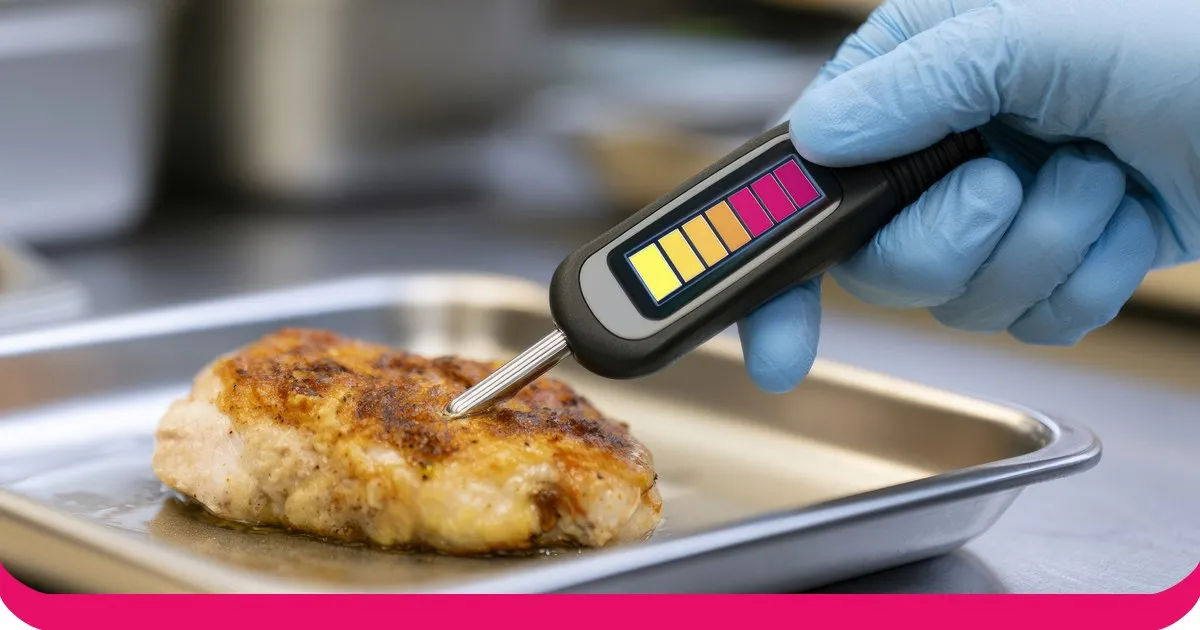
Three assessors watch the same line cook sauté a chicken breast and plate it. One scores it 9 out of 10 because the plate looks lovely. One scores it 6 because the pan was crowded and the chicken lost its juices because it was not rested. The third scores it 7 because "it was fine, a bit slow". Nobody did anything wrong. They each used a different private standard, and the cook gets three different messages about the same performance.
This is an illustrative scenario, not a documented incident. It is the problem that culinary competency assessment is meant to solve when a franchise has many kitchens and many assessors. This guide is for hospitality training directors and restaurant or hotel operations leads. It covers how to define the task, choose a representative sample of the work, write criteria with anchors, calibrate assessors, and use the results for follow-up.
One boundary up front. Physical cooking skill needs direct observation by a qualified assessor. A quiz or a slide activity can check knowledge of the standards and prepare people for the assessment, but it cannot stand in for watching someone cook.
Quick facts
| Question | Short answer |
|---|---|
| What is being assessed? | A line cook's preparation of a defined dish to the brand standard, observed in the kitchen. |
| What goes wrong across locations? | Assessors apply different private standards, so scores are not comparable. |
| What fixes it? | Observable criteria, written anchors, and assessor calibration before live use. |
| Does a rubric guarantee consistency? | No. Research on rubrics links them to better scoring reliability, most clearly when they are specific and paired with examples or rater training. |
| Can a slide tool replace observation? | No. It supports preparation, practice and calibration discussions only. |
| Who validates the rubric? | A qualified chef assessor and a restaurant or hotel operations lead. |
1. Define the performance being assessed
Start with the observable task, not the word "mastery". For example: prepare the brand's signature chicken dish at line speed, to the approved recipe, portion, temperature and plating, while following food safety procedures.
Then state the boundaries. Which station? Which dishes? During a quiet service, a busy one, or a set practical? Who is authorised to sign off, and what are they signing off? "Competent on the grill station for the lunch menu" is a defensible claim. "A master cook" is not something one observation can show.
Check the cognitive demand too. Recalling a temperature is a recall task. Preparing a dish to standard is Apply. Diagnosing why a sauce keeps splitting, or why two sites get different results from the same recipe, is Analyse. The Bloom-style framing helps you match the assessment to the demand, as in this guide to matching learning activities to Bloom's taxonomy.
2. Select a representative task
You cannot observe everything, so pick a task that samples the real work. A good one has these features:
- It uses skills the cook needs every shift, such as knife work, heat control, timing, seasoning, portioning and plating.
- It is the same dish and spec at every location, so scores compare.
- It has a clear start and finish, so the assessor can see the whole sequence.
- It is unfamiliar enough that the cook has not simply rehearsed that one plate for the assessment.
Be honest about what the task cannot show. One dish on one day says little about performance on a Friday rush, with a new ingredient delivery, or on a different station. Plan several short observations over time for anything you would call overall competency.
3. Write observable criteria and anchors
A rubric converts "looks good" into things an assessor can point to. Build the criteria from what you can see, smell, measure or hear, not from impressions of confidence or speed.
Here is an illustrative starting set for the chicken dish. Score each criterion 0 to 2 using the anchors, and adapt it with a qualified chef assessor.
| Criterion | 0: weak | 1: developing | 2: proficient |
|---|---|---|---|
| Mise en place and station set-up | Missing items; stops mid-task to fetch them | Most items ready; one or two gaps cause a pause | All items ready and in reach before starting |
| Recipe and portion adherence | Departs from the recipe; portion visibly off | Follows the recipe; portion is slightly outside tolerance | Follows the recipe; portion within the stated tolerance on a scale check |
| Technique and doneness | Overcrowded pan or wrong heat; product under or over cooked | Mostly correct technique; core temperature reached but not rested | Correct heat and pan use; reaches the safe temperature and rests as specified |
| Food safety | Skips handwashing, cross-contaminates | Mostly compliant; one lapse corrected when prompted | Compliant throughout without prompting |
| Plating to spec | Does not match the reference photo | Matches the reference with noticeable differences | Matches the reference within the stated tolerance |
Define critical errors separately. Serving chicken below the safe internal temperature, or ignoring an allergen control, should fail the task whatever the total score. An overall score must never hide a critical failure.
For a wider view of scoring judgement-based work, see this guide to assessing judgement and problem-solving in training. Avoid criteria like "shows confidence" or "works fast" with no definition. Speed can be a criterion if you set a measurable target for it, for example a plated dish within a stated number of minutes, but do not let it stand in for quality.
The same issue appears in other fields, and the general guidance carries over. A well-known review by Jonsson and Svingby of rubric research found that rubrics can improve the reliability of scoring, especially analytic, topic-specific rubrics used with examples or rater training. It also found that a rubric alone does not guarantee valid judgements of performance. You can read the summary in the ERIC record for the review. In plain terms: write the anchors, then train the people using them.
4. Calibrate assessors and run a pilot
Calibration is where consistency is built. Before assessors score real cooks:
- Score independently. Have every assessor watch the same example, live or on recorded video, and score it alone against the rubric.
- Compare evidence, not just scores. Ask each person what they saw that supports each score. A disagreement between a 1 and a 2 usually points to an anchor that is vague.
- Revise the ambiguous criteria. Add an observable detail, such as a tolerance in grams or a named doneness test, to any anchor people read differently.
- Repeat with a new example until assessors agree on the large majority of criteria, and agree to review the rest. Choose the agreement level you will accept with your specialist, rather than borrowing a number.
- Pilot at two or three sites. Check whether scores differ because of the cook or because of the assessor or the equipment.
Keep a qualified chef assessor in the loop. They validate the rubric, the reference plate, the doneness checks and the critical errors, and they decide who is authorised to assess. Recalibrate whenever the menu or the standard changes, and at set intervals, because assessors drift.
A calibration session is also a good place to use an interactive activity. Show each reference photo or a short clip, have assessors vote on a score anonymously, and then reveal and discuss the spread. That surfaces disagreements without anyone having to speak first. It supports calibration, but the observation itself still happens in the kitchen.
5. Use the results for follow-up
A score is only useful if it leads somewhere. Match the next step to the gap you saw.
- Knowledge gap (the cook could not state the doneness rule): targeted self-paced study, then a quick recall check. A recall check confirms prerequisites only.
- Judgement gap (the cook followed steps but missed that the plate was off): interactive case practice with feedback, using photos or recorded weights from real shifts.
- Skill gap (the technique was wrong): supervised practice with live coaching from a qualified person.
- Context gap (the right technique, but the equipment, supply or staffing got in the way): fix the cause, not the cook.
Reassess on a new, unseen task after a suitable period of work exposure. Track the same criteria over time, with a clear denominator such as observations per cook per quarter. Look at concurrent changes, such as a new oven, a menu change or a staffing change, before crediting training for any movement.
A readiness decision has limits. A pass means the cook met the criteria on the tasks observed, under those conditions. It does not mean they are ready for every station or every service.
What assessment will not fix
- Different equipment. If one site's grill runs hot, you will get different results with the same skill.
- Unclear specifications. If the spec says "cook until done", assessors will disagree because the spec is vague.
- Assessor availability. A rubric with no trained assessor at a site is just a document.
- Evidence limits. One observation shows what happened that day. It does not prove why.
Name these early to franchise owners and agree who fixes each one. The linked guide on reducing recipe variation and portion inconsistency across franchise locations covers the recipe and tooling side in more depth.
Frequently asked questions
What is culinary competency assessment?
It is the structured observation of a cook performing defined tasks, scored against written criteria. It checks what the person can do in the kitchen, not only what they know.
How do you keep scoring consistent across locations?
Use the same observable criteria and anchors everywhere, and calibrate assessors by having them score the same examples and compare evidence. Recalibrate when the standard changes.
Can you assess cooking skills online?
Only in part. Knowledge checks, scenario questions and calibration discussions can run online or live, but the practical skill needs a qualified assessor watching real preparation, in person or through recorded video.
How many criteria should a rubric have?
Few enough that an assessor can score them in one observation. A handful of observable criteria, each with clear anchors, works better than a long list that people skim.
Where to start
Pick one signature dish. Draft a five-criterion rubric with anchors, then ask a qualified chef assessor to correct it. Run a calibration session with your assessors on two recorded examples, revise the anchors that caused disagreement, and pilot it at two sites before you roll it out.
To see how a calibration session or a knowledge check could run live, and be reused self-paced afterwards, explore AhaSlides.