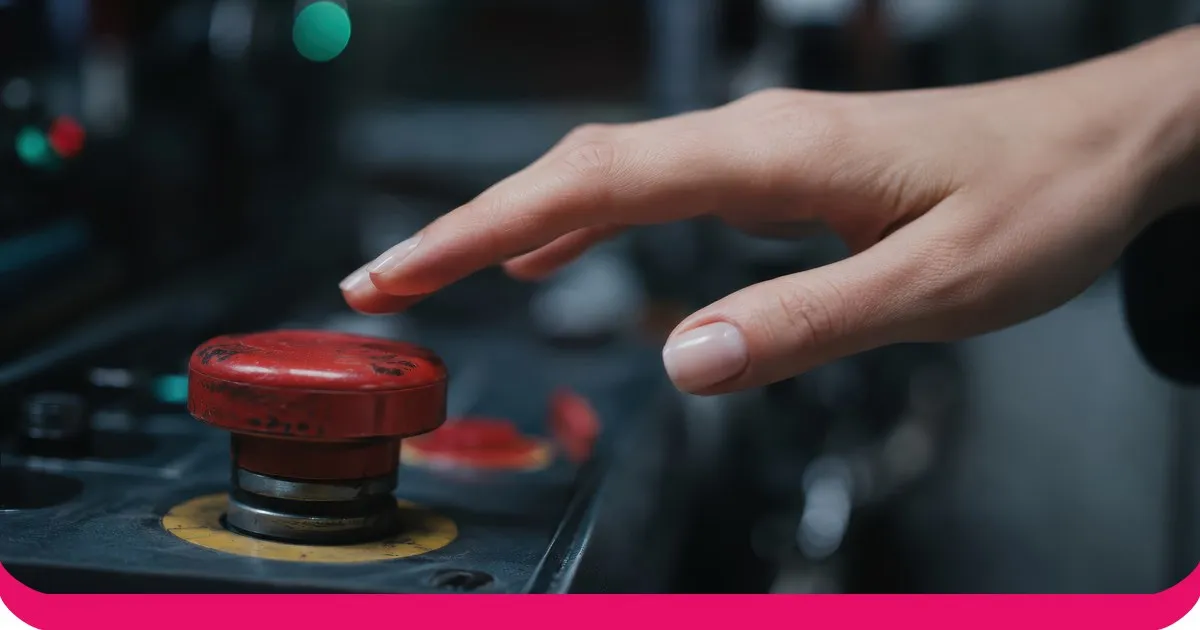
A line worker notices what might be a defect on a part, two hours before the end of a shift in which the line is behind its target. She is not sure. The part is within what she has seen before, the supervisor is at the other end of the hall, and everyone has been told the numbers matter today. She lets it pass.
This is an illustrative scenario, not a documented customer case. It shows what andon cord training has to prepare people for: noticing a possible quality problem, deciding in the moment whether to raise it, and doing so clearly enough that a supervisor can act. This guide is for plant training managers and the maintenance or quality leads who own the stop-the-line procedure. It is about training design, and it assumes your supervisors and your stop-work policy will back the people you train.
What is andon cord training?
Andon cord training teaches line workers to recognise an abnormal condition, signal it through the plant's andon system, and describe the problem so that a team leader can respond. The Lean Enterprise Institute defines andon as "a visual management tool that highlights the status of operations in an area at a single glance and that signals whenever an abnormality occurs". The word is Japanese for "lamp". A light turns on when a machine sensor detects a problem, or when an operator pulls a cord or pushes a button, and the lit signal summons a quick response from the team leader.
Quick facts
| Question | Short answer |
|---|---|
| What is the task? | Raise a quality concern and take part in the supervisor's response. |
| What is an andon? | A visual signal that an abnormality has occurred, set off by a sensor or by an operator pulling a cord or pushing a button. |
| What do you score? | Clarity of the concern and consistency of the supervisor's response, not recall of the procedure. |
| Is knowing the procedure enough? | No. It shows the procedure was taught, not that someone will use it under target pressure. |
| Who validates the case? | A quality or maintenance lead who owns the stop procedure. |
| What can training not fix? | Supervisor incentives, a stop-work policy that is not backed in practice, and staffing that leaves nobody free to respond. |
| How do you know it worked? | A new, unseen case scored against agreed criteria, then workplace follow-up. |
1. Describe the performance problem
Start with the job. A line worker should be able to see something that may be wrong, decide whether it meets the plant's criteria for raising a concern, signal it, and say what they saw. A supervisor should be able to respond in a way that makes the next worker more, not less, willing to speak up. Those are judgements and behaviours, not facts to recall.
The idea behind the signal is jidoka. The Lean Enterprise Institute describes jidoka as providing "machines and operators the ability to detect when an abnormal condition has occurred and immediately stop work", so that quality is built in at each process. It adds that jidoka "highlights the causes of problems because work stops immediately when a problem first occurs", which leads to improvements that remove root causes of defects. The cord is only the mechanism. The behaviour you are training is deciding to use it.
Stopping is not always instant. The same source describes Toyota's fixed-position stop on final-assembly lines: when an operator pulls the rope, the line stops after the product reaches a predetermined position, and the team tries to solve the problem within the cycle first. Your plant may work differently. Training should teach the plant's own rule, not the textbook one.
2. Diagnose the learning and context gaps
Compare what the job needs with what your current training practises and assesses.
- Does current practice rehearse the decision? A slide deck that explains the andon system and ends with a quiz on the colours of the lights tests recall. It does not practise the harder moment, when the worker is unsure, the target is close and a stop will be noticed.
- What is the cognitive demand? In Bloom's revised taxonomy, applying the stop criteria to a new situation is application, comparing a doubtful part with the standard is analysis, and judging whether a concern justifies stopping is evaluation. Remembering what each light means sits at the lowest level. Our guide to matching learning activities to Bloom's taxonomy shows how to read these demands.
- Is something other than skill in the way? If supervisors are measured only on output, if earlier stops were met with blame, or if nobody is free to respond to a signal, more training will not change behaviour. Check incentives, staffing, tools and procedures first, and report blockers to whoever owns them.
3. Design purposeful preparation and practice
Give each stage a distinct job.
Preparation: confirm the basics. A short self-paced check on what your plant treats as a reportable concern, what each signal means, who responds and what authority a line worker has to stop. A recall check like this confirms prerequisites only. Do not report it as capability.
Practice: scenarios that make people decide. Three kinds of practice, in rising order of demand:
- Andon decision scenarios. Show a short video, photo or written description of a situation and ask each learner to choose: continue, raise a concern, or stop. Then ask them to justify the choice in one sentence. Include cases where the right answer is to continue, so learners are not trained only to stop.
- Say it clearly. Learners write or say the concern in a form a team leader can act on: what they saw, where, on which part or step, and what they are unsure about. "Something looks off" is a signal. "The seal on this unit is not seated on the left side" is a concern.
- Supervisor response rehearsal. Supervisors and team leaders practise the first thirty seconds after a signal: arrive, ask, listen, decide who investigates. The aim is consistency, so that a worker who stops the line gets the same respectful response on every shift.
Feedback linked to decisions. "You raised the right concern but did not say which station" is more useful than a total score. Feedback to supervisors should say what the worker would have taken from their response.
Live input or asynchronous review? Live input adds most value for the supervisor rehearsal and for discussing ambiguous cases, because the disagreement is the lesson. Asynchronous review is enough for the policy and for checking decisions against an annotated expert answer. A common mix is self-paced preparation, then a facilitated session with workers and supervisors together.
4. Work through a realistic example
Illustrative. A quality or maintenance lead should validate the case and the answer criteria before use.
The case. On a packaging line, a worker sees that some sealed units look slightly misaligned at the edge. The line is behind target for the shift. Her team leader is two stations away. The plant's procedure says a worker may stop the line for a suspected quality defect and should call the team leader.
The task. The learner decides whether to continue, raise a concern or stop, explains the decision, cites what they saw, and says what further information or support they would need.
A first attempt. The learner chooses to continue and mention it at the end of the shift, because the units look "mostly fine". Their reasoning cites the target and not the standard.
Feedback and retry. The facilitator asks: what does the procedure say about a suspected defect, and who would be affected if the next hundred units were the same? The learner revisits the case, compares the unit with the reference sample and revises.
A stronger attempt. "I would raise a concern now. I see misalignment at the left edge on three of the last ten units, compared with the reference sample at station four. I would signal the team leader, say which station and which units, and keep the suspect units apart. I am not sure whether the cause is the machine or the film, so I would ask the team leader and maintenance to check."
Why each response is defensible or incomplete. Judge each against approved criteria, not the facilitator's preference. The first attempt leans on the target over the standard and delays the signal. The stronger attempt separates what she saw from what she does not know, uses the plant's procedure and asks for support. One more point: the supervisor's reply matters as much as the worker's. If the next scene shows a supervisor who thanks her and checks the units, the lesson holds. If it shows a supervisor who sighs at the delay, the training has taught the opposite.
5. Assess capability and plan transfer
Evidence of capability is a response to a new case the learner has not seen, not a score on the one they practised. Score a short rubric from 0 to 2 for each criterion, defined with your quality or maintenance lead.
| Criterion | Observable evidence |
|---|---|
| Task execution | Raises a quality concern in the plant's agreed form and records the action and the evidence behind it. |
| Reasoning | Explains the relevant constraints, the alternatives considered and what remains uncertain. |
| Boundaries | Uses approved procedures and asks for help when information or authority is missing. |
Anchors: 0 means absent or unsupported, 1 means partial with relevant omissions, and 2 means complete and justified against agreed criteria. Define critical errors separately, for example continuing to run after a defect that the procedure says must be stopped, so a good overall score cannot hide one. This rubric is a proposed starting point, not a validated readiness standard. Our guide to assessing judgement and problem solving in training covers calibrating assessors and writing anchors.
Workplace follow-up. After suitable time on the line, observe a real signal or, with the team leader's agreement, review the plant's own andon log with the team. Look at whether concerns were specific, whether the response was consistent, and whether anyone held back. Ask workers what happened the last time they were unsure.
Measure what changed
Score concern clarity and response consistency on a baseline case and on an unseen follow-up case. Define the population, the denominator and the timing. If you also track line data, such as the number of signals raised or defects caught early, check what else changed in the same period, such as a new product, a different shift pattern or a change in targets, before crediting the training. More signals can be a good sign, because people are speaking up, or a sign of a process problem. Read them with the line, not on their own.
Where interactive delivery helps
Interactive formats suit the parts of this design that depend on everyone committing before they see the group. In a live session, a facilitator can show a scenario, ask every participant to choose continue, raise or stop, and show the spread before the discussion begins. Workers who would not speak first in a room are more willing to answer when their choice is not tied to their name. The same case can run self-paced as preparation. AhaSlides supports interactive learning and moving between live and self-paced delivery. Check any authoring, feedback or reporting function you plan to rely on against your own workflow, and treat simulators, AI and system integrations as external or unconfirmed until you have seen them work.
What training will not fix
- Incentives. If supervisors are rewarded only for output, a worker who stops the line pays for it. Training cannot change that.
- Policy in practice. A written right to stop means little if the last person who used it was blamed.
- Staffing and response time. A signal nobody can answer teaches people that signals are pointless.
- Equipment and sensors. A system that cries wolf is ignored, which is a maintenance problem.
- Evidence limits. One case shows one set of choices. A score does not describe how a person behaves on a bad day.
Name these to sponsors early and agree who fixes each one.
Frequently asked questions
What is andon cord training?
Practice that teaches line workers to spot an abnormality, signal it through the plant's andon system and describe the problem so a team leader can respond.
What does the andon cord do?
It lets an operator signal a problem. At Toyota's final-assembly lines, pulling it stops the line at a predetermined position after the product reaches it, unless the problem is solved first.
Should every worker be able to stop the line?
That is a plant policy and safety decision, not a training one. Train workers on the authority your procedure gives them.
How do you know the training worked?
Score a new, unseen case for concern clarity and response consistency, compare with a baseline, then check real behaviour on the line after suitable time.
Where to start
Pick one stop-or-continue situation that your line has seen. Have a quality or maintenance lead agree the right response, draft the three-criterion rubric, and run it with one team and its supervisor. Score a new case before you roll it out.
To see how a case like this could run live and be reused self-paced afterwards, explore AhaSlides.