


In manufacturing, a knowledge gap is not just a performance issue. It is a physical risk. When a worker forgets a lockout/tagout sequence or misidentifies a chemical hazard label, the consequences can be severe and irreversible.
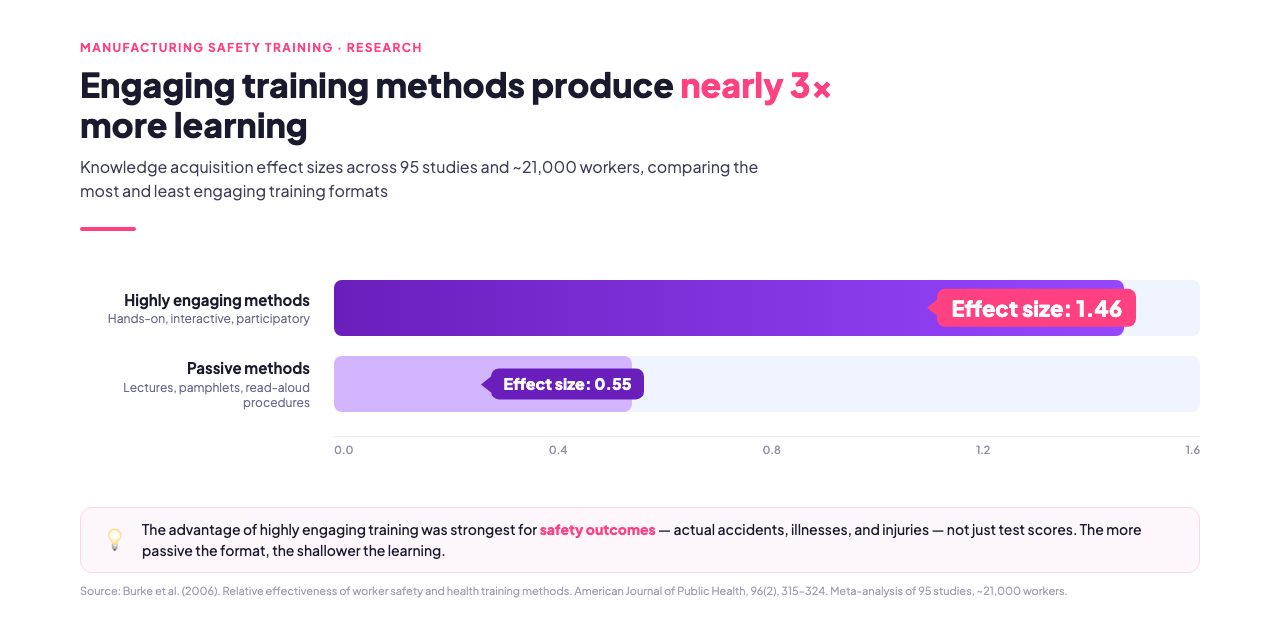
Most safety programs acknowledge this. What fewer programs acknowledge is that the training format is often part of the problem. A 2006 meta-analysis by Burke et al., published in the American Journal of Public Health and covering 95 studies with nearly 21,000 workers, found that the most engaging training methods produced a knowledge acquisition effect size of 1.46, compared to 0.55 for the least engaging methods such as lectures and pamphlets. The more passive the format, the shallower the learning.
Below are five common mistakes that keep manufacturing safety training stuck in passive mode, along with practical ways to fix them.
Mistake 1: Reading out procedures instead of practising them
Why it happens: Most trainers default to narrating steps because it is fast to prepare and easy to deliver. A slide listing the lockout/tagout sequence takes minutes to build. It also leaves workers with a weak grasp of what to actually do when they are standing in front of the machine.
Cognitive research on procedural memory shows that sequencing tasks (physically or mentally placing steps in order) produces stronger encoding than passive review. Asking workers to reconstruct a procedure from memory is fundamentally different from asking them to follow along.
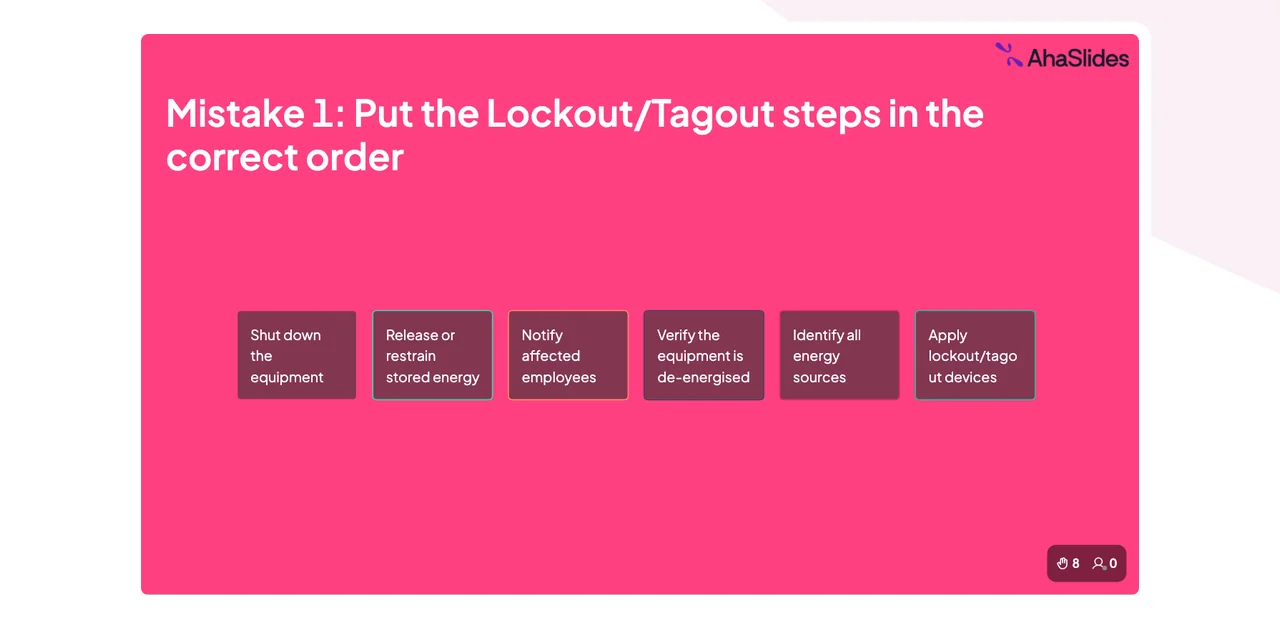
How Correct Order fixes it: Present the steps of a procedure in a scrambled sequence and ask workers to arrange them correctly before the answer is revealed. This works well for lockout/tagout sequences, confined space entry procedures, and spill response protocols. Running it at the end of a module rather than the beginning functions as retrieval practice, which produces stronger long-term retention than re-reading the same material.
Quick-start tip: Build one Correct Order slide per critical procedure. Five steps is usually enough. Run it as a closing activity, not a warm-up: the recall effort is the point.
Mistake 2: Treating all workers as equally prepared
Why it happens: Standardised training is logistically easier. One session plan, one delivery. The assumption is that everyone starts from the same place, which is rarely true on a manufacturing floor.
A new hire and a ten-year veteran have very different starting points. Running the same session for both wastes the veteran's time and risks rushing the new hire through content they have not yet absorbed.
How Pick Answer fixes it: Open each session with a short unscored poll. Keep it light: three to five questions is enough to get a read on the room. Use the results to decide how much time to spend on foundational content versus reinforcement. If most of the room gets a question right, move on. If a question trips most people up, you know exactly where to slow down.
Quick-start tip: Use Pick Answer in poll mode (unscored) so it reads as a genuine check-in rather than a test. Display the aggregate results on screen so the group can see where the gaps are without singling anyone out.
Mistake 3: Writing scenario questions that are too easy to guess
Why it happens: Multiple-choice questions about safety are often written with one clearly correct answer and two implausible distractors. Workers learn quickly to eliminate the obvious wrong choices and select what remains, without having to recall anything. The quiz produces a high pass rate and low actual learning.
There is a related problem upstream of the quiz itself. Karl Kapp, professor of instructional technology at Commonwealth University and a longtime ATD contributor, made the point in his session "Pick Your Path: Discover and Experience Action-First Learning" at ATD 2026 (Los Angeles, May 2026) that safety training frequently includes rules so self-evident that stating them out loud causes learners to disengage entirely. The example he uses: "Don't put your hand in the machine." Every worker on the floor already knows this. When training opens with content at that level, the mental response is to stop listening, and that default-off mode tends to persist for the rest of the session, including the parts that actually matter.
Effective knowledge checks require that the content is worth the learner's attention, and that the wrong answers are plausible. A worker who genuinely understands a hazard will answer correctly; a worker who is guessing will not reliably land on the right option.
How Pick Answer fixes it: Write scenario-based questions where the wrong answers reflect mistakes workers actually make. Instead of "which of the following is a lockout step," describe a specific situation and ask what the worker should do next, with distractors that represent common shortcuts or misunderstandings. This format surfaces genuine gaps rather than confirming that workers can eliminate nonsense options. Running the same question set before and after a training block also gives trainers a clean measure of what the session actually changed.
Quick-start tip: Take the last incident report or near-miss from your site and write one question based on what went wrong. That single question will be more diagnostic than five generic questions drawn from a standard hazard checklist.
Mistake 4: Skipping anonymous feedback channels
Why it happens: Open verbal Q&A is the default because it requires nothing beyond asking "any questions?" The problem is that it systematically produces silence from the workers most likely to have gaps. Quieter workers, newer employees, and non-native speakers often stay silent even when they have real concerns, because speaking up in a group setting carries social risk.
Safety culture depends on psychological safety. Workers who fear being singled out are less likely to surface the information that prevents incidents.
How Q&A (anonymous) fixes it: Anonymous Q&A lets workers submit questions from their own devices without their names attached. The trainer reviews and addresses them live. This removes the social barrier without requiring a separate reporting channel. Over time, the types of questions submitted also reveal which topics workers genuinely find unclear, as opposed to which topics they simply did not speak up about.
Quick-start tip: Add an anonymous Q&A slide as the final activity in every session. Tell workers explicitly that their names are not visible to anyone, including the trainer. A brief explanation of how it works tends to increase participation significantly.
Mistake 5: Running training once and considering it done
Why it happens: Annual compliance training satisfies a regulatory requirement. It is scheduled, logged, and ticked off. What it does not do is maintain knowledge over time. The forgetting curve, first described by Hermann Ebbinghaus in the 1880s and replicated extensively since, shows that information from a single session decays rapidly without reinforcement.
The Burke et al. meta-analysis found that the advantage of highly engaging training was clearest for safety outcomes (actual accidents, illnesses, and injuries), not just test scores. Engagement at the time of training matters, but so does what happens in the months after.
How self-paced mode fixes it: Short reinforcement sessions spread across the year do significantly more retention work than a single annual block. AhaSlides sessions can be set to self-paced mode, so workers on rotating or different shifts can complete a ten-minute review asynchronously without requiring a live facilitator. A quarterly quiz covering three or four key procedures keeps critical knowledge active without adding meaningful time to the training calendar.
Quick-start tip: Take the Correct Order and Pick Answer slides from your main session and republish them as a self-paced module. Set a completion reminder at the three-month mark. No new content required.
Putting it together
None of these fixes require a complete training overhaul. They require substituting passive formats for active ones at the moments that matter most: at the start of a session (Pick Answer to read the room), during instruction (Correct Order for procedures, Pick Answer scenario checks for hazard recognition), at the end (anonymous Q&A to surface what workers did not say out loud), and in the months after (short self-paced reinforcement sets).
The goal of safety training is not for workers to pass a test. It is for workers to act correctly under pressure, in conditions that are sometimes noisy, fast-moving, or stressful. That kind of performance comes from practice and retrieval, not from a single exposure to a slide.
Try this manufacturing safety training template
The slides described in this article are available as a ready-to-use AhaSlides template. It includes a Correct Order slide for the lockout/tagout sequence, a Poll to read the room on hazard label confidence, a scenario-based Pick Answer quiz, and an anonymous Q&A slide.
To use it: open the link, click Use this template, and the presentation will be copied to your account. You can adapt the procedure steps, scenario questions, and poll options to match your site's specific hazards and protocols.
Reference
Burke, M. J., Sarpy, S. A., Smith-Crowe, K., Chan-Serafin, S., Salvador, R. O., and Islam, G. (2006). Relative effectiveness of worker safety and health training methods. American Journal of Public Health, 96(2), 315–324. https://doi.org/10.2105/AJPH.2004.059840