Looking for reliable ways to test your children’s maths and critical thinking? This list gives you 30 mathematical logic and reasoning questions for kids, each with an answer. They are short enough for a car journey, a classroom warm-up or a family quiz night.
Learning works best when it feels like a game, so every question is a small puzzle rather than a worksheet line. Read them out, print them, or turn them into a live quiz (there is a quick guide further down).
What is mathematical logic and reasoning?
Mathematical logic and reasoning means using logical thinking to solve maths problems. It is like being a detective in the world of numbers and patterns: you use rules and clues to work out something new, instead of only calculating.
Logic explains how a mathematical argument is built, step by step. Reasoning is putting that to work: spotting patterns, seeing how the pieces fit together, and making sensible guesses from the information you have.
This is not an extra. The US Common Core State Standards for Mathematics list ‘construct viable arguments and critique the reasoning of others’ as one of eight Standards for Mathematical Practice that students should develop at every grade (Common Core State Standards Initiative). Children who practise explaining why an answer is right learn to analyse information, recognise patterns and make connections, which helps well beyond maths lessons.
30 mathematical logic and reasoning questions for kids (answers included)
Good logic questions for children sit in a sweet spot: hard enough to make them think, easy enough to avoid frustration. Start with the first ten, then move on as confidence grows.
Questions
- Pattern Identification: What comes next in the sequence: 2, 4, 6, 8, __?
- Simple Arithmetic: If you have three apples and you get two more, how many apples do you have in total?
- Shape Recognition: How many corners does a rectangle have?
- Basic Logic: If all cats have tails, and Whiskers is a cat, does Whiskers have a tail?
- Fraction Understanding: What is half of 10?
- Time Calculation: If a movie starts at 2 PM and is 1 hour and 30 minutes long, what time does it end?
- Simple Deduction: There are four cookies in the jar. You eat one. How many are left?
- Size Comparison: Which is bigger, 1/2 or 1/4?
- Counting Challenge: How many days are there in a week?
- Spatial Reasoning: If you turn a cup upside down, will it hold water?
- Numerical Patterns: What comes next: 10, 20, 30, 40, __?
- Logical Reasoning: If it is raining, the ground gets wet. The ground is wet. Did it rain?
- Basic Geometry: What shape is a standard football (soccer ball)?
- Multiplication: What do 3 groups of 2 apples make?
- Measurement Understanding: Which is longer, a metre or a centimetre?
- Problem Solving: You have 5 sweets and your friend gives you 2 more. How many sweets do you have now?
- Logical Inference: All dogs bark. Buddy barks. Is Buddy a dog?
- Sequence Completion: Fill in the blank: Monday, Tuesday, Wednesday, __, Friday.
- Colour Logic: If you mix red and blue paint, what colour do you get?
- Simple Algebra: If 2 + x = 5, what is x?
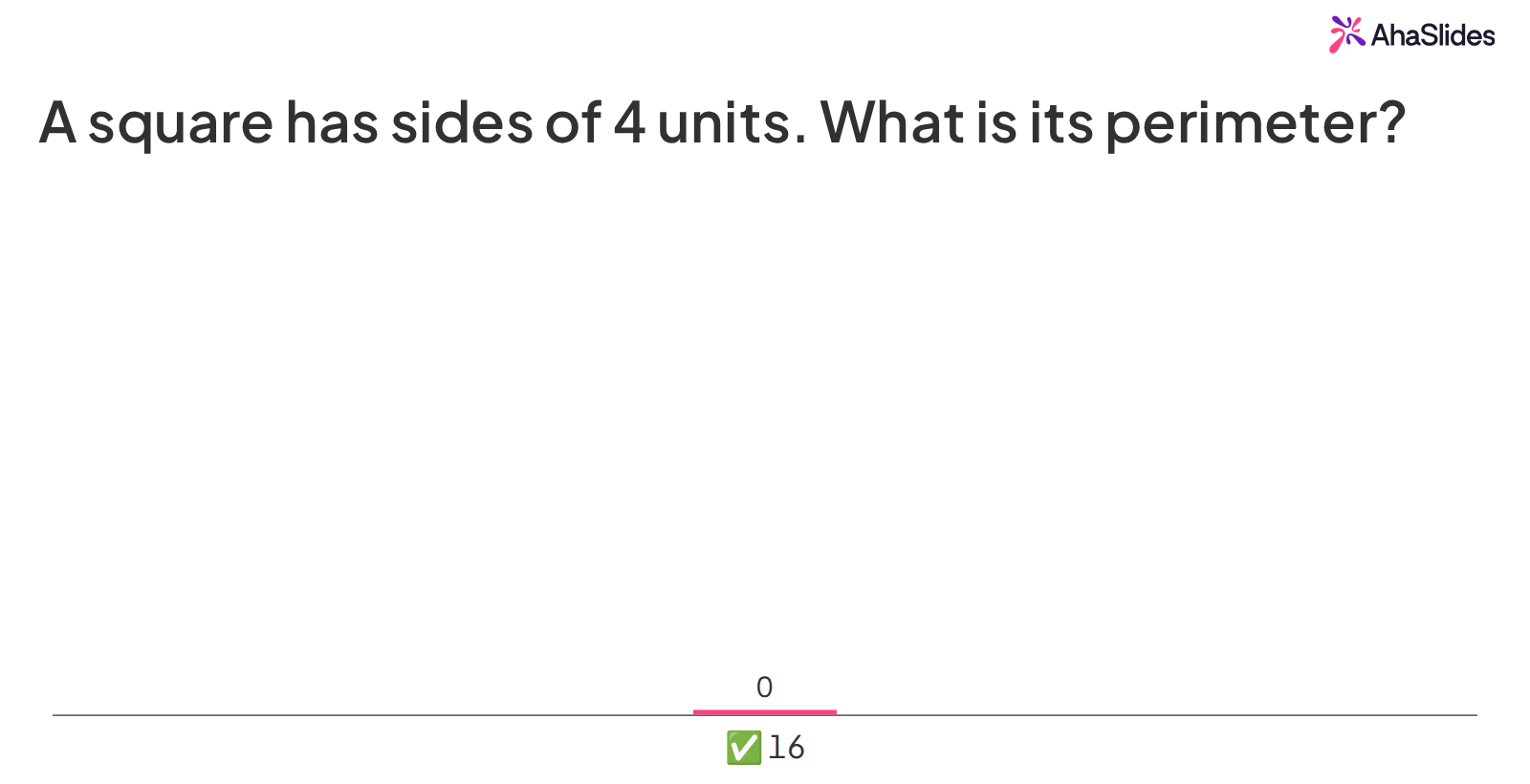
- Perimeter Calculation: What is the perimeter of a square with each side measuring 4 units?
- Weight Comparison: Which is heavier, a kilogram of feathers or a kilogram of bricks?
- Temperature Understanding: Is 40 degrees Celsius hot or cold for a day outdoors?
- Money Calculation: If you have two £5 notes, how much money do you have?
- Logical Conclusion: If every bird has wings and a penguin is a bird, does a penguin have wings?
- Size Estimation: Is a mouse bigger than an elephant?
- Speed Understanding: If you walk slowly, will you finish a race faster than if you run?
- Age Puzzle: If your brother is 5 years old today, how old will he be in two years?
- Opposite Finding: What is the opposite of ‘up’?
- Cutting a Pizza: What is the most pieces you can get from a round pizza with 4 straight cuts?
Tip for adults: after each answer, ask ‘How do you know?’ Explaining the reason is where the reasoning skill is built, not just in getting the answer right.
Answers
The answers below are in the same order as the questions.
- Pattern Identification: 10 (add 2 each time)
- Simple Arithmetic: 5 apples (3 + 2)
- Shape Recognition: 4 corners
- Basic Logic: Yes, because all cats have tails
- Fraction Understanding: 5
- Time Calculation: 3:30 PM
- Simple Deduction: 3 cookies
- Size Comparison: 1/2 is bigger than 1/4
- Counting Challenge: 7 days
- Spatial Reasoning: No, it will not hold water
- Numerical Patterns: 50 (add 10 each time)
- Logical Reasoning: Not necessarily. The ground could be wet for other reasons, such as a sprinkler
- Basic Geometry: A sphere
- Multiplication: 6 apples
- Measurement Understanding: A metre is longer
- Problem Solving: 7 sweets
- Logical Inference: Not necessarily. Other animals bark too
- Sequence Completion: Thursday
- Colour Logic: Purple
- Simple Algebra: x = 3 (2 + 3 = 5)
- Perimeter Calculation: 16 units (4 sides of 4 units each)
- Weight Comparison: They weigh the same
- Temperature Understanding: Hot
- Money Calculation: £10
- Logical Conclusion: Yes, a penguin has wings
- Size Estimation: No, an elephant is much bigger
- Speed Understanding: No, you will finish later
- Age Puzzle: 7 years old
- Opposite Finding: Down
- Cutting a Pizza: 11 pieces. Cutting through the centre every time gives only 8, but if each new cut crosses all the earlier ones at different points you can reach 11
Why two of the answers say ‘not necessarily’
Questions 12 and 17 trip up adults too. ‘If it rains, the ground gets wet; the ground is wet; so it rained’ is a classic reasoning mistake called affirming the consequent. Wet ground has other causes, such as a sprinkler (Internet Encyclopedia of Philosophy: Fallacies). ‘All dogs bark, Buddy barks, so Buddy is a dog’ has the same flaw. Compare it with question 4, where the logic does hold: all cats have tails and Whiskers is a cat, so Whiskers has a tail.
Question 30 also surprises people. The most pieces you can get from a round pizza with n straight cuts is (n² + n + 2) ÷ 2, which gives 11 for four cuts (Wolfram MathWorld: Circle Division by Lines).
Play these questions as a live quiz
If you are running these in a classroom or at a family gathering, you can build the questions as slides in AhaSlides’ quiz maker and let everyone answer on their own device. Here is how three of the questions above look when built as live slides.
Multiple choice for pattern questions
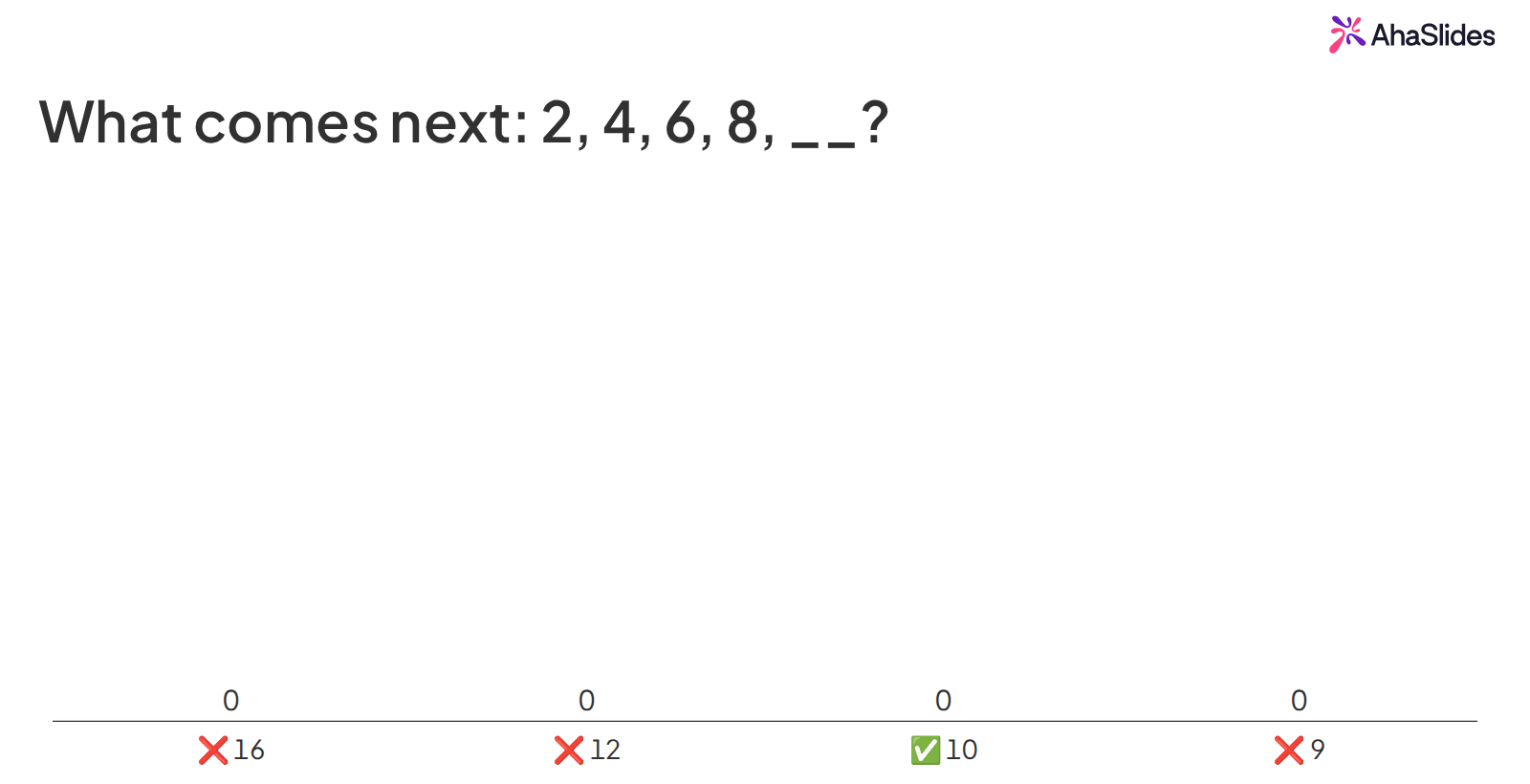
Question 1 works well as a multiple-choice slide: you type the question, add four options and tick the correct one. Include a couple of tempting wrong answers (9 and 12 here) so children have to check the pattern rather than guess.
True or false for logical conclusions
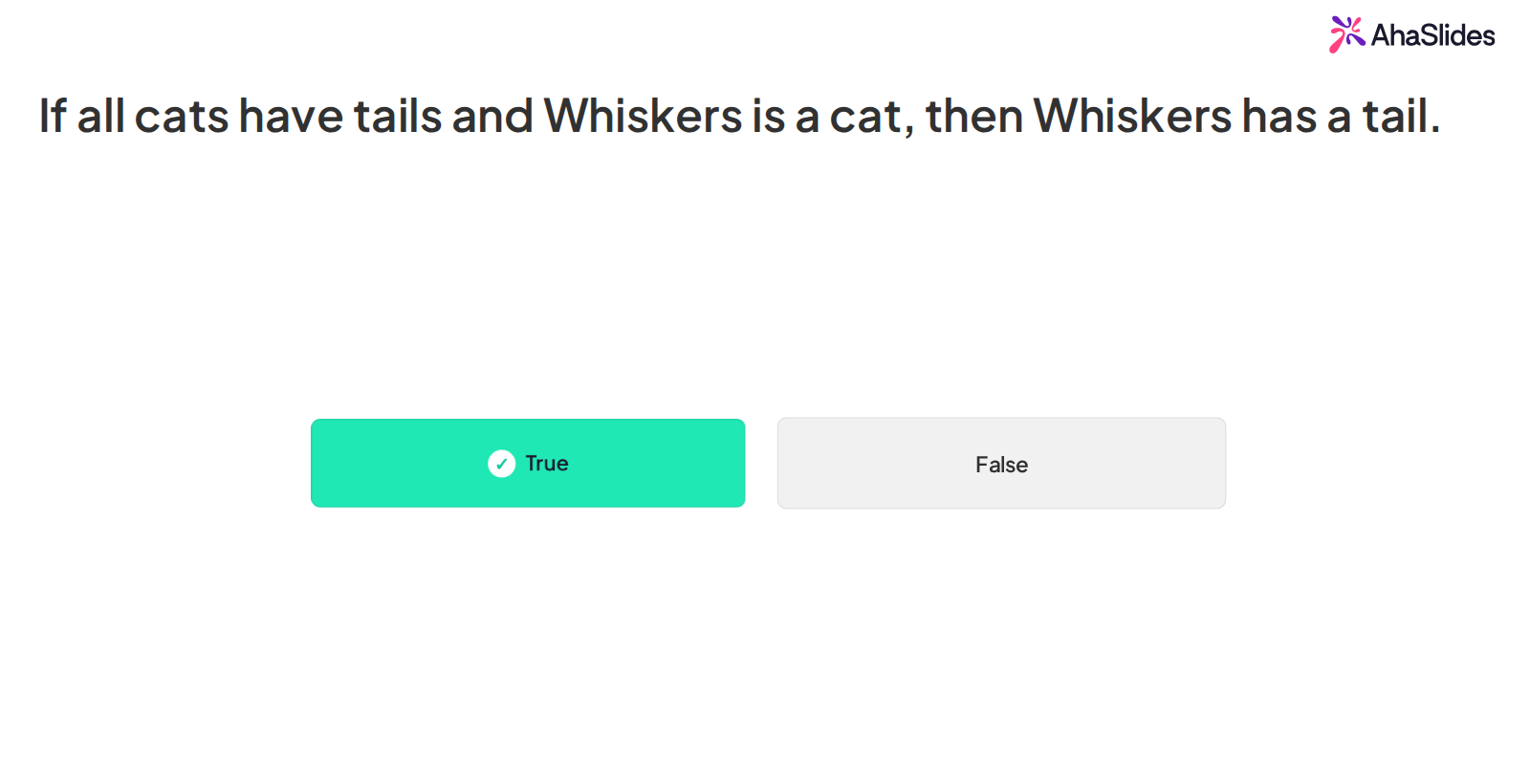
The cat and tail question (question 4) suits a True or False slide, because the claim is a single statement to accept or reject. Use the same format for the ‘not necessarily’ questions to get children debating the reasoning.
Short answer for calculation questions
For a question with one exact answer, such as the perimeter question (question 21), a short-answer slide makes players type the number themselves instead of picking from a list.
Want more kid-friendly question sets? Try our general knowledge questions for kids.
Seven kinds of mathematical reasoning
There is no single official list, but these are seven kinds of reasoning that come up again and again in primary maths and logic puzzles. This is a practical grouping, not a formal taxonomy.
- Deductive reasoning: drawing a specific conclusion from general rules (the cat and tail question).
- Inductive reasoning: making a general rule from specific examples (spotting that a sequence adds 2 each time).
- Analogical reasoning: drawing parallels between similar situations or patterns.
- Abductive reasoning: forming the best explanation for what you observe (why the ground is wet).
- Spatial reasoning: picturing and moving shapes in space (the upside-down cup, the pizza cuts).
- Temporal reasoning: working with time, order and sequences (the movie end time, the days of the week).
- Quantitative reasoning: using numbers to solve problems (money, perimeter, algebra).
To conclude
Mathematical logic and reasoning are not only about numbers and fixed rules. They are about learning to ask ‘why?’ and ‘how do you know?’, which prepares children for harder problems later. Keep the mood playful, praise the explanation as much as the answer, and move up in difficulty when they are ready.
FAQs
What are mathematical logic and mathematical reasoning?
Mathematical logic is the study of formal logical systems and how proofs are structured and conclusions drawn. Mathematical reasoning is using logic and critical thinking to solve maths problems, connect ideas and find solutions.
What is logical reasoning in maths?
It is a structured, rational process for moving from known facts to a sound conclusion. It includes spotting patterns, forming and testing hypotheses, and using methods such as deduction and induction.
What does P ∧ Q mean?
‘P ∧ Q’ is the logical conjunction of two statements and reads ‘P and Q’. It is true only when both P and Q are true; if either is false, the whole statement is false. It is the AND operation in logic.