


A good IQ-style question does something rare: it makes you feel your brain click into gear. These puzzles test the reasoning skills that intelligence assessments look at, pattern recognition, logic, verbal reasoning and number sense, but here they are for fun, not for a formal score. Treat them as brain teasers for a quiz night, a classroom warm-up or a team break, not a clinical measure of anyone's intelligence.
Below are 24 questions across four types of reasoning, starting with picture puzzles, each with the answer and a short explanation so you can see how it works. At the end, there is a simple way to run the whole set as a live quiz so a whole group can play along.
How to run these as a live group quiz
Reading answers aloud one by one loses a room fast. The questions land far better when everyone can attempt each one and see how the group did.
AhaSlides' quiz maker lets you build the questions once and run them live. Players answer on their phones, responses arrive in real time, and the results appear on screen the moment the timer closes, so you can reveal the answer and see exactly how many were caught out.
The picture questions below work particularly well this way: drop the image onto a quiz slide, and everyone is looking at the same puzzle at the same time instead of squinting at a handout.
Because the results gather in one view, you get an instant read on which questions were too easy and which split the room, useful whether you are running a lesson, a training icebreaker or a pub quiz round. You can also make it anonymous, so nobody feels put on the spot for a wrong guess.
Visual and spatial reasoning questions
These are the closest to what a real IQ test looks like. Because they are pictures rather than words, they work in any language and they are the easiest set to run with a group on screen.
1. Which tile completes the grid?
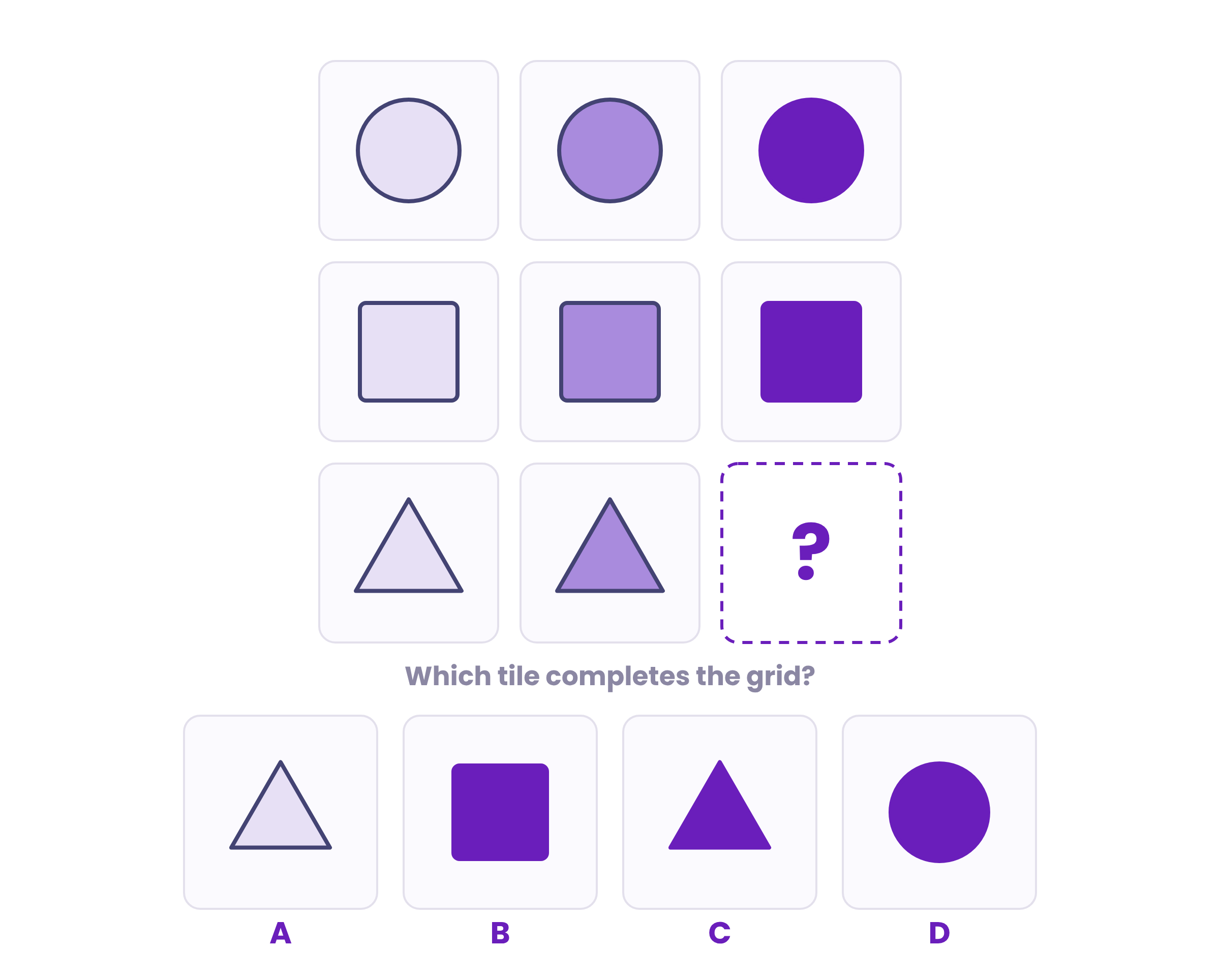
Answer: C. The rows set the shape (circles, then squares, then triangles) and the columns set the shade (lightest, mid, darkest). The missing tile sits in the triangle row and the darkest column, so it has to be a triangle in the darkest shade.
2. Which shape comes next?
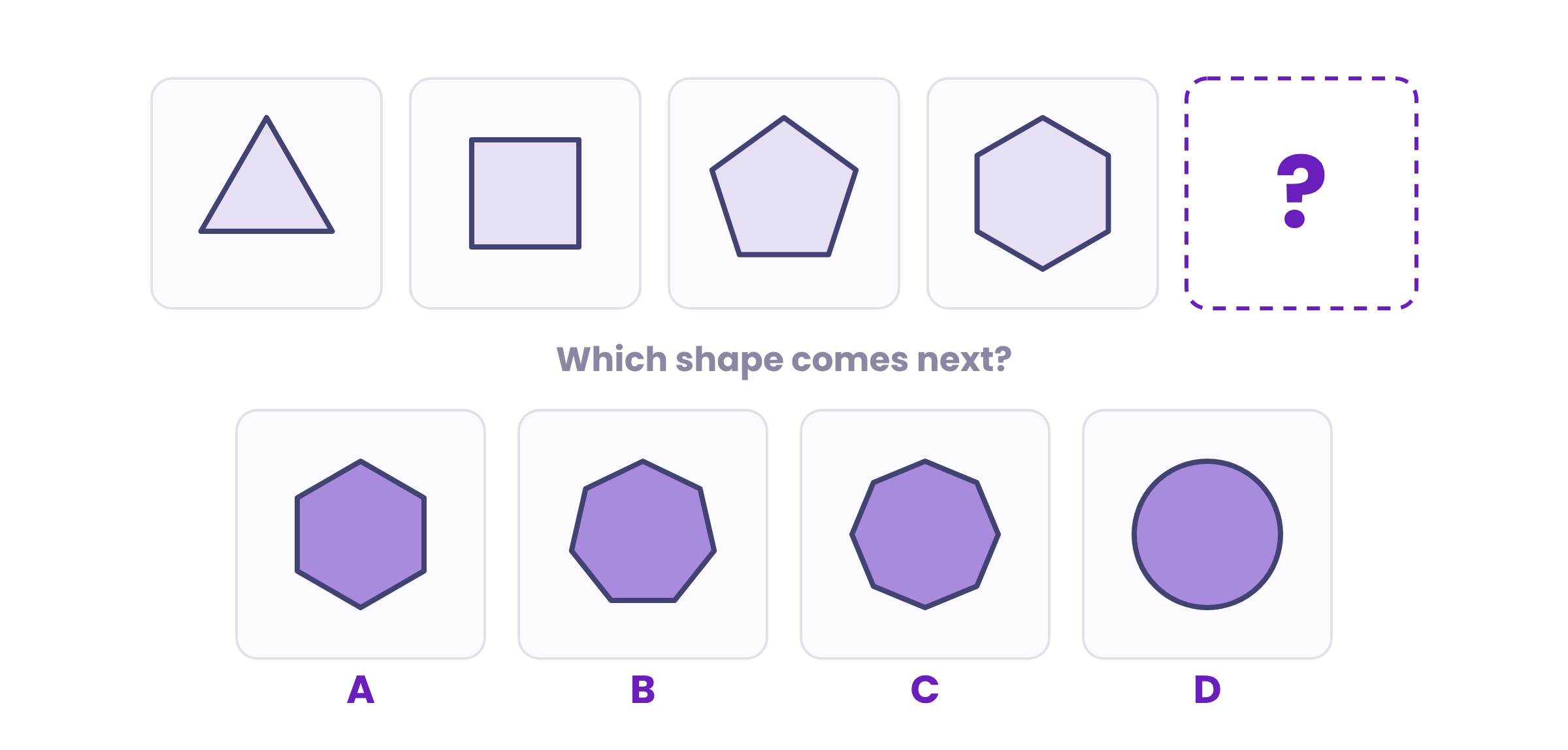
Answer: B. Each shape gains one side: triangle (3), square (4), pentagon (5), hexagon (6). Next in line is the seven-sided heptagon. The eight-sided option is the trap for anyone counting the shapes rather than the sides.
3. Three of these follow the same rule. Which one breaks it?
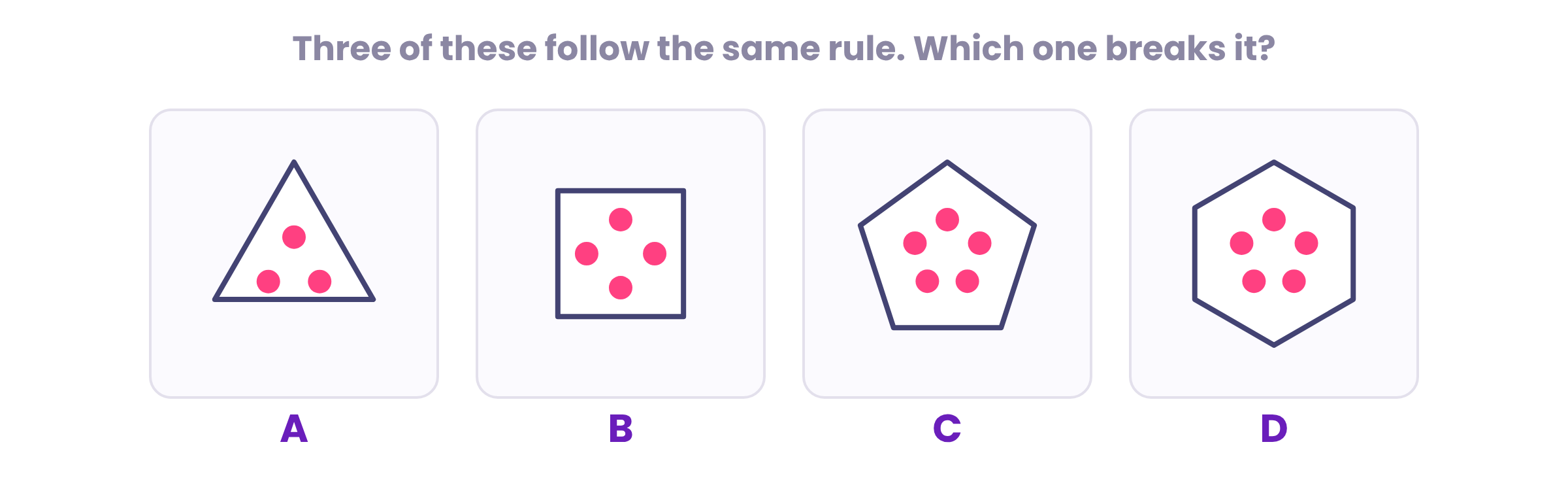
Answer: D. In every other tile the number of dots matches the number of sides: three dots in the triangle, four in the square, five in the pentagon. The hexagon has six sides but only five dots.
4. Three of the options are rotations of the shape at the top. Which one is not?
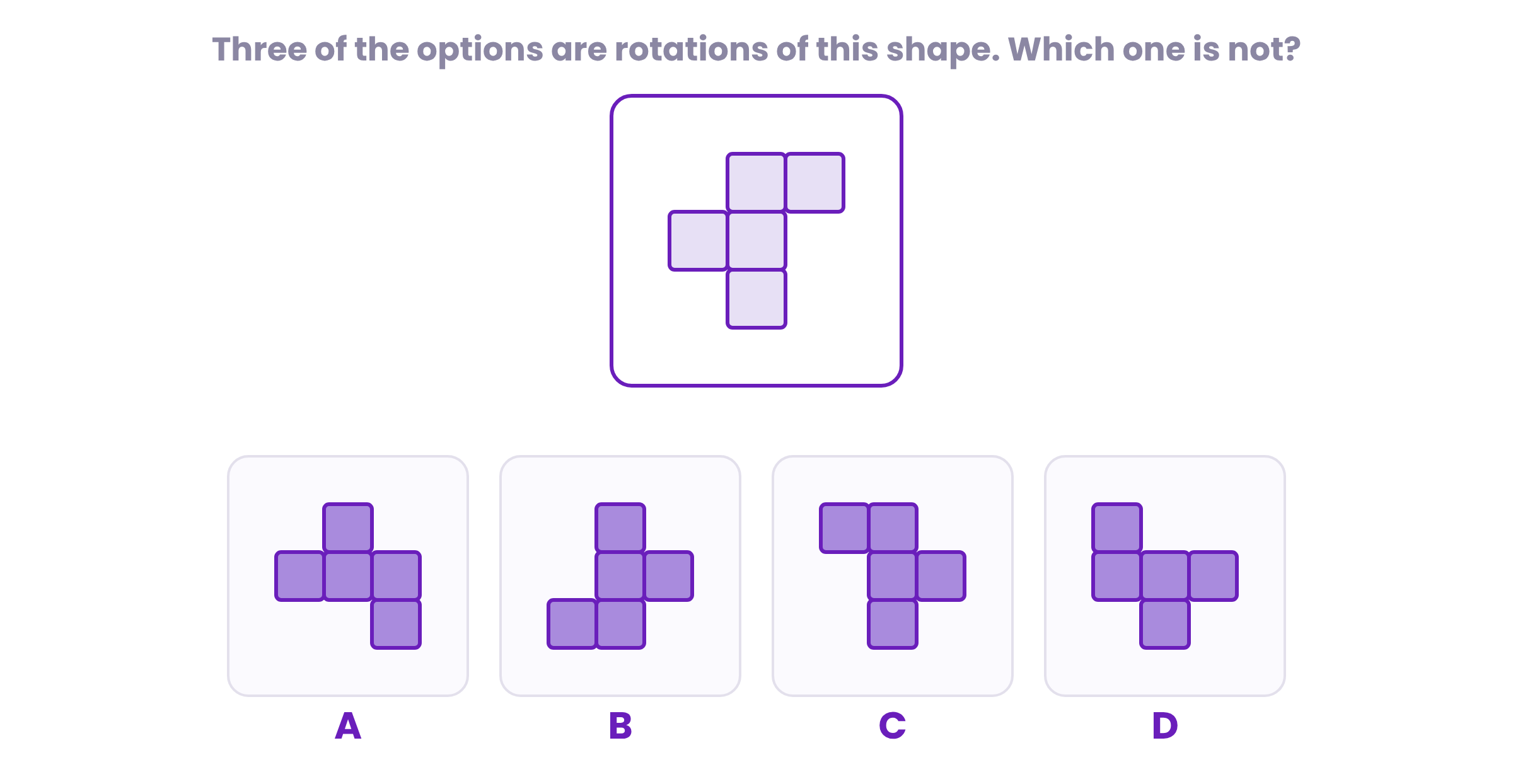
Answer: C. A, B and D are the same shape turned by 90, 180 and 270 degrees. C is a mirror image: flip it over and it matches, but no amount of turning it on the page ever will.
5. A square is folded in half, a hole is punched through both layers, then it is unfolded. Which sheet is the result?
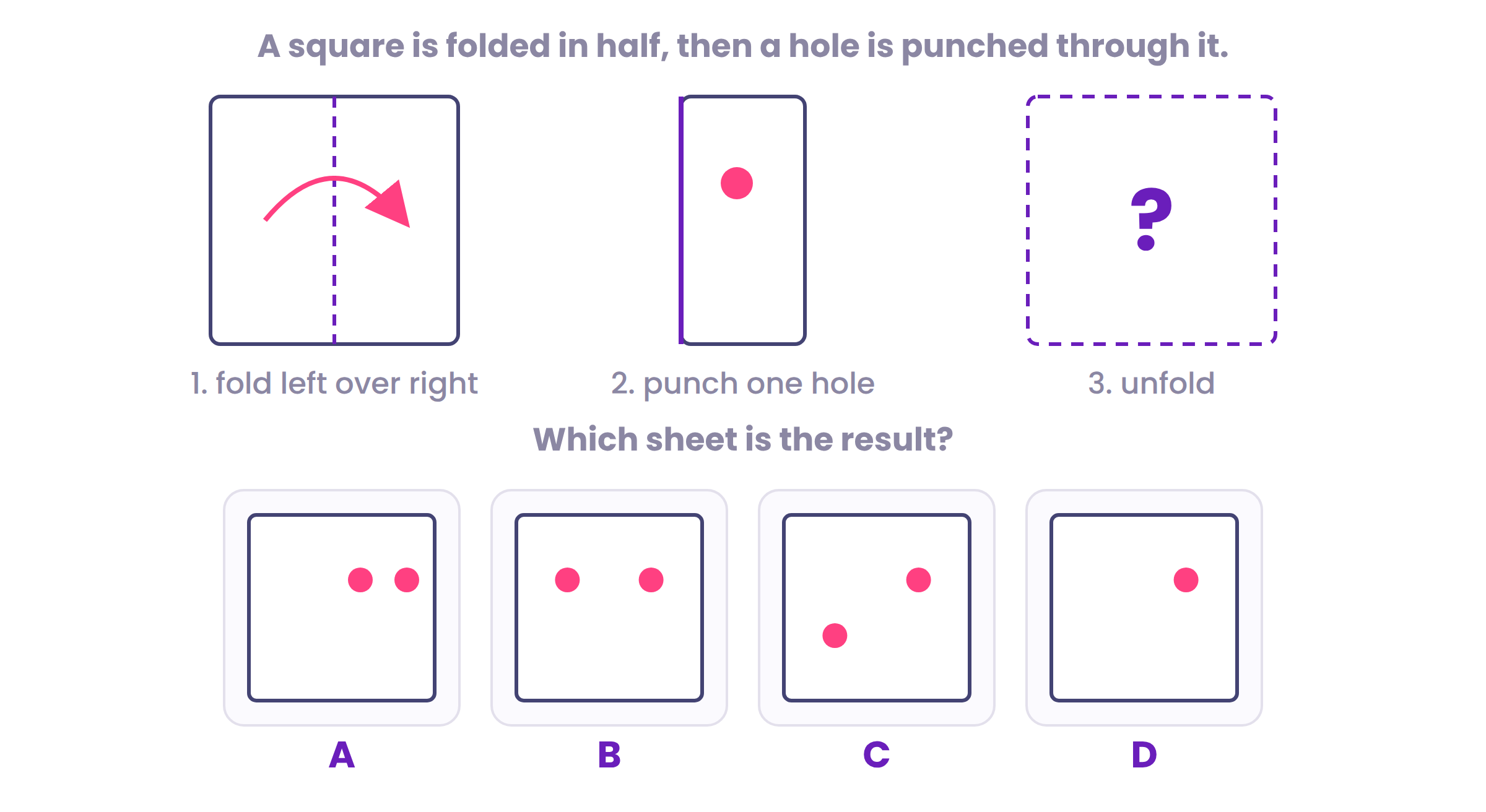
Answer: B. The punch goes through both layers, so unfolding leaves two holes at the same height, mirrored either side of the crease. A keeps both holes on one side of the fold, C drops one of them lower, and D forgets the second layer entirely.
6. The first pair are related in the same way as the second pair. Which option completes it?
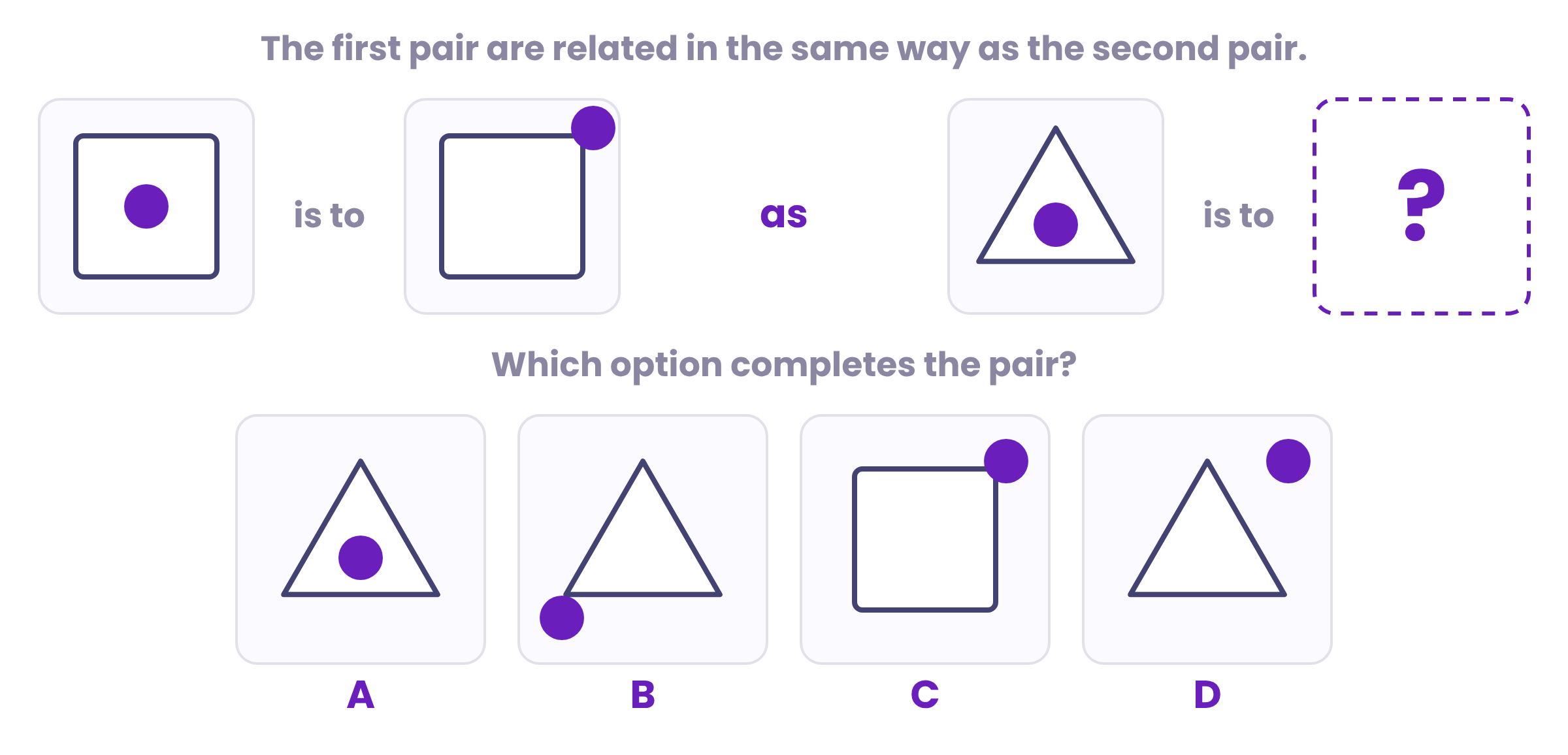
Answer: D. In the first pair the dot moves from inside the shape to just outside its top-right corner, and the shape itself does not change. Apply the same move to the triangle and the dot sits outside the triangle's top-right corner.
Logic and pattern questions
7. Which number comes next? 2, 6, 12, 20, 30, ? Answer: 42. The gaps grow by two each time (4, 6, 8, 10, 12), so 30 + 12 = 42.
8. Complete the sequence: 1, 1, 2, 3, 5, 8, ? Answer: 13. Each number is the sum of the two before it (the Fibonacci sequence): 5 + 8 = 13.
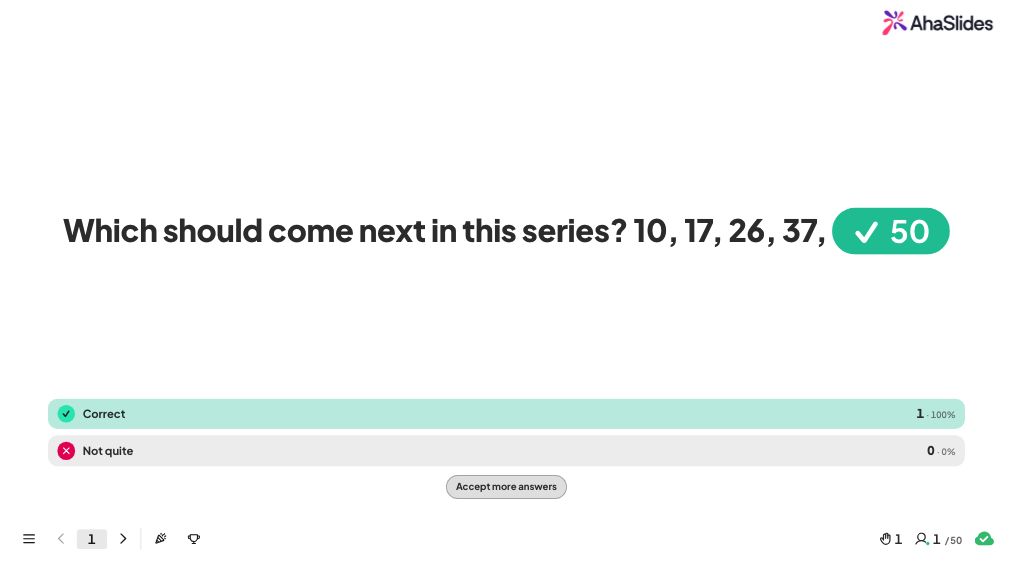
9. Which number should come next? 10, 17, 26, 37, ? Answer: 50. The differences are 7, 9, 11, 13, so 37 + 13 = 50.
10. A man points at a photo and says: "Brothers and sisters I have none, but that man's father is my father's son." Who is in the photo? Answer: His son. "My father's son" is the speaker himself, so the man's father is the speaker, making the man his son.
11. If all Bloops are Razzies, and all Razzies are Lazzies, are all Bloops definitely Lazzies? Answer: Yes. This is a chain of logic: if every Bloop is a Razzie and every Razzie is a Lazzie, then every Bloop must be a Lazzie.
12. A cube is painted red on all sides, then cut into 27 equal smaller cubes. How many small cubes have exactly one red face? Answer: 6. Only the cube in the centre of each of the six faces has a single painted side.
Verbal reasoning questions
13. FBG, GBF, HBI, IBH, ? Answer: JBK. The letters climb in pairs that swap places: F and G, then H and I, then J and K, giving JBK.
14. Which day comes next? Sunday, Monday, Wednesday, Saturday, Wednesday, ? Answer: Monday. The gap grows by one day each step: +1, +2, +3, +4, then +5. Wednesday plus five days is Monday.
15. Select the synonym for "happy": gloomy, joyful, sad, angry. Answer: Joyful. It is the only word that means the same as happy; the others are opposites.
16. Find the odd one out: square, circle, triangle, green. Answer: Green. The other three are shapes; green is a colour.
17. Poor is to rich as pauper is to ? Answer: Multi-millionaire. A pauper is at the extreme of poverty, so its opposite is the extreme of wealth, not merely "wealthy".
18. Rearrange the letters of "CIFAIPC" to name something huge. What is it? Answer: Pacific (an ocean). The seven letters spell the largest ocean on Earth.
Numerical reasoning questions
19. How many corners does a cube have? Answer: 8. A cube has eight vertices, one at each corner.
20. What is two-thirds of 192? Answer: 128. 192 divided by 3 is 64, and 64 times 2 is 128.
21. Solve: 7 × 9 − 3 × 4 + 10 Answer: 61. Do the multiplication first: 63 − 12 + 10 = 61.
22. What is 15% of 200? Answer: 30. 10% of 200 is 20, and 5% is 10, so 15% is 30.
23. How many men does it take to dig half a hole? Answer: None. There is no such thing as half a hole, a hole is a hole whatever its size.
24. Which month has 28 days? Answer: All of them. Every month has at least 28 days; the trick is that the question does not say "only" 28.
Tips for using these questions
- Open with a picture. The visual questions need no reading and no language, so they pull a mixed room in faster than a word puzzle does.
- Mix easy and hard. Follow with a couple of gentle ones (the day sequence, the synonym) so everyone gets a win before the trickier lateral-thinking puzzles.
- Reveal the reasoning, not just the answer. The explanation is where the learning happens, and it stops disputes over the trick questions.
- Keep rounds short. Six to eight questions per sitting keeps the energy up. Save the rest for next time.
Frequently asked questions
Are these real IQ test questions?
They are in the same style as the reasoning items used in intelligence assessments (visual, verbal and numerical), but this is a fun quiz, not a validated IQ test. A real IQ score comes from a standardised, professionally administered assessment.
What kinds of intelligence do IQ questions measure?
Most cover a few reasoning types: spatial and logical (patterns, matrices and sequences), verbal (word relationships and analogies), and numerical (arithmetic and number series). Together they give a rough picture of problem-solving ability.
Why do IQ tests use pictures instead of words?
Picture puzzles like matrices, mental rotation and paper folding test reasoning without depending on vocabulary, reading level or first language, so they are fairer across a mixed group. That is also why they travel so well in a quiz: nobody is disadvantaged by the wording.
How can I make an IQ quiz work for a big group?
Run it as a live quiz where everyone answers on their phone. Put each picture on screen, give the room a timer, and reveal the answer with the group's results next to it. That keeps large audiences engaged far better than reading answers aloud or passing round a printout.
Are trick questions fair in an IQ quiz?
They are fine for a fun round, as long as you flag that a section contains lateral-thinking puzzles. The "half a hole" and "28 days" style questions test how carefully you read, not raw reasoning, so mix them in rather than filling a whole quiz with them.
Ready to test your group?
These 24 questions are enough for a lively quiz round, a lesson starter or a team break. Lead with the pictures, mix in logic, verbal and numerical, reveal the reasoning behind each answer, and let people compare scores.
Build the whole quiz and collect everyone's answers live with the AhaSlides quiz maker, free to start and live in minutes.