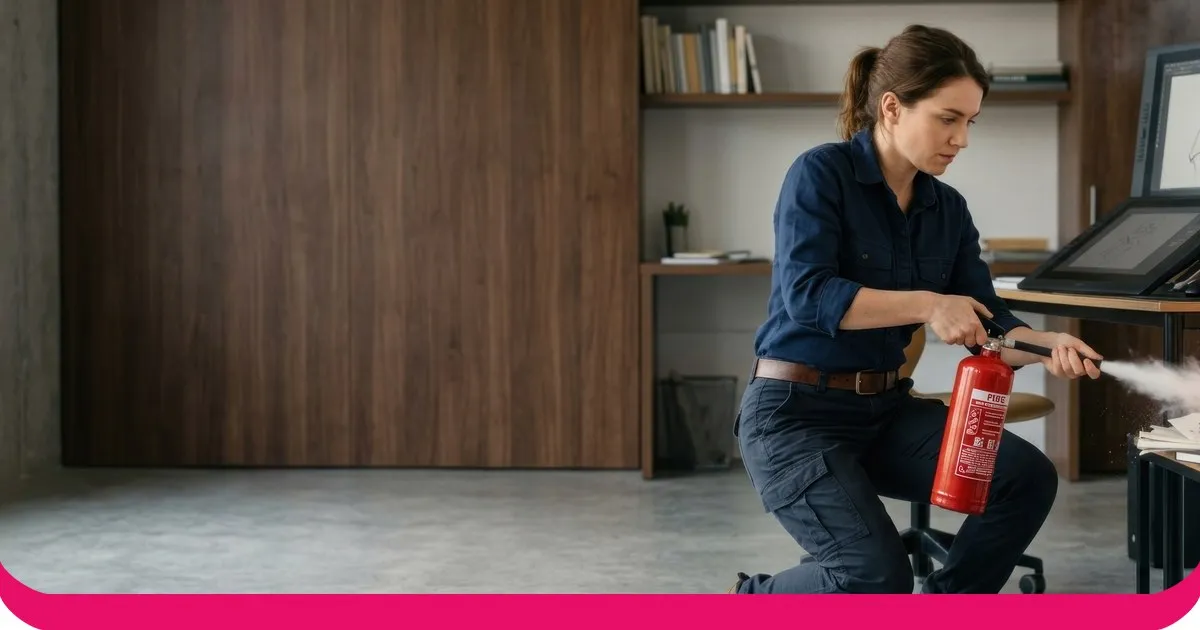
Before PASS comes a decision: should you pick up the extinguisher at all? Raise the alarm, check that the fire is small and contained, and keep your back to an exit. Only then do the four steps apply. The stakes are real: the US Fire Administration estimates 110,000 nonresidential building fires in the United States in 2023, with 130 deaths and 1,200 injuries.
This guide gives you the four PASS steps in order, five checks to run before you fight a fire, the extinguisher classes on one page, five reasons to leave instead, and a ten-minute way to refresh your team. It is for employees who may need to use an extinguisher, fire wardens, and the supervisors who brief them.
Your employer's emergency action plan decides who is expected to fight a fire at all. 29 CFR 1910.157(b) exempts an employer who has a written policy of immediate and total evacuation on the fire alarm, with no extinguishers available in the workplace, and the plan itself must set out emergency evacuation procedures under 29 CFR 1910.38. If your workplace evacuates totally, follow the plan and leave.
What does PASS stand for?
PASS is the four-step method that OSHA teaches for portable extinguishers. The wording below follows the OSHA eTool on fire extinguisher use.
| Step | What to do |
|---|---|
| Pull | Pull the pin. This also breaks the tamper seal. |
| Aim | Aim low, pointing the nozzle (or its horn or hose) at the base of the fire. |
| Squeeze | Squeeze the handle to release the extinguishing agent. |
| Sweep | Sweep from side to side at the base of the fire until it appears to be out. |
Two details trip people up. First, aim at the base of the fire, where the fuel is, not at the flames above it. Second, there is no single distance that suits every extinguisher. OSHA says to discharge within the extinguisher's effective range, so read the label on the unit nearest your desk before you need it. When the fire seems out, back away in case it flames up again.
Before you use it: fight or flee
Run these five checks, in this order, in the few seconds you have. If any answer is no, leave.
Set 1: the five checks
- The alarm is raised and people are leaving. Someone has called the fire department, or you have triggered the alarm yourself.
- The fire is small and not spreading. OSHA's fight-or-flee guidance asks whether the fire is too big. A waste bin fire is a candidate; a fire that has reached the curtains is not.
- You know what is burning. The extinguisher must match the fuel (see the classes below).
- You have the right extinguisher. Check the label for the class letters before you pull the pin.
- You have a clear exit behind you. OSHA's guidance is to identify your evacuation path first and make sure the fire, heat or smoke will not block it.
Our pick: check 5, the exit. Every other check can be wrong by a little and you can still walk away. If the fire sits between you and the door, a small mistake has nowhere to go. Stand with the exit at your back, always.
OSHA's fight-or-flee guidance frames the same decision as a short risk assessment: is the fire too big, is the air safe to breathe, is the environment too hot or smoky, and is there a safe evacuation path? A "no" to the last one, or a "yes" to any of the first three, means leave.
Extinguisher classes at a glance
Using the wrong extinguisher can make things worse. This table follows OSHA's extinguisher basics page.
Set 2: the five classes
| Class | Covers | Workplace example |
|---|---|---|
| A | Paper, cloth, wood, rubber and many plastics | A bin of paper in an office |
| B | Oils, gasoline, some paints, lacquers, grease and solvents | A spill of solvent in a workshop |
| C | Wiring, fuse boxes, energised electrical equipment, computers | A fuse box or a server cabinet |
| D | Powders, flakes or shavings of combustible metals such as magnesium | Metal machining swarf |
| K | Combustible cooking fluids such as oils and fats | A kitchen fryer |
An ABC extinguisher is one rated for all three of the most common classes. OSHA notes that multipurpose dry chemical is suitable for class A, B and C fires.
Two warnings to teach explicitly. Water extinguishers are for class A fires. Do not use water on a flammable-liquid fire or an electrical fire. Class K extinguishers belong to kitchens, and OSHA says to use them only after a built-in hood suppression system has activated.
Our pick: class K. It is the class most people have never seen up close, and it matters wherever there is a fryer. Make sure kitchen staff know it is a different extinguisher from the one in the corridor.
When to evacuate instead
Fighting a fire is a choice, never a duty you owe the building. The same USFA figure of 110,000 nonresidential fires in 2023 shows why. Leave straight away when any of these is true.
Set 3: five reasons to leave
- Smoke is filling the room. If the air is not safe to breathe, you cannot fight the fire.
- The fire has spread past where it started. OSHA says to evacuate if the fire grows beyond the incipient, or early, stage.
- The extinguisher is empty and the fire is not out. Leave rather than go looking for another unit.
- You have not been trained. OSHA's advice is blunt: if you have the slightest doubt about your ability to fight a fire, evacuate immediately.
- The fire is between you and the exit. This is the failure of check 5 above, and it ends the decision.
Our pick: reason 4, no training. An untrained person with an extinguisher is a second casualty waiting to happen. Calling for help and getting others out is a full and respectable response.
What does the law say about training?
Under 29 CFR 1910.157(g), where an employer has provided portable fire extinguishers for employee use, the employer must provide an educational program on the general principles of extinguisher use and the hazards of incipient stage firefighting, "upon initial employment and at least annually thereafter". Employees designated to use fire fighting equipment as part of an emergency action plan must also be trained in the use of the appropriate equipment, on initial assignment and at least annually. Your employer's plan decides which group you are in.
Ways to host a 10-minute refresher
A short, live refresher is easier to repeat every year than a long course. Here is a ten-minute format with AhaSlides that fits into a team meeting or a fire warden briefing.
- Pick Answer: put the four PASS steps in order. Show the steps scrambled and ask the room to pick the right sequence.
- Pick Answer: which class for a kitchen fryer fire? The answer is class K, and the follow-up is why water is the wrong answer.
- Word Cloud: "What is near your nearest extinguisher?" The cloud shows blocked access, such as boxes, coats and a closed door, which is a finding in itself.
- Rating Scale: how confident would you be using one today? Ask people to rate from 1 to 5. A cluster of low scores tells you who needs hands-on practice.
- Open Ended: one question for the fire warden. Collect the questions anonymously and answer the top three out loud.
An online refresher covers the knowledge, not the skill. A hands-on practical with a live extinguisher is still needed for employees who are expected to use one. If you want a ready-made classroom portion, the Fire extinguisher awareness course template gives you the structure to adapt.
Frequently asked questions
What does PASS stand for?
Pull, Aim, Squeeze, Sweep. Pull the pin, aim at the base of the fire, squeeze the handle, then sweep from side to side.
Where do you aim a fire extinguisher?
At the base of the fire, not the flames. The fuel is at the base, and that is where the agent needs to land.
How often is fire extinguisher training required?
At hire and at least annually, where the employer provides extinguishers for employee use, under 29 CFR 1910.157(g). Employees designated to use firefighting equipment also need equipment training on assignment and at least annually.
Can you use a water extinguisher on an electrical fire?
No. Water on energised electrical equipment risks electric shock. Use a class C or ABC extinguisher.
What is an ABC extinguisher?
One rated for ordinary combustibles (A), flammable liquids (B) and energised electrical equipment (C). It uses multipurpose dry chemical, so one unit covers all three classes.
Where to start
Walk to your nearest extinguisher today. Read its label for the class letters, check the pin is in place, and note your exit. Then run the five-question refresher with your team. For more topics to cover at the same meeting, see our list of workplace safety topics for toolbox talks and safety meetings.
This post is general information, not legal advice. For a decision about your own workplace, speak to a qualified safety professional or the regulator.