

Multiple-choice questions have served you well, but relying on them for every round gets stale fast. The good news: AhaSlides supports nine distinct quiz formats, each suited to a different audience, setting, or learning goal. This guide breaks down each type with real examples, best use cases, and practical tips so you can pick the right format before you build your next quiz.
1. Open-ended
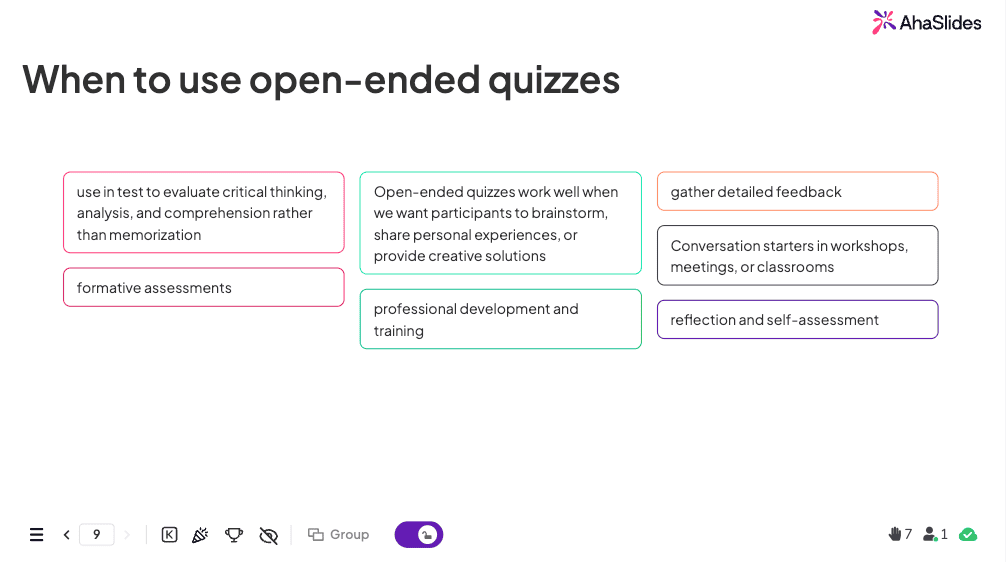
Open-ended questions let participants write any answer they choose. There is no fixed list of options, which means the format rewards genuine knowledge and surfaces ideas you might not have anticipated.
Best use cases: Knowledge checks in classrooms, brainstorming sessions in workshops, team-building events where creative or funny answers are welcome.
Example question: "Name one invention from the 1800s that changed how people communicate."
In AhaSlides, the open-ended quiz slide collects typed responses directly from participants' phones. Once 10 or more responses come in, use the Group function to cluster similar answers together, which is especially useful in training sessions where you want to surface common misconceptions.
Tips:
Keep the question specific enough that there is a defensible correct answer, or set clear judging criteria upfront.
Combine open-ended rounds with faster formats like multiple choice to maintain energy throughout a longer quiz.
Use the grouping feature to facilitate discussion rather than reveal a single answer.
2. Multiple choice
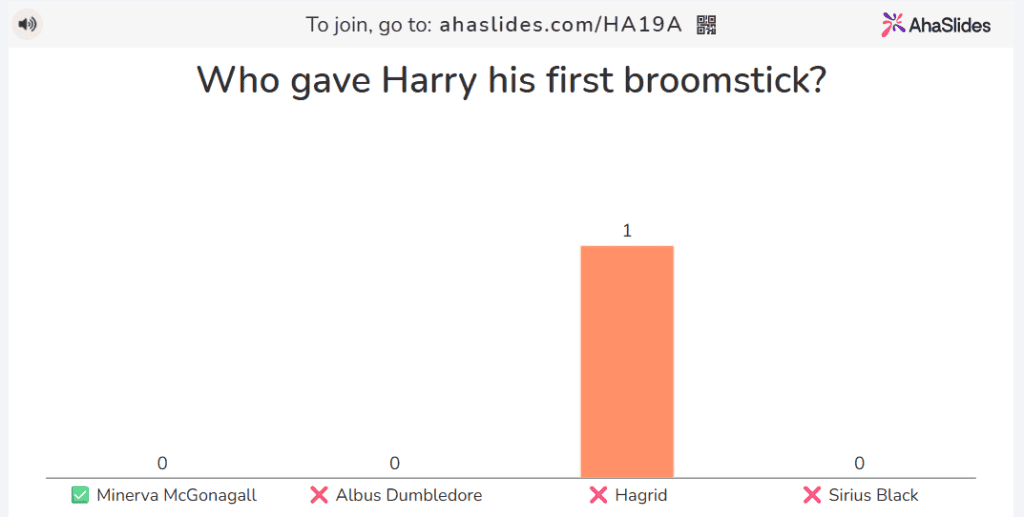
Multiple-choice questions present a statement or question alongside two or more answer options, and participants select the correct one. It is the most familiar quiz format for a reason: it is fast to run, easy to score automatically, and works with groups of any size.
Best use cases: Corporate training assessments, classroom formative checks, pub quiz warm-up rounds, any situation where you need a quick pulse on group knowledge.
Example question: "Which planet has the most moons?" with options: Earth, Jupiter, Saturn, Mars.
What separates a good multiple-choice round from a forgettable one is the quality of the wrong options, called distractors. Plausible distractors slow down confident participants and give less confident ones a fighting chance.
Tips:
Include at least one distractor that is commonly confused with the correct answer (for example, Saturn instead of Jupiter when both have many moons).
Avoid answer options like "all of the above" or "none of the above," which telegraph the answer.
Limit rounds to 8 to 10 questions if this is the only format you are using, or the pace becomes predictable.
3. Categorize
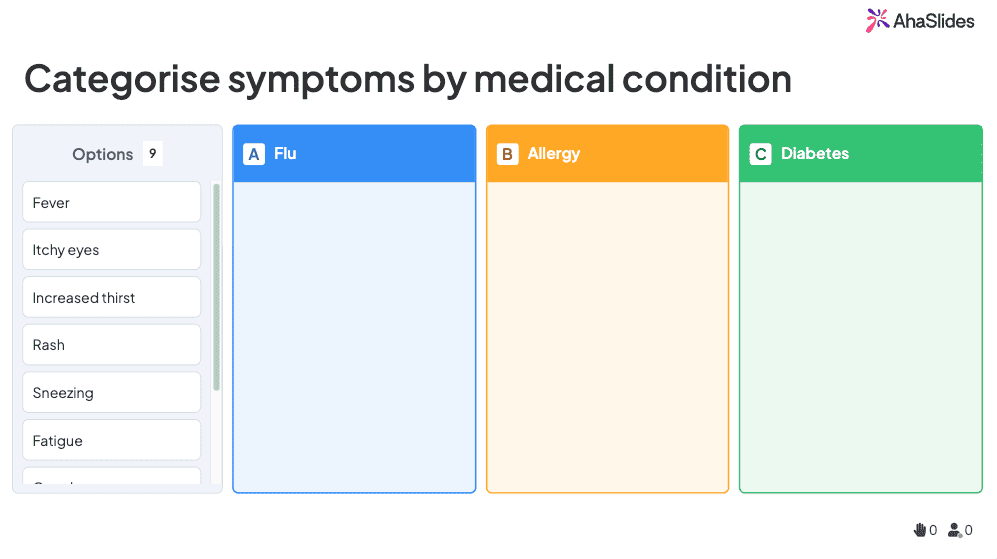
Categorize questions ask participants to sort a set of items into the correct groups. Instead of recalling a single fact, participants must understand how concepts relate to each other, which tests deeper comprehension.
Best use cases: Language learning classes, science or biology lessons, employee onboarding sessions, business training on frameworks or taxonomies.
Example question: Sort these words into the correct column: "run, happiness, quickly, dog, beautiful, jump." Columns: Noun, Verb, Adjective, Adverb.
This format is particularly effective in corporate settings. A new-hire onboarding quiz might ask employees to sort company expenses into "Capital costs" vs. "Operational costs," which reinforces policy without a lecture.
Tips:
Keep the number of categories to three or four maximum. More than that becomes visually cluttered on a phone screen.
Make sure at least one item in the set is genuinely ambiguous to provoke discussion after the reveal.
Follow up a categorize round with a short open-ended question asking participants to explain their reasoning on the tricky item.
4. Match the pairs
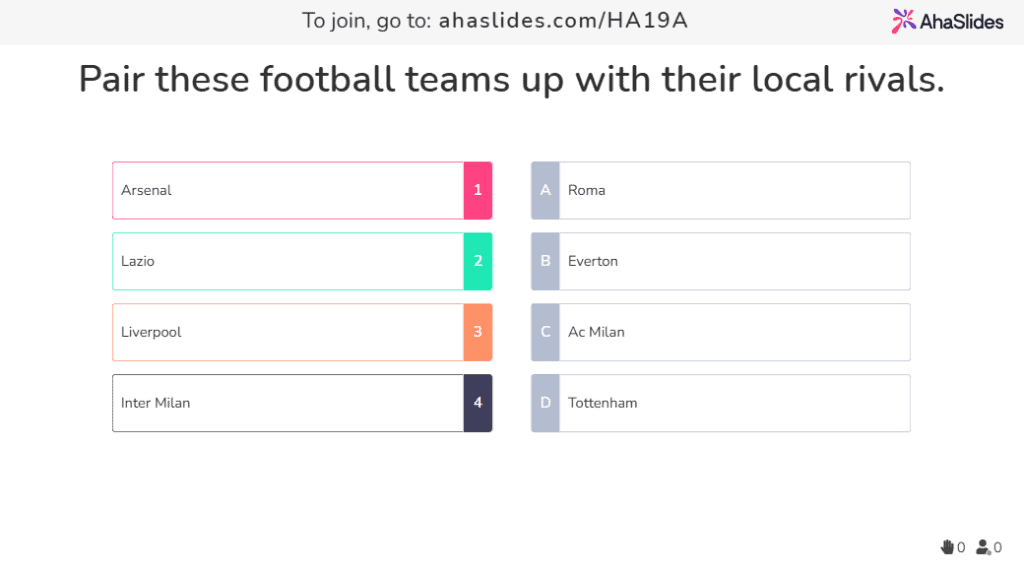
Match the pairs presents two parallel lists: a set of prompts on one side and a set of answers on the other. Participants drag or select to connect each prompt with its correct answer.
Best use cases: Vocabulary building in language classes, pairing scientific terms with definitions, matching historical figures to their achievements, connecting product features to their benefits in sales training.
Example question: Match each capital city to its country: Oslo / Norway, Lisbon / Portugal, Zagreb / Croatia, Tallinn / Estonia.
A matching pairs round covers a lot of factual ground quickly. In a 90-minute language lesson, you can test 10 vocabulary words in the time it would take a traditional worksheet to cover three.
Tips:
Use four to six pairs per question. Fewer than four is trivial; more than six overwhelms the screen layout.
Include one or two pairs where the prompt and answer share a word root or sound similar, which is a common source of productive errors in language learning.
In competitive quiz nights, award partial points so participants are not penalized for getting nine out of ten pairs correct.
5. Fill-in-the-blank
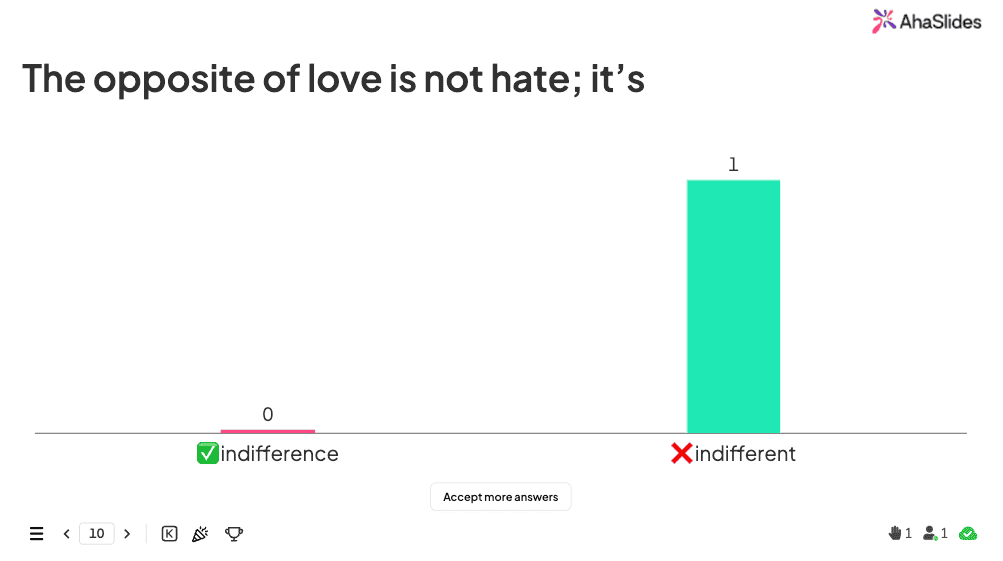
Fill-in-the-blank questions give participants a sentence or phrase with one or more words removed, and they type the missing word(s). In AhaSlides, this format is called "Short answer." You set the correct answer and any accepted variants, and the system scores responses automatically.
Best use cases: Song lyric rounds in pub quizzes, movie quote rounds, testing precise terminology in technical training, spelling checks in language lessons.
Example question: "In the 1994 film Forrest Gump, the main character says: 'Life is like a box of _.'"
This format works especially well for entertainment rounds because song lyrics and film quotes have a single definitive answer. Participants either know it or they do not, which creates genuine suspense before the reveal.
Tips:
For quiz nights, use a short excerpt rather than the full sentence so participants cannot work backward from context clues.
Add common alternate spellings or abbreviations as accepted answers to avoid unfair scoring (for example, "gonna" and "going to" if the lyric is informal).
In educational settings, remove a key technical term rather than a filler word, so the blank tests the concept, not recall of sentence structure.
6. Audio quiz
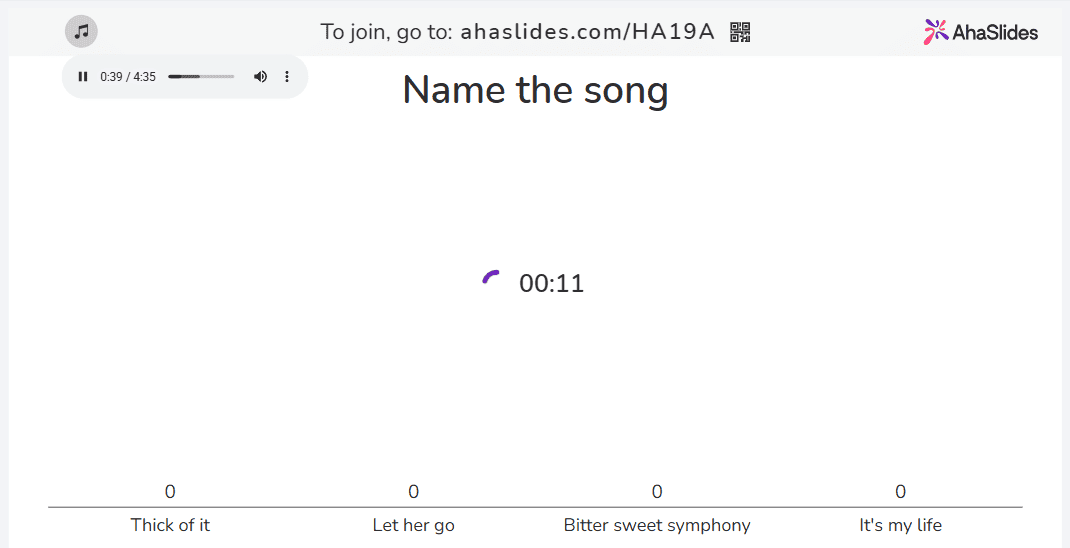
Audio questions play a sound clip and ask participants to identify something about it: the song title, the artist, the language being spoken, or the sound itself. Paired with a multiple-choice slide in AhaSlides, the audio clip plays automatically when the question opens.
Best use cases: Music rounds in pub quizzes, language lessons where listening comprehension matters, team-building events where pop culture knowledge is the hook.
Example question: Play 10 seconds of a song and ask: "Name this artist." Options: Billie Eilish, Olivia Rodrigo, Dua Lipa, Taylor Swift.
You are not limited to music. Here are three creative ways to use audio questions:
Celebrity impressions: Play an audio impression and ask participants to name who is being impersonated, with a bonus point for naming the impersonator.
Language listening round: Ask a question in English, play the answer spoken in the target language, and have participants choose the correct written translation.
What's that sound?: Play an everyday sound, an animal call, or a mechanical noise and ask participants to identify the source.
Tips:
Keep audio clips to 10 to 15 seconds. Longer clips drag the pace and give too much information away.
Test your audio level before the event. A clip that is too quiet kills the atmosphere; one that is too loud is jarring.
Use audio as the second or third round in a quiz, not the opener, so participants are settled and paying attention.
7. Odd one out
Odd-one-out questions present a set of four or five items and ask participants to identify which one does not belong. The catch is that the connection between the other items should be specific enough to rule out multiple interpretations.
Best use cases: General knowledge pub quiz rounds, critical thinking exercises in classrooms, team warm-ups that reward lateral thinking over rote memorization.
Example question: "Which does not belong: Batman, Wonder Woman, Spider-Man, Superman?" Answer: Spider-Man (he belongs to the MCU; the others are DC characters).
The format rewards participants who notice subtle patterns rather than those who know the most facts. A confident team that rushes past the nuance often gets it wrong, while a thoughtful team that looks twice gets it right.
Tips:
The connection between the correct group must be specific and defensible. Avoid setups where multiple items could plausibly be the odd one out.
After the reveal, briefly explain the connection. The explanation is often the most memorable moment of the round.
Do not use this format more than twice per quiz or it becomes formulaic.
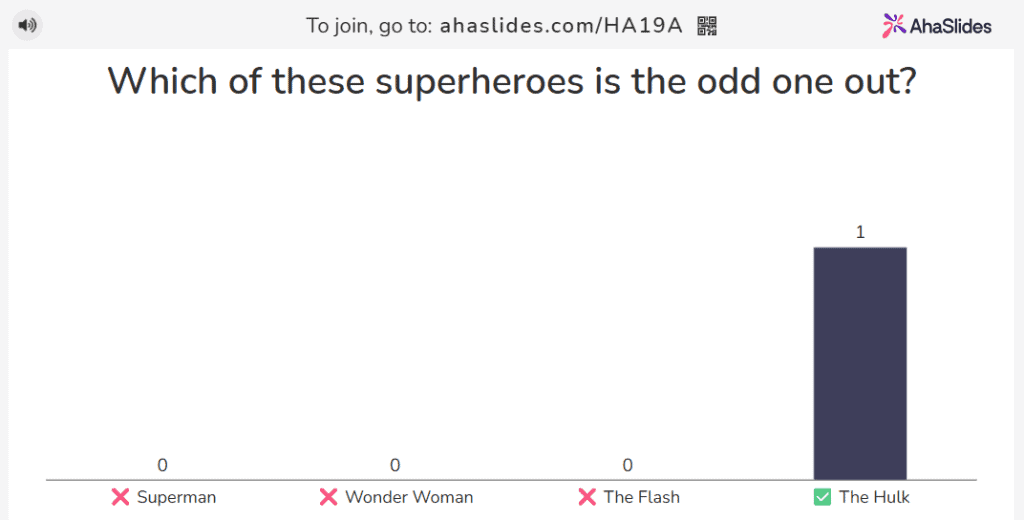
p/s: Spider-Man belongs to the MCU while the other heroes belong to DC.
8. Correct order
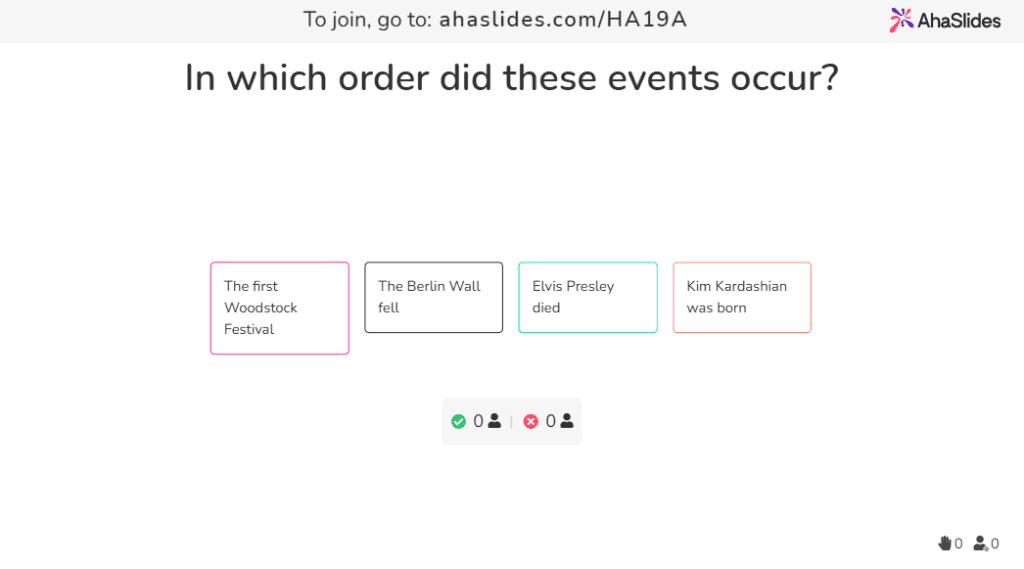
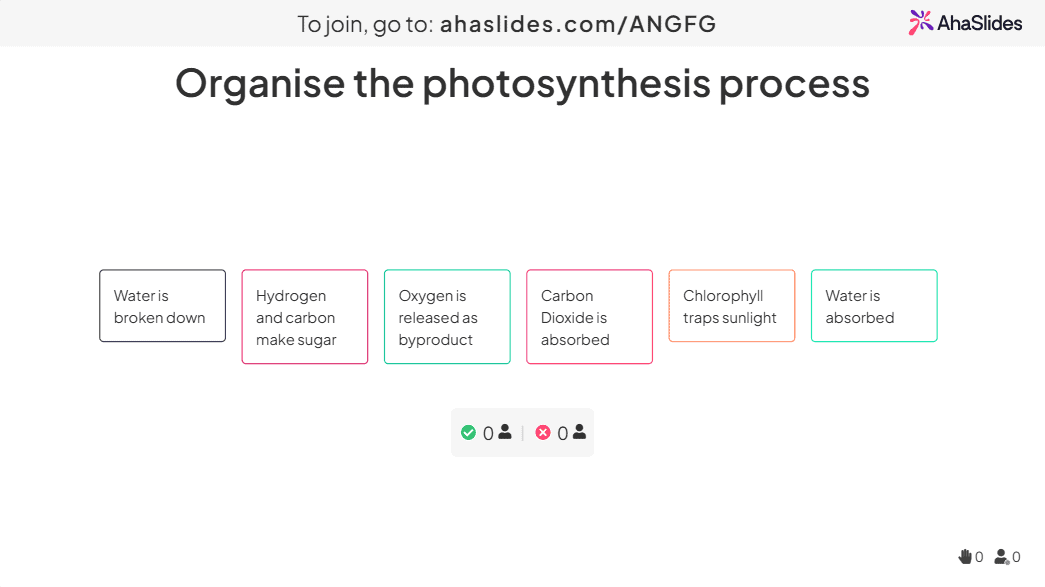
Correct-order questions present a jumbled list of events, steps, or items and ask participants to arrange them in the right sequence. It tests both knowledge and logic because even partial knowledge lets participants eliminate impossible orderings and work toward the right answer.
Best use cases: History rounds in pub quizzes, science lessons covering processes (mitosis, the water cycle), language rounds where sentence word order matters, onboarding quizzes that test the steps of a workflow.
Example question: "Put these moon landings in chronological order: Apollo 17, Apollo 11, Apollo 14, Apollo 12."
The format naturally generates table discussion. Teams will debate, negotiate, and reason through the sequence together, which makes it one of the most socially engaging question types in a group setting.
Tips:
Use four to six items. Fewer than four makes it too easy; more than six means participants spend more time scrolling than thinking.
Choose sequences where the order is genuinely surprising at one or two points, for example, a historical event that happened earlier than most people assume.
In classroom settings, follow up with a question asking students to explain why a specific step must come before another, which converts recall into reasoning.
9. True or false
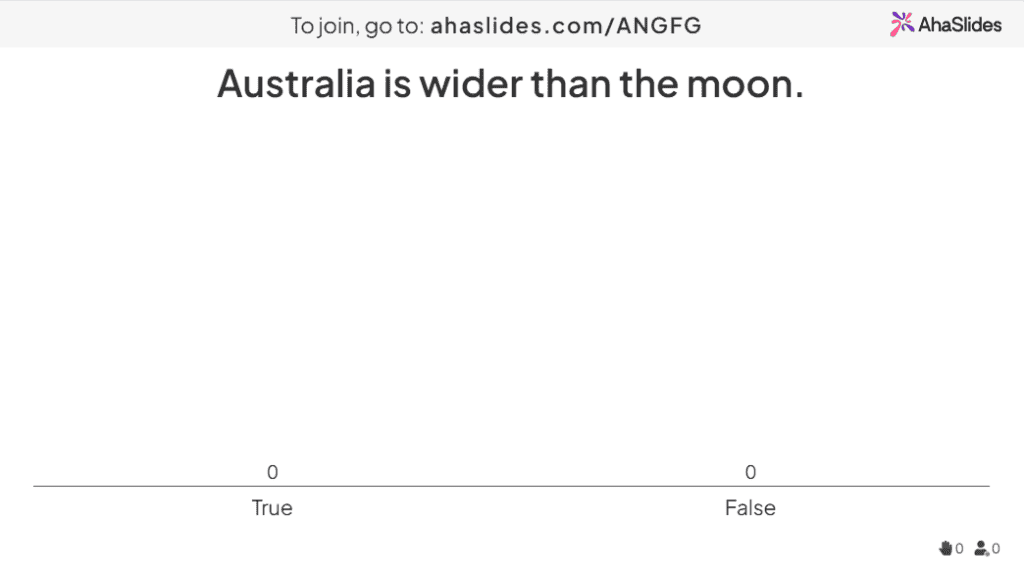
True or false quizzes are the simplest format on this list, and that is exactly what makes them effective. You state a claim and participants decide whether it is correct. No options to weigh, no lists to sort, a binary decision.
Best use cases: Icebreakers at the start of a quiz or meeting, tie-breaker rounds, fast-paced mid-quiz resets when energy dips, low-stakes classroom warm-ups.
Example question: "True or false: A group of flamingos is called a flamboyance." (True.)
The craft is in writing statements that sound plausible either way. Common misconceptions and surprising-but-true facts work best. "Goldfish have a three-second memory" is a classic example: most people believe it, and it is false.
Tips:
Avoid patterns. If every counterintuitive-sounding statement in your set turns out to be true, participants will spot the pattern and guess correctly without thinking.
Mix crowd-pleasing trivia (celebrity facts, pop culture) with genuinely informative claims (scientific myths, historical corrections) to appeal to different types of participants.
True or false rounds work well as the final round of a quiz: they are fast, the stakes feel low, and a surprising fact at the end sends participants away with something to talk about.
Choosing the right quiz type for your situation
Not every format suits every setting. Here is a quick reference:
| Your situation | Best quiz type(s) |
|---|---|
| Large group, limited time | Multiple choice, true or false |
| Classroom comprehension check | Open-ended, fill-in-the-blank, categorize |
| Pub quiz night | Audio, odd one out, correct order |
| Team-building or icebreaker | True or false, odd one out |
| Language learning | Match the pairs, fill-in-the-blank, audio |
| Training and onboarding | Categorize, correct order, multiple choice |
The most engaging quizzes mix three or four formats across different rounds. A pub quiz night that opens with multiple choice, builds into an audio round, and closes with a correct-order history challenge covers three distinct cognitive experiences, and participants leave having genuinely enjoyed it.
Ready to build your next quiz? Try AhaSlides free and create your first interactive quiz in minutes.