Most people at work are not electricians, but they plug things in, work under power lines and stack boxes in front of panels every day. That matters: the Electrical Safety Foundation International (ESFI) analysed OSHA fatality reports from 2011 to 2024 and found that contact with overhead power lines caused 57% of the electrical deaths among workers in non-electrical jobs. In many overhead line deaths, ESFI says, the line was clearly visible.
OSHA splits workers into two groups. A qualified person has been trained in, and has shown skills and knowledge of, the construction and operation of electrical equipment and the hazards involved. Everyone else is unqualified, and OSHA 1910.332 still expects those who face a risk of electric shock to be trained in the safety practices their job needs.
This post is for that second group. It gives 15 electrical safety tips in 3 sets of 5: everyday hazards, safe habits and when to stop. None of them involves repairing anything. Each set has an Our pick, the tip we would brief first. The rules quoted are US (OSHA), so check your own regulator's rules if you work elsewhere.
Round 1: Everyday hazards
Set 1: What to look for
- Damaged cords and plugs. OSHA 1910.334 says portable equipment and extension cords must be checked before use on each shift for loose parts, deformed or missing pins and damaged insulation. Anything damaged comes out of service until a qualified person has repaired and tested it.
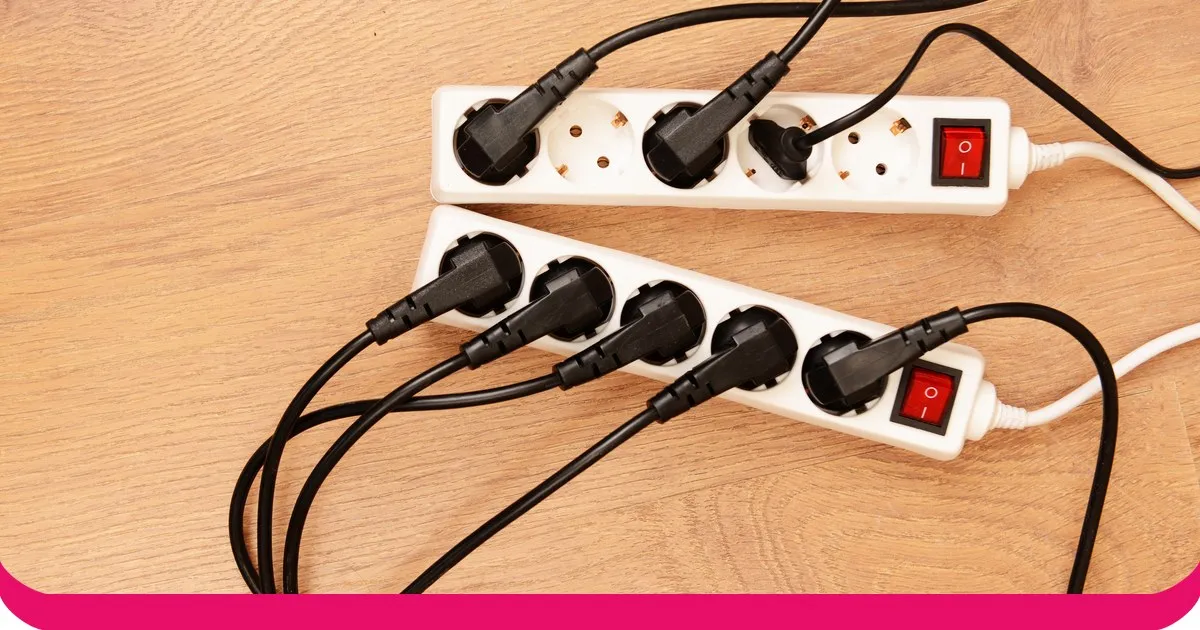
- Overloaded sockets. The Canadian Centre for Occupational Health and Safety (CCOHS) calls them "octopus connections": several items or several extension cords in one socket. Spread the load or ask for another socket.
- Power strips plugged into power strips. In a 2002 interpretation, OSHA notes that the UL listing says power strips go straight into a permanent socket, not into another strip or an extension cord. OSHA requires equipment to be used as its listing says.
- Water near equipment. CCOHS says the risk of shock is greater in wet or damp areas. 1910.334 says your hands must not be wet when you plug in or unplug live equipment.
- Blocked electrical panels. OSHA 1910.303 says the working space in front of electrical equipment "may not be used for storage". For equipment up to 150 volts to ground, Table S-1 sets a minimum depth of 0.9 m (3 ft), and the space must be at least 762 mm (30 in) wide or the width of the equipment, whichever is greater.
Our pick: tip 5, blocked panels. Nobody thinks a pallet is an electrical hazard. But if a fault starts, the person sent to switch off the power has to reach the panel first.
Round 2: Safe habits
Set 2: Every day, every shift
- Inspect before you use. Make the 1910.334 check a habit: look along the cord and at the plug before you switch on, not after something smells wrong.
- Unplug by the plug. CCOHS says pulling or jerking the cord wears it and may cause a shock. OSHA adds that cords may not be used to raise or lower equipment.
- Use ground-fault protection where it is provided. A GFCI (ground-fault circuit interrupter, the socket or adaptor with test and reset buttons) cuts the power when current leaks. CCOHS says to use GFCI protection in wet or damp locations, and ESFI says it should be installed wherever electricity and water may come into contact. Never bypass one.
- Keep clear of overhead lines. OSHA 1910.333 says unqualified workers, and the longest conductive object they may contact, must stay at least 10 ft (305 cm) from unguarded, energised overhead lines of 50 kV or below. Remember the ESFI figure above: overhead lines caused 57% of electrical deaths in non-electrical jobs. Look up before you raise a ladder, pole or tipper.
- Respect every lock and tag. A lock or tag on a switch means the equipment has been switched off so someone can work on it safely. Under 1910.333, each tag must carry a statement prohibiting unauthorised operation of the switch and removal of the tag. Never switch it on, and never remove it.
Our pick: tip 9, keep clear of overhead lines. It is the hazard most likely to kill someone who is not an electrician, and it is the easiest to forget because it is above your head.
Round 3: When to stop
Set 3: Stop, step back, report
- A shock or tingle. Even a small one can be a sign of a fault. Stop using the equipment, do not touch it again and report it.
- A burning smell. Switch off at the equipment if it is safe to do so, move away and report it. Do not open the casing to find the source.
- Sparks or arcing. Keep clear and report it at once. Sparks or arcing from a socket, plug or machine can point to a fault that only a qualified person should look at.
- Warm sockets, plugs or cords. CCOHS says unusually warm or hot sockets or cords may be a sign of unsafe wiring. Unplug, stop using that socket and have a qualified electrician check it.
- A breaker that keeps tripping. 1910.334 says that after a breaker trips, the circuit may not be switched back on until it has been determined that it can be safely re-energised, and that repeatedly resetting a breaker is prohibited. If a breaker trips, report it rather than resetting it yourself.
Our pick: tip 15, the breaker that keeps tripping. Resetting it feels like fixing the problem. A trip means an overload or a fault, and OSHA prohibits resetting a breaker again and again.
When you stop, say why. ESFI's advice to workers is to "know when to say when": if a job feels unsafe, speak up. Stopping to ask costs a few minutes; with overhead lines behind 57% of the electrical deaths in non-electrical jobs, it is a habit worth building.
Who may work on electrical equipment
Only qualified persons. OSHA 1910.333 says only qualified persons may work on parts that have not been switched off and locked or tagged out, and that they must be familiar with the protective equipment, insulating materials and insulated tools the job needs. Many employers also follow NFPA 70E, the Standard for Electrical Safety in the Workplace, for arc flash risk. For unqualified workers, ESFI's advice is simple: keep out of electrical rooms and leave all electrical work to qualified workers.
Ways to host an electrical safety briefing with AhaSlides
A briefing sticks when people answer rather than listen. Use the 15 tips as your content.
- Pick Answer: hazard or fine? Show a photo of each situation, such as a strip plugged into a strip or a pallet in front of a panel, and ask "Hazard or fine?". Then go through the tip.
- Word Cloud: "Which electrical hazard do you see most?" The biggest words show which set to brief first.
- Rating Scale: "How often do you check cords before use?" Ask for a rating from 1 (never) to 5 (every shift). Low scores show where tip 6 needs work.
- Open Ended, anonymous: "Report a hazard." People name a warm socket or a blocked panel without being singled out, and you get a list to fix.
For more topics to cover in the same session, see our list of workplace safety topics, or turn the photos into a spot the hazard round.
Frequently asked questions
What are the basic electrical safety tips?
Inspect cords before use, do not overload sockets, keep water away from equipment and report damage straight away. Add "keep clear of overhead lines" if you work outdoors.
Who is a qualified person under OSHA?
Someone trained to work on or near exposed live parts. OSHA defines a qualified person as one who has been trained in, and has shown skills and knowledge of, the construction and operation of electrical equipment and the hazards involved, and 1910.332 lists the extra training they need.
How much clearance is needed in front of an electrical panel?
At least 0.9 m (3 ft) deep for equipment up to 150 volts to ground, under OSHA 1910.303 Table S-1, and at least 762 mm (30 in) wide. The space may not be used for storage. Equipment at 151 to 600 volts needs 0.9 to 1.2 m (3 to 4 ft), depending on what is around it.
What should you do if someone is being shocked?
Do not touch them. CCOHS says to disconnect the power source first, so switch it off at the plug or switch only if you can do so safely, then call emergency services.
Where to start
Pick one set and use it this week: Round 1 as a walk-round checklist, or Round 3 as a two-minute talk at the start of a shift.
For a full session, the Electrical safety awareness course template gives you a 7-lesson self-paced course for unqualified workers, a live session deck and two surveys, ready to adapt.