
Most organizations treat onboarding as a one-time event: hand over the laptop, run through the compliance checklist, introduce the team. Then six weeks later, the new hire is gone.
Only 12% of employees say their company does a great job of onboarding them [1]. That gap between what HR teams think is happening and what new hires actually experience is the problem onboarding questions are designed to close.
This guide covers what to ask, when to ask it, and how to act on the answers — so your onboarding program improves the numbers that matter: retention, productivity, and time to full contribution.
Why onboarding surveys matter more than you think
The data on early attrition is hard to ignore. BambooHR found that 70% of new hires decide whether a job is the right fit within their first month — and 29% make that call within the first week [2]. Companies have, on average, 44 days to influence whether a new hire stays.
Organizations with a structured onboarding process improve new hire retention by 82% and productivity by over 70% [3]. When managers actively participate, new hires are 3.4 times more likely to describe their onboarding experience as exceptional [1].
Onboarding questions give you the mechanism to catch problems before they become resignation letters. A new hire who struggles to find the right point of contact, doesn't understand their role, or feels disconnected from the team is unlikely to say so unprompted in their first weeks. A short, well-timed survey gives them a structured way to do it.
When to run onboarding surveys

Timing matters as much as question content. A single survey at day 90 misses the critical first-impression window. A survey on day one asks people to evaluate things they haven't experienced yet. The right cadence gives you data at each inflection point.
Day 3 to 7 — first impressions
Ask about logistics and first impressions only. This is too early to evaluate culture or manager relationship quality, but it's exactly the right time to catch basic setup failures: missing system access, unclear schedules, or an office tour that never happened.
Day 30 — early integration
By week four, a new hire has had enough contact with their team, manager, and daily responsibilities to give you meaningful feedback on role clarity and support. This is the most important survey in the sequence.
Day 60 — momentum check
At two months, you can assess whether the initial impressions are holding. Employees who are struggling to connect their work to the organization's goals will show up clearly here.
Day 90 — program evaluation
At the 90-day mark, ask new hires to evaluate the onboarding process as a whole. This is when you collect the data that feeds back into program design.
Onboarding questions by category
Role clarity
Unclear expectations are one of the most common drivers of early turnover. According to a survey cited by multiple HR sources, 44% of new employees say they don't know who their direct manager is, and 65% don't know who to contact when they have a question [3]. Role clarity questions surface these gaps early.
- Do you have a clear understanding of your day-to-day responsibilities?
- Do your actual job tasks match what was described during the interview process?
- Do you know what success looks like in your role at 30, 60, and 90 days?
- Do you have the tools and system access you need to do your work?
- Do you know who to go to when you have a question about your role?
These work well as simple yes/no or 5-point agreement scale questions. Low scores on any of these warrant a direct follow-up from the hiring manager, not a generic email.
Manager support
Gallup's research consistently shows that the manager relationship is the single biggest predictor of onboarding success. When managers are actively involved, new hire satisfaction and engagement increase sharply [1].
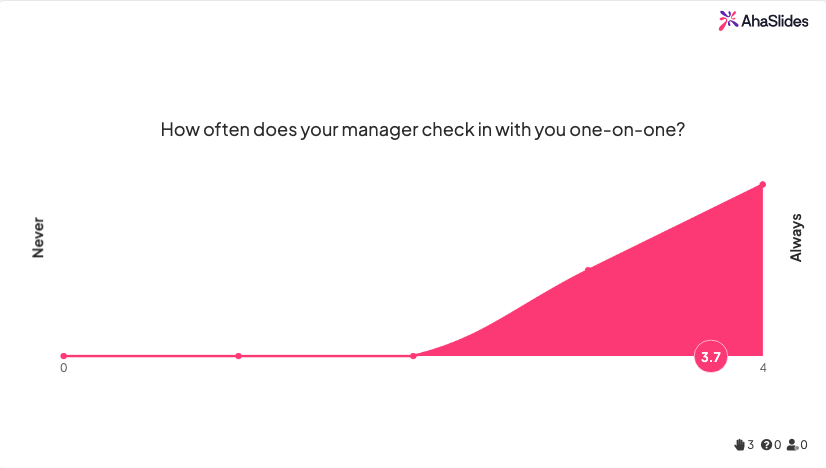
- How often does your manager check in with you one-on-one?
- Does your manager give you clear direction on priorities?
- How comfortable do you feel asking your manager for help?
- Does your manager give you useful feedback on your work?
- Do you feel your manager is invested in your success?
Use a frequency scale (Never / Rarely / Sometimes / Often / Always) for check-in frequency questions, and a satisfaction scale (Very dissatisfied to Very satisfied) for relationship quality questions.
Team integration
Feeling socially connected accelerates performance. Employees who feel included report higher engagement and are less likely to leave in the first year.
- Have you been introduced to all the teammates you work with directly?
- Do you feel like a valued member of your team?
- Are there opportunities to connect informally with colleagues?
- Do you understand how your team's work fits into broader organizational goals?
- Have any teammates gone out of their way to help you get up to speed?
Culture and values
New hires who don't connect with organizational culture are more likely to leave, even when the role itself is a good fit. BambooHR found that 91% of employees who received effective culture training feel connected to their workplace, compared to just 29% who say their onboarding lacked that component [2].
- Do you understand the company's values and how they show up in day-to-day work?
- Do you feel the company culture aligns with what you were told during hiring?
- Do you feel comfortable being yourself at work?
- Is there anything about the culture that has surprised you since you started?
- How would you describe the culture to a friend considering joining?
The last two questions work better as open text fields. The answers often surface things that a scale question would never capture.
Training and development
76% of new hires say training is important to their ability to succeed in a role [2]. If your training program has gaps, you'll see it here.
- Did your onboarding training prepare you for your actual responsibilities?
- Were training sessions well-organized and easy to follow?
- Is there a topic or skill you feel you need more training on?
- Did you have enough time to complete your training before being expected to work independently?
- How would you rate the overall quality of your training experience?
Onboarding program evaluation (day 90)
These questions are for evaluating the program itself, not the individual experience. Use them to drive program improvement rather than individual follow-up.
- How satisfied are you with your overall onboarding experience?
- What was the most useful part of onboarding?
- What would you change if you were designing the program?
- Did onboarding help you feel prepared for your role?
- How likely are you to recommend this company to a friend looking for a similar role?
A real-world example: onboarding at scale
A mid-size technology company running quarterly cohort hiring found that 90-day turnover was high despite strong interview feedback. When they introduced a structured three-survey sequence (day 7, day 30, day 90), the day 30 results revealed a consistent pattern: new hires in one department rated manager communication significantly lower than peers across the rest of the organization.
Without the survey data, this would have been invisible. The team lead assumed their regular department-wide meetings counted as adequate communication. New hires interpreted those meetings as group announcements, not the one-on-one check-ins they needed.
Once the issue was named, the fix was straightforward: mandatory weekly 1:1s for the first 60 days. Turnover in that department dropped by roughly a third over the next two cohorts.
That outcome — a specific problem, a specific change, a measurable result — is the point of onboarding questions. They only work when someone is actually reading the responses and acting on them.
Question format tips
Keep surveys short. A day-7 survey should have five to seven questions, not twenty. Completion rates drop significantly as length increases, and an incomplete survey gives you worse data than a short one that gets answered.
Mix scale and open-text questions. Scale questions (1–5, agreement, frequency) are easy to aggregate across a cohort. Open-text questions surface the specifics. Use both: scale questions to spot the pattern, open-text to understand it.
Make responses anonymous where possible. New hires are unlikely to give honest feedback about their manager if they think their manager will see it. Anonymity lifts response quality on the questions that matter most.
Act visibly on the data. If employees don't see that their feedback leads to any change, response rates fall in future cycles. Even a brief summary shared with the cohort — "here's what you told us, here's what we're adjusting" — closes the loop and builds trust in the process.
Common mistakes to avoid
Even well-intentioned onboarding survey programs fall short when a few recurring mistakes are baked into the design. Here are the ones that show up most often.
Sending one survey at the end of onboarding
Waiting until day 90 to ask for feedback means you've already lost the new hires who were struggling at day 30. End-of-program surveys are useful for program evaluation, but they can't substitute for the earlier check-ins where intervention is still possible. If someone didn't understand their role in week three, knowing that in week thirteen doesn't help them.
The fix: build the full cadence — day 7, day 30, day 60, day 90 — even if each survey is short. A five-question check-in at day 30 is more useful than a twenty-question retrospective at day 90.
Asking the same questions at every stage
Some teams reuse a single question set across all survey touchpoints to save time. The problem is that a question like "do you feel prepared for your responsibilities?" means something very different at day 7 versus day 60. Asking it too early produces noise. Asking it too late means the window for corrective action has passed.
The fix: map each question to the stage where it's actionable. Day 7 is for logistics and first impressions. Day 30 is for role clarity and manager relationship. Day 90 is for program-level reflection.
Collecting data but not closing the loop
This is the most common failure point. HR teams run the survey, review the results internally, and move on. New hires notice when their feedback disappears into a black box, and response rates fall in subsequent cohorts as a result. More importantly, the problems that showed up in the data don't get fixed.
The fix: assign ownership of each survey category to a specific person — manager support responses go to the people manager, training gaps go to the L&D team, logistics issues go to HR operations. Then share a brief summary with the cohort: what you heard, and what you're changing. It doesn't need to be exhaustive. Even a short message signals that the feedback was read and taken seriously.
Skipping anonymous collection for manager questions
Manager relationship quality is one of the most important things to measure in onboarding surveys, and it's also the category most likely to produce inaccurate data if responses aren't anonymous. New hires in their first weeks are not going to rate their manager poorly on a form that goes directly to that manager or is reviewed in a meeting where the manager is present.
The fix: make manager-related questions anonymous by default, and communicate that clearly to new hires before they answer. If your survey tool doesn't support anonymization, treat manager questions as open-text and aggregate manually before sharing results.
Running onboarding surveys with AhaSlides
Getting new hires to actually complete a survey is half the challenge. Long forms sent by email are easy to ignore, especially in the first week when inboxes are already overwhelming.
AhaSlides lets you run onboarding surveys as live, interactive sessions - either in a cohort onboarding meeting or asynchronously via a link. You can mix rating scale questions, multiple choice, and open-text responses in a single flow, and results appear in real time so HR or L&D teams can spot gaps immediately rather than waiting for a spreadsheet export.
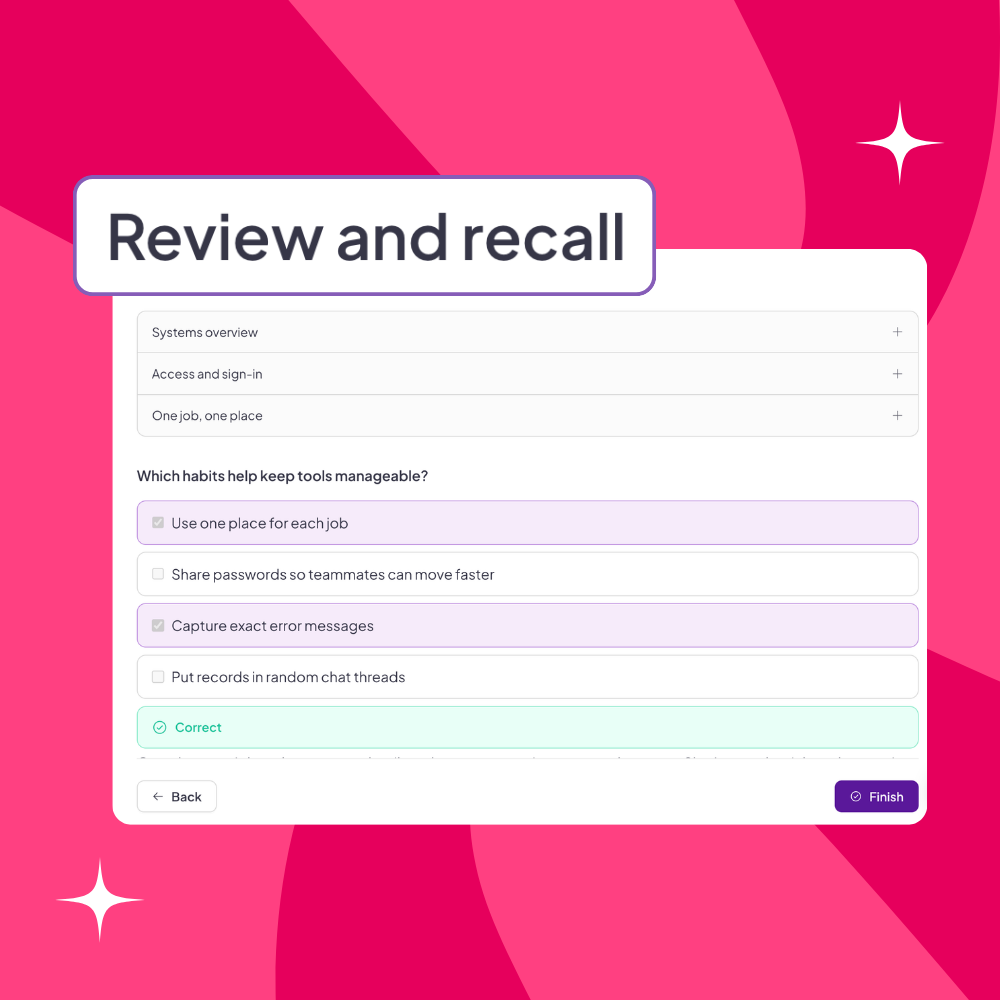
For cohort onboarding in particular, running a live survey at the end of a session and reviewing the results together changes the dynamic. New hires see their peers' responses aggregated on screen, which often opens a conversation that a private form never would. For the training content itself, pairing these surveys with an online course creator lets new hires work through onboarding modules at their own pace between check-ins.
Sources
[1] Gallup. Why the onboarding experience is key for retention. https://www.gallup.com/workplace/235121/why-onboarding-experience-key-retention.aspx
[2] BambooHR. First impressions are everything: 44 days to make or break a new hire. https://www.bamboohr.com/resources/data-at-work/data-stories/2023-onboarding-statistics
[3] AIHR. 27+ employee onboarding statistics and trends. https://www.aihr.com/blog/employee-onboarding-statistics/