


Hannah Choi, executive function coach, podcast host & public speaker
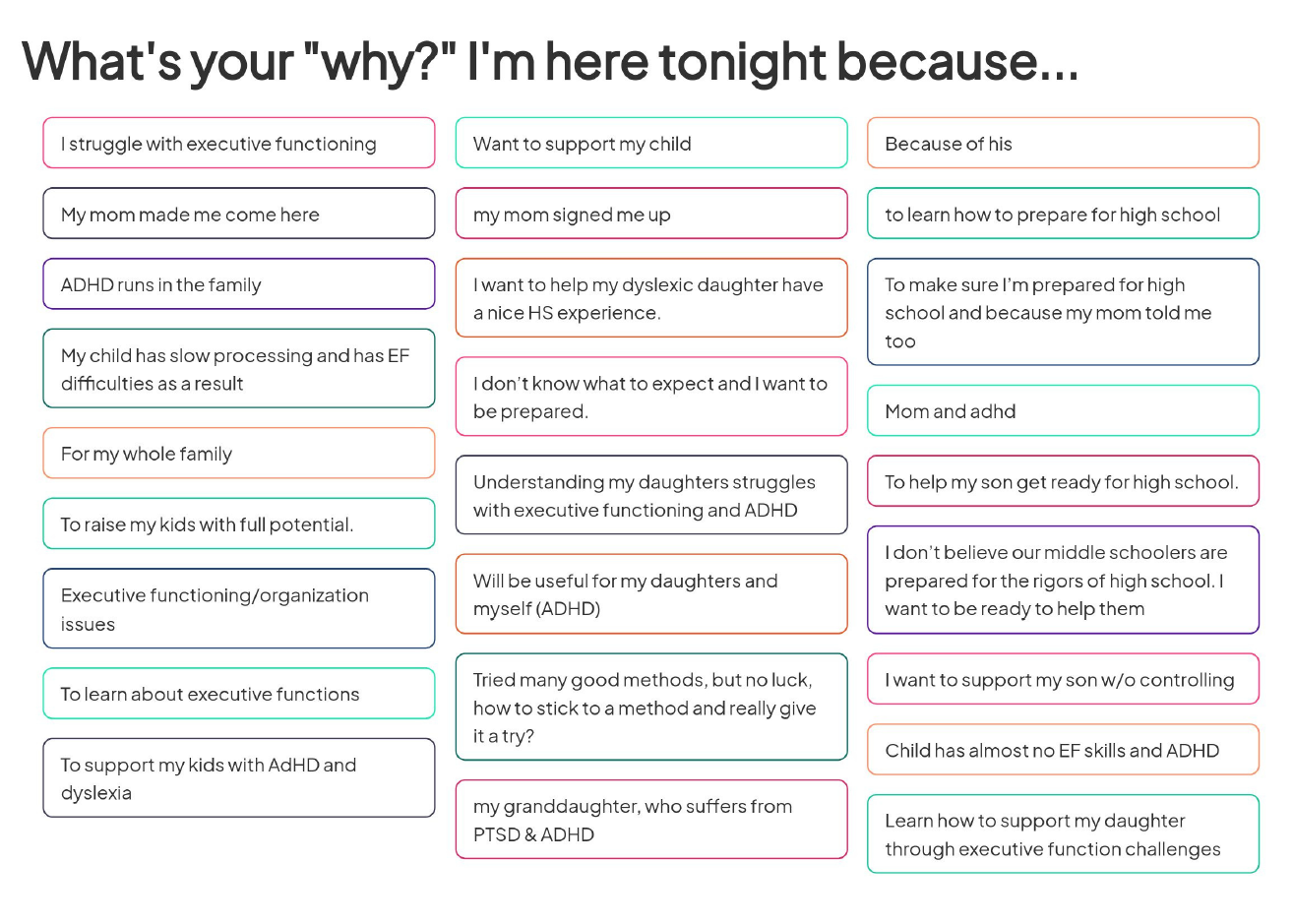
A parent typed into the AhaSlides Open Ended slide during my presentation: 'My child has almost no executive function skills and ADHD.' She shared something that vulnerable because she felt safe enough to do so. That didn't happen by accident. I worked hard to create that safety. It might not occur to you to consider the psychological safety of your audience when designing and delivering presentations, but if you want your audience to learn, engage, and take away as much as possible, it’s imperative that you put some intentional effort into this aspect of presentations.
Amy Edmondson, a top researcher on psychological safety has found that people feel more engaged and motivated and learn more when they feel safe at work. When we design with this in mind, we create an environment that is going to naturally make it easier for everyone to participate, engage, and learn. If you don’t know me, I’m Hannah Choi and I am an executive function coach and a podcast host. I know first-hand from my own life experience and my clients’ stories about what it’s like to feel unsafe at work.
As a coach, I know that one of the most important executive function skills that helps us get through our days is self-regulation. When we are feeling regulated, we’re calm, not anxious, present, and ready to learn. This applies during presentations and trainings, too. A dysregulated audience, or one that feels unsafe, is going to have a harder time paying attention, participating, and remembering what you’re trying to teach them. Here are five ways we can create psychological safety for our audience.
Normalizing by telling your own story
We can build trust with our audience very early on in the presentation by sharing a story about ourselves that normalizes the challenges around the topic you’re about to present on. Yes, you are the so-called “expert” on the topic (otherwise you would likely not be giving this presentation!), but there’s no way you’re going to be perfect all the time. Can you share something that happened to you that led you to become an expert on this topic or an experience where you “failed” at the thing you’re now an expert on? You may have to think creatively about this, but see if there’s a way you can normalize any fears your audience may have about the topic. I have ADHD and often speak to people with ADHD, so it’s easy for me to share stories about challenges I’ve experienced myself. And, they’re often funny “mistakes” I’ve made, so I also have a chance to make people laugh right from the start. If you want to read more about me, my stories about executive functioning, and how I use my own experience to build connections with audiences, I write about this and related topics regularly in my blog.
Anonymous participation in your design
When considering psychological safety for audiences, one of the absolute best features of AhaSlides’ engagement activities is that people can participate anonymously. When we deliberately use anonymity, people are more likely to answer and participate without fear of judgment. When people see that others feel the same as them or have had similar experiences, they immediately feel less alone.
I lead presentations and workshops on executive functioning skills and strategies for teens, working adults, and parents. In order to help people feel safe and less alone right from the start, I always have my first engagement activity be an Open Ended slide that asks, "What's your why? I’m here tonight because…" The parent who answered, "My child has almost no executive function skills and ADHD" may not have felt comfortable sharing this without anonymity. In addition to using anonymous answers, I also make sure that my poll settings are set to show results in percentages so no one feels isolated if they're the only one who voted a certain way. We can easily design with intention thanks to AhaSlides’ thoughtful features that allow for anonymity.
Include some fun and low-stakes activities
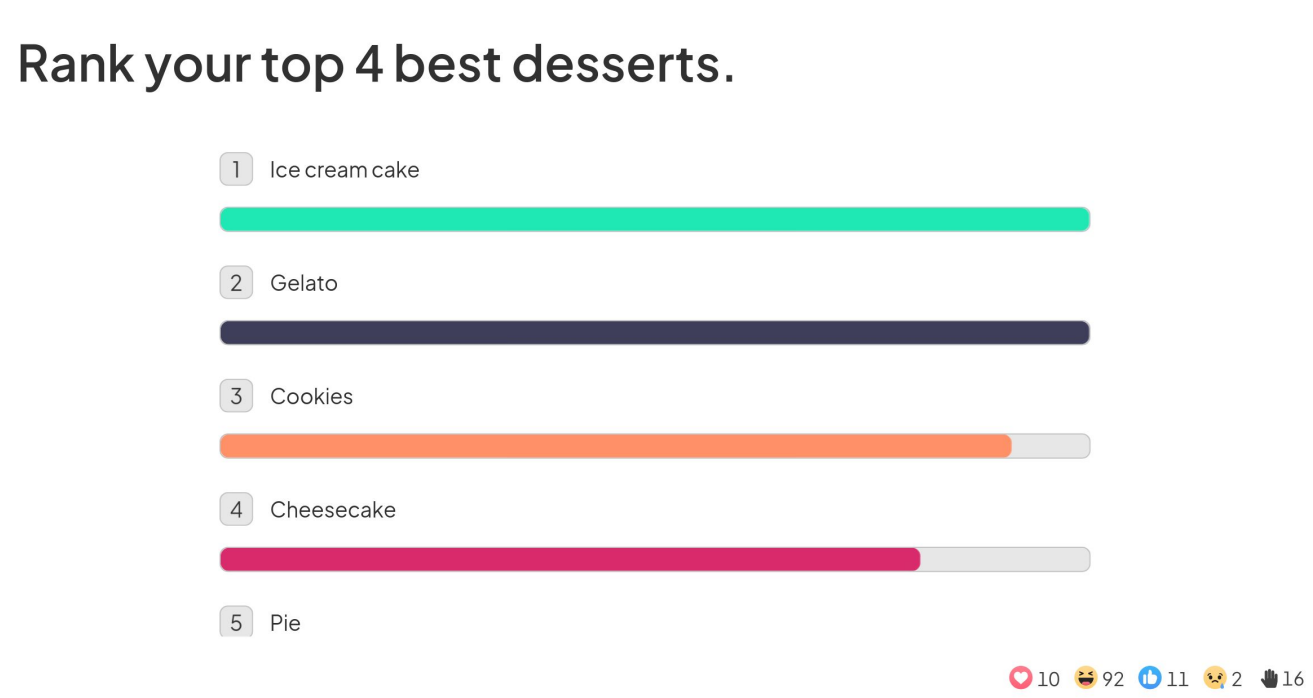
This one might be one that gets overlooked but it's actually doing really important work. I like starting with something completely low-stakes and fun before getting into anything emotionally loaded or technically complicated helps people relax and hopefully feel regulated. It gets people comfortable with the interactive format and the AhaSlides technology. A fun activity might inspire engagement from those who initially didn’t want to participate. It can also just do the simple job of making people (including you!) comfortable being in the room before the real content or “work” begins. I recently took advantage of AhaSlides’ new slide type, Ranking, in a couple of my presentations. We all ranked desserts! Not only was it fun, but I also used it as an opportunity to teach them what executive function skills are using a delicious topic as an example. Sadly, my favorite dessert, “Anything chocolate, especially chocolate lava cake” didn’t make it to the top 4 this time around!
Regulate yourself first
Due to mirror neurons in the brain that mimic the behaviors of others around us, our emotions are contagious! It’s a phenomenon called emotional contagion. A calm, prepared, and present presenter or facilitator helps the audience experience psychological safety. An anxious or disorganized presenter likely does the opposite. Your behavior, your presence, and how prepared you are will play a huge part in how engaged your audience is. Before you arrive at the event or go live for a virtual event, take the time to regulate yourself, if needed. This might mean having a snack or some water, taking some deep, calming breaths if you’re feeling overly anxious, or doing some jumping jacks if you’re tired. And, way before the day of the event, be sure that you’re well-prepared. Take the time to make sure you know your stuff! A good test is to see if you can do your presentation without speaker notes. Your level of preparedness will show and your audience will pick up on it, whether you want them to or not.
Making things relevant and actionable
We want our audience to walk away with ideas for how they can implement ideas and strategies and a great way to do this is by making it relevant to them. Throughout the presentation, you can build in questions or prompts that encourage people to think about how the content applies to them. When I do this, I like to build in choices, too, so they feel like they’re making some decisions. I also give them some guardrails and suggestions to help them organize their thoughts. I especially like to add in an activity towards the end called "A Place to Start.” AhaSlides’ new feature, Idea Board, is my current favorite way to run this activity. I’ll prompt the audience to choose one of three prompts and then answer how they’ll adjust it to fit their lives. For example, at a recent presentation to parents and teens about the transition from middle school to high school, I asked them to choose one of the following: 1. One system to set up at home, 2. One question to change the way you talk with your kid about school, 3. One thing to let your kid handle themselves. I then asked them to add some details to it and share with everyone via the Idea Board. This way, everyone gets to see people’s ideas, but I’m only asking them to choose one for themselves. It’s less overwhelming and shows them that there’s no expectation to change everything at once.
My experience as a presenter, doing webinars, workshops, and trainings, and my expertise in executive functioning have helped me understand the high importance of creating psychological safety for my audience. These five principles (and others) now inform everything I design, from a 45-minute parent workshop on the transition to high school to a corporate training session on executive function skills. I recently published a blog post on the topic of presenting and if you're curious about how to apply these principles to your own work, I'd love to talk. I also love to learn, so if you’ve got thoughts on this topic and want to chat about them with me, reach out!
Feel free to email me at hello@hannahchoi.me. You can also find me on my website, www.hannahchoi.me, on Instagram @hannahchoi.ef, or YouTube @HannahChoi-EF. The podcast that I co-host with Amy McDuffie is called I Think I Can Be Happier. We cover stories and science for people in progress!
Reference
Edmondson, A. (1999). Psychological safety and learning behavior in work teams. Administrative Science Quarterly, 44(2), 350–383. https://drive.google.com/file/d/1Hi6cMDmIZs3M_E3KG0sXbkzGM-Hcb-_q/view
Immordino-Yang, M. H., Darling-Hammond, L., & Krone, C. (2018). The brain basis for integrated social, emotional, and academic development: How emotions and social relationships drive learning. The Aspen Institute. https://files.eric.ed.gov/fulltext/ED596337.pdf
Chen, W. (2024). The role of self-representation in emotional contagion. Frontiers in Human Neuroscience. https://doi.org/10.3389/fnhum.2024.1361368

.webp)